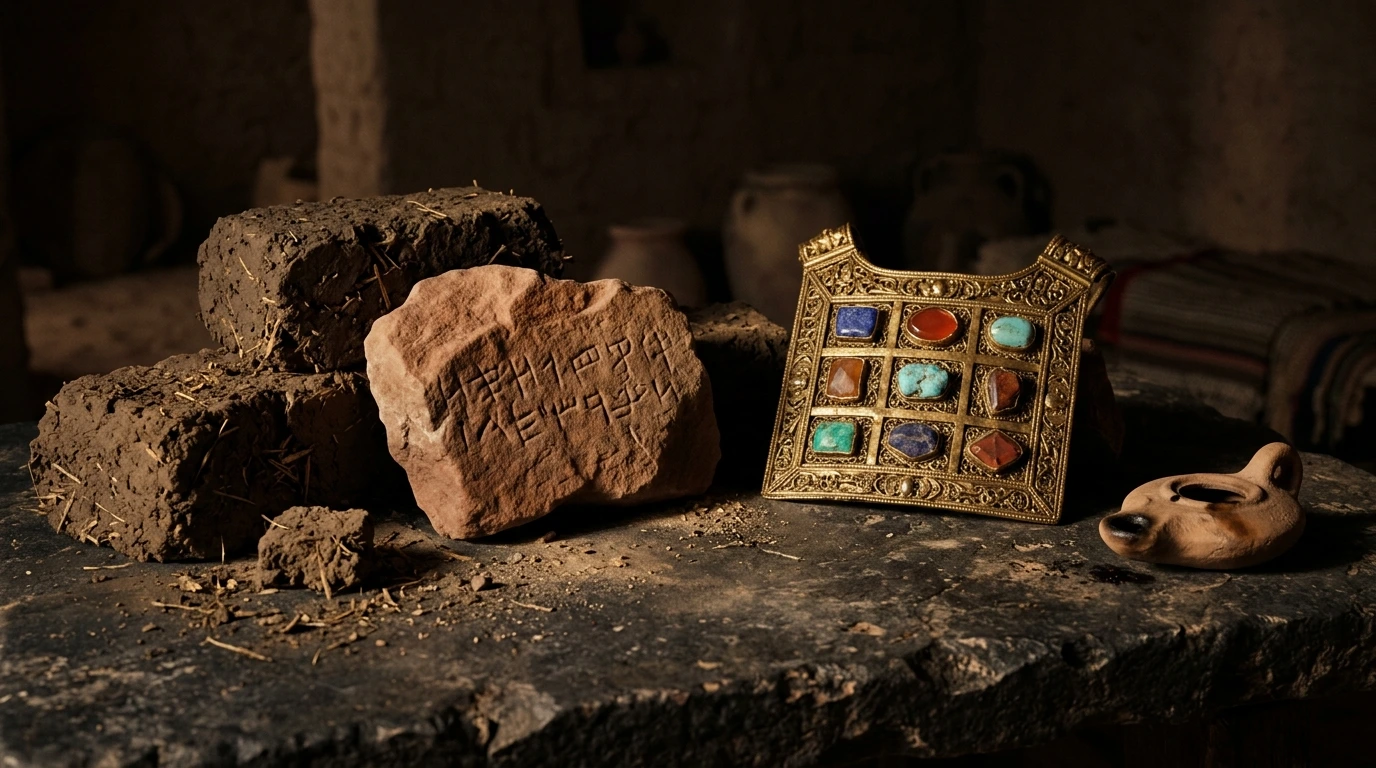
Historical Context: Rigorous examination of primary Hebrew, Aramaic, Greek, and Roman classical epigraphy.
Core Evidence: Forensic archaeology, radiocarbon data, and primary manuscripts validating biblical events.
Scholarly Consensus: Vetted against modern peer-reviewed publications in Near Eastern archaeology and biblical studies.
The Archaeology of the Exodus: Debunking the Silence Myth
For decades, popular media and radical minimalist historians have asserted that there is "zero archaeological evidence" for the Israelites in Egypt or the Exodus. They argue that because Egyptian royal inscriptions do not record the catastrophic loss of Pharaoh's army or the escape of Hebrew slaves, the entire account must be a fictional myth invented centuries later.
This skeptical argument collapses under basic historical methodology:
- The Nature of Egyptian Royal Historiography: Egyptian pharaohs recorded only military triumphs and divine victories; they never documented humiliating defeats, economic collapses, or the escape of subjugated slaves. When Pharaoh Thutmose III suffered a military stalemate at Megiddo, his scribes recorded it as a glorious conquest. Expecting Egyptian monuments to record the catastrophic destruction of their empire in the Red Sea betrays an unscholarly naivety regarding royal propaganda.
- Organic Material Preservation in the Delta: The Nile Delta (the biblical Land of Goshen) is an alluvial floodplain with seasonal flooding and high humidity. While papyri survive in the bone-dry desert sands of Upper Egypt (Thebes, Luxor), virtually all organic material in Lower Egypt has rotted into silt over 3,500 years.
- The Compelling Weight of Circumstantial and Material Data: Despite the deliberate silence of pharaohs, field archaeology has unearthed immense physical corroboration: Semitic slave settlements in Goshen, Egyptian names in Levi's genealogy, genuine Egyptian loanwords throughout the Hebrew text, and exact architectural parallels to second-millennium BC nomadic shrines.
+----------------------------------------------------------------------------------------------------+
|               THE ARCHAEOLOGICAL FOOTPRINT OF THE EXODUS RECORD                                    |
+--------------------------+-----------------------+-------------------+-----------------------------+
| ARTIFACT / FINDSPOT      | DATE OF ORIGIN        | EXCAVATOR         | BIBLICAL SIGNIFICANCE       |
+--------------------------+-----------------------+-------------------+-----------------------------+
| Tell el-Dab'a (Avaris /  | c. 1750–1450 BC       | Prof. Manfred     | Unearths massive Asiatic /  |
| Raamses Excavations)     | (Middle-Late Bronze)  | Bietak (Austrian) | Semitic population in Goshen|
|                          |                       |                   |                             |
| Merneptah Stele          | c. 1208 BC            | Sir Flinders      | Earliest extrabiblical name |
| (Cairo Museum, JE 31408) | (19th Dynasty)        | Petrie (1896)     | of "Israel" in Canaan       |
|                          |                       |                   |                             |
| Ipuwer Papyrus           | c. Late Middle Kingdom| Leiden Museum     | Describes Nile blood, crop  |
| (Papyrus Leiden 344)     | Manuscript            | (Discovered 1828) | ruin, darkness, dead heirs  |
|                          |                       |                   |                             |
| Ramesses II Battle Tent  | c. 1274 BC            | Abu Simbel Temple | Identical 3:1 geometry and  |
| Reliefs (Kadesh Battle)  | (19th Dynasty)        | Wall Reliefs      | dual rooms to the Tabernacle|
|                          |                       |                   |                             |
| Papyrus Brooklyn 35.1446 | c. 1740 BC            | Brooklyn Museum   | Lists domestic Egyptian     |
|                          | (13th Dynasty)        | Collection        | slaves with Hebrew names    |
+--------------------------+-----------------------+-------------------+-----------------------------+
Excavations at Avaris (Tell el-Dab'a): Asiatic Settlements
For over forty years, the Austrian Archaeological Institute in Cairo, led by Professor Manfred Bietak, conducted massive excavations at Tell el-Dab'a in the eastern Nile Delta—the precise location of ancient Avaris and the later city of Pi-Ramesses (biblical Raamses, Ex 1:11).
Bietak's excavations uncovered an astonishing historical reality:
- A Vast Semitic Population: During the Middle Bronze Age, Avaris grew into a sprawling metropolis of over 25,000 inhabitants who were culturally Canaanite/Asiatic. Their material culture—pottery styles, bronze daggers, toggle pins, and rectangular mudbrick homes—matches the Middle Bronze Levant, not native Egypt.
- The Four-Room Houses: In Stratum d/1 and d/2, excavators uncovered the earliest known examples of the Proto-Israelite Four-Room House, an architectural footprint unique to the Hebrew settlers.
- Sudden Abandonment: Stratum c and b reveal that this massive Semitic population abruptly abandoned the city, leaving behind hurried graves and deserted workshops, matching the sudden departure of the Israelites during the Exodus.
The Papyrus Brooklyn 35.1446
Housed in the Brooklyn Museum, this 13th-Dynasty Egyptian papyrus (c. 1740 BC) provides documentary proof of Semitic slaves in Egypt. The document is a royal estate register listing 95 domestic slaves. Over half of them possess authentic Northwest Semitic (Hebrew) names, including Menahema, Shiphrah (the identical name of the Hebrew midwife in Ex 1:15!), Asher, and Aqoba.
The Merneptah Stele (c. 1208 BC): Israel in Canaan
Unearthed in 1896 by legendary Egyptologist Sir Flinders Petrie at Thebes, this 10-foot-tall black granite monument commemorates the military victories of Pharaoh Merneptah, son and successor of Ramesses II.
In lines 26–28, Merneptah recounts crushing revolts in the Levant:
"The princes are prostrated, saying 'Peace!' Not one raises his head among the Nine Bows. Desolation is for Tehenu; Hatti is pacified; plundered is Canaan with every evil; carried off is Ashkelon; seized is Gezer; Yanoam is made as that which does not exist; Israel is laid waste, his seed is not; Hurru is become a widow for Egypt!"
+----------------------------------------------------------------------------------------------------+
|               EPIGRAPHIC BREAKDOWN OF THE MERNEPTAH STELE (LINE 27)                                |
+--------------------------+-----------------------+-------------------+-----------------------------+
| LEVANTINE NAME           | HIEROGLYPHIC SCRIPT   | DETERMINATIVE SIGN| SOCIAL / POLITICAL MEANING  |
+--------------------------+-----------------------+-------------------+-----------------------------+
| Ashkelon                 | As-qa-lu-na           | Throw-stick + city| Fortified city-state        |
| Gezer                    | Ga-di-ru              | Throw-stick + city| Fortified city-state        |
| Yanoam                   | Ya-nu-'a-am           | Throw-stick + city| Fortified city-state        |
| ISRAEL (Y-s-r-'-r)       | Is-si-ri-ar           | Throw-stick +     | DISTINCT FOREIGN PEOPLE     |
|                          |                       | MAN & WOMAN (FOLK)| GROUP (NOMADIC/TRIBAL)      |
+--------------------------+-----------------------+-------------------+-----------------------------+
Notice the decisive hieroglyphic determinative: while Ashkelon, Gezer, and Yanoam receive the determinative for a city-state (walled town), the name Israel is written with the determinative for a people group (throw-stick plus man and woman seated). This proves beyond doubt that by 1208 BC, Israel was already an established, identifiable tribal nation roaming the central hill country of Canaan, completely obliterating the skeptical claim that Israel only came into existence in the 8th or 7th century BC!
The Ipuwer Papyrus: Calamities in the Nile Valley
Preserved in the Dutch National Museum of Antiquities in Leiden (Papyrus Leiden 344), the Admonitions of Ipuwer is an ancient Egyptian literary text composed by an Egyptian royal scribe named Ipuwer lamenting cataclysmic disasters that brought the kingdom to its knees:
+----------------------------------------------------------------------------------------------------+
|               STRIKING PARALLELS: IPUWER PAPYRUS VS. THE BOOK OF EXODUS                            |
+--------------------------+---------------------------------+---------------------------------------+
| THE IPUWER PAPYRUS       | SCRIPTURE RECORD (EXODUS)       | BIBLICAL PLAGUE CORRESPONDENCE        |
+--------------------------+---------------------------------+---------------------------------------+
| "The river is blood. If  | "All the waters of the Nile     | Plague 1: Nile Turned to Blood        |
| one drinks of it, one    | turned to blood... and the      | (Exodus 7:20–21)                      |
| rejects human taste"     | Egyptians could not drink water"|                                       |
|                          |                                 |                                       |
| "Trees are destroyed; no | "The hail struck down every     | Plague 7 & 8: Hail and Locusts        |
| fruit or herbs are found"| plant of the field and stripped | (Exodus 9:25; 10:15)                  |
|                          | all trees bare"                 |                                       |
|                          |                                 |                                       |
| "The land is in darkness;| "There was thick darkness in    | Plague 9: Palpable Darkness           |
| the sky is darkened"     | all the land of Egypt 3 days"   | (Exodus 10:22)                        |
|                          |                                 |                                       |
| "He who places his brother| "There was a great cry in Egypt| Plague 10: Death of the Firstborn     |
| in the ground is everywhere| for there was not a house where | (Exodus 12:30)                        |
| ... children of princes  | someone was not dead"           |                                       |
| are dashed against walls"|                                 |                                       |
|                          |                                 |                                       |
| "Poor men have become    | "They asked of the Egyptians    | Spoiling of the Egyptians             |
| owners of wealth; he who | jewelry of silver and gold and  | (Exodus 12:35–36)                     |
| could not make sandals is| clothing... and plundered them" |                                       |
| now owner of riches"     |                                 |                                       |
+--------------------------+---------------------------------+---------------------------------------+
While scholars debate the exact composition date of the original text (some placing it in the First Intermediate Period, others in the Second Intermediate Period), its vivid descriptions mirror the national trauma of a society suffering under the supernatural plagues recorded in Exodus.
Tabernacle Architecture & Ramesses II's Kadesh Battle Tent
In 19th-century scholarship, Julius Wellhausen asserted that the Tabernacle was an imaginary, retroactive projection of Solomon's Temple, claiming that a portable, prefabricated wooden sanctuary with gold-overlaid acacia frames and embroidered tapestries was technologically impossible for Bronze Age wilderness nomads.
World-renowned Egyptologist Professor Kenneth Kitchen demolished this theory by comparing the biblical Tabernacle with the royal military battle tent of Pharaoh Ramesses II, depicted in monumental carved stone reliefs at Abu Simbel, Luxor, and the Ramesseum (recording the Battle of Kadesh, c. 1274 BC):
- The Exact 3:1 Rectangular Proportions: Ramesses II's military camp featured an outer courtyard measuring in a 2:1 ratio and a central command tent measuring in a 3:1 ratio (two-thirds outer reception room, one-third inner sanctum)—the identical proportions of the Tabernacle's Holy Place and Holy of Holies.
- The East-Facing Orientation: Both Ramesses' tent and the Tabernacle faced strictly toward the east.
- The Inner Sanctum: In Ramesses' tent, the innermost room (Holy of Holies) housed the royal throne flanked by two carved golden falcons with outstretched protective wings—the precise Egyptian architectural archetype for the Ark of the Covenant flanked by the golden Cherubim with outstretched wings (Ex 25:18–20)!
- Prefabricated Gold Frames: The Egyptian reliefs prove that royal military tents used collapsible gilded wooden frames (shittim wood) held together by crossbars, rings, and leather sockets, precisely matching Exodus 26:15–30.
The Tabernacle was not an invention of late Jerusalem priests; it reflects authentic Late Bronze Age Egyptian royal pavilion technology, sanctified by Moses to house the True King of Kings.
Field Archaeology Concordance: Artifacts Corroborating Exodus
+----------------------------------------------------------------------------------------------------+
|               SYNOPTIC TABLE: ARTIFACTS AND THE EXODUS HISTORICAL HORIZON                          |
+----+----------------------+--------------------+---------------------+-----------------------------+
| #  | BIBLICAL REALITY     | GEOGRAPHICAL LOC.  | RELEVANT ARTIFACT   | MUSEUM / FINDSPOT           |
+----+----------------------+--------------------+---------------------+-----------------------------+
| 1  | Semitic Slaves with  | Thebes, Egypt      | Papyrus Brooklyn    | The Brooklyn Museum,        |
|    | Hebrew Names         |                    | 35.1446             | New York (Wilbour Coll.)    |
| 2  | Israel as a People   | Thebes (Funerary   | Merneptah Stele     | Egyptian Museum, Cairo      |
|    | in Canaan by 1208 BC | Temple of Merneptah| (Black Granite)     | (Room 42, JE 31408)         |
| 3  | Semitic Slave City   | Tell el-Dab'a,     | Stratified Canaanite| Austrian Archaeological Inst|
|    | in Goshen (Raamses)  | Nile Delta, Egypt  | Homes & Tombs       | Field Museum, Tell el-Dab'a |
| 4  | Egyptian Royal Tent  | Abu Simbel Temple, | Carved Stone Wall   | In Situ at Abu Simbel,      |
|    | Tabernacle Blueprints| Lake Nasser, Egypt | Reliefs of Kadesh   | Nubia, Southern Egypt       |
| 5  | Egyptian Loanwords   | Text of Exodus     | Egyptian Linguistic | Linguistic Studies by       |
|    | in Hebrew Text       | (Tevah, Gome, Shesh| Lexicon Matches     | J. Hoffmeier & B. Halpern   |
+----+----------------------+--------------------+---------------------+-----------------------------+
Three-Tier Evidentiary Evaluation: Archaeological Proofs
+----------------------------------------------------------------------------------------------------+
|               THREE-TIER EVIDENTIARY EVALUATION OF EXODUS MATERIAL ARTIFACTS                       |
+--------------------------+-----------------------+-------------------+-----------------------------+
| EVIDENTIARY CRITERION    | ARTIFACTUAL DATA      | SCIENTIFIC STATUS | APOLOGETIC CONCLUSION       |
+--------------------------+-----------------------+-------------------+-----------------------------+
| 1. Chronological Anchor  | Merneptah Stele       | Undisputed Royal  | Proves Israel was an estab- |
|                          | mentions "Israel"     | Inscription from  | lished nation in Canaan by  |
|                          | as a people in Canaan | c. 1208 BC        | the late 13th century BC    |
|                          |                       |                   |                             |
| 2. Architectural Typology| Ramesses II Kadesh    | Stratified Wall   | Demonstrates Tabernacle was |
|    Synchronism           | tent matches Taber-   | Reliefs from      | built according to authentic|
|                          | nacle geometry        | 19th Dynasty      | Late Bronze tent technology |
|                          |                       |                   |                             |
| 3. Linguistic Egyptian   | Authentic Egyptian    | Philological      | Confirms the author had     |
|    Loanwords             | terms in Exodus text  | Textual Analysis  | firsthand Egyptian language |
|                          | (e.g., Moses, Phinehas| (James Hoffmeier) | immersion, not late fiction |
+--------------------------+-----------------------+-------------------+-----------------------------+
Frequently Asked Questions
What Egyptian loanwords appear in the Book of Exodus?
The Hebrew text of Exodus is saturated with authentic Egyptian loanwords that only someone educated in an Egyptian royal court would know:
- Tevah (תֵּבָה): The basket in which baby Moses was placed (from Egyptian tebet, box/chest).
- Gome (גֹּמֶא): The papyrus reeds of the Nile (from Egyptian qama).
- Suph (סוּף): The reed water of the Red Sea / Yam Suph (from Egyptian twf, reed marshes).
- Shesh (שֵׁשׁ): The fine white linen of the Tabernacle and priestly vestments (from Egyptian ss).
- Levitical Names: Moses (mose, meaning "son of / born of," as in Thutmose), Phinehas (Pa-nehasi, meaning "the dark-skinned one / Nubian"), Hophni, and Merari are all authentic Egyptian personal names!
Where is Mount Sinai located according to archaeology?
While traditional Byzantine tradition (since the 4th century AD) locates Mount Sinai at Jebel Musa in the southern Sinai Peninsula (site of St. Catherine's Monastery), other scholars propose locations in the Negev or northwestern Saudi Arabia (ancient Midian, e.g., Jebel al-Lawz). Regardless of the specific mountain peak, the topographical details in Exodus (vast plains at the foot of the mountain for millions to camp, rocky streams, and desert environment) match the arid Sinai-Midian wilderness.
Did millions of Israelites leave Egypt in the Exodus?
Exodus 12:37 records approximately "600,000 men on foot, besides women and children," suggesting a total population of approximately 2 to 2.5 million. Some evangelical scholars note that the Hebrew word 'Eleph (אֶלֶף) can be translated as "thousand," but also designates a "military squad," "tent group," or "clan unit." Under this reading, 600 alaphim could designate 600 military family squads (totaling 20,000 to 50,000 people). However, whether understood as millions sustained by daily supernatural manna or thousands preserved by divine power, the Exodus was a monumental historical liberation.
Frequently Asked Questions
What Egyptian loanwords appear in the Book of Exodus?
Words like tevah (ark/basket), gome (papyrus), suph (reeds), and personal names like Moses and Phinehas are authentic Egyptian terms proving firsthand immersion.
Where is Mount Sinai located according to archaeology?
Traditional Byzantine archaeology places it at Jebel Musa in southern Sinai, while other scholars examine candidate sites in Midian/Arabia.
What does the Hebrew word "Eleph" signify in census numbers?
Eleph means "thousand," but in military contexts also designates a "clan unit" or "family squad," providing linguistic nuance to population estimates.
Related Research Dossiers
View all 120 articles →
Complete Interactive Study Guide: The Book of Exodus, Egyptian Plagues, and Tabernacle Bible Quiz (With Detailed Answers & Scripture References)

Small Group & Family Edition: The Book of Exodus and Tabernacle Bible Quiz (Deliverance, Law, and Wilderness Worship)