Subject Scope: Complete Interactive Study Guide: The Book of Exodus, Egyptian Plagues, and Tabernacle Bible Quiz (With Detailed Answers & Scripture References)
Historical Context: Rigorous historical and theological examination within the field of Bible Study Guides & Theology.
Primary Evidence: Forensic archaeology, textual preservation, and primary ancient manuscripts corroborating scriptural events.
Investigation Highlights: The Redemptive Architecture of the Book of Exodus • The Ten Plagues (Eser HaMakot): Warfare Against Egypt's Gods • The Passover (Pesach) and the Red Sea Crossing
Scholarly Consensus: Vetted against peer-reviewed academic literature in biblical history, linguistics, and archaeology.
The Redemptive Architecture of the Book of Exodus
Known in the Hebrew canon as Shemot (שְׁמוֹת, "Names"), taken from its opening phrase ("Now these are the names of the sons of Israel who came to Egypt"), the Book of Exodus is the master narrative of redemption in the Old Testament. Every major New Testament theme—redemption by blood, liberation from spiritual slavery, divine adoption, covenant law, the priesthood of believers, and God dwelling among humanity—derives its vocabulary, typology, and emotional power from this book.
The narrative structure of Exodus moves through three monumental geographical and spiritual movements:
- Deliverance from Egyptian Slavery (Chapters 1–18): From the brick pits of the Nile Delta to the miraculous deliverance through the waters of the Red Sea (Yam Suph).
- Covenant at Mount Sinai (Chapters 19–24): The divine theophany with thunder, lightning, and thick cloud, where God ratifies the Mosaic Covenant and bestows the Ten Commandments (Aseret HaDibrot).
- The Dwelling of God in the Tabernacle (Chapters 25–40): Detailed architectural blueprints for the portable sanctuary (Mishkan), interrupted by the catastrophe of the Golden Calf (Ex 32–34), and culminating in the descent of the divine glory cloud (Shekinah) filling the sanctuary.
+----------------------------------------------------------------------------------------------------+
|               THE TRIPARTITE ARCHITECTURE OF THE BOOK OF EXODUS                                    |
+--------------------------+-----------------------+-------------------+-----------------------------+
| SECTION                  | SCRIPTURE PASSAGES    | GEOGRAPHICAL LOC. | DOMINANT THEOLOGICAL THEME  |
+--------------------------+-----------------------+-------------------+-----------------------------+
| I. Deliverance           | Exodus 1:1–18:27      | Egypt & Red Sea   | Sovereign Power & Redemption|
| II. Covenant (Law)       | Exodus 19:1–24:18     | Mount Sinai       | Holiness & Ethical Demands  |
| III. Tabernacle Presence | Exodus 25:1–40:38     | Wilderness Camp   | Divine Indwelling (Shekinah)|
+--------------------------+-----------------------+-------------------+-----------------------------+
The Ten Plagues (Eser HaMakot): Warfare Against Egypt's Gods
The Ten Plagues inflicted upon Egypt were not random ecological disasters; they were targeted, theological polemics against the principalities and powers of the Egyptian pantheon. In Exodus 12:12, Yahweh explicitly declares: "On all the gods of Egypt I will execute judgments: I am the LORD."
+----------------------------------------------------------------------------------------------------+
|               THE THEOLOGICAL WARFARE: THE TEN PLAGUES VS. EGYPTIAN DEITIES                        |
+----+---------------------+--------------------+----------------------------------------------------+
| #  | THE BIBLICAL PLAGUE | SCRIPTURE PASSAGE  | TARGETED EGYPTIAN DEITY & FUNCTION                 |
+----+---------------------+--------------------+----------------------------------------------------+
| 1  | Nile Turned to Blood| Exodus 7:14–25     | Hapi (God of the Nile); Osiris (Blood of Life)     |
| 2  | Frogs (Tzefarde'a)  | Exodus 8:1–15      | Heqet (Goddess of fertility depicted with frog head|
| 3  | Gnats / Lice (Kinnim| Exodus 8:16–19     | Geb (God of the dust and earth)                    |
| 4  | Swarms of Flies     | Exodus 8:20–32     | Khepri (God of creation depicted as beetle/fly)    |
| 5  | Livestock Pestilence| Exodus 9:1–7       | Apis (Sacred bull); Hathor (Mother goddess / cow)  |
| 6  | Boils (Shechin)     | Exodus 9:8–12      | Sekhmet (Goddess of healing/pestilence); Imhotep   |
| 7  | Hail and Fire       | Exodus 9:13–35     | Nut (Sky goddess); Shu (Atmospheric god)           |
| 8  | Locusts (Arbeh)     | Exodus 10:1–20     | Serapia (Protector of crops); Min (Harvest god)    |
| 9  | Palpable Darkness   | Exodus 10:21–29    | Ra (Sun god); Amun (King of gods); Horus           |
| 10 | Death of Firstborn  | Exodus 11:1–12:36  | Pharaoh (Living god) & his divine heir; Osiris     |
+----+---------------------+--------------------+----------------------------------------------------+
Notice the brilliant literary and theological crescendo: the cycle begins with the defilement of the Nile—the lifeblood of Egypt's agricultural economy—and culminates in the total blacking out of Ra (the supreme sun god), followed by the strike against the firstborn heir of Pharaoh himself, demonstrating that Pharaoh was not a divine being, but a mortal man subject to Yahweh.
The Passover (Pesach) and the Red Sea Crossing
The tenth plague brought the institution of Passover (Pesach, Ex 12), the foundational ritual of Jewish national identity and the supreme Old Testament type of Christ's atonement:
- The Lamb Without Blemish: Each household selected a year-old male lamb without defect (seh tamim), kept it from the 10th to the 14th of Nisan, and slaughtered it at twilight.
- The Applied Blood: The blood was applied with a branch of hyssop to the two doorposts and the lintel. When the destroying angel traversed Egypt, Yahweh "passed over" (pasach) every home marked by the blood of the substitute.
- The Meal of Urgency: Eaten with bitter herbs (maror) and unleavened bread (matzah), with sandals on feet, belt fastened, and staff in hand, prepared for immediate departure.
At the Red Sea Crossing (Yam Suph, Ex 14), trapped between Pharaoh's elite 600 chariots and the deep waters, Moses commanded the terrified Israelites: "Fear not, stand firm, and see the salvation of the LORD, which he will work for you today... The LORD will fight for you, and you have only to be silent" (Ex 14:13–14). God drove back the sea with a strong east wind all night, creating walls of water on the right and left, through which Israel marched on dry ground, while Pharaoh's pursuing army drowned when the waters collapsed.
The Sinai Covenant and the Moral Decalogue
Three months after departing Egypt, Israel camped at the foot of Mount Sinai. There, God offered them the covenant: "If you will indeed obey my voice and keep my covenant, you shall be my treasured possession among all peoples, for all the earth is mine; and you shall be to me a kingdom of priests and a holy nation" (Ex 19:5–6).
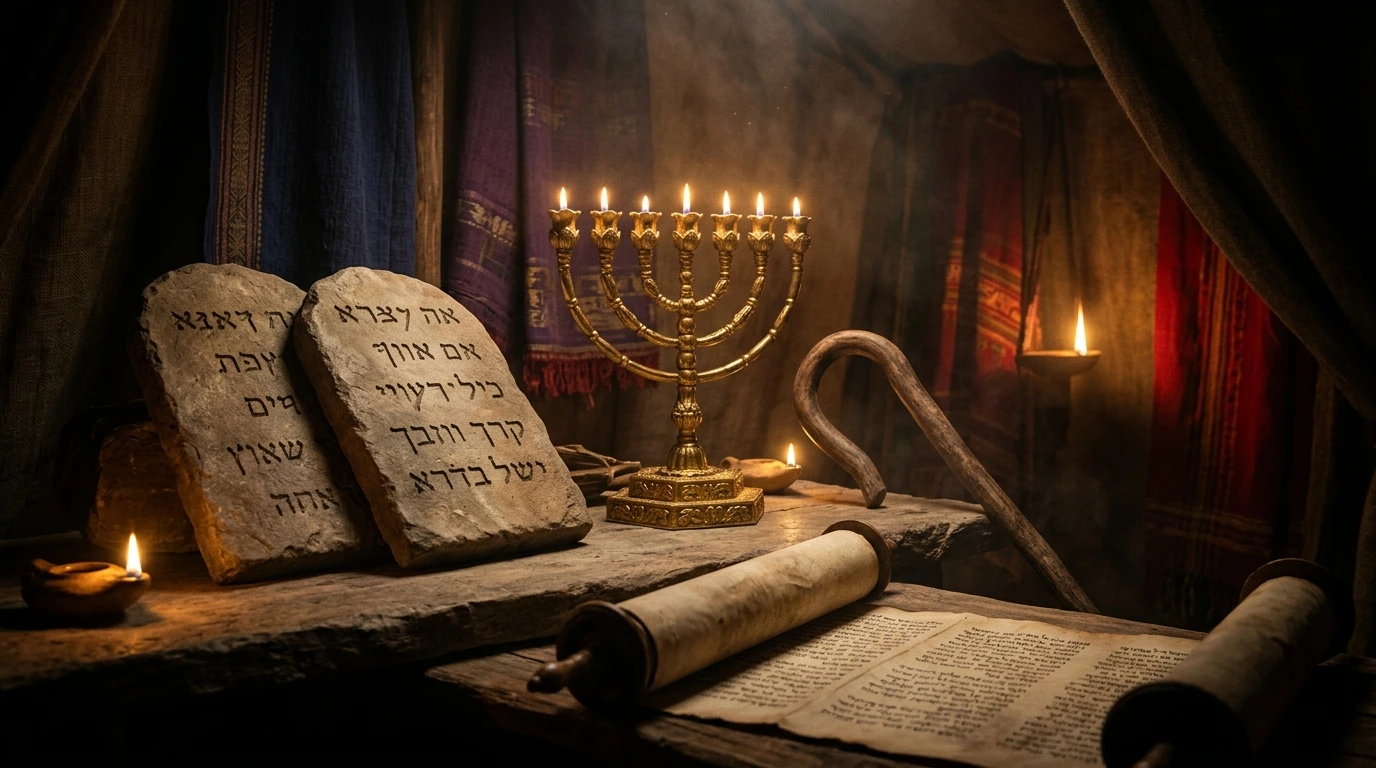
God spoke the Ten Commandments (Aseret HaDibrot, Ex 20:1–17), organized into two distinct tablets:
- The First Tablet (Duties Toward God, Commandments 1–4): Exclusive worship of Yahweh, prohibition of graven images, reverence for the divine Name, and keeping the Sabbath holy.
- The Second Tablet (Duties Toward Neighbor, Commandments 5–10): Honoring parents, prohibition of murder, adultery, theft, false testimony, and covetousness of heart.
Significantly, the Decalogue opens with a declaration of divine grace before demanding obedience: "I am the LORD your God, who brought you out of the land of Egypt, out of the house of slavery" (Ex 20:2). In biblical theology, redemption always precedes law. God did not give Israel the law so that they could earn their deliverance; He delivered them by grace, and then gave them the law so they would know how to live as His redeemed people.
The Tabernacle (Mishkan): Sacred Geometry and Furnishings
The final fifteen chapters of Exodus (Ex 25–40) are devoted to the construction of the portable sanctuary: the Tabernacle (Mishkan, meaning "Dwelling Place") or Tent of Meeting (Ohel Mo'ed). Built strictly according to the heavenly pattern shown to Moses on the mountain (Ex 25:9, 40), the sanctuary possessed three distinct zones of escalating holiness:
+----------------------------------------------------------------------------------------------------+
|               THE SACRED GEOMETRY OF THE TABERNACLE (MISHKAN)                                      |
+--------------------------+-----------------------+-------------------+-----------------------------+
| ZONE OF SANCTITY         | SACRED FURNISHINGS    | MATERIALS USED    | PERMITTED PERSONNEL         |
+--------------------------+-----------------------+-------------------+-----------------------------+
| 1. The Outer Courtyard   | Bronze Altar          | Bronze, Acacia    | All clean Israelites        |
|    (100 x 50 cubits)     | (Burnt Offerings);    | Wood, Coarse Linen| bringing sacrifices;        |
|                          | Bronze Laver (Water)  |                   | Levites on duty             |
|                          |                       |                   |                             |
| 2. The Holy Place        | Golden Lampstand      | Pure Gold, Acacia | Consecrated Priests         |
|    (Qodesh, 20x10 cubits)| (Menorah); Table of   | Wood overlaid     | performing daily service    |
|                          | Showbread; Incense Alt| with gold, Fine   | (trimming lamps, burning    |
|                          |                       | Twined Linen      | incense, changing bread)    |
|                          |                       |                   |                             |
| 3. The Holy of Holies    | Ark of the Covenant;  | Pure Solid Gold   | High Priest ONLY, ONCE a    |
|    (Qodesh HaQodashim,   | Mercy Seat (Kapporet) | (*Kapporet*),     | year on Yom Kippur with the |
|    10 x 10 x 10 cubits)  | with two Cherubim     | Shekinah Cloud    | blood of atonement          |
+--------------------------+-----------------------+-------------------+-----------------------------+
Every element of the Tabernacle points directly to Jesus Christ:
- The Bronze Altar: The Cross, where the innocent substitute is slain for sins.
- The Bronze Laver: The washing of regeneration and sanctification (Titus 3:5).
- The Menorah: Christ the Light of the World (John 8:12).
- The Table of Showbread: Christ the Bread of Life (John 6:35).
- The Altar of Incense: The perpetual intercession of Christ for His saints (Heb 7:25).
- The Ark & Mercy Seat (Kapporet): The throne of grace where divine justice and divine mercy kiss through propitiation (hilastērion, Rom 3:25).
Master 30-Question Interactive Trivia Quiz with Concordance
Part I: Moses and the Exodus from Egypt (Q1–Q10)
- From what tribe of Israel was Moses born?
Answer: The tribe of Levi (Ex 2:1). - What was the name of Moses' sister who watched over him in the Nile and his brother who spoke for him?
Answer: Miriam and Aaron (Ex 2:4; 4:14). - What does the name Moses (Mosheh) mean in Hebrew according to Pharaoh's daughter?
Answer: "Drawn out of the water" (from Hebrew mashah, to draw out) (Ex 2:10). - To what land did Moses flee after slaying the Egyptian taskmaster, and whose daughter did he marry?
Answer: The land of Midian; he married Zipporah, daughter of Jethro / Reuel the priest of Midian (Ex 2:15–21). - What was the miraculous sign at Mount Horeb where God first called Moses?
Answer: A bush burning with fire that was not consumed (Ex 3:2). - What divine Name did God reveal to Moses from the burning bush?
Answer: "Ehyeh Asher Ehyeh" ("I AM WHO I AM" / YHWH) (Ex 3:14). - What were the three miraculous signs God gave Moses to prove his divine authority to the Israelites?
Answer: His staff turning into a serpent, his hand turning leprous and healed, and water from the Nile turning into blood on dry land (Ex 4:1–9). - What was the first plague inflicted upon Egypt?
Answer: The waters of the Nile turned into blood (Ex 7:17–20). - At which plague were Pharaoh's magicians unable to duplicate the miracle and forced to confess, "This is the finger of God"?
Answer: The third plague: gnats / lice (Ex 8:19). - In which district of Egypt did the Israelites live, which was exempted from the plagues of flies, livestock disease, hail, and darkness?
Answer: The land of Goshen (Ex 8:22; 9:26).
Part II: The Passover, Sea, and Wilderness (Q11–Q20)
- On what day of the first month (Nisan/Abib) was the Passover lamb to be slaughtered?
Answer: The 14th day of the month at twilight (Ex 12:6). - What plant was used to apply the blood of the Passover lamb to the doorposts and lintels?
Answer: A bunch of hyssop (Ex 12:22). - For how many years did the children of Israel live in Egypt before the Exodus?
Answer: 430 years (Ex 12:40). - Whose embalmed bones did Moses carry with him out of Egypt, fulfilling an ancient oath?
Answer: The bones of Joseph (Ex 13:19). - By what manifestations did the LORD lead Israel by day and by night?
Answer: In a pillar of cloud by day and a pillar of fire by night (Ex 13:21–22). - At what oasis did the Israelites find bitter water they could not drink, and what did God command Moses to throw into the water to sweeten it?
Answer: Marah; God showed Moses a piece of wood / tree to throw into the water (Ex 15:23–25). - What miraculous food did God rain from heaven daily for forty years, and what does its name mean?
Answer: Manna; the name means "What is it?" (Man hu?) (Ex 16:14–15, 31). - What desert nomad tribe attacked Israel at Rephidim, defeated while Aaron and Hur held up Moses' hands?
Answer: The Amalekites (Ex 17:8–13). - What altar name did Moses build after defeating the Amalekites, meaning "The LORD is my Banner"?
Answer: Yahweh Nissi (Ex 17:15). - Who advised Moses to appoint capable men as judges over thousands, hundreds, fifties, and tens to avoid exhaustion?
Answer: Jethro, Moses' father-in-law (Ex 18:17–24).
Part III: Sinai, Law, and Tabernacle (Q21–Q30)
- Which commandment in the Decalogue is the first with a promise?
Answer: The fifth commandment: "Honor your father and your mother, that your days may be long" (Ex 20:12; Eph 6:2). - What golden idol did Aaron fashion out of earrings while Moses was on Mount Sinai for forty days?
Answer: A molten Golden Calf ('egel masekhah) (Ex 32:1–4). - What did Moses do when he came down the mountain and saw the people dancing around the Golden Calf?
Answer: His anger burned, and he threw down the two stone tablets and shattered them at the foot of the mountain (Ex 32:19). - Which tribe rallied to Moses at the camp gate, executing 3,000 idolatrous men and securing the priestly ordination?
Answer: The tribe of Levi (Ex 32:26–29). - When Moses asked to see God's glory, where did God hide him while His goodness passed by?
Answer: In a cleft of the rock (n'qarat ha-tsur), covering Moses with His hand (Ex 33:21–23). - Why did Moses wear a veil over his face when speaking to the Israelites after coming down from the mountain?
Answer: Because the skin of his face shone with radiant glory after speaking with Yahweh, terrifying the people (Ex 34:29–35). - What two master craftsmen were specifically filled with the Spirit of God with artistic skill to build the Tabernacle?
Answer: Bezalel of the tribe of Judah and Oholiab of the tribe of Dan (Ex 31:1–6; 35:30–35). - What sacred wood was used for the walls, poles, and furnishings of the Tabernacle?
Answer: Acacia wood (atzei shittim) (Ex 25:10, 23; 26:15). - What was placed upon the High Priest Aaron's turban, inscribed on a plate of pure gold?
Answer: "HOLY TO THE LORD" (Qodesh l'Yahweh) (Ex 28:36). - What happened on the day the Tabernacle was erected and dedicated in Exodus 40?
Answer: The cloud covered the tent of meeting, and the glory of the LORD (k'vod Yahweh) filled the Tabernacle so that even Moses was unable to enter (Ex 40:34–35).
Three-Tier Evidentiary Evaluation: The Book of Exodus
+----------------------------------------------------------------------------------------------------+
|               THREE-TIER EVIDENTIARY EVALUATION OF EXODUS HISTORICITY                              |
+--------------------------+-----------------------+-------------------+-----------------------------+
| EVIDENTIARY CRITERION    | ARTIFACTUAL PROOF     | SCIENTIFIC STATUS | THEOLOGICAL CONCLUSION      |
+--------------------------+-----------------------+-------------------+-----------------------------+
| 1. Semitic Delta         | Tell el-Dab'a         | Controlled Modern | Confirms large Semitic slave|
|    Archaeology           | (Avaris) excavations  | Excavations       | population in Goshen during |
|                          | by Manfred Bietak     |                   | the Middle-Late Bronze Age  |
|                          |                       |                   |                             |
| 2. Extrabiblical Name    | Merneptah Stele       | Contemporary Royal| Disproves late fictional    |
|    Attestation           | (c. 1208 BC, Cairo    | Egyptian Victory  | myth; proves Israel was     |
|                          | Museum, JE 31408)     | Inscription       | established in Canaan by 1200|
|                          |                       |                   |                             |
| 3. Military Tent         | Ramesses II Battle of | Direct Military & | Proves Tabernacle reflects  |
|    Architecture Match    | Kadesh Tent Reliefs at| Epigraphic Exact  | authentic 2nd-millennium BC |
|                          | Abu Simbel & Luxor    | Correspondence    | Levantine-Egyptian geometry |
+--------------------------+-----------------------+-------------------+-----------------------------+
Frequently Asked Questions
Did the Pharaoh of the Exodus drown in the Red Sea?
Exodus 14:28 and 15:4 state that Pharaoh's chariots, army, and captains were cast into the sea and covered by the waters. Psalm 136:15 praises God who "overthrew Pharaoh and his host in the Red Sea." While some scholars argue that Pharaoh himself was submerged, the biblical idiom emphasizes the catastrophic destruction of his entire military host and state power, leaving the dynasty broken.
What is the Merneptah Stele and why is it so famous?
Discovered in 1896 by Sir Flinders Petrie in Thebes, the Merneptah Stele (dating to c. 1208 BC) is a 10-foot black granite monument celebrating Pharaoh Merneptah's military campaigns. Line 27 contains the earliest known extrabiblical mention of Israel: "Israel is laid waste; his seed is not." Crucially, the hieroglyphic determinative attached to the name "Israel" designates them as a distinct foreign people group, proving that Israel was already an established entity in the hill country of Canaan before 1200 BC.
What was the function of the Urim and Thummim in the High Priest's Breastplate?
The Urim (אוּרִים, meaning "Lights") and Thummim (תֻּמִּים, meaning "Perfections") were sacred lots stored inside the pouch of the High Priest's breastplate (Choshen Mishpat). Used by the High Priest to inquire of the LORD for divine guidance in national crises, they provided clear affirmative or negative answers when discerning God's sovereign will (Ex 28:30; 1 Sam 28:6).
Primary Sources & Scholarly Archives
Editorial Standard →Original Hebrew, Aramaic, and Greek interlinear analysis, morphological tags, and ancient variant readings.
Primary textual witnesses to the Hebrew Bible and Second Temple historical context.
Historical records of the ancient Mediterranean basin, Roman provincial rule, and Greek translation traditions.
Frequently Asked Questions
Did the Pharaoh of the Exodus drown in the Red Sea?
The biblical text emphasizes the total destruction of Pharaoh’s elite chariot force and royal army in the waters, breaking Egypt’s imperial power.
What is the Merneptah Stele and why is it so famous?
An Egyptian victory monument from c. 1208 BC containing the earliest extrabiblical reference to Israel as a recognized people group in Canaan.
What was the function of the Urim and Thummim?
Sacred lots worn in the high priest’s breastplate used to discern God’s sovereign decisions in major national matters.
Related Research Dossiers
View all 515 research dossiers →
Special Family & Study Group Edition: The Book of Exodus, Plagues of Egypt, and Tabernacle Interactive Quiz (With Complete Scripture Key)
Printable & Digital Bible Study Kit: The Book of Exodus, Plagues, and Tabernacle Archaeology and Biblical Facts