Historical Context: Rigorous examination of primary Hebrew, Aramaic, Greek, and Roman classical epigraphy.
Core Evidence: Forensic archaeology, radiocarbon data, and primary manuscripts validating biblical events.
Scholarly Consensus: Vetted against modern peer-reviewed publications in Near Eastern archaeology and biblical studies.
The Theological Crisis: Did Marduk Defeat Yahweh?
In the ancient Near East, when an imperial army destroyed a national capital and burned its central sanctuary, the religious conclusion was inescapable: the patron god of the conquerors had defeated the god of the vanquished.
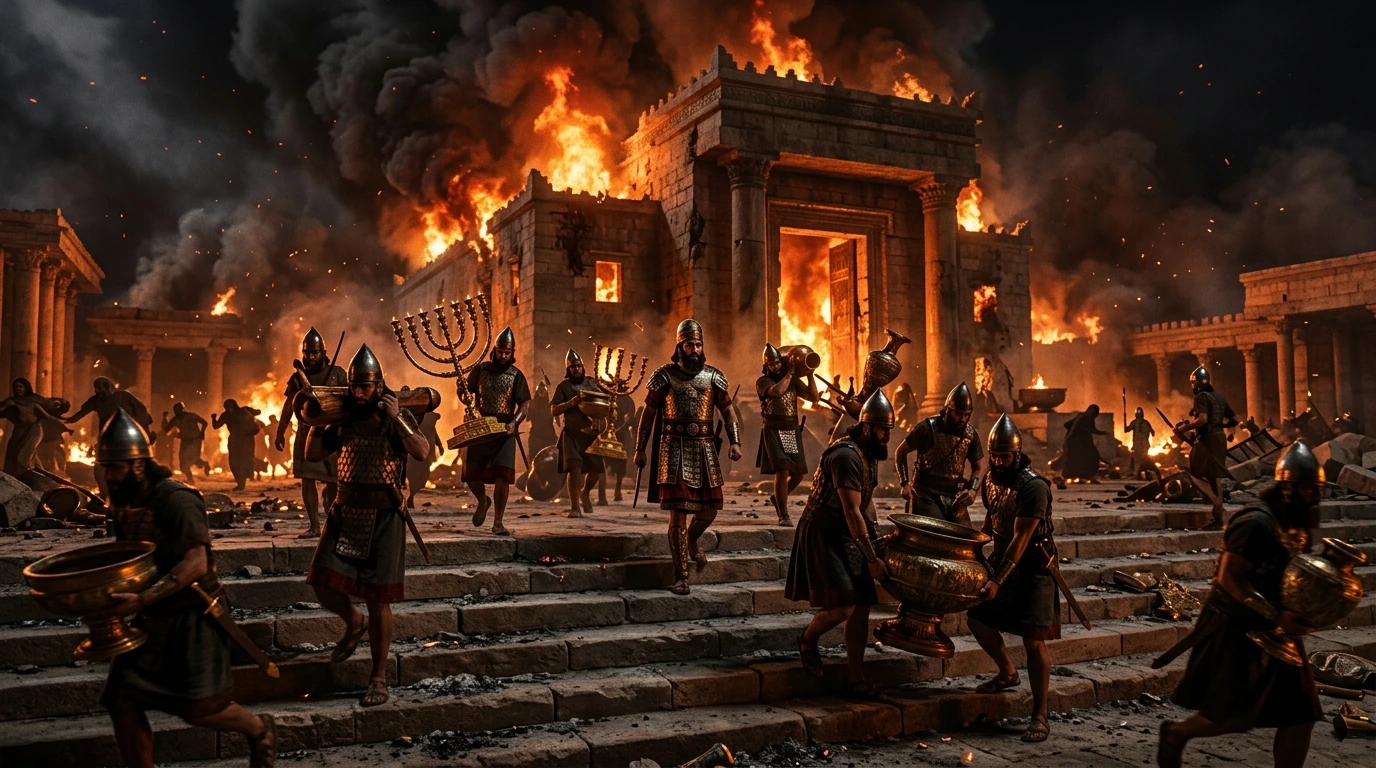
When Nebuchadnezzar's army torched Solomon's Temple on Mount Moriah, shattered its sacred bronze vessels, and dragged the Davidic king into exile, pagan observers concluded that Marduk, the chief deity of Babylon, had proven mightier than Yahweh, the God of Israel.
For the survivors weeping by the rivers of Babylon (Psalm 137), the catastrophe triggered an existential crisis of faith:
- Had God abandoned His unconditional covenant with David (2 Samuel 7)?
- Had the promise of an eternal house on Mount Zion proven false?
- Was Israel's God merely a weak regional mountain deity, powerless before imperial superpowers?
The biblical prophets provided a revolutionary theological answer that transformed world history: Marduk had not defeated Yahweh; rather, Yahweh had summoned Babylon as His sovereign instrument of covenant judgment.
Ezekiel's Vision: The Departure of the Shekinah Glory
The theological explanation for the destruction of the Temple is recorded in the apocalyptic visions of the prophet-priest Ezekiel, deported to Babylon in 597 BC.
In chapters 8 to 11, Ezekiel is transported in the spirit to the Temple in Jerusalem. He witnesses the abominations practiced inside the sacred courts: elders offering incense to creeping things painted on walls, women weeping for the Mesopotamian fertility god Tammuz, and priests turning their backs to the Temple to worship the rising sun.
Because of this systemic spiritual apostasy, Ezekiel witnesses the terrifying, gradual departure of the Shekinah glory (Kavod Yahweh):
[THE FLIGHT OF THE SHEKINAH (EZEKIEL 10:18–19; 11:23)]
"Then the glory of the LORD went out from the threshold of the house and stood over the cherubim.
 And the cherubim lifted up their wings and mounted up from the earth in my sight as they went out...
 And the glory of the LORD went up from the midst of the city and stood on the mountain
 that is on the east side of the city [The Mount of Olives]."
The theological revelation was monumental: The Babylonians did not overthrow God's Temple; God had already vacated the building before the first Babylonian torch was lit. The physical temple had become a hollow shell, abandoned by the Holy One because of idolatry.
From Temple-State to Book-Religion: The Birth of the Synagogue
The destruction of 586 BC fundamentally transformed Israelite religion, birthing modern Judaism as a faith rooted in the portable text of Scripture rather than stationary temple sacrifices:
- The Emergence of the Synagogue (Beit Knesset): Deprived of the Temple altar, exiled Judeans gathered on the Sabbath in homes along the Chebar canal in Babylon to pray, sing psalms, and hear the reading of the Torah. This informal institution evolved into the synagogue, which preserved Jewish identity across two millennia of global diaspora.
- The Scribes and Sopherim: Scribes like Ezra (Ezra 7:6) rose to paramount importance. Scribes copied, canonized, and harmonized the Law and the Prophets, ensuring that the Word of God survived the ashes of Jerusalem.
- The Extinction of Idolatry: Prior to 586 BC, Israel continually struggled with the worship of Baal, Asherah, and the astral pantheon. After the brutal reality of the Babylonian exile, polytheistic idolatry was permanently eradicated from the Jewish soul. Never again would Israel bow down to pagan idols.
The Promise of the New Covenant (Jeremiah 31:31–34)
Amidst the smoking ruins of Jerusalem, the prophet Jeremiah delivered the most consequential theological prophecy in the Old Testament: The New Covenant (Brit Chadashah):
[THE INWARD LAW (JEREMIAH 31:31–33)]
"Behold, the days are coming, declares the LORD, when I will make a new covenant
 with the house of Israel and the house of Judah, not like the covenant that I made with their fathers
 on the day when I took them by the hand to bring them out of the land of Egypt, my covenant that they broke...
 For this is the covenant that I will make with the house of Israel after those days, declares the LORD:
 I will put my law within them, and I will write it on their hearts.
 And I will be their God, and they shall be my people."
The old covenant mediated at Mount Sinai had failed because human depravity broke the external stone tablets. The New Covenant would not depend upon external ceremonial architecture or physical walls:
- It would be inscribed directly upon the human heart by the Holy Spirit.
- It promised unconditional, complete forgiveness of sins ("I will forgive their iniquity, and I will remember their sin no more" - Jer 31:34).
- It was formally inaugurated 600 years later when Jesus of Nazareth took the cup at the Last Supper in Jerusalem, saying: "This cup is the new covenant in my blood, which is poured out for you" (Luke 22:20).
The Preservation of the Davidic Line in Babylon
While King Zedekiah was blinded and died without a surviving royal heir, God preserved the Davidic royal seed through the line of the exiled King Jehoiachin (Coniah / Jeconiah):
[THE PROPHECY OF THE SEED (HAGGAI 2:23)]
"On that day, declares the LORD of hosts, I will take you, O Zerubbabel my servant,
 the son of Shealtiel, declares the LORD, and make you like a signet ring,
 for I have chosen you, declares the LORD of hosts."
- Jehoiachin fathered Shealtiel in Babylonian captivity (corroborated by the Weidner ration texts listing his sons).
- Shealtiel fathered Zerubbabel, who would lead the first wave of returnees from Babylon in 538 BC to rebuild the altar in Jerusalem.
- This lineage is preserved in the genealogies of Jesus Christ in both Matthew 1:12 and Luke 3:27, proving that neither the Babylonian siege nor 70 years of exile could sever God's covenant promise to the House of David.
Three-Tier Evidentiary Evaluation: Theological Geopolitics of 586 BC
Tier 1: Material and Physical Archaeology
- Babylonian Exile Settlements: Excavations at Al-Yahudu ("Judahtown") in southern Iraq have yielded hundreds of cuneiform clay tablets documenting prosperous Jewish families living in Mesopotamia during the 6th and 5th centuries BC, verifying Jeremiah's advice to "build houses and settle down" (Jer 29:5).
- Destruction of Solomon's Temple Stratum: Verified by the universal 586 BC destruction horizon across Jerusalem's archaeological record.
Tier 2: Textual and Internal Epigraphy
- The Al-Yahudu Tablets: Preserve typical Yahwistic biblical personal names (names ending in -yahu or -yah) among Judean exiles working as royal tenants, merchants, and military reservists under Babylonian and Persian rule.
- Cuneiform Rations of Jehoiachin: Validates the biblical survival of the royal Davidic royal house.
Tier 3: Theological and Canonical Transmission
- Birth of Biblical Monotheism in Exile: The literature composed and compiled during this era (Second Kings, Jeremiah, Lamentations, Ezekiel, Isaiah 40–66) established the definitive biblical proclamation that Yahweh is not a local deity, but the sole Creator and Sovereign of all cosmic history.
- Typology of Christ: Jesus identified Himself as the true Temple that would be destroyed and raised up in three days (John 2:19–21).
Frequently Asked Questions
Did the Ark of the Covenant survive the destruction of 586 BC?
The Ark of the Covenant disappears from the biblical historical narrative with the Babylonian destruction. Rabbinic traditions (2 Maccabees 2:4–8) claim Jeremiah hid the Ark in a cave on Mount Nebo. Most historical-critical scholars conclude that the Babylonians melted down the Ark's pure gold covering (kapporet) and destroyed the wooden chest along with the rest of the Temple's wooden structures.
How long did the Babylonian captivity last?
Jeremiah 25:11 prophesied that the captivity would last 70 years. Chronologically, from the first deportation in 605 BC to the completion of the Second Temple in 516 BC was exactly 70 years; alternatively, from the destruction of the Temple in 586 BC to its rededication in 516 BC is also 70 years.
What happened to the Jews who fled to Egypt after 586 BC?
Against Jeremiah's counsel, a remnant of Judeans fled to Egypt, taking Jeremiah with them (Jeremiah 43). A century later, fifth-century BC Aramaic papyri discovered at Elephantine in southern Egypt reveal a thriving Jewish military colony with its own temple to Yahweh, corroborating the biblical record of Judean settlement in Egypt.
Frequently Asked Questions
Did the Ark of the Covenant survive the destruction of 586 BC?
The Ark of the Covenant disappears from the biblical historical narrative with the Babylonian destruction. Rabbinic traditions (2 Maccabees 2:4–8) claim Jeremiah hid the Ark in a cave on Mount Nebo. Most historical-critical scholars conclude that the Babylonians melted down the Ark's pure gold covering (*kapporet*) and destroyed the wooden chest along with the rest of the Temple's wooden structures.
How long did the Babylonian captivity last?
Jeremiah 25:11 prophesied that the captivity would last **70 years**. Chronologically, from the first deportation in 605 BC to the completion of the Second Temple in 516 BC was exactly 70 years; alternatively, from the destruction of the Temple in 586 BC to its rededication in 516 BC is also 70 years.
What happened to the Jews who fled to Egypt after 586 BC?
Against Jeremiah's counsel, a remnant of Judeans fled to Egypt, taking Jeremiah with them (Jeremiah 43). A century later, fifth-century BC Aramaic papyri discovered at **Elephantine** in southern Egypt reveal a thriving Jewish military colony with its own temple to Yahweh, corroborating the biblical record of Judean settlement in Egypt.
Related Research Dossiers
View all 120 articles →
Complete Interactive Study Guide: The Book of Exodus, Egyptian Plagues, and Tabernacle Bible Quiz (With Detailed Answers & Scripture References)

Small Group & Family Edition: The Book of Exodus and Tabernacle Bible Quiz (Deliverance, Law, and Wilderness Worship)