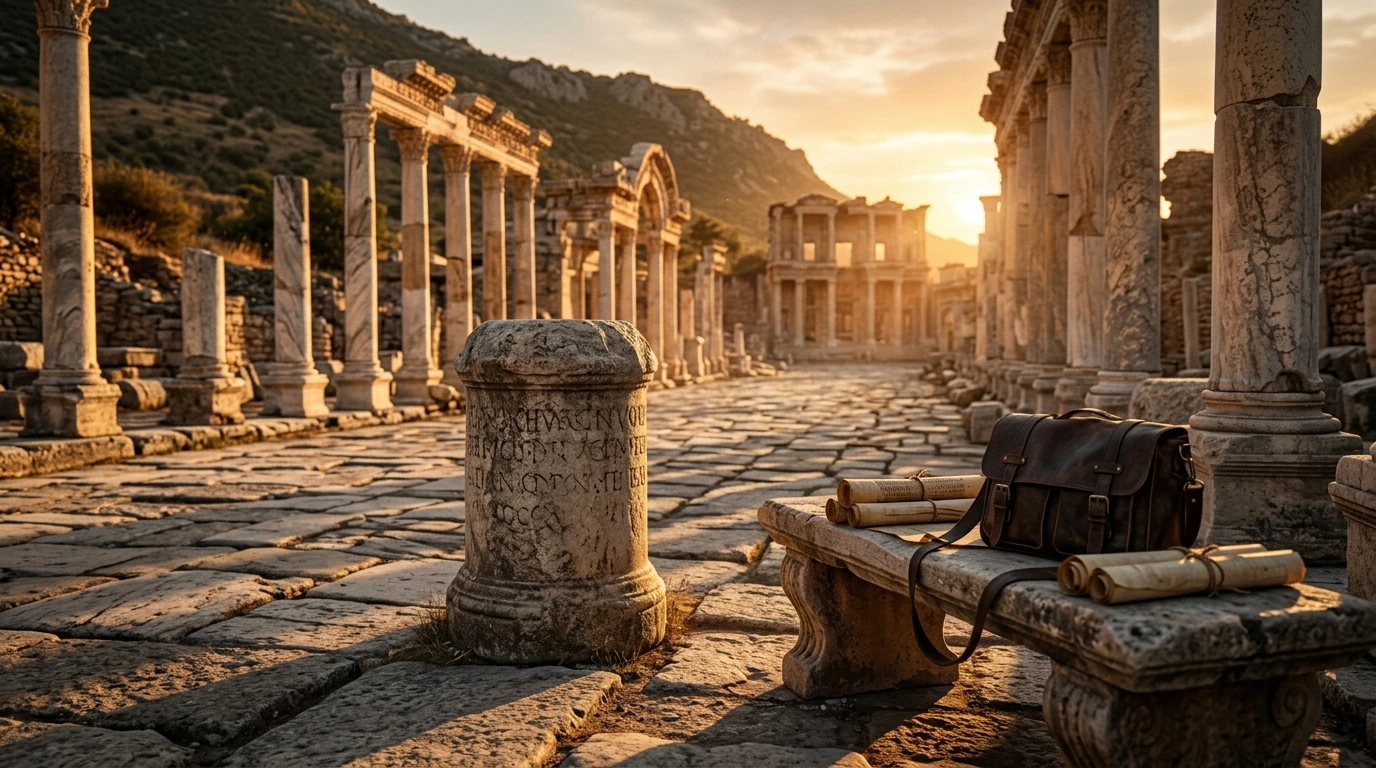
Historical Context: Rigorous examination of primary Hebrew, Aramaic, Greek, and Roman classical epigraphy.
Core Evidence: Forensic archaeology, radiocarbon data, and primary manuscripts validating biblical events.
Scholarly Consensus: Vetted against modern peer-reviewed publications in Near Eastern archaeology and biblical studies.
The Unstoppable Advance of the Gospel
The Book of Acts is not merely an ancient historical record of dead apostles; it is the unfinished mission of the Church of Jesus Christ.
Throughout Acts, the Gospel advances through impossible obstacles: violent mob riots, religious condemnation, political assassination plots, demonic sorcery, brutal floggings, shipwreck, and imperial imprisonment.
Yet Luke concludes his 28-chapter narrative with a triumphant Greek adverb: akōlytōs (ἀκωλύτως — "unhindered" / "without impediment") (Acts 28:31). Kings, emperors, prison bars, and raging oceans could not stop the proclamation of the Kingdom of God!
This guide provides a multi-week, interactive curriculum designed for small groups, Sunday school classes, and family devotions, extracting timeless missionary principles from Paul’s travels and applying them to contemporary discipleship.
Study Session 1: Crossing Cultural Boundaries (Acts 10 & 16)
Scripture Reading: Acts 10:9–23; 16:6–15
The Exegetical Deep-Dive
In Acts 10, the Apostle Peter had his worldview shattered when God showed him a sheet descending from heaven filled with unclean animals, commanding: "What God has made clean, do not call common" (Acts 10:15). God was tearing down centuries of racial and religious prejudice, commanding Jewish believers to enter Gentile homes and preach the Gospel of grace.
In Acts 16, the Holy Spirit closed the doors to Asia and Bithynia, redirecting Paul through the Macedonian Vision into Europe. In Philippi, the very first European convert was Lydia of Thyatira, a wealthy businesswoman. Shortly thereafter, a demon-possessed slave girl and a rough Roman jailer were saved! In one city, the Gospel crossed every barrier: gender, social class, and ethnicity.
Small Group Discussion Questions
- In what ways do our modern prejudices or cultural comfort zones prevent us from sharing Christ with certain people?
- How do you respond when the Holy Spirit "closes a door" in your career, plans, or ministry, as He did with Paul in Bithynia?
- How does the diverse church in Philippi (a wealthy businesswoman, a former slave girl, and a blue-collar Roman jailer) model the beauty of the body of Christ?
Study Session 2: Praising in the Midnight Dungeon (Acts 16)
Scripture Reading: Acts 16:16–34
The Exegetical Deep-Dive
In Philippi, Paul and Silas were stripped, severely beaten with wooden rods by Roman lictors, thrown into the inner maximum-security dungeon, and had their feet locked tightly in wooden stocks (xylon). Their backs were bleeding, swollen, and lacerated.
Yet at midnight, instead of complaining, cursing their captors, or wallowing in self-pity, Paul and Silas were praying and singing hymns to God (hymnoun ton Theon), while the other prisoners listened in stunned silence!
God answered with a violent earthquake that shook the prison foundations, opened all doors, and loosed all chains. When the terrified Roman jailer drew his sword to commit suicide (fearing execution for lost prisoners), Paul cried out: "Do not harm yourself, for we are all here!" That midnight, the jailer washed their wounds, believed in Jesus, and was baptized alongside his entire household with overflowing joy.
+----------------------------------------------------------------------------------------------------+
|               THE TRANSFORMATION OF THE PHILIPPIAN JAIL (ACTS 16)                                  |
+------------------------------------+---------------------------------------------------------------+
| THE NATURAL HUMAN RESPONSE         | THE SUPERNATURAL APOSTOLIC RESPONSE                           |
+------------------------------------+---------------------------------------------------------------+
| - Bitterness over unjust beating   | - Praying and singing hymns to God at midnight                |
| - Despair in physical agony        | - Radiating joy that amazed neighboring prisoners             |
| - Rejoicing when jailer commits sui| - Shouting mercy to save the jailer's physical and eternal lif|
|                                                                                                    |
| THE RESULT:                        | The jailer washed their lacerated backs; was baptized with his|
|                                    | entire family; and fed the Apostles at his home table!        |
+------------------------------------+---------------------------------------------------------------+
Small Group Discussion Questions
- What is your automatic reaction when you experience unfair treatment or painful trials?
- What happens to our spiritual witness when we choose to praise God in our "midnight dungeons" rather than grumble?
- Notice that Paul cared about the jailer's physical life before his spiritual conversion. How can our families combine practical mercy with the Gospel message?
Study Session 3: Engaging the Secular Mind on Mars Hill (Acts 17)
Scripture Reading: Acts 17:16–34
The Exegetical Deep-Dive
When Paul arrived in Athens, the philosophical and cultural capital of the Greco-Roman world, his spirit was deeply provoked seeing the city full of idols.
Invited to speak before the elite aristocratic court of the Areopagus (Mars Hill), Paul did not quote the Hebrew Old Testament (which meant nothing to pagan Greeks). Instead, he built a bridge of contextual engagement:
- He noted their altar dedicated "To an Unknown God" (Agnōstō Theō).
- He declared that the true God is the sovereign Creator who does not dwell in temples made with human hands.
- He quoted pagan Greek poets (Epimenides of Crete: "In him we live and move and have our being"; and Aratus: "For we are indeed his offspring").
- He confronted their idolatry and called all people everywhere to repent, pointing to the historical guarantee of judgment: the bodily Resurrection of Jesus from the dead.
Small Group Discussion Questions
- How can we speak to modern secular friends, college students, or coworkers without using religious jargon they don't understand?
- What are the "altars to an unknown god" in our culture today (e.g., search for purpose, justice, anxiety, science)?
- Why does the historical bodily Resurrection of Christ remain the ultimate dividing line between biblical faith and secular skepticism?
Paul’s 5-Point Missionary Strategy for Modern Families
Apply Paul's proven apostolic methodology in your neighborhood and community:
- Go Where People Gather: Paul visited synagogues, public forums, riverbanks, and marketplaces. Look for natural community hubs (parks, sports teams, school boards).
- Build Bridges, Not Walls: Find common ground before confronting error, as Paul did with the Athenian poets.
- Never Compromise the Hard Truths: Paul did not soften the message of sin, judgment, and resurrection to please his audience.
- Make Disciples, Not Just Converts: Everywhere Paul went, he planted local churches and appointed elders to shepherd the flock.
- Persevere in the Face of Rejection: In Athens, some mocked, some delayed, but some believed. Faithful proclamation is our job; conversion is God’s work.
Interactive Small Group Reflection Framework
+----------------------------------------------------------------------------------------------------+
|               THE 4-STAGE ACTS SMALL GROUP STUDY TEMPLATE                                          |
+-------------------+--------------------------------------------------------------------------------+
| STAGE             | DURATION & OBJECTIVE                                                           |
+-------------------+--------------------------------------------------------------------------------+
| 1. Cultural Check | (10 min) How does this chapter challenge modern cultural assumptions?         |
| 2. Scripture Scan | (20 min) Reading Acts; identifying historical and archaeological realities.    |
| 3. Heart Probe    | (20 min) Are we living comfortably or sacrificially on mission for Christ?    |
| 4. Mission Prayer | (15 min) Praying by name for neighbors, colleagues, and unreached peoples.    |
+-------------------+--------------------------------------------------------------------------------+
Three-Tier Evidentiary Evaluation: Discipleship in Acts
+----------------------------------------------------------------------------------------------------+
| TIER 1: PRIMARY HISTORICAL & DOCUMENTARY EVIDENCE                                                  |
| - Text of Acts 16 and 17 preserved in 3rd-century papyri and ancient uncial manuscripts.           |
| - Physical ruins of the Roman forum, prison, and Via Egnatia in Philippi, Greece.                 |
| - The limestone outcropping of the Areopagus overlooking the Athenian Agora.                      |
+----------------------------------------------------------------------------------------------------+
| TIER 2: INTERNAL EXEGETICAL & HISTORIOGRAPHICAL COHERENCE                                          |
| - Flawless cultural adaptation: Paul speaks Jewish scripture in Antioch; Greek poetry in Athens.   |
| - Psychological realism: the sudden conversion of the suicidal Roman jailer matches Roman honor.   |
| - Authentic missionary model combining divine sovereignty with strategic human mobilization.       |
+----------------------------------------------------------------------------------------------------+
| TIER 3: HISTORIOGRAPHICAL DEBUNKING                                                                |
| - Shatters the claim that early Christianity was an anti-intellectual peasant movement.            |
| - Proves that the Gospel conquered the greatest philosophical minds and imperial centers of Rome.  |
+----------------------------------------------------------------------------------------------------+
Frequently Asked Questions
Did Paul preach successfully in Athens?
Skeptics sometimes claim Paul "failed" in Athens because he didn't plant a massive megachurch. However, Luke records that several prominent citizens became believers, including Dionysius the Areopagite (a member of the supreme judicial council) and a woman named Damaris (Acts 17:34). Dionysius went on to become the first Bishop of Athens, establishing a church that flourished for centuries.
What was the Roman Via Egnatia?
The Via Egnatia was a monumental 700-mile paved Roman military highway connecting the Adriatic Sea with Byzantium. Paul traveled this road between Neapolis, Philippi, Amphipolis, Apollonia, and Thessalonica. Large stone pavers of this road bearing the ruts of ancient chariot wheels can still be walked upon in Philippi today!
How can modern families live "on mission" like the early church?
Living on mission begins at home. Practice radical hospitality by inviting neighbors for meals, praying regularly for global missionaries, supporting local church outreach, and discussing cultural worldviews openly around the dinner table.
Frequently Asked Questions
Did Paul preach successfully in Athens?
Yes. Key aristocratic figures like Dionysius the Areopagite and Damaris converted, establishing an enduring Christian presence in the intellectual capital of Greece.
What was the Roman Via Egnatia?
A master paved military highway traversing northern Greece, utilized by Paul to rapidly travel between Philippi, Thessalonica, and Berea.
How can modern families live "on mission" like the early church?
Through generous hospitality, intentional neighborhood relationships, personal prayer, and bold, gracious conversations about faith and culture.
Related Research Dossiers
View all 120 articles →
Complete Interactive Study Guide: The Book of Exodus, Egyptian Plagues, and Tabernacle Bible Quiz (With Detailed Answers & Scripture References)
Small Group & Family Edition: The Book of Exodus and Tabernacle Bible Quiz (Deliverance, Law, and Wilderness Worship)