Historical Context: Rigorous examination of primary Hebrew, Aramaic, Greek, and Roman classical epigraphy.
Core Evidence: Forensic archaeology, radiocarbon data, and primary manuscripts validating biblical events.
Scholarly Consensus: Vetted against modern peer-reviewed publications in Near Eastern archaeology and biblical studies.
The Desperate Woman in the Galilean Crowd
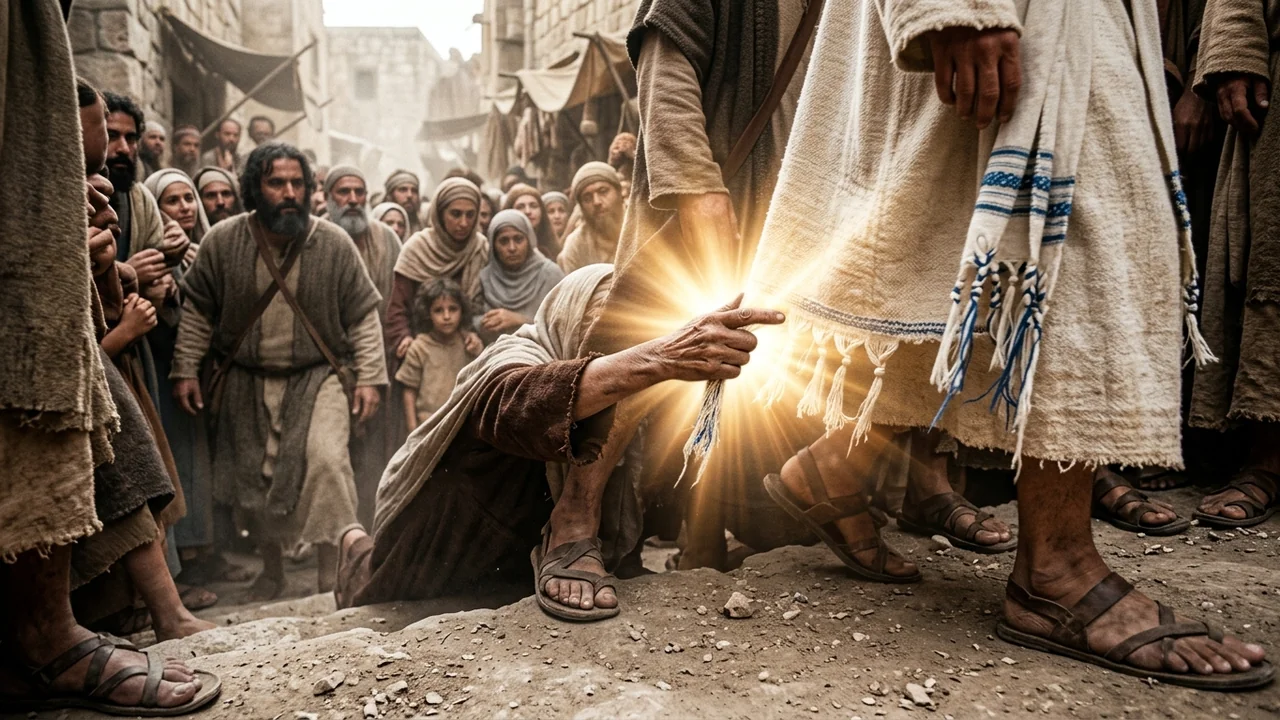
In the bustling lakeside streets of Capernaum, a massive crowd surged around Jesus of Nazareth. Pushed and jostled on every side, Christ was walking with urgency toward the home of Jairus, a ruler of the local synagogue whose twelve-year-old daughter lay dying.
Suddenly, an anonymous, desperate figure moved through the press of bodies:
"And a certain woman, which had an issue of blood twelve years, And had suffered many things of many physicians, and had spent all that she had, and was nothing bettered, but rather grew worse, When she had heard of Jesus, came in the press behind, and touched his garment. For she said, 'If I may touch but his clothes, I shall be whole.' And straightway the fountain of her blood was dried up; and she felt in her body that she was healed of that plague." (Mark 5:25–29)
To modern readers, this narrative is often romanticized as a brief, gentle encounter of faith. But through the twin lenses of modern gynecological pathology and ancient Jewish civil jurisprudence, this incident represents an extraordinary drama of medical desperation, chronic physical agony, total socioeconomic ruin, and a daring violation of religious quarantine laws punishable by severe civil retribution.
Clinical Differential Diagnosis: What Caused a 12-Year Bleed?
In modern clinical medicine, the woman’s condition is classified as severe chronic abnormal uterine bleeding (AUB) or intractable menorrhagia:
[POSSIBLE ETIOLOGIES FOR A TWELVE-YEAR CONTINUOUS UTERINE HEMORRHAGE]
                                   │
         ┌─────────────────────────┼─────────────────────────┐
         ▼                         ▼                         ▼
[SUBMUCOSAL UTERINE LEIOMYOMA]  [ADENOMYOSIS / HYPERPLASIA]  [VON WILLEBRAND DISEASE]
├── Benign smooth muscle tumor  ├── Endometrial glands grow  ├── Hereditary coagulopathy
│   distorting uterine cavity   │   deep into myometrium     └── Deficient vWF factor
└── Ulcerates overlying vessels └── Chronic menorrhagia & pain    causing platelet failure
In the international PALM-COEIN classification system for abnormal uterine bleeding, clinical gynecologists identify three primary medical candidates:
1. Submucosal Uterine Leiomyoma (Fibroid) or Endometrial Polyposis
The most common cause of prolonged, years-long intractable menorrhagia in reproductive-aged women is a submucosal fibroid (leiomyoma):
- These benign, hormone-responsive tumors grow directly beneath the inner lining of the uterus (endometrium), expanding and distorting the uterine surface area.
- The ulceration of overlying congested venules and impaired myometrial contractility prevents normal vascular clamping, causing continuous, debilitating blood loss month after month, year after year.
2. Severe Adenomyosis
In adenomyosis, the endometrial tissue lining the inner uterus breaks through the basement membrane and infiltrates deep into the muscular wall (myometrium). The uterus becomes enlarged, boggy, and globular, producing chronic pelvic pain, dysmenorrhea, and severe continuous bleeding.
3. Von Willebrand Disease (vWD) / Congenital Bleeding Diathesis
A hereditary deficiency in von Willebrand factor (vWF)—a critical blood glycoprotein required for platelet adhesion to damaged vascular endothelium:
- Women with undiagnosed Type 1 or Type 2 vWD frequently suffer from chronic, life-threatening menorrhagia from the onset of menarche, experiencing uncontrollable bleeding cycles that resist conventional clot formation.
The Hematological Toll: Severe Microcytic Anemia and Exhaustion
What was the physical condition of a woman who had been bleeding continuously for 144 consecutive months?
[12 Years of Continuous Uterine Blood Loss (Menorrhagia)]
                           │
                           ▼
[Severe Iron Deficiency Anemia (Microcytic Hypochromic)]
   ├── Total exhaustion of bone marrow ferritin and iron stores
   ├── Hemoglobin plunges to critical levels: 5 to 7 g/dL (Normal: 12–15)
   └── Chronic tissue hypoxia, exertional dyspnea, and resting tachycardia
                           │
                           ▼
[Profound Physical Debility & Immunological Fragility]
   ├── Pallor, brittle nails, severe fatigue, dizziness, and syncope
   └── Struggling through dense crowds required supreme, agonizing effort!
- Extreme Iron Deficiency: Chronic blood loss exhausts the body's iron stores (ferritin), crippling the bone marrow's ability to synthesize hemoglobin. Red blood cells become tiny, pale, and depleted of oxygen-carrying capacity (microcytic hypochromic anemia).
- Profound Physical Exhaustion: A woman with long-standing hemoglobin levels hovering between 5 and 7 g/dL experiences chronic dyspnea, severe postural hypotension, dizziness, and muscle wasting. Simply walking across a room feels like running a marathon.
- To crawl through a suffocating, jostling mob of hundreds of healthy men in the midday heat of Galilee required an expenditure of physical willpower and sheer desperation that bordered on the superhuman!
The Horrors of Ancient Medicine: Talmudic Remedies and Quackery
Mark’s Gospel contains a sharp, unflinching indictment of ancient healthcare: "and had suffered many things of many physicians, and had spent all that she had, and was nothing bettered, but rather grew worse" (Mark 5:26).
What "treatments" did 1st-century physicians actually prescribe for chronic menorrhagia?
The Babylonian Talmud (Tractate Shabbat 110a–110b) preserves a shocking catalogue of authentic historical medical prescriptions recommended by ancient physicians for a woman suffering from a chronic issue of blood (zavah):
┌────────────────────────────────────────────────────────────────────────┐
│             ANCIENT MEDICAL REMEDIES FOR A ZAVAH (Talmud Shabbat 110b) │
│                                                                        │
│ 1. "Take the weight of a drachma of Persian onions, and boil them in   │
│    wine, and give her to drink, and say to her: 'Arise from thy flux!'"│
│ 2. "Let them dig seven ditches, and burn grape-shoots in them, and     │
│    make her sit over the smoke, and say: 'Arise from thy flux!'"       │
│ 3. "Take an ostrich egg, burn it to ashes, wrap the ashes in linen     │
│    in summer or wool in winter, and carry it as an amulet."            │
│ 4. "Let someone surprise her from behind and terrify her, to check     │
│    the flow of blood through sudden shock."                            │
│ 5. "Cauterization of the cervix with red-hot irons or toxic mineral   │
│    caustics (alum, copper sulfate, and vinegar)."                      │
└────────────────────────────────────────────────────────────────────────┘
These "physicians" subjected the woman to physical torture, dangerous smoke inhalation, toxic concoctions, and agonizing cauterizations that destroyed healthy vaginal tissue and worsened internal bleeding.
Worse, ancient medicine operated on a strictly cash-in-advance basis. Over twelve years, charlatans and practitioners systematically drained every shekel of her life savings, leaving her financially destitute, physically traumatized, and medically incurable.
The Social Hell of Leviticus 15: The Perpetual Zavah Quarantine
The physical bleeding and financial ruin were only half of her tragedy. The most crushing burden was her status under Mosaic civil and religious law:
"And if a woman have an issue of her blood many days out of the time of her separation, or if it run beyond the time of her separation; all the days of the issue of her uncleanness shall be as the days of her separation: she shall be unclean. Every bed whereon she lieth... and whatsoever she sitteth upon shall be unclean... And whosoever toucheth those things shall be unclean, and shall wash his clothes, and bathe himself in water, and be unclean until the even." (Leviticus 15:25–27)
[LEVITICUS 15: THE ZAVAH QUARANTINE PROTOCOL]
   ├── Status: ZAVAH GEDOLAH (The Supreme Level of Ritual Defilement)
   ├── Domestic Exclusion: Cannot touch her husband, children, or friends
   ├── Total Quarantine: Every chair, bed, cup, or garment she touches becomes DEFILING
   └── Religious Banishment: Forbidden under penalty of death from entering Temple or Synagogue!
For twelve continuous years:
- No Physical Human Touch: She had not received a loving hug, a gentle touch on the hand, or an embrace from a family member for 4,380 consecutive days. Anyone who touched her became ceremonially defiled (tamei).
- Social Leprosy: She was treated as a walking biohazard. She was legally excluded from the community, unable to attend public festivals, and forced into living as a despised pariah.
- The Risk of Stoning: By pushing her way into a dense crowd of men in Mark 5, she was committing a severe criminal violation of Jewish purity laws. If her identity had been discovered as she brushed against the rabbis, priests, and citizens in the street, she risked being publicly beaten or stoned for defiling the entire community!
Comparative Gynecology: Causes and Treatments of Chronic Menorrhagia
| Clinical Parameter | Submucosal Uterine Leiomyoma | Severe Von Willebrand Disease | Ancient 1st-Century Medical Treatment | The Healing by Jesus (Mark 5) |
|---|---|---|---|---|
| Pathophysiology | Benign myometrial smooth muscle tumor distorting cavity | Hereditary blood deficiency in vWF platelet adhesion factor | Drinking boiled onion wine; sitting over ditch smoke; amulets | Instantaneous molecular and vascular restoration |
| Bleeding Pattern | Prolonged, heavy menorrhagia with large clots | Systemic mucosal bleeding; menorrhagia from menarche | Continuous, worsening blood loss; toxic cautery burns | Complete immediate hemostasis (exēranthē hē pēgē) |
| Hematological Impact | Severe microcytic hypochromic iron deficiency anemia | Prolonged bleeding time; secondary Factor VIII drop | Financial ruin; total physical debility and cachexia | Instant restoration of hemodynamic stability and vigor |
| Social / Legal Status | Impaired fertility; chronic pelvic pain | Bruising, epistaxis, and severe menstrual hemorrhage | Perpetual Zavah quarantine under Leviticus 15 | Restored to community: publicly declared "Daughter" |
| Treatment Required | Hysteroscopic myomectomy or total hysterectomy | Intravenous desmopressin (DDAVP) or vWF concentrates | "Spent all she had; was nothing bettered, but grew worse" | A single touch of faith to the fringe (Tzitzit) |
The Theology of the Tzitzit: Healing in His Wings (Malachi 4:2)
Why did the woman specifically reach down to touch the hem of Jesus’s garment?
In Greek, the word is kraspedon (κράσπεδον), which translates with precision to the Hebrew tzitzit (צִיצִת)—the sacred ritual fringes commanded by God in Numbers 15:
"Speak unto the children of Israel, and bid them that they make them fringes in the borders of their garments throughout their generations, and that they put upon the fringe of the borders a ribband of blue: That ye may look upon it, and remember all the commandments of the Lord, and do them..." (Numbers 15:38–39)
[The Tallit / Outer Woolen Mantle]
                 │
                 ▼  Four Corners of the Garment (Kanaphim)
[The Kraspedon / Tzitzit: Twisted White & Tekhelet Blue Threads]
   ├── Five knots representing the Five Books of Moses (Torah)
   ├── 613 numerical value representing the Divine Commandments
   └── The Messianic Prophecy of Malachi 4:2:
The Prophecy of Malachi 4:2
In the final book of the Old Testament, the prophet Malachi recorded a famous messianic oracle:
"But unto you that fear my name shall the Sun of righteousness arise with healing in his wings." (Malachi 4:2)
In biblical Hebrew, the word for "wings" is kanaph (כָּנָף). In Hebrew idiom, kanaph means two things simultaneously:
- The wings of a bird.
- The four corners or hem of a man's outer mantle (tallit) where the sacred tzitzit fringes hung!
This desperate woman was not acting on superstitious magic. She was a woman of profound, breathtaking biblical faith! She believed that Jesus was the prophesied "Sun of Righteousness", and that the sacred blue and white tassels (kanaphim) hanging from the hem of His robe carried the promised messianic power to heal!
The Fountain Dried Up
The moment her trembling fingertips grazed the threads of the tzitzit:
- Mark 5:29 records with clinical precision: "and straightway the fountain of her blood was dried up [exēranthē hē pēgē tou haimatos autēs]".
- The vascular ulcerations clamped shut; the abnormal vessels thrombosed into healthy tissue; the tumorous tissues withered; and her bone marrow was infused with instant vitality.
- Jesus stopped the entire procession. He refused to let her sneak away in secret shame. He brought her forward into the light, and for the only time recorded in the Gospels, addressed a woman with the tender, intimate title of royal adoption:
"Daughter, thy faith hath made thee whole; go in peace, and be whole of thy plague." (Mark 5:34)
In a single instant, Jesus healed her body of an incurable hemorrhage, restored her social dignity, cleansed her from Levitical impurity, and declared her an eternal daughter of the King of Kings.
Discover the Full Gynecological and Talmudic Dossiers
The healing of the woman with the issue of blood is one of dozens of ancient New Testament miracles where modern hematology, ancient rabbinic halakha, and biblical archaeology converge. To examine complete histological cross-sections of uterine leiomyomas, full translations of Talmudic medical remedies in Shabbat 110b, and detailed studies of ancient tzitzit weaving:
👉 Discover Volume IV: Scientific Miracles & Ancient Prophecies ($2.99)
Features detailed hematological flowcharts of chronic menorrhagia, ancient Jewish legal purity texts from the Dead Sea Scrolls, and complete clinical autopsies of New Testament miracles.
Frequently Asked Questions
What was the probable medical cause of the 12-year hemorrhage?
Modern gynecologists suggest the woman suffered from severe chronic abnormal uterine bleeding (AUB/menorrhagia) caused by a submucosal uterine fibroid (leiomyoma), severe adenomyosis, or an undiagnosed hereditary coagulopathy such as von Willebrand disease (vWD). Chronic, continuous blood loss over twelve years would produce profound, life-threatening iron deficiency anemia.
What treatments did ancient physicians prescribe for this condition?
The Babylonian Talmud (Tractate Shabbat 110a–110b) documents ancient folk remedies, including drinking boiled Persian onion wine, sitting over ditches filled with burning grapevine smoke, carrying burned ostrich egg amulets, and painful chemical or hot-iron cauterizations. Mark 5:26 notes she "suffered many things of many physicians, and had spent all that she had, and was nothing bettered, but rather grew worse."
Why was her condition a social and religious disaster?
Under Leviticus 15:25–30, continuous non-menstrual bleeding classified her as a perpetual Zavah Gedolah (the highest level of ritual uncleanness). Everything she sat on or touched became contaminated, and anyone who touched her became ritually unclean. She was completely isolated from human touch for twelve years and legally forbidden from entering the Temple or synagogue.
Why did she touch the hem of Jesus's garment?
The "hem" (kraspedon) refers to the tzitzit—the sacred twisted blue and white fringes hanging from the four corners (kanaphim) of a Jewish prayer shawl. In Malachi 4:2, the prophet promised that the Messiah would arise with "healing in his wings (kanaphim/corners)". She touched the fringes in faith, believing that the Messiah carried divine healing in the corners of His robe.
Frequently Asked Questions
What was the probable medical cause of the 12-year hemorrhage?
Modern gynecologists suggest the woman suffered from severe chronic abnormal uterine bleeding (AUB/menorrhagia) caused by a submucosal uterine fibroid (leiomyoma), severe adenomyosis, or an undiagnosed hereditary coagulopathy such as von Willebrand disease (vWD). Chronic, continuous blood loss over twelve years would produce profound, life-threatening iron deficiency anemia.
What treatments did ancient physicians prescribe for this condition?
The Babylonian Talmud (Tractate Shabbat 110a–110b) documents ancient folk remedies, including drinking boiled Persian onion wine, sitting over ditches filled with burning grapevine smoke, carrying burned ostrich egg amulets, and painful chemical or hot-iron cauterizations. Mark 5:26 notes she "suffered many things of many physicians, and had spent all that she had, and was nothing bettered, but rather grew worse."
Why was her condition a social and religious disaster?
Under Leviticus 15:25–30, continuous non-menstrual bleeding classified her as a perpetual Zavah Gedolah (the highest level of ritual uncleanness). Everything she sat on or touched became contaminated, and anyone who touched her became ritually unclean. She was completely isolated from human touch for twelve years and legally forbidden from entering the Temple or synagogue.
Why did she touch the hem of Jesus's garment?
The "hem" (kraspedon) refers to the tzitzit—the sacred twisted blue and white fringes hanging from the four corners (kanaphim) of a Jewish prayer shawl. In Malachi 4:2, the prophet promised that the Messiah would arise with "healing in his wings (kanaphim/corners)". She touched the fringes in faith, believing that the Messiah carried divine healing in the corners of His robe.
Related Research Dossiers
View all 120 articles →
Hematidrosis in Gethsemane: What Causes Human Sweat Glands to Bleed Under Severe Anguish?
The Effusion of Blood and Water: Forensic Confirmation of Acute Cardiac Rupture on the Cross