Historical Context: Rigorous examination of primary Hebrew, Aramaic, Greek, and Roman classical epigraphy.
Core Evidence: Forensic archaeology, radiocarbon data, and primary manuscripts validating biblical events.
Scholarly Consensus: Vetted against modern peer-reviewed publications in Near Eastern archaeology and biblical studies.
The Standoff in the Synagogue: Luke 6:6–11
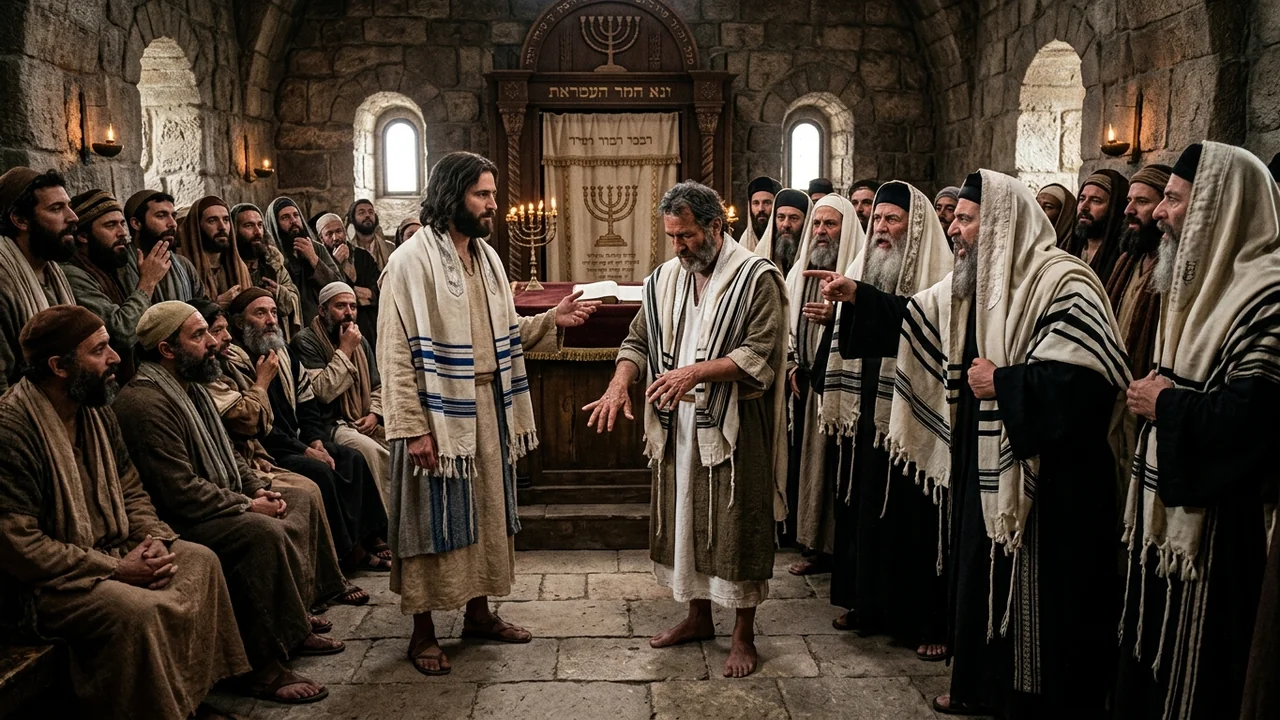
On a Sabbath morning in a Galilean town, Jesus entered the local limestone synagogue to teach. Positioned prominently among the congregation was a man whose physical deformity was immediately apparent:
"And it came to pass also on another sabbath, that he entered into the synagogue and taught: and there was a man whose right hand was withered. And the scribes and Pharisees watched him, whether he would heal on the sabbath day; that they might find an accusation against him. But he knew their thoughts, and said to the man which had the withered hand, 'Rise up, and stand forth in the midst.' And he arose and stood forth." (Luke 6:6–8)
The stage was set for an explosive theological, legal, and medical confrontation. The religious authorities were not watching in compassionate anticipation of a miracle; they were lying in ambush, waiting to see if Jesus would commit what they classified as a capital violation of Sabbath oral law.
Knowing the deadly stakes, Jesus looked the Sanhedrin scribes directly in the eyes:
"Then said Jesus unto them, 'I will ask you one thing; Is it lawful on the sabbath days to do good, or to do evil? to save life, or to destroy it?' And looking round about upon them all, he said unto the man, 'Stretch forth thy hand.' And he did so: and his hand was restored whole as the other. And they were filled with madness; and communed one with another what they might do to Jesus." (Luke 6:9–11)
Through the lens of modern neuromuscular pathology, orthopedic surgery, and 1st-century rabbinic jurisprudence, this account reveals an astonishing biological impossibility: commanding a chronically atrophied, fibrotic hand to "stretch forth" demanded an instantaneous reversal of dead scar tissue and denervated muscle fibers!
Clinical Differential Diagnosis: The Anatomy of a "Withered Hand"
In the Greek text, Luke—the beloved physician—notes with clinical precision that it was the man's "right hand" (hē cheir autou hē dexia). In the ancient world, the right hand was the hand of labor, masonry, agriculture, and social honor. To lose the use of the right hand was an economic catastrophe, plunging a craftsman into immediate poverty.
The Greek term used is xēra (ξηρά), meaning "dried up, atrophied, shriveled, or desiccated":
[POSSIBLE CLINICAL ETIOLOGIES FOR A "WITHERED HAND"]
                                │
         ┌──────────────────────┼──────────────────────┐
         ▼                      ▼                      ▼
[VOLKMANN'S CONTRACTURE]  [RADIAL / MEDIAN PALSY] [BRACHIAL PLEXUS AVULSION]
├── Ischemic muscle necrosis ├── Nerve laceration /    ├── Traumatic stretch injury
│   following compartment       entrapment causing     │   severing spinal roots
│   syndrome in forearm         total denervation      └── Total flaccid paralysis
└── Severe fibrotic claw hand└── Classic "wrist drop"      and profound muscular wasting
In clinical orthopedics and neurology, three primary diagnoses explain a chronically withered upper extremity:
1. Volkmann’s Ischemic Contracture (Compartment Syndrome)
The most likely clinical diagnosis is a classic Volkmann’s contracture:
- Following an untreated fracture of the elbow or severe crush injury to the forearm in childhood or youth, bleeding within the unyielding fascial compartments causes intense pressure (compartment syndrome).
- The arterial blood supply to the deep flexor muscles of the forearm (flexor digitorum profundus) is completely choked off.
- The ischemic muscle fibers die and undergo necrosis. Over months, the dead muscle is systematically replaced by dense, unyielding, scarred collagen fibrous tissue, permanently pulling the fingers into a tight, curled, rigid, claw-like fist!
2. Chronic Radial or Median Nerve Palsy
A complete transection or severe crush injury to the radial nerve paralyzes the extensor muscles of the wrist and fingers, producing permanent, debilitating "wrist drop". Over years without re-innervation, the extensor muscles undergo profound disuse atrophy, leaving the limb limp, shriveled, and completely dysfunctional.
Volkmann’s Ischemic Contracture: The Fibrotic Claw
To understand the physical impossibility of Jesus's command, one must examine the histological reality of a hand afflicted with Volkmann's contracture:
[Ischemic Injury to Forearm Compartment]
                     │
                     ▼
[Necrosis of Flexor Muscle Bellies (Myocytes Die)]
                     │
                     ▼
[Proliferation of Fibroblasts & Dense Type-I Collagen Scar Tissue]
                     │
                     ▼
[TENDONS FROZEN INTO SHORTENED, RIGID FIBROTIC CORDS]
   ├── Fingers drawn permanently into palm (Claw-Hand Deformity)
   ├── Extensor muscles completely atrophied from disuse
   └── Joint capsules undergo secondary fibrotic ankylosis
In a chronic contracture:
- The muscles are no longer biological muscle tissue capable of contraction and relaxation; they have been converted into rigid fibrous scar tissue.
- If a surgeon attempts to force the fingers open under general anesthesia without surgical intervention, the scarred tendons will rupture and snap before the fingers can straighten!
- In modern reconstructive surgery, correcting a severe Volkmann's contracture requires extensive surgical releases, tendon transfers, microvascular free-muscle transplantation, and months of intensive rehabilitation—and full functional restoration is almost never achieved.
Why Stretching Forth Was Biomechanically Impossible
When Jesus stood before this crippled man and said, "Stretch forth thy hand" (Ekteinon tēn cheira sou), Christ was demanding an action that the man’s physical anatomy was completely, mechanically incapable of executing!
[THE BIOMECHANICAL CASCADE REQUIRED FOR INSTANT EXTENSION]
                                 │
         ┌───────────────────────┴───────────────────────┐
         ▼                                               ▼
[1. INSTANTANEOUS SCAR LYSIS]                   [2. MOTOR UNIT RE-INNERVATION]
├── Immediate enzymatic dissolution             ├── Instantaneous restoration of
│   of dense fibrotic scar collagen             │   radial nerve action potentials
├── Immediate cellular regeneration of          ├── Instant re-synthesis of acetylcholine
│   contractile actin and myosin filaments      │   receptors at neuromuscular junctions
└── Restoration of tendon length & elasticity   └── Coordinated extensor muscle contraction!
The Microscopic Reconstruction
For the man to extend his arm and open his curled, withered fingers in the space of a single second required:
- Instantaneous Collagen Cleavage: The dense, rigid fibrotic scar tissue binding the flexor tendons had to be instantly dissolved and replaced with pliable, living, vascularized muscle tissue.
- Instant Re-Myelination and Synaptogenesis: Damaged motor axons had to be regenerated, coated with myelin sheaths, and reconnected to motor endplates across millions of muscle fibers.
- Restoration of Articular Cartilage: The frozen, ankylosed interphalangeal and radiocarpal joints had to be instantly lubricated with fresh synovial fluid to allow smooth, painless articulation.
Yet the Gospel records with breathtaking simplicity: "And he did so: and his hand was restored whole as the other" (Luke 6:10). The withered fingers uncurled, the wrist straightened, the forearm filled out with healthy muscle, and the hand was restored to full, vigorous athletic strength!
The Sabbath Halakha Controversy: Pikuach Nefesh vs. Legalism
Why were the scribes and Pharisees so enraged by this healing that Luke 6:11 records they were "filled with madness" (anoias, insane rage), plotting Jesus's execution?
To understand their fury, one must examine 1st-century Pharisaic Sabbath halakha:
[THE PHARISAIC SABBATH HEALING CODE (Mishnah Yoma 8:6 / Shabbat 14:4)]
   ├── Rule: All medical treatment on the Sabbath is strictly FORBIDDEN.
   └── The Sole Exception: PIKUACH NEFESH (Saving a human life in imminent danger!)
The Logic of the Pharisees
Under the oral traditions codified in the Mishnah:
- If a wall collapsed on a person, or a child fell into a pit, or someone suffered an acute, life-threatening hemorrhage on the Sabbath, all Sabbath laws were suspended to save life (Pikuach Nefesh).
- However, for a chronic, non-fatal condition—such as a withered hand, an old fracture, or congenital blindness—medical treatment on the Sabbath was classified as unlawful work (melakhah).
- In Luke 13:14, a synagogue ruler articulates this exact legalistic mindset: "There are six days in which men ought to work: in them therefore come and be healed, and not on the sabbath day."
- Their argument was simple: "The man has been crippled for twenty years! He will not die before sunset. Let him wait twelve hours until the Sabbath ends, and be healed on Sunday!"
Jesus's Revolutionary Counter-Question
Jesus exposed the grotesque moral bankruptcy of their system with a single piercing question:
"Is it lawful on the sabbath days to do good, or to do evil? to save life, or to destroy it?" (Luke 6:9)
To Jesus, there is no neutral moral ground. If you have the power to relieve human suffering and refuse to do so under the pretense of religious piety, you are not keeping the Sabbath holy—you are committing evil! While the Pharisees were piously refraining from "working" on the Sabbath, they were using that very Sabbath day to plot the murder of the Son of God (Mark 3:6)!
Comparative Neuromuscular Pathology: Chronic Contracture vs. Restoration
| Pathology Feature | Volkmann’s Ischemic Contracture | Chronic Radial Nerve Palsy | The Healing by Jesus (Luke 6) |
|---|---|---|---|
| Muscle Histology | Extensive myofibrillar necrosis; replaced by dense fibrous scar | Severe neurogenic atrophy; loss of cross-sectional muscle area | Instantaneous regeneration of healthy, vascularized myocytes |
| Tendon Architecture | Severe irreversible shortening of deep and superficial flexors | Intact tendons, but flaccid due to lack of motor tone | Instantaneous restoration of tensile elasticity and length |
| Neurological Conduction | Secondary ischemic neuropathy of median and ulnar nerves | Zero nerve action potentials passing through damaged radial nerve | Instantaneous normal motor unit recruitment and firing |
| Finger Extension Ability | Mechanically Impossible (Fingers frozen into rigid palm) | Voluntarily Impossible (Wrist drop; cannot lift fingers) | Immediate smooth, full, active extension on command! |
| Surgical Prognosis | Requires tendon lengthenings, free-muscle transfers, poor outcome | Requires nerve grafting or tendon transfers; 12–18 month recovery | Zero recovery time; "restored whole as the other" in 1 second! |
The Command That Created Its Own Capability
Notice how Jesus performed the miracle:
- He did not touch the man.
- He did not apply medicinal poultices or knead the muscles.
- He did not utter an incantation or perform physical therapy.
He simply spoke an impossible command: "Stretch forth thine hand."
[THE IMPOSSIBLE COMMAND] ────────► Humanly, anatomically, and biomechanically IMPOSSIBLE.
                                          │
                                          ▼
[THE ACT OF FAITH] ──────────────► The man did not argue, make excuses, or complain of pain.
                                          │
                                          ▼
[DIVINE POWER RELEASED] ─────────► The power to obey was embedded inside the command itself!
If the man had looked at his curled, scarred fingers and said, "Master, you do not understand my anatomy; my muscles are dead and my tendons are frozen," he would have remained crippled. But in simple, obedient faith, he willed his arm to move—and in the very act of willing, the sovereign word of Christ created the physical capability that nature had denied him!
The restored hand in the Galilean synagogue stands as an eternal rebuke to all dead, legalistic religious systems that elevate ritual regulations over human mercy. And it stands as an enduring testament of hope: that the voice of Christ possesses the power to speak life into withered limbs, dead hopes, and broken souls, restoring them whole to the glory of God.
Discover the Full Neuromuscular and Halakhic Dossiers
The healing of the withered hand is one of dozens of ancient New Testament wonders where modern orthopedic surgery, clinical neurology, and Second Temple synagogue archaeology intersect. To examine complete histological cross-sections of ischemic contractures, full translations of Mishnah tractates on Sabbath healing (Yoma and Shabbat), and architectural reconstructions of Galilean synagogues:
👉 Discover Volume IV: Scientific Miracles & Ancient Prophecies ($2.99)
Features detailed orthopedic case studies of Volkmann's contracture, ancient rabbinic halakhic flowcharts, and clinical autopsies of New Testament miracles.
Frequently Asked Questions
What was the probable medical cause of the withered hand?
In clinical neurology and orthopedics, a "withered hand" (xēra) most commonly represents Volkmann’s ischemic contracture (severe fibrotic scarring of the forearm flexor muscles following compartment syndrome) or chronic radial nerve palsy (causing permanent wrist drop and severe extensor muscle atrophy).
Why was stretching out the hand biomechanically impossible?
In a chronic ischemic contracture, the flexor muscles are not merely asleep; they are dead, replaced by dense, unyielding collagen scar tissue that freezes the fingers into a tight claw. Attempting to physically straighten the fingers without surgical tendon lengthening would tear the tendons and dislocate the joints.
Why were the Pharisees so angry that Jesus healed him on the Sabbath?
Under 1st-century Pharisaic oral law (Mishnah Yoma 8:6), medical treatment on the Sabbath was strictly forbidden unless the patient was in imminent danger of death (Pikuach Nefesh). Because a withered hand was a chronic, non-fatal condition, the Pharisees viewed healing it on the Sabbath as unlawful work (melakhah), warranting severe religious prosecution.
How did Jesus refute their Sabbath objection?
Jesus asked them: "Is it lawful on the sabbath days to do good, or to do evil? to save life, or to destroy it?" (Luke 6:9). He exposed that refusing to heal someone when you have the power to do so is morally equivalent to doing evil, demonstrating that the Sabbath was created for human restoration, not oppressive legalism.
Frequently Asked Questions
What was the probable medical cause of the withered hand?
In clinical neurology and orthopedics, a "withered hand" (xēra) most commonly represents Volkmann’s ischemic contracture (severe fibrotic scarring of the forearm flexor muscles following compartment syndrome) or chronic radial nerve palsy (causing permanent wrist drop and severe extensor muscle atrophy).
Why was stretching out the hand biomechanically impossible?
In a chronic ischemic contracture, the flexor muscles are not merely asleep; they are dead, replaced by dense, unyielding collagen scar tissue that freezes the fingers into a tight claw. Attempting to physically straighten the fingers without surgical tendon lengthening would tear the tendons and dislocate the joints.
Why were the Pharisees so angry that Jesus healed him on the Sabbath?
Under 1st-century Pharisaic oral law (Mishnah Yoma 8:6), medical treatment on the Sabbath was strictly forbidden unless the patient was in imminent danger of death (Pikuach Nefesh). Because a withered hand was a chronic, non-fatal condition, the Pharisees viewed healing it on the Sabbath as unlawful work (melakhah), warranting severe religious prosecution.
How did Jesus refute their Sabbath objection?
Jesus asked them: "Is it lawful on the sabbath days to do good, or to do evil? to save life, or to destroy it?" (Luke 6:9). He exposed that refusing to heal someone when you have the power to do so is morally equivalent to doing evil, demonstrating that the Sabbath was created for human restoration, not oppressive legalism.
Related Research Dossiers
View all 120 articles →
Hematidrosis in Gethsemane: What Causes Human Sweat Glands to Bleed Under Severe Anguish?
The Effusion of Blood and Water: Forensic Confirmation of Acute Cardiac Rupture on the Cross