Historical Context: Rigorous examination of primary Hebrew, Aramaic, Greek, and Roman classical epigraphy.
Core Evidence: Forensic archaeology, radiocarbon data, and primary manuscripts validating biblical events.
Scholarly Consensus: Vetted against modern peer-reviewed publications in Near Eastern archaeology and biblical studies.
The Bread of Heaven in the Desert of Sin
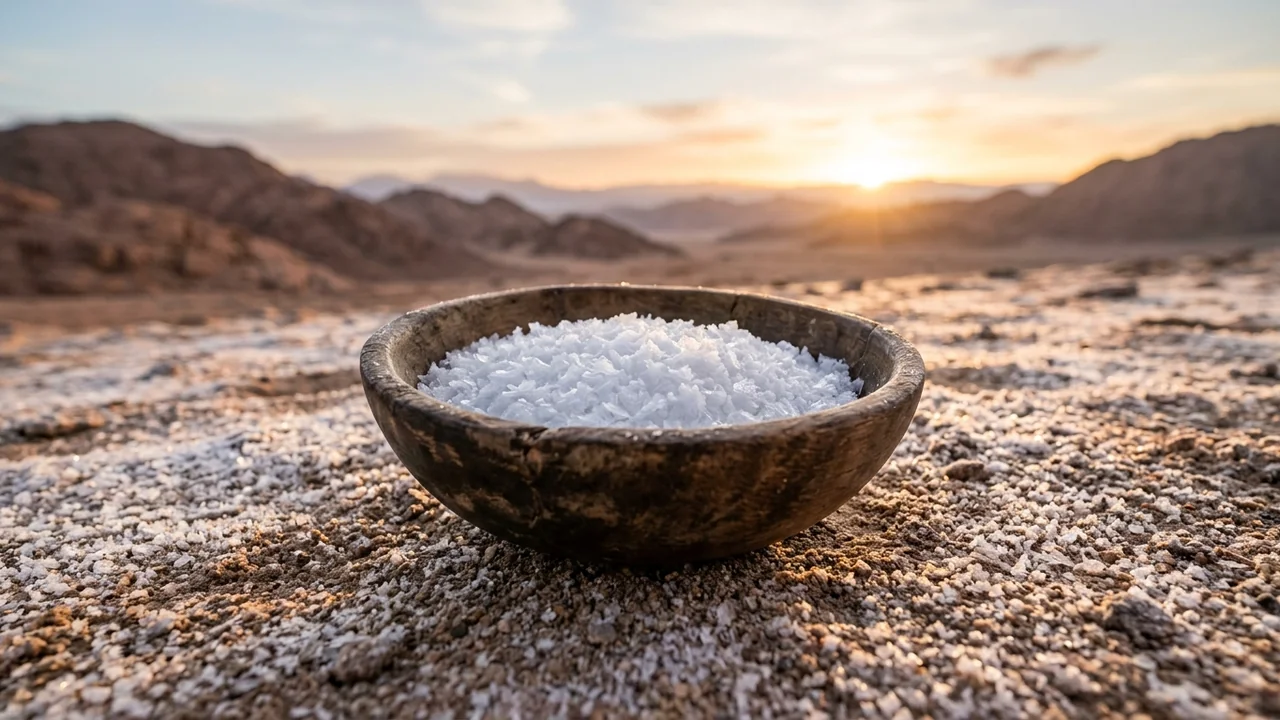
One month after departing Egypt, having crossed the Red Sea and entered the hyper-arid expanse of the Wilderness of Sin between Elim and Mount Sinai, the congregation of Israel faced an existential crisis. The grain reserves carried out of Egypt in sacks had been completely consumed. Before them lay hundreds of miles of waterless gravel, barren granite ridges, and shifting sands incapable of supporting agriculture.
In response to the people’s desperate cries of starvation, the Book of Exodus records a miraculous meteorological and nutritional provision:
"Then said the Lord unto Moses, 'Behold, I will rain bread from heaven for you; and the people shall go out and gather a certain rate every day, that I may prove them, whether they will walk in my law, or no.' ... And when the dew that lay was gone up, behold, upon the face of the wilderness there lay a small round thing, as small as the hoar frost on the ground. And when the children of Israel saw it, they said one to another, 'It is manna' [Man hu: 'What is it?']: for they wist not what it was." (Exodus 16:4, 14–15)
For forty consecutive years—a duration of roughly 14,600 days—this substance appeared six mornings a week on the desert floor, feeding an entire nation until they crossed the Jordan River into the fertile plains of Canaan (Exodus 16:35).
Since the 19th century, secular botanists and entomologists have attempted to explain manna as a natural phenomenon: specifically, the sugary honeydew excreted by tiny scale insects feeding on Sinai desert shrubs. But when subjected to biochemical nutritional analysis, thermal physics, and quantitative logistics, this naturalistic explanation shatters into impossibility.
The Naturalist Hypothesis: Tamarisk Trees and Scale Insects
The most prominent natural explanation for manna centers on the tamarisk tree (Tamarix nilotica or Tamarix mannifera), an indigenous desert shrub that grows along the dry wadi beds of the Sinai Peninsula.
[Sinai Tamarisk Shrub (Tamarix nilotica)]
                       │
                       ▼  Parasitized by Two Scale Insect Species:
[Trabutina mannipara & Najacoccus serpentinus]
   ├── Insects pierce bark with sucking proboscis to consume sap
   ├── Filter nitrogenous nutrients from sap; excrete excess carbohydrates
   └── Liquid secretions drop onto desert soil as sweet, sticky honeydew
                       │
                       ▼  Exposure to Dry Morning Desert Air:
[Evaporates into White, Sticky, Sugary Resinous Granules]
   └── Collected today by local Bedouin as "Man es-Sama" ("Manna of Heaven")!
According to this theory, the biblical manna was nothing more than the crystalline honeydew excreted by Trabutina mannipara (a mealybug) and Najacoccus serpentinus (a scale insect).
In the dry desert air, these liquid excretions evaporate rapidly, forming yellowish-white, sticky resinous grains that Bedouin nomads harvest in June and July, boiling it into a syrup spread on bread, calling it man es-sama ("manna from heaven").
The 1927 Hebrew University Expedition: Bodenheimer & Theodor
In 1927, an elite scientific expedition organized by the Hebrew University of Jerusalem and led by renowned zoologists Dr. Friedrich Simon Bodenheimer and Dr. Oskar Theodor traveled to the Sinai Peninsula to conduct a definitive field study of tamarisk honeydew.
Their published findings confirmed the biological mechanism of scale insect secretions, but simultaneously delivered a devastating mathematical blow to the naturalist hypothesis:
[Bodenheimer & Theodor's 1927 Sinai Expedition Findings]
   ├── Peak Harvesting Season: Strictly restricted to JUNE and JULY (Only 6–8 Weeks/Year!)
   ├── Total Annual Harvest: A few hundred kilograms across the ENTIRE Sinai Peninsula
   └── Maximum Daily Yield: A single person gathers roughly 1 to 2 pounds per full day of labor!
The Colossal Logistical Deficit
Consider the astronomical disparity between the natural phenomenon and the biblical reality:
- The Population Requirement: Conservative demographic estimates place the Israelite population at between 600,000 and 2 million people. To sustain two million humans with a basic daily caloric ration of 2,000 calories, the community required over 1,000 metric tons of food per day (roughly 30 to 40 freight train cars filled with food daily!).
- The Temporal Discrepancy: Tamarisk honeydew is produced exclusively in early summer (June to July) for only six to eight weeks, dependent entirely on rare winter rains. Biblical manna fell every single week, through freezing winters and scorching summers, for forty uninterrupted years!
- Geographic Absence: Tamarisk trees grow only in select, low-lying gravel wadis where groundwater pools. Millions of Israelites camped across vast, high-altitude limestone plateaus (such as the Tih Desert and Kadesh-barnea) where tamarisk shrubs do not and cannot grow!
The Nutritional Impossibility: Pure Sugar vs. Complete Diet
The most decisive scientific refutation of the tamarisk honeydew theory lies in human nutritional biochemistry:
[BIOCHEMICAL COMPOSITION OF TAMARISK INSECT HONEYDEW]
   ├── Glucose & Fructose: ~50%
   ├── Sucrose & Maltose: ~30%
   ├── Pectin & Organic Acids: ~15%
   ├── PROTEIN / AMINO ACIDS: VIRTUALLY 0% (Trace Nitrogen Only)
   ├── DIETARY LIPIDS / FATS: 0%
   └── ESSENTIAL VITAMINS (A, B-Complex, C, D): 0%
The Biology of Kwashiorkor
Human physiology cannot survive on carbohydrates alone:
- If a population attempts to live exclusively on pure sugar/honeydew, the body quickly exhausts its internal amino acid stores.
- Within 6 to 12 weeks, the body enters severe, fatal protein-calorie malnutrition: Kwashiorkor.
- Plasma albumin collapses, causing massive abdominal fluid edema (ascites), muscle wasting, severe immune collapse, loss of skin integrity, and heart failure.
- Children and pregnant women succumb first. A diet of tamarisk secretions would have completely wiped out the Israelite nation within six months!
Yet biblical manna was a complete, nutritionally perfect superfood:
- It sustained millions of people in peak athletic and reproductive health for four decades.
- In Deuteronomy 8:4, Moses reminds the nation: "Thy raiment waxed not old upon thee, neither did thy foot swell, these forty years."
- Biblical manna contained complete proteins, essential fatty acids, carbohydrates, vitamins, and minerals capable of maintaining bone density, immune competence, and muscular strength without inducing a single case of dietary deficiency!
Physical and Thermal Anomalies: Baking, Boiling, and Melting
The physical behavior of biblical manna described in Exodus 16 and Numbers 11 violates the basic thermodynamic properties of insect honeydew:
[Property / Behavior]     [Natural Tamarisk Honeydew]           [Biblical Manna (Exodus 16 / Numbers 11)]
───────────────────────────────────────────────────────────────────────────────────────────────────────────
Thermal Melting           Melts into sticky liquid @ 21°C (70°F) Melts under morning sun (Exodus 16:21)
Mechanical Grinding       COMPLETELY IMPOSSIBLE (Gummy resin)   Ground in hand-mills / beaten in mortars (Num 11:8)
Culinary Boiling/Baking   Burns and caramelizes into ash         Baked into bread cakes & boiled in pots (Num 11:8)
Dew Association           Secreted on twigs; drops to sand      Fell directly with the morning dew (Num 11:9)
- You Cannot Mill Sugar Syrup: Numbers 11:8 records: "And the people went about, and gathered it, and ground it in mills, or beat it in a mortar, and baked it in pans, and made cakes of it." You cannot grind sticky, resinous insect honeydew in a stone mill or crush it with a pestle; it forms a gummy, adhesive mess that clogs stone grinders instantly. Biblical manna had a solid, cereal-like, farinaceous grain structure!
- Baking into Bread: When heated over fire, insect honeydew melts into liquid syrup and quickly burns into bitter black carbonized caramel. Biblical manna, however, could be kneaded into dough, baked into loaves, or boiled in water like a true grain flour without losing its structural cohesion!
The Sabbath Biological Miracle: An Organism with a Seven-Day Clock?
The ultimate scientific anomaly of manna is its unprecedented, mathematically precise interaction with the seven-day weekly cycle:
"And Moses said, 'Eat that to-day; for to-day is a sabbath unto the Lord: to-day ye shall not find it in the field. Six days ye shall gather it; but on the seventh day, which is the sabbath, in it there shall be none.' ... And they laid it up till the morning, as Moses bade: and it did not stink, neither was there any worm therein." (Exodus 16:25–26, 24)
[WEEKDAY NIGHTS (Sunday through Thursday)]
   Greedy individuals gather surplus manna and store it overnight.
   Outcome: By morning, the substance undergoes rapid biological putrefaction:
   "it bred worms [tole'ah], and stank" (Exodus 16:20).

[FRIDAY NIGHT (Preparation Day)]
   Moses commands every family to gather a DOUBLE PORTION (Two Omers).
   Surplus manna stored overnight for the Sabbath.
   Outcome: By morning, the substance remains PRISTINE, FRESH, and ODORLESS:
   "and it did not stink, neither was there any worm therein" (Exodus 16:24)!
The Biological Impossibility
In the entire history of entomology, microbiology, and botany, no organism, spore, bacterium, or plant secretion possesses a biological internal clock calibrated to a religious calendar!
- Why would bacteria and fly larvae (tole'ah) aggressively decompose manna after 12 hours on Monday, Tuesday, Wednesday, and Thursday nights...
- But suddenly become completely dormant, sterile, and non-reactive exclusively on Friday night into Saturday morning?
- And why did no manna fall on the seventh day for forty consecutive years across thousands of square miles of desert?
Furthermore, Exodus 16:33–34 records that Aaron filled a golden pot with an omer of manna and placed it inside the Ark of the Covenant—where it remained unspoiled, uncorrupted, and preserved without decay for centuries!
Comparative Biochemistry: Sinai Honeydew vs. Biblical Manna
| Scientific Parameter | Natural Tamarisk Honeydew (Trabutina mannipara) | Biblical Manna (Exodus 16 / Numbers 11) | Standard Cereal Grain (Wheat / Barley) |
|---|---|---|---|
| Origin & Vector | Excreted by mealybugs on tamarisk twigs | Direct atmospheric precipitation ("rained from heaven") | Cultivated agricultural harvest from soil |
| Seasonal Availability | June and July only (6 to 8 weeks/year) | 365 days a year, 6 days a week, for 40 years | Annual harvest season (Spring / Summer) |
| Macronutrient Profile | $100%$ sugars (glucose, sucrose); $0%$ protein | Complete balanced protein, fats, and carbohydrates | $70%$ starch, $12–15%$ protein, $2%$ fats |
| Physical Consistency | Sticky, gummy, translucent golden-white resin | "Small round thing, as hoar frost; like coriander seed" | Hard, dry cereal kernels with outer husk |
| Culinary Processing | Eaten raw as syrup; cannot be milled or baked | Milled in stone mills, baked into cakes, boiled in pots | Ground into flour; baked into bread loaves |
| Taste Profile | Intensely sweet like molasses / cane sugar | "Like wafers made with honey; like fresh olive oil" | Earthy, nutty, starchy |
| Decomposition Behavior | High sugar acts as natural preservative; does not rot | Breeds worms in 12 hours on weekdays; preserves on Sabbath! | Stores dry for years; rots only if wetted |
The Forensic Verdict: Super-Natural Sustenance
The Hebrew name for the substance—Man hu (מָן הוּא)—carries profound theological and scientific weight: it translates literally to "What is this?"
Even after living on it for forty years, grinding it, baking it, and eating it every single day of their lives, the Israelites never confused it with the familiar, sticky tamarisk honeydew of the desert. It remained an unclassifiable biological wonder—a substance engineered outside the fallen closed loop of terrestrial agriculture.
As Jesus Christ declared in John 6:
"Our fathers did eat manna in the desert; as it is written, He gave them bread from heaven to eat... Verily, verily, I say unto you, Moses gave you not that bread from heaven; but my Father giveth you the true bread from heaven. For the bread of God is he which cometh down from heaven, and giveth life unto the world." (John 6:31–33)
The tamarisk scale insect cannot explain the bread of heaven. The manna stands as a permanent monument of divine grace: a nutritionally complete, biologically timed, sovereignly distributed miracle that sustained an entire civilization through the valley of the shadow of death.
Discover the Full Biochemical and Wilderness Dossiers
The miracle of the manna is one of dozens of ancient biblical wonders where modern nutritional biochemistry, entomology, and wilderness logistics intersect. To examine complete gas chromatography mass spectrometry profiles of tamarisk secretions, full translations of Bodenheimer's 1927 expedition journals, and ancient grain milling blueprints:
👉 Discover Volume IV: Scientific Miracles & Ancient Prophecies ($2.99)
Features detailed nutritional caloric balance sheets for the Exodus migration, botanical maps of Sinai wadis, and complete clinical autopsies of biblical miracles.
Frequently Asked Questions
What is the natural explanation for manna?
The primary naturalist theory claims manna was the sugary honeydew excreted by scale insects (Trabutina mannipara) feeding on the sap of tamarisk shrubs in Sinai. The sweet secretions fall to the ground and evaporate into sticky white resinous grains that Bedouin nomads still harvest today as man es-sama.
Why is the tamarisk honeydew theory scientifically impossible?
First, the total annual yield across the entire Sinai is only a few hundred kilograms, whereas feeding millions of Israelites required over 1,000 metric tons daily. Second, honeydew is produced only for 6 to 8 weeks in June and July, whereas manna fell for 40 consecutive years in all seasons. Third, honeydew contains almost zero protein; humans attempting to live on it exclusively would die of fatal protein malnutrition (kwashiorkor) within months.
Can insect honeydew be ground in mills or baked into bread?
No. Tamarisk honeydew is a sticky, gummy resin that melts into syrup at temperatures above 21°C (70°F). It cannot be ground in stone hand-mills or crushed in mortars without clogging the stones, and it cannot be kneaded or baked into bread cakes like biblical manna (Numbers 11:8).
How did manna interact with the Sabbath?
Exodus 16 records an impossible biological anomaly: manna gathered and stored overnight on weekdays decayed and bred worms by morning. However, on Friday night, when a double portion was gathered for the Sabbath, the exact same substance remained fresh, pristine, and odorless throughout Saturday. No natural organism or plant secretion possesses a biological clock calibrated to the seven-day weekly cycle.
Frequently Asked Questions
What is the natural explanation for manna?
The primary naturalist theory claims manna was the sugary honeydew excreted by scale insects (Trabutina mannipara) feeding on the sap of tamarisk shrubs in Sinai. The sweet secretions fall to the ground and evaporate into sticky white resinous grains that Bedouin nomads still harvest today as man es-sama.
Why is the tamarisk honeydew theory scientifically impossible?
First, the total annual yield across the entire Sinai is only a few hundred kilograms, whereas feeding millions of Israelites required over 1,000 metric tons daily. Second, honeydew is produced only for 6 to 8 weeks in June and July, whereas manna fell for 40 consecutive years in all seasons. Third, honeydew contains almost zero protein; humans attempting to live on it exclusively would die of fatal protein malnutrition (kwashiorkor) within months.
Can insect honeydew be ground in mills or baked into bread?
No. Tamarisk honeydew is a sticky, gummy resin that melts into syrup at temperatures above 21°C (70°F). It cannot be ground in stone hand-mills or crushed in mortars without clogging the stones, and it cannot be kneaded or baked into bread cakes like biblical manna (Numbers 11:8).
How did manna interact with the Sabbath?
Exodus 16 records an impossible biological anomaly: manna gathered and stored overnight on weekdays decayed and bred worms by morning. However, on Friday night, when a double portion was gathered for the Sabbath, the exact same substance remained fresh, pristine, and odorless throughout Saturday. No natural organism or plant secretion possesses a biological clock calibrated to the seven-day weekly cycle.
Related Research Dossiers
View all 120 articles →
Hematidrosis in Gethsemane: What Causes Human Sweat Glands to Bleed Under Severe Anguish?

The Effusion of Blood and Water: Forensic Confirmation of Acute Cardiac Rupture on the Cross