Historical Context: Rigorous examination of primary Hebrew, Aramaic, Greek, and Roman classical epigraphy.
Core Evidence: Forensic archaeology, radiocarbon data, and primary manuscripts validating biblical events.
Scholarly Consensus: Vetted against modern peer-reviewed publications in Near Eastern archaeology and biblical studies.
The Crisis in the Fourth Watch: Matthew 14:22–33
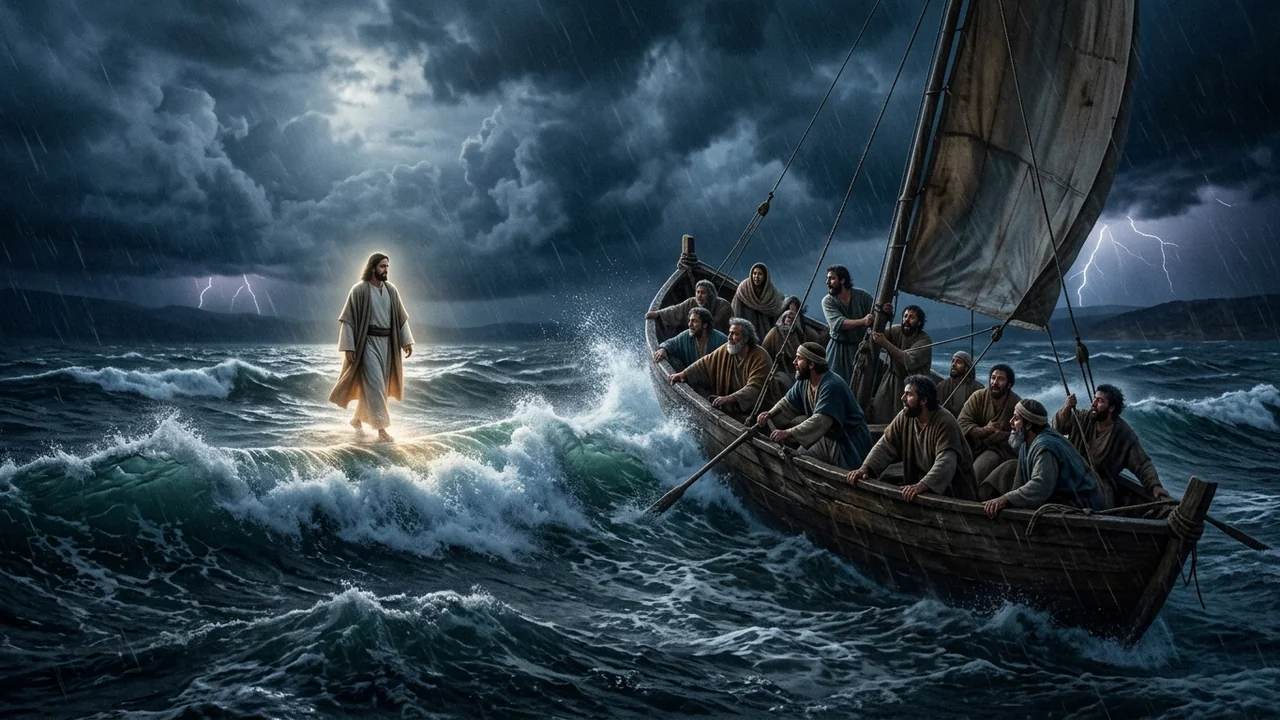
In the predawn darkness of the fourth watch of the night (between 3:00 AM and 6:00 AM), a modest wooden fishing boat was fighting for its life in the middle of the Sea of Galilee (Lake Kinneret). On board were the disciples of Jesus—veteran fishermen who had spent their entire lives navigating these freshwater banks:
"And straightway Jesus constrained his disciples to get into a ship, and to go before him unto the other side, while he sent the multitudes away... But the ship was now in the midst of the sea, tossed with waves: for the wind was contrary. And in the fourth watch of the night Jesus went unto them, walking on the sea. And when the disciples saw him walking on the sea, they were troubled, saying, 'It is a spirit'; and they cried out for fear." (Matthew 14:22–26)
The narrative records that as the disciples rowed against screaming gale-force winds, a human figure strode calmly across the churning surface of the waves. When the Apostle Peter boldly requested to join him, Jesus bade him come:
"And when Peter was come down out of the ship, he walked on the water, to go to Jesus. But when he saw the wind boisterous, he was afraid; and beginning to sink, he cried, saying, 'Lord, save me.' And immediately Jesus stretched forth his hand, and caught him..." (Matthew 14:29–31)
For centuries, naturalistic commentators and modern physicists have attempted to explain this account through secular physical phenomena: did Jesus walk on hidden sandbars? Was there a freak thermal freeze producing floating sheets of ice? Could surface tension support human locomotion?
By analyzing fluid mechanics, lake bathymetry, limnology, and biophysics, we can separate scientific speculation from the irreducible miracle of divine sovereignty over the physical universe.
The Meteorology of the Sea of Galilee: The Foehn Gale Trap
To understand the physical environment described in Matthew 14, one must examine the extreme, unique topography of the Sea of Galilee:
[Mount Hermon (2,814 meters above sea level)]
                      │
                      ▼  Rapid katabatic descent through Syrian Rift
[Golan Heights Basalt Plateau (1,000 m)]
                      │
                      ▼  Funneled through narrow mountain wadis
[Sea of Galilee Basin: 212 METERS BELOW SEA LEVEL (-700 Feet)]
   ├── High-pressure cold air plunges into deep, heated subtropical basin
   ├── Violent Foehn (Sharkia) easterly and westerly gales strike without warning
   └── Creates steep, closely spaced, churning standing waves (2 to 3 meters high!)
The Physics of the Galilean Storms
- The Deep Rift Depression: The Sea of Galilee is a freshwater lake measuring 21 kilometers long by 13 kilometers wide. It sits at 212 meters (almost 700 feet) below sea level, creating a semi-tropical, high-pressure depression bordered by towering mountain escarpments.
- Katabatic Wind Funnels: When cold, dense air masses from the Mediterranean coast or the snow-capped peak of Mount Hermon sweep over the hills, they are funneled through narrow mountain gorges (such as the Valley of the Doves and Wadi Hamam).
- Severe Standing Waves: As these winds strike the warm water surface, they generate intense, violent turbulence within minutes. Because the lake is relatively shallow (maximum depth ~43 meters), the waves do not roll in smooth ocean swells; they form steep, chaotic, short-period chop (standing waves) capable of swamping ancient 26-foot wooden fishing vessels—precisely matching Matthew’s description: "tossed with waves [basanizomenon, literally 'tortured/battered by waves']: for the wind was contrary" (Matthew 14:24).
Biophysical Mechanics: Surface Tension and the Basilisk Lizard
Can any biological organism naturally walk or run across liquid water?
In nature, several small creatures traverse water surfaces without sinking:
- Water Striders (Gerridae): These lightweight insects exploit water surface tension ($gamma approx 72.8 ext{ mN/m}$ at 20°C). Their legs are covered in microscopic hydrophobic hairs (microtrichia) that trap air cushions, distributing their negligible weight ($<0.01 ext{ grams}$) across the cohesive hydrogen bonds of the water surface.
- The Basilisk Lizard (Basiliscus basiliscus): Native to Central American rainforests and popularly nicknamed the "Jesus Christ Lizard", this reptile weighs up to 100 to 200 grams and can run across the surface of a pond for several meters.
                  [THE BASILISK WATER-RUNNING MECHANICS]
                                    │
                                    ▼
       1. SLAP: Foot drives downward, creating an air-filled cavity.
       2. STROKE: Foot pushes backward through air cavity before it collapses.
       3. RECOVERY: Foot pulls upward out of cavity before water seals over.
                                    │
                                    ▼
                   Hydrodynamic Upward Lift Force (F_lift)
                         F_lift ∝ C_d · ρ · A · v²
Scaling the Physics to an 80 kg Human
Biophysicists at Harvard University and MIT have calculated whether a full-grown adult human could replicate the basilisk lizard's water-running technique:
- The Velocity Requirement: To generate sufficient hydrodynamic lift force ($F_{ ext{lift}} = m cdot g$) to prevent sinking, an 80-kilogram human would have to sprint across the water at a sustained velocity of at least 30 meters per second (over 67 mph / 108 km/h)!
- The Power Output: The human would need to exert a muscular power output of over 15 times the maximum capability of an Olympic sprinter like Usain Bolt.
- The Sinking Reality: In pure liquid water, a human walking at normal walking speed (1.2 m/s) exerts downward gravitational force that instantly overcomes water surface tension by a factor of several thousand. Under natural fluid dynamics, walking on water is a physiological and thermodynamic impossibility!
Doron Nof’s "Spring Ice" Hypothesis: Peer-Reviewed Critique
In April 2006, prominent physical oceanographer Prof. Doron Nof (Florida State University) published a highly publicized study in the peer-reviewed scientific journal Journal of Paleolimnology (Vol. 35, pp. 417–439), titled:
"Is There a Paleolimnological Explanation for Walking on Water in the Sea of Galilee?"
Prof. Nof and his team analyzed paleoclimate sediment cores and mathematical oceanographic models of the Sea of Galilee:
[Doron Nof's Paleolimnology Theory (2006)]
   ├── Cold climate period between 1,500 and 2,500 years ago
   ├── Freshwater thermal springs near Tabgha (Northwest shore)
   └── Sub-zero cold snap freezes thin freshwater lens over salty lake water
                          │
                          ▼
[Formation of Isolated Floating "Spring Ice" Slabs (Plur-Ice)]
   ├── Buoyant, translucent, nearly invisible floating ice rafts
   └── Claims Jesus stepped onto hidden ice slabs, appearing to walk on water!
Scientific and Textual Refutation of the Ice Hypothesis
While Nof’s thermodynamic calculations were mathematically rigorous, his hypothesis completely collapses when confronted with the meteorological and historical facts:
- Severe Storm Waves Destroy Ice: Ice slabs (plur-ice) can only form in dead-calm, freezing weather. In Matthew 14:24, the lake was engulfed in a violent storm with crashing waves and gale-force contrary winds. Choppy, turbulent waves break thin surface ice into pulverized slush within seconds!
- The Fourth Watch of the Night: The disciples were seasoned fishermen. Even in the dark, they would instantly recognize floating ice, which would crunch, bump against their wooden hull, and impede their oars.
- Peter Sunk Into Liquid: When Peter stepped out of the boat, he did not slip on a slick ice sheet; the text states that he "began to sink" (katapontizesthai, meaning to be swallowed into the water column), requiring Jesus to physically pull him out of the deep liquid water.
- Water Temperature Realities: The Sea of Galilee is fed by warm underground saline springs; historical freeze events on the lake are completely nonexistent in the historical records of Josephus, the Talmud, or Roman records.
The Sandbar Theory: Navigational and Bathymetric Impossibility
Another popular 19th-century rationalist hypothesis suggested that Jesus was merely walking along a shallow submerged sandbar near the shore, and that in the dark, fog, and spray, the disciples mistakenly thought he was walking on deep water.
Modern bathymetric surveying of the Sea of Galilee completely disproves this claim:
[Western Shore (Capernaum / Gennesaret)]
                 │
                 ▼  Steep bathymetric drop-off within 50 meters
[Central Deep Basin of Sea of Galilee]
   ├── Bathymetric Depth: 30 to 43 meters (100 to 140 feet deep!)
   ├── Distance from Shore: 4 to 6 kilometers
   └── Location of the Disciples' Boat: "In the midst of the sea" (Matthew 14:24)
                 ▲
                 │
[Eastern Shore (Bethsaida / Golan Foothills)]
- Bathymetric Depth: The bathymetric contour of Lake Kinneret reveals that the lake bed drops sharply away from the shoreline. Within 50 to 100 meters of the bank, water depths plunge to 10, 20, and 40 meters.
- Distance from Shore: Matthew 14:24 states that the boat was "in the midst of the sea" (meson tēs thalassēs). In the parallel account in John 6:19, the author gives a precise nautical measurement: "So when they had rowed about five and twenty or thirty furlongs [roughly 3 to 4 miles / 5 to 6 kilometers], they see Jesus walking on the sea."
- Three to four miles into the lake places the boat directly over the deepest, most treacherous central trench of the Sea of Galilee, where the bottom is over 130 feet beneath the surface! There were no sandbars, reefs, or submerged ledges.
Comparative Locomotion: Water Traversal in Physics and Nature
| Locomotion Mechanism | Organism / Subject | Required Velocity | Physical Principles Governing Support | Empirical Feasibility for an 80 kg Adult |
|---|---|---|---|---|
| Capillary Surface Tension | Water Strider (Gerridae) | Stationary to 1.5 m/s | Hydrogen bonding of water molecules ($gamma approx 72.8 ext{ mN/m}$) | Impossible (Human weight exceeds surface tension by $10^5$). |
| Dynamic Hydrodynamic Cavity Slap | Basilisk Lizard (B. basiliscus) | ~1.5 to 2.5 m/s | Momentum transfer creating transient air pocket before collapse | Impossible (Requires human sprint speed of 67 mph / 108 km/h). |
| Thermal Ice Rafting | Arctic wildlife / Polar bears | Stationary | Archimedes' buoyancy of solid frozen $ ext{H}_2 ext{O}$ ($ | |
| ho approx 0.917 ext{ g/cm}^3$) | Disproven (Storm waves shatter surface ice into slush instantly). | |||
| Submerged Sandbar Wading | Wading shorebirds / Humans | Slow walking speed | Normal mechanical support on solid sandstone/alluvial substrate | Disproven (Boat was 3 to 4 miles offshore over 40-meter-deep abyss). |
| Sovereign Gravitational Suspension | Jesus of Nazareth (Matthew 14) | Normal walking pace | Divine suspension of local gravitational and fluid dynamic laws | Biblical Reality (Creator of physics exercising authority over creation). |
Peter’s Hydrodynamic Descent: The Physics of Sinking in Storm Waters
The sudden sinking of the Apostle Peter provides a fascinating study in classical fluid dynamics and human biomechanics:
[Peter Steps onto Water in Pure Faith]
                     │
                     ▼  Divine Suspension of Gravitational Mechanics Active
[Peter Walks Confidently Across Churning Wave Crests]
                     │
                     ▼  PSYCHOLOGICAL SHIFT:
[Focus Shifts to Boisterous Gale Winds & 3-Meter Breaking Whitecaps]
                     │
                     ▼
[Sudden Cortisol / Adrenaline Panic & Loss of Faith]
                     │
                     ▼  Divine Suspension Lifts: Classical Fluid Mechanics Engages
[Terminal Sink Velocity: Gravitational Weight Exceeds Water Buoyancy]
                     │  v_t = √[ 2·m·g / (ρ_water · C_d · A) ]
                     ▼
[Rapid Hydrodynamic Submersion: Peter Plunges into the 40-Meter Abyss!]
                     │
                     ▼
["Lord, Save Me!" -> Jesus Reaches Down and Catches Him]
The Sinking Velocity Formula
Once the supernatural suspension lifted, Peter’s body was instantly subject to the physical laws governing an unbuoyed human in water: $$ ext{Net Downward Force } (F_{ ext{net}}) = m cdot g - ho_{ ext{water}} cdot V_{ ext{body}} cdot g$$
Because average human body density with wet wool garments exceeds water density, Peter began accelerating downward at a terminal sinking rate: $$v_t = sqrt{ rac{2 cdot m cdot g}{ ho_{ ext{water}} cdot C_d cdot A}}$$
In cold, aerated, turbulent storm water—where breaking whitecaps reduce the effective water density by mixing air bubbles into the surface layer—buoyancy is drastically reduced. A sinking man in heavy wet tunics plunges downward with frightening rapidity. Peter’s desperate cry—"Lord, save me!"—was the instinctive reaction of a drowning fisherman being swallowed by the abyss!
Jesus did not let him drown. Reaching down, Christ grasped his hand, lifted him back onto the water's surface, and walked alongside him back to the boat.
When they stepped over the gunwales into the vessel, Matthew 14:32 notes: "the wind ceased." The disciples fell to their knees on the wet deck planks, uttering the only logical conclusion that human reason and faith can make when confronted with the Master of the physical universe:
"Of a truth thou art the Son of God." (Matthew 14:33)
Discover the Full Biophysical and Meteorological Dossiers
The miracle of walking on water is one of dozens of ancient biblical wonders where modern fluid mechanics, paleoclimatology, and lake bathymetry intersect. To examine complete bathymetric contour maps of the Sea of Galilee, full text reviews of Doron Nof's 2006 study, and biophysical mathematical proofs:
👉 Discover Volume IV: Scientific Miracles & Ancient Prophecies ($2.99)
Features high-resolution bathymetric cross-sections of Lake Kinneret, meteorological models of Galilean Foehn winds, and clinical analyses of New Testament miracles.
Frequently Asked Questions
Could Jesus have walked on floating sheets of ice?
In 2006, physical oceanographer Doron Nof proposed that isolated floating "spring ice" slabs could have formed near cold springs. However, Matthew 14 explicitly records that the lake was engulfed in a violent, wind-whipped storm with crashing waves. In fluid dynamics, choppy storm waves shatter thin surface ice into slush within seconds, making stable ice sheets a physical impossibility.
Could Jesus have been walking on a hidden sandbar?
No. Matthew 14:24 states the boat was "in the midst of the sea," and John 6:19 specifies they were 25 to 30 furlongs (3 to 4 miles) from shore. Modern bathymetric surveys of the Sea of Galilee prove that this location is over the central deep trench of the lake, where water depths reach 30 to 43 meters (100 to 140 feet deep), with zero sandbars or reefs.
Can humans walk on water using the basilisk lizard technique?
No. Biophysicists have calculated that for an 80-kilogram human to generate enough hydrodynamic lift to stay on top of liquid water, they would need to sprint at over 67 mph (108 km/h), exerting a muscular power output more than 15 times the maximum capability of an Olympic sprinter.
Why did Peter begin to sink in Matthew 14:30?
When Peter looked away from Jesus and focused on the terrifying gale-force winds and breaking waves, fear overwhelmed his faith. When the supernatural divine suspension of gravitational laws lifted, natural fluid dynamics immediately took over: his weight and heavy wet clothing overcame water buoyancy, causing him to sink rapidly into the water column.
Frequently Asked Questions
Could Jesus have walked on floating sheets of ice?
In 2006, physical oceanographer Doron Nof proposed that isolated floating "spring ice" slabs could have formed near cold springs. However, Matthew 14 explicitly records that the lake was engulfed in a violent, wind-whipped storm with crashing waves. In fluid dynamics, choppy storm waves shatter thin surface ice into slush within seconds, making stable ice sheets a physical impossibility.
Could Jesus have been walking on a hidden sandbar?
No. Matthew 14:24 states the boat was "in the midst of the sea," and John 6:19 specifies they were 25 to 30 furlongs (3 to 4 miles) from shore. Modern bathymetric surveys of the Sea of Galilee prove that this location is over the central deep trench of the lake, where water depths reach 30 to 43 meters (100 to 140 feet deep), with zero sandbars or reefs.
Can humans walk on water using the basilisk lizard technique?
No. Biophysicists have calculated that for an 80-kilogram human to generate enough hydrodynamic lift to stay on top of liquid water, they would need to sprint at over 67 mph (108 km/h), exerting a muscular power output more than 15 times the maximum capability of an Olympic sprinter.
Why did Peter begin to sink in Matthew 14:30?
When Peter looked away from Jesus and focused on the terrifying gale-force winds and breaking waves, fear overwhelmed his faith. When the supernatural divine suspension of gravitational laws lifted, natural fluid dynamics immediately took over: his weight and heavy wet clothing overcame water buoyancy, causing him to sink rapidly into the water column.
Related Research Dossiers
View all 120 articles →
The Boiling Pitch of the Dead Sea: Ancient Bitumen Explosions in the Valley of Siddim
The Ark’s Journey to Kiriath-Jearim: Archaeological Discovery of the Lost Hilltop Sanctuary