Historical Context: Rigorous examination of primary Hebrew, Aramaic, Greek, and Roman classical epigraphy.
Core Evidence: Forensic archaeology, radiocarbon data, and primary manuscripts validating biblical events.
Scholarly Consensus: Vetted against modern peer-reviewed publications in Near Eastern archaeology and biblical studies.
The Lethal Wilderness: 72 Hours to Dehydration
The Sinai Peninsula is one of the most brutally inhospitable desert wildernesses on earth. Covering roughly 60,000 square kilometers between the Gulf of Suez and the Gulf of Aqaba, this barren land bridge is characterized by hyper-arid climatic extremes: daytime ground temperatures routinely exceed 50°C (122°F), annual rainfall averages less than 25 to 50 millimeters in the interior basins, and relative humidity often drops below 10%.
In this environment, human physiology faces a relentless, non-negotiable countdown:
- A human walking under the desert sun loses between 1.5 and 2.5 liters of water per hour through insensible perspiration and active sweating to maintain thermal homeostasis.
- Without water replacement, acute dehydration sets in rapidly: blood volume drops (hypovolemia), serum sodium spikes to neurotoxic levels (hypernatremia), heat dissipation mechanisms fail, and core body temperature climbs toward fatal heatstroke within 48 to 72 hours.
- For an migrating population of hundreds of thousands of men, women, children, and millions of head of livestock (Exodus 12:37–38), water was not a matter of comfort; it was an hourly question of biological survival.
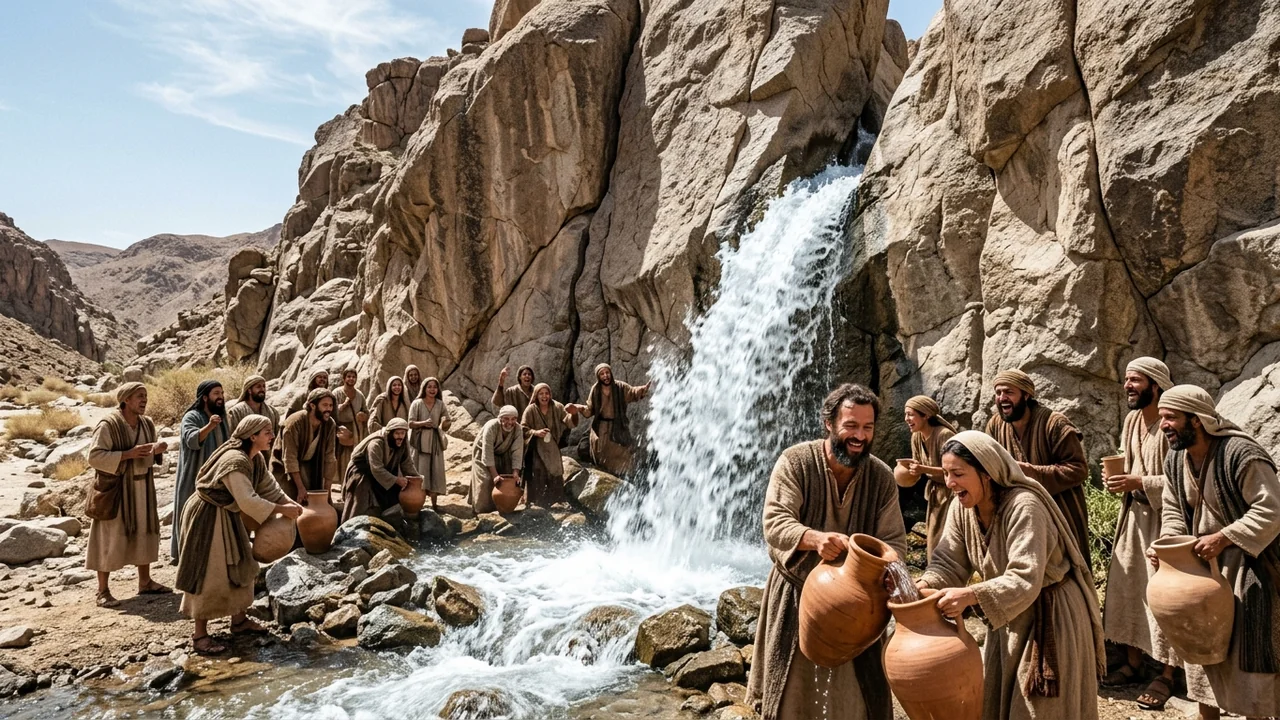
When the Hebrew encampment arrived at Rephidim in the southwestern Sinai wilderness, they encountered a catastrophe: there was no natural surface spring, no seasonal stream, and no oasis well.
The Crisis at Rephidim: Massah and Meribah
The Book of Exodus captures the raw, desperate panic of a populace staring into the jaws of mass dehydration:
"And all the congregation of the children of Israel journeyed from the wilderness of Sin, after their journeys, according to the commandment of the Lord, and pitched in Rephidim: and there was no water for the people to drink. Wherefore the people did chide with Moses, and said, 'Give us water that we may drink.' And Moses said unto them, 'Why chide ye with me? wherefore do ye tempt the Lord?' And the people thirsted there for water; and the people murmured against Moses, and said, 'Wherefore is this that thou hast brought us up out of Egypt, to kill us and our children and our cattle with thirst?'" (Exodus 17:1–3)
Moses cried out to the Lord, warning that the mob was on the verge of stoning him. The divine response directed him to take the rod of God with which he had struck the Nile, assemble the elders of Israel, and approach a specific geological feature:
"Behold, I will stand before thee there upon the rock in Horeb; and thou shalt smite the rock, and there shall come water out of it, that the people may drink. And Moses did so in the sight of the elders of Israel." (Exodus 17:6)
For centuries, skeptics viewed this account as pure mythological fantasy—a magical conjuring trick where solid stone spontaneously transforms into a flowing river. However, modern hydrogeology, structural geology, and desert geomorphology reveal that the arid mountains of Sinai harbor vast, pressurized subterranean aquifers sealed behind deceptive stone barriers.
The Geological Anatomy of Sinai: Basement Granite to Porous Karst
To understand how water can burst from a desert cliff, one must dissect the unique three-dimensional geological stratigraphy of the Sinai Peninsula:
[Northern Sinai: Coastal Sand Dunes & Saline Sabkhas]
                     │
                     ▼
[Central Sinai: The Gebel et-Tih Plateau (Cretaceous-Tertiary Limestone)]
   ├── Highly fractured, cavernous Cenomanian & Turonian limestone beds
   ├── Massive capacity for subterranean rainwater infiltration and storage
   └── Confined artesian aquifers under massive hydrostatic head pressure
                     │
                     ▼
[Southern Sinai: The Arabo-Nubian Crystalline Basement Complex]
   └── Pre-Cambrian red granite, diorite, and metamorphic gneiss massifs
   └── Deep tectonic shear faults, wadi gorges, and basaltic dike intrusions
The Sinai Peninsula acts as an enormous regional geological sponge:
- Intense Episodic Cloudbursts: While annual rainfall is meager, when rain does fall, it occurs as violent, highly localized winter convective cloudbursts over the elevated plateaus of Gebel et-Tih and Gebel Maghara.
- Deep Karst Infiltration: The porous, heavily fractured limestone and dolomite formations (karst topography) absorb millions of cubic meters of rainwater like a colossal subterranean sponge, preventing surface evaporation.
- Subterranean Aquifer Migration: This water migrates downward along dipping bedding planes and deep tectonic fault fractures until it encounters impermeable clay layers (aquitards) or crystalline granite basement rocks, forming confined artesian aquifers under immense subterranean pressure.
The Case-Hardened Caliche Crust: How Rocks Hide Oceans
The critical geological phenomenon that unlocks the biblical mystery is known in geomorphology as "case hardening" or the formation of an impermeable desert caliche patina:
[Atmospheric Exposure & Scorching Desert Heat]
                     │
                     ▼
[Upward Capillary Evaporation of Moisture from Rock Surface]
                     │
                     ▼
[Deposition of Calcium Carbonate, Silica, Gypsum & Iron Oxides]
                     │
                     ▼
[Formation of Hard, Brittle, Glassy Impermeable "Caliche" Exterior Shell]
   ├── Thickness: 2 to 10 centimeters of dense, rock-hard mineral crust
   └── Interior: Extremely soft, porous, water-saturated chalk or limestone
                     │
                     ▼
[Pressurized Water Sealed Behind Brittle Crust Under Hydraulic Head]
The Physics of the Impermeable Crust
In hot, arid climates, moisture deep within porous chalk and limestone slowly migrates toward the surface via capillary action. As this water evaporates into the searing desert air, it leaves behind dissolved minerals—primarily calcium carbonate ($CaCO_3$), gypsum ($CaSO_4 cdot 2H_2O$), and iron-manganese oxides.
Over centuries, this process creates an extremely dense, glassy, rock-hard exterior patina over the cliff face, while the interior limestone remains soft, crumbly, and completely saturated with trapped water.
If this geological formation is situated at the base of an elevated plateau where rain has infiltrated higher elevations, the trapped water is held under significant artesian pressure (hydraulic head). The brittle caliche crust acts precisely like the shell of a massive pressurized water tank!
When a heavy blow strikes this brittle crust at a point of tectonic weakness or micro-fracture:
- The thin, rock-hard caliche shell fractures and shatters.
- The hydrostatic pressure behind the barrier blows outward through the fracture.
- The soft, porous chalk behind the crust rapidly erodes under the rushing torrent, instantly opening a wide conduit that discharges hundreds of thousands of gallons of clean, natural artesian mineral water into the dry wadi basin below!
Major C.S. Jarvis and British Engineers in Sinai: Modern Eyewitness Proof
The most extraordinary modern historical confirmation of this hydrogeological phenomenon was recorded by Major Claude Scudamore Jarvis (1879–1953), who served as the British Governor of Sinai from 1923 to 1936.
In his celebrated 1938 memoir, Yesterday and Today in Sinai, Major Jarvis documented a breathtaking incident that occurred during British military road-building operations in the central Sinai desert:
"The striking of the rock at Rephidim by Moses... has always been considered a miracle of the first water, but it is not entirely outside the bounds of possibility that there was an element of natural occurrence in it. I have seen the same thing happen myself...
A party of men of the Camel Corps were digging in a wadi... seeking water. They had reached a limestone rock face which was covered with a hard crust formed by the sun and evaporation... One of the men, exasperated with his failure to find water, struck the rock face violently with his pickaxe. The hard crust broke away, and from the soft, porous limestone beneath there shot out a stream of clear water as thick as a man's wrist, which continued to flow freely for several hours." — Major C.S. Jarvis, Yesterday and Today in Sinai (1938)
Major Jarvis explained that the Bedouin nomads of the Sinai were well aware of this hidden hydrogeological reality. Experienced desert wanderers knew that beneath specific weathered limestone ledges where subterranean springs seeped against the crust, the stone could be breached by a sharp concussive blow to release trapped artesian flows.
Moses, who had spent forty years as a shepherd in the wilderness of Midian and Horeb (Exodus 3:1), was intimately familiar with every rock formation, seasonal seep, and geological contour of the Sinai wilderness. Guided by divine omniscience that pinpointed the exact rock where subterranean water was under maximum hydrostatic pressure, Moses struck the brittle crust with his heavy wooden staff, shattering the mineral barrier and quenching the thirst of a dying nation!
Comparative Hydrogeology of Sinai Rock Strata
| Rock Formation / Stratum | Primary Mineral Composition | Effective Porosity (%) | Hydraulic Permeability | Aquifer Characteristics in Sinai | Biblical / Practical Role |
|---|---|---|---|---|---|
| Cenomanian/Turonian Limestone | Calcite ($ ext{CaCO}_3$) & Dolomite | 15% – 30% | High (via karst fissures & dissolution cavities) | Major regional artesian aquifer; stores vast reserves of ancient fossil rainwater. | Primary formation capable of harboring pressurized water behind caliche crusts. |
| Nubian Sandstone | Quartz sand grains ($ ext{SiO}_2$) cemented with silica/iron | 20% – 35% | Extremely High | Enormous regional fossil water reservoir (Deep Nubian Aquifer); excellent filtration. | Feeds desert oases like Ein Qudeirat (Kadesh-barnea) and Feiran. |
| Precambrian Granite | Quartz, Feldspar, Hornblende, Mica | < 1% – 3% | Virtually Impermeable | Forms the crystalline basement of Southern Sinai; acts as an impermeable barrier (aquiclude). | Forces descending groundwater to pool horizontally into wadi gravels. |
| Caliche / Evaporite Crust | Recrystallized Calcite, Gypsum, Iron Oxides | < 2% | Zero (Impermeable Seal) | Forms brittle 2–10 cm exterior shell over saturated cliff faces due to rapid solar evaporation. | The brittle "rock" struck by Moses; shatters under sharp concussive impact. |
| Alluvial Wadi Gravels | Mixed limestone, quartz, and basaltic gravel | 25% – 40% | High to Moderate | Shallow, seasonal sub-surface aquifers (wadi underflow) accessed by digging shallow pits. | The standard desert wells (be'erot) dug by patriarchs throughout Negev/Sinai. |
The Two Rocks: Exodus 17 vs. Numbers 20 and Covenant Typology
A critical distinction often missed in superficial readings of the Exodus narrative is that the Bible records two separate, distinct incidents of water coming from a rock, separated by nearly forty years and hundreds of kilometers:
[Exodus 17:1–7 — Month 2 of Year 1]
   ├── Location: Rephidim (near Mount Sinai / Horeb, southern Sinai)
   ├── Geological Feature: Tsur (צוּר) — Massive protruding boulder or crag
   ├── Divine Command: "Smite the rock" (וְהִכִּיתָ בַצּוּר)
   └── Outcome: Moses strikes the rock; water flows; praise given to God.

[Numbers 20:1–13 — Year 40 of Wilderness Wandering]
   ├── Location: Kadesh-barnea (Wilderness of Zin, northern Sinai/Negev border)
   ├── Geological Feature: Sela (סֶלַע) — Cliff wall, canyon precipice, or mountain face
   ├── Divine Command: "Speak ye unto the rock before their eyes" (וְדִבַּרְתֶּם אֶל-הַסֶּלַע)
   └── Outcome: Moses angrily strikes the rock TWICE; water flows, but Moses is barred from Canaan!
The Tragedy of Moses at Meribah
In Numbers 20, the second generation of Israel arrived at Kadesh-barnea, where Miriam died. Once again, water failed. The Lord instructed Moses: "Take the rod... and speak ye unto the rock before their eyes; and it shall give forth his water" (Numbers 20:8).
Instead of speaking in quiet faith to the porous limestone cliff (sela), Moses succumbed to bitter wrath: "Hear now, ye rebels; must we fetch you water out of this rock?" (Numbers 20:10). Moses lifted his arm and struck the rock twice with his staff.
While the artesian water burst forth abundantly to satisfy the multitude, the Lord immediately delivered a devastating verdict:
"Because ye believed me not, to sanctify me in the eyes of the children of Israel, therefore ye shall not bring this congregation into the land which I have given them." (Numbers 20:12)
Why was this physical act so severely penalized?
The Forensic and Theological Rationale
- Robbing God of Glory: By declaring "must WE fetch you water", Moses presented himself and Aaron as the source of the miracle rather than humble instruments of Yahweh's grace.
- Violating Covenant Typology: The Apostle Paul reveals the profound theological architecture uniting these two geological events in the New Testament:
"And did all drink the same spiritual drink: for they drank of that spiritual Rock that followed them: and that Rock was Christ." (1 Corinthians 10:4)
In biblical typology, Christ—the Living Rock—was destined to be smitten only once upon the cross of Calvary for the sins of the world (Hebrews 9:28). After that singular sacrifice, the living water of the Holy Spirit is received not by striking Him again through works of wrath, but simply by speaking to Him in faith! By striking the rock a second time in an outburst of carnal anger, Moses shattered the divine parabolic picture that God had woven into the redemptive history of the world.
The hydrogeology of Sinai testifies to the physical reality of the miracle: God did not need to invent water ex nihilo; He orchestrated the deep tectonic rifting of Sinai, gathered the subterranean rains into hidden karst vaults, and guided His prophet to release the hidden life of the desert at the precise moment of national extremity.
Discover the Full Hydrogeological and Archaeological Dossiers
The water from the rock at Rephidim is one of dozens of ancient biblical events where geology, desert hydrology, and forensic archaeology intersect. To examine complete geological cross-sections of the Sinai aquifers, British colonial survey maps by Major Jarvis, and high-resolution topological models of Kadesh-barnea:
👉 Discover Volume III: The Final Files – Biblical Disasters & Ancient Wonders ($2.99)
Features detailed hydrogeological blueprints of the Gebel et-Tih aquifers, chemical mineral analyses of Sinai spring waters, and historical records of desert wanderings.
Frequently Asked Questions
How could water come out of a solid rock in the desert?
In the Sinai Peninsula, porous limestone and chalk strata absorb millions of gallons of rainwater from high plateaus, trapping it in confined subterranean aquifers under high hydrostatic pressure. Desert weathering creates a brittle, rock-hard exterior crust of calcium carbonate and gypsum (caliche). When a heavy blow fractures this brittle shell, the trapped pressurized artesian water bursts forth like a geyser.
Did modern British soldiers witness this same phenomenon?
Yes. Major Claude Scudamore Jarvis, British Governor of Sinai from 1923 to 1936, recorded in his memoirs that British Camel Corps soldiers seeking water in a dry wadi struck a limestone rock face with a pickaxe. The hard exterior crust broke away, and a stream of clear water as thick as a man's wrist gushed forth from the soft, porous stone beneath for several hours.
Why are two different Hebrew words used for "rock" in Exodus and Numbers?
In Exodus 17 at Rephidim, the text uses tsur (צוּר), referring to a massive freestanding boulder or crag. In Numbers 20 at Kadesh-barnea, the text uses sela (סֶלַע), referring to an elevated cliff face, mountain wall, or canyon precipice. This demonstrates precise topographical and geological observation by the biblical authors.
Why was Moses barred from the Promised Land for striking the rock?
Moses was commanded to speak to the rock, but instead, he angrily struck it twice and took personal credit ("must we fetch you water?"). Theologically, as Paul explains in 1 Corinthians 10:4, the rock was a prophetic type of Christ, who was to be smitten only once. By striking it again in anger, Moses distorted the divine redemptive picture and failed to sanctify the Lord before the congregation.
Frequently Asked Questions
How could water come out of a solid rock in the desert?
In the Sinai Peninsula, porous limestone and chalk strata absorb millions of gallons of rainwater from high plateaus, trapping it in confined subterranean aquifers under high hydrostatic pressure. Desert weathering creates a brittle, rock-hard exterior crust of calcium carbonate and gypsum (caliche). When a heavy blow fractures this brittle shell, the trapped pressurized artesian water bursts forth like a geyser.
Did modern British soldiers witness this same phenomenon?
Yes. Major Claude Scudamore Jarvis, British Governor of Sinai from 1923 to 1936, recorded in his memoirs that British Camel Corps soldiers seeking water in a dry wadi struck a limestone rock face with a pickaxe. The hard exterior crust broke away, and a stream of clear water as thick as a man's wrist gushed forth from the soft, porous stone beneath for several hours.
Why are two different Hebrew words used for "rock" in Exodus and Numbers?
In Exodus 17 at Rephidim, the text uses tsur (צוּר), referring to a massive freestanding boulder or crag. In Numbers 20 at Kadesh-barnea, the text uses sela (סֶלַע), referring to an elevated cliff face, mountain wall, or canyon precipice. This demonstrates precise topographical and geological observation by the biblical authors.
Why was Moses barred from the Promised Land for striking the rock?
Moses was commanded to speak to the rock, but instead, he angrily struck it twice and took personal credit ("must we fetch you water?"). Theologically, as Paul explains in 1 Corinthians 10:4, the rock was a prophetic type of Christ, who was to be smitten only once. By striking it again in anger, Moses distorted the divine redemptive picture and failed to sanctify the Lord before the congregation.
Related Research Dossiers
View all 120 articles →
150 mph Ballistics: Why Goliath’s Bronze Helmet Was Useless Against David’s Sling
185,000 Assyrian Soldiers Wiped Out in One Night: The Pathology of Sennacherib's Siege Failure