Historical Context: Rigorous examination of primary Hebrew, Aramaic, Greek, and Roman classical epigraphy.
Core Evidence: Forensic archaeology, radiocarbon data, and primary manuscripts validating biblical events.
Scholarly Consensus: Vetted against modern peer-reviewed publications in Near Eastern archaeology and biblical studies.
The War of the Nine Kings in the Valley of Siddim
In Genesis 14, the biblical narrative records the earliest geopolitical world war in Scripture: the War of the Nine Kings. A formidable military coalition of four Mesopotamian emperors led by Chedorlaomer, King of Elam, marched over a thousand miles along the Transjordanian highway to crush a rebellion of five Canaanite city-states nestled in the lush, subtropical basin of the Jordan Rift:
"And it came to pass... that these made war with Bera king of Sodom, and with Birsha king of Gomorrah, Shinab king of Admah, and Shemeber king of Zeboiim, and the king of Bela, which is Zoar. All these were joined together in the vale of Siddim, which is the salt sea." (Genesis 14:1–3)
The five kings of the Pentapolis selected their battlefield with deliberate tactical calculation: the Valley of Siddim (Emek HaSiddim), adjacent to the shallow southern basin of the Dead Sea. They believed the treacherous terrain would neutralize Mesopotamian chariot charges and heavy infantry tactics.
However, the battlefield proved to be a lethal natural deathtrap:
"And the vale of Siddim was full of slimepits; and the kings of Sodom and Gomorrah fled, and fell there; and they that remained fled to the mountain." (Genesis 14:10)
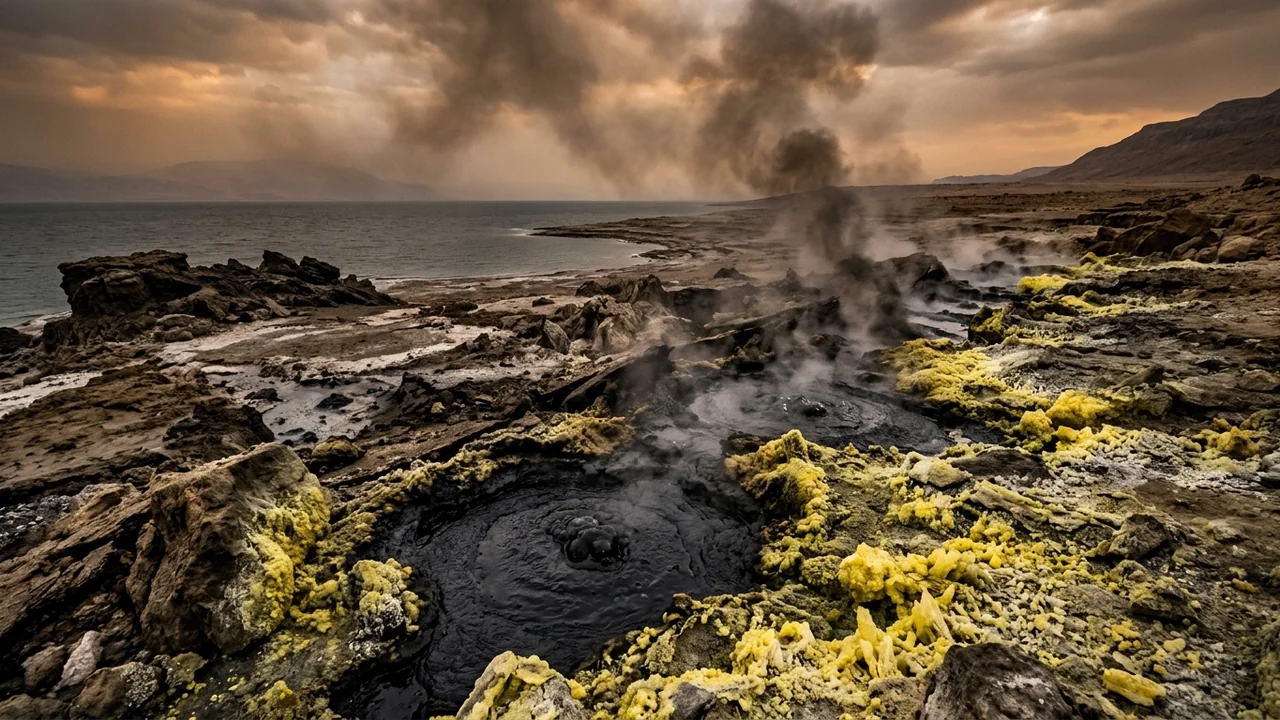
What were these mysterious "slimepits" that swallowed royal armies? Through modern petroleum geology, geophysics, and tectonic fault analysis, we can reconstruct the volatile hydrocarbon cauldron that made the Dead Sea basin one of the most explosive, economically coveted, and physically treacherous landscapes on earth.
The Hebrew Forensic: Be’erot Hemar (Wells of Bitumen)
In Genesis 14:10, the Hebrew original employs a striking grammatical device known as a superlative reduplication: be'erot be'erot hemar (בֶּאֱרֹת בֶּאֱרֹת חֵמָר).
[Hebrew Text: בֶּאֱרֹת בֶּאֱרֹת חֵמָר]
   ├── Be'erot (בֶּאֱרֹת): Pits, shafts, bubbling subterranean wells or sinkholes
   ├── Reduplication (Be'erot Be'erot): An intense multitude; "wells upon wells"
   └── Hemar (חֵמָר): Heavy, viscous, boiling asphalt / petroleum bitumen
- Not Ordinary Mud: The word hemar does not mean ordinary river mud or wet clay (tit or bort). It specifically designates pure natural bitumen, heavy asphalt, or semi-solid petroleum pitch. It is the identical word used in Genesis 11:3 to describe the asphalt mortar used to cement the bricks of the Tower of Babel, and in Exodus 2:3 for the waterproof pitch used by Jochebed to coat baby Moses’ basket in the Nile!
- "Wells Upon Wells": The repeating phrase signifies that the Valley of Siddim was not merely slightly muddy; it was a dense, treacherous minefield of active, bubbling, open petroleum seeps, asphalt sinkholes, and boiling tar vents piercing through the valley floor!
The Petroleum Geology of the Dead Sea Pull-Apart Basin
The Dead Sea sits within the Dead Sea Transform (DST)—a colossal strike-slip tectonic plate boundary separating the African Plate and the Arabian Plate. It is a deep pull-apart basin that forms the deepest continental depression on the surface of the planet, plunging more than 430 meters (1,410 feet) below sea level.
Underneath this geological trench lies an enormous, highly pressurized hydrocarbon system:
[Ground Surface / Dead Sea Floor (-430 m)]
                         │
                         ▼  Alluvial gravels, halite, and marl
[Cretaceous Bituminous Rocks: Senonian Oil Shales (Menuha & Mishash Formations)]
   ├── Organic-rich kerogen and heavy asphalt source rocks
   ├── Buried at depths of 2,000 to 5,000 meters under geostatic pressure
   └── Extreme thermal maturation generating methane gas & liquid bitumen
                         │
                         ▼  Major Active Tectonic Strike-Slip Faults
[Pressurized Hydrocarbon Migration along Fractures to Valley Floor]
The Generation of Dead Sea Bitumen
- Organic Source Rocks: Millions of years ago, rich marine organic sediments were deposited in ancient Tethyan chalks and marls, forming thick beds of bituminous oil shale (the Senonian Ghareb and Mishash formations).
- Subterranean Cooking: As the tectonic rift pulled apart and subsided, these source rocks were buried under thousands of feet of sediment, subjecting them to intense geostatic pressure and subterranean heat (80°C to 150°C).
- Active Fault Conduits: The Dead Sea Transform is sliced by vertical strike-slip and normal faults. These tectonic fracture networks act as super-highways for pressurized hydrocarbons. Heavy asphalt, methane gas ($CH_4$), and hydrogen sulfide ($H_2S$) are constantly forced upward toward the surface under tremendous hydrostatic and tectonic pressure!
Salt Diapirism: How Mount Sodom Squeezed Asphalt to the Surface
The primary geological engine driving these bitumen eruptions is the phenomenon of salt diapirism, personified by Mount Sodom (Jebel Usdum) on the southwestern shore of the Dead Sea:
                      [SURFACE OF THE VALLEY OF SIDDIM]
                       ▲         ▲                 ▲
                       │         │  Active Seeps   │
                       │         │  & Gas Vents    │
           ┌───────────┴─────────┴─────────────────┴──────────┐
           │     Alluvial Mud, Sand, and Brine Sediments      │
           └─────────────────────┬────────────────────────────┘
                                 │
                   ▲             │             ▲
                   │  UPWARD     │  EXTRUDING  │
                   │  BUOYANCY   │  SALT PLUG  │
         ┌─────────┴─────────────┴─────────────┴──────────┐
         │     THE MOUNT SODOM SALT DIAPIR (HALITE)       │
         │  (Density: ~2.16 g/cm³ vs. Overburden: 2.40)   │
         └───────────────────────┬────────────────────────┘
                                 │
                                 ▼
         [Deep Fractured Hydrocarbon Traps Squeezed Like a Piston!]
The Physics of the Salt Piston
- Halite Buoyancy: Rock salt (halite) has a lower density (~2.16 g/cm³) than the heavier surrounding limestone, dolomite, and clay overburden (~2.40 g/cm³).
- The Diapiric Upward Squeeze: Under the enormous weight of overlying sediments, the buried salt behaves like a slow-moving, viscous fluid, pushing upward toward the surface in a massive vertical plug or salt diapir (which created the 11-kilometer-long ridge of Mount Sodom).
- Pumping the Bitumen Wells: As the salt diapir pierced through deep Cretaceous rock strata, it acted like a colossal hydraulic piston, compressing deep petroleum reservoirs and forcing viscous black asphalt and volatile methane gas up through surface fissures into the Valley of Siddim!
Classical Accounts of Lacus Asphaltites: Diodorus, Strabo, and Josephus
To the ancient Greeks and Romans, the Dead Sea was not known by its biblical name; it was universally celebrated as Lacus Asphaltites—the "Asphalt Lake" or the "Sea of Pitch".
Major classical historians and geographers have left astonishing eyewitness accounts confirming that the Dead Sea actively spewed massive floating islands of bitumen:
1. Diodorus Siculus (1st Century BC)
In his Bibliotheca Historica (Book XIX, 98–100), Greek historian Diodorus Siculus describes the extraction of Dead Sea bitumen during the Hellenistic era:
"The size of this lake is approximately five hundred furlongs in length by sixty furlongs in breadth... Every year a great quantity of asphalt floats up from the middle of the lake in pieces larger than twenty plethra [several hundred square meters], but sometimes in pieces resembling islands... The barbarians who live around the lake paddle out on rafts made of reeds... and having cut the asphalt, they load their rafts and depart."
2. Strabo (1st Century AD)
The Roman geographer Strabo records in his Geographica (Book XVI, 2.42):
"The lake is full of asphalt. The asphalt is blown to the surface at irregular intervals from the middle of the deep, and with it rise bubbles, as though water were boiling; and the surface of the lake, being curved, looks like a hill... It is accompanied by smoke and soot, which tarnishes bronze and silver."
3. Flavius Josephus (1st Century AD)
The Jewish historian Josephus writes in The Jewish War (IV.8.4):
"The lake also casts up black masses of asphalt, which float upon the water; and in size and shape they resemble headless bulls... The asphalt is useful not only for caulking ships, but also for the healing of men's bodies; being mixed into many medical ointments."
Egyptian Mummification and the Economics of Bitumen
Why was this asphalt so valuable? The word "mummy" is derived from the Persian word mumiya, meaning bitumen. Ancient Egyptian embalmers imported massive quantities of Dead Sea asphalt across the Sinai to embalm the pharaohs and sacred animals, creating a multi-million-dollar ancient export industry centered on the exact petroleum seeps described in Genesis 14!
Comparative Geochemistry: Hydrocarbon Deposits of the Dead Sea Basin
| Material / Deposit | Chemical / Elemental Composition | Physical State | Specific Gravity / Density | Combustion Properties | Historical / Industrial Application |
|---|---|---|---|---|---|
| Dead Sea Pure Bitumen (Hemar) | $80% ext{ C}, 10% ext{ H}, 8–10% ext{ S}, 1% ext{ N}$ | Viscous, semi-solid black pitch | 1.05 – 1.15 g/cm³ (floats in Dead Sea brine @ 1.24) | Highly flammable; ignites easily with crackling yellow flame & black smoke | Ancient Egyptian mummification; waterproofing ship hulls; masonry mortar. |
| Bituminous Oil Shale (Menuha) | Kerogen-rich calcite & dolomite matrix | Solid sedimentary rock | 1.90 – 2.20 g/cm³ | Combusts when heated to >450°C; yields synthetic crude oil | Burned as fuel by ancient Bedouin; primary source rock for deep asphalt. |
| Elemental Sulfur (Goprith) | Pure Sulfur ($ ext{S}_8$) | Crystalline yellow nodules | 2.07 g/cm³ | Burns with pale blue flame @ 248°C, releasing suffocating $ ext{SO}_2$ gas | Ancient fumigation, weaponized fire arrows, sacrificial purification. |
| Subterranean Methane Gas | Methane ($ ext{CH}_4$) + Hydrogen Sulfide ($ ext{H}_2 ext{S}$) | Pressurized colorless gas | 0.66 g/L (Gas) | Explosively flammable in air mixtures (5–15% concentration) | Primary propellant forcing liquid asphalt and salt dome eruptions to the surface. |
| Dead Sea Deep Brine | $ ext{MgCl}_2, ext{NaCl}, ext{CaCl}_2, ext{KCl}$ | Super-saturated mineral brine | 1.24 g/cm³ | Non-flammable; prevents normal sinking of human bodies | Explains why heavy solid bitumen floats to the surface like giant islands! |
Tactical Quagmire: How Bitumen Pits Decided an Ancient War
Re-examining Genesis 14:10 with modern geotechnical insight reveals why the battle turned into a massacre:
[Mesopotamian Shock Chariots & Elite Infantry Advance]
                          │
                          ▼
[Five Canaanite Kings Lure Invaders into the Valley of Siddim]
   ├── Believed local terrain would break enemy chariot axles
   └── Assumed local familiarity with bitumen pit pathways
                          │
                          ▼  TACTICAL DISASTER ERUPTS:
[Mesopotamian Flanking Maneuver Forces Panic Retreat]
   ├── Fleeing Canaanite infantry run blindly into open tar pits
   ├── Highly viscous, adhesive bitumen acts like industrial flypaper
   └── Trapped soldiers immobilized; slaughtered or suffocated in slime
The Industrial Trap
Bitumen in natural desert pits is not a smooth, glassy road. Under the blazing sun, the surface forms a deceptively thin, sun-baked crust of sand, salt, and dust over a deep, viscous pool of liquid asphalt.
- An unsuspecting soldier stepping onto the crust breaks through.
- Once an armored foot penetrates the hot pitch, the adhesive shear viscosity of petroleum bitumen traps the limb with irresistible force. Pulling a leg free requires immense tensile strength.
- As panic-stricken soldiers and horses thrash violently, they sink deeper into the suffocating mire, exactly like the famous prehistoric animals trapped in the La Brea Tar Pits of California!
The kings of Sodom and Gomorrah fell into the very traps they had counted on to save them, while Chedorlaomer’s veterans looted their cities and carried away Abraham’s nephew Lot (Genesis 14:11–12), setting the stage for Abraham’s legendary night rescue at Dan.
The "slimepits" of the Valley of Siddim were not mythological embellishments. They were the raw, volatile, geological reality of the Dead Sea Transform—a landscape where tectonic rifting, salt diapirism, and boiling petroleum seeps bore witness to the ancient historical struggles of the Patriarchal world.
Discover the Full Petroleum and Archaeological Dossiers
The boiling pitch of the Dead Sea is one of dozens of ancient biblical disasters where petroleum geology, classical historiography, and biblical warfare intersect. To examine complete petroleum reservoir maps of the Dead Sea Rift, translations of Diodorus Siculus's asphalt trade reports, and chemical laboratory assays of Dead Sea bitumen:
👉 Discover Volume III: The Final Files – Biblical Disasters & Ancient Wonders ($2.99)
Features high-resolution geological stratigraphy diagrams of Mount Sodom, geochemical mass spectrometry reports of ancient bitumen, and tactical battlefield maps of Genesis 14.
Frequently Asked Questions
What were the "slimepits" in Genesis 14:10?
The Hebrew phrase be'erot hemar literally means "wells or pits of bitumen (asphalt)". The Valley of Siddim, near the southern Dead Sea, was covered in natural open petroleum seeps, bubbling tar pits, and asphalt sinkholes created by deep tectonic faults forcing heavy oil and pitch to the surface under pressure.
Why was the Dead Sea called Lacus Asphaltites in classical antiquity?
Ancient Greek and Roman historians like Diodorus Siculus, Strabo, and Josephus called the Dead Sea Lacus Asphaltites ("The Asphalt Lake") because massive blocks of solid bitumen, some as large as islands or "headless bulls", regularly detached from the sea floor and floated to the surface. Local tribesmen harvested this asphalt to sell to Egypt for embalming mummies.
How does salt diapirism cause bitumen eruptions in the Dead Sea?
The Mount Sodom salt diapir is a massive underground plug of low-density rock salt (halite) that pushes upward through denser rock layers like a giant piston. As it rises, it fractures deep Cretaceous source rocks, compressing subterranean petroleum reservoirs and forcing volatile methane gas, hydrogen sulfide, and heavy asphalt up through surface fissures.
Why did heavy bitumen float on the water of the Dead Sea?
Pure petroleum bitumen has a specific gravity of roughly 1.05 to 1.15 g/cm³, meaning it normally sinks in freshwater (which has a density of 1.00 g/cm³). However, the water of the Dead Sea is super-saturated with dissolved mineral salts, giving it an extreme density of 1.24 g/cm³. Because the brine is significantly denser than the asphalt, the heavy pitch naturally floats on the surface!
Frequently Asked Questions
What were the "slimepits" in Genesis 14:10?
The Hebrew phrase be'erot hemar literally means "wells or pits of bitumen (asphalt)". The Valley of Siddim, near the southern Dead Sea, was covered in natural open petroleum seeps, bubbling tar pits, and asphalt sinkholes created by deep tectonic faults forcing heavy oil and pitch to the surface under pressure.
Why was the Dead Sea called Lacus Asphaltites in classical antiquity?
Ancient Greek and Roman historians like Diodorus Siculus, Strabo, and Josephus called the Dead Sea Lacus Asphaltites ("The Asphalt Lake") because massive blocks of solid bitumen, some as large as islands or "headless bulls", regularly detached from the sea floor and floated to the surface. Local tribesmen harvested this asphalt to sell to Egypt for embalming mummies.
How does salt diapirism cause bitumen eruptions in the Dead Sea?
The Mount Sodom salt diapir is a massive underground plug of low-density rock salt (halite) that pushes upward through denser rock layers like a giant piston. As it rises, it fractures deep Cretaceous source rocks, compressing subterranean petroleum reservoirs and forcing volatile methane gas, hydrogen sulfide, and heavy asphalt up through surface fissures.
Why did heavy bitumen float on the water of the Dead Sea?
Pure petroleum bitumen has a specific gravity of roughly 1.05 to 1.15 g/cm³, meaning it normally sinks in freshwater (which has a density of 1.00 g/cm³). However, the water of the Dead Sea is super-saturated with dissolved mineral salts, giving it an extreme density of 1.24 g/cm³. Because the brine is significantly denser than the asphalt, the heavy pitch naturally floats on the surface!
Related Research Dossiers
View all 120 articles →
150 mph Ballistics: Why Goliath’s Bronze Helmet Was Useless Against David’s Sling
185,000 Assyrian Soldiers Wiped Out in One Night: The Pathology of Sennacherib's Siege Failure