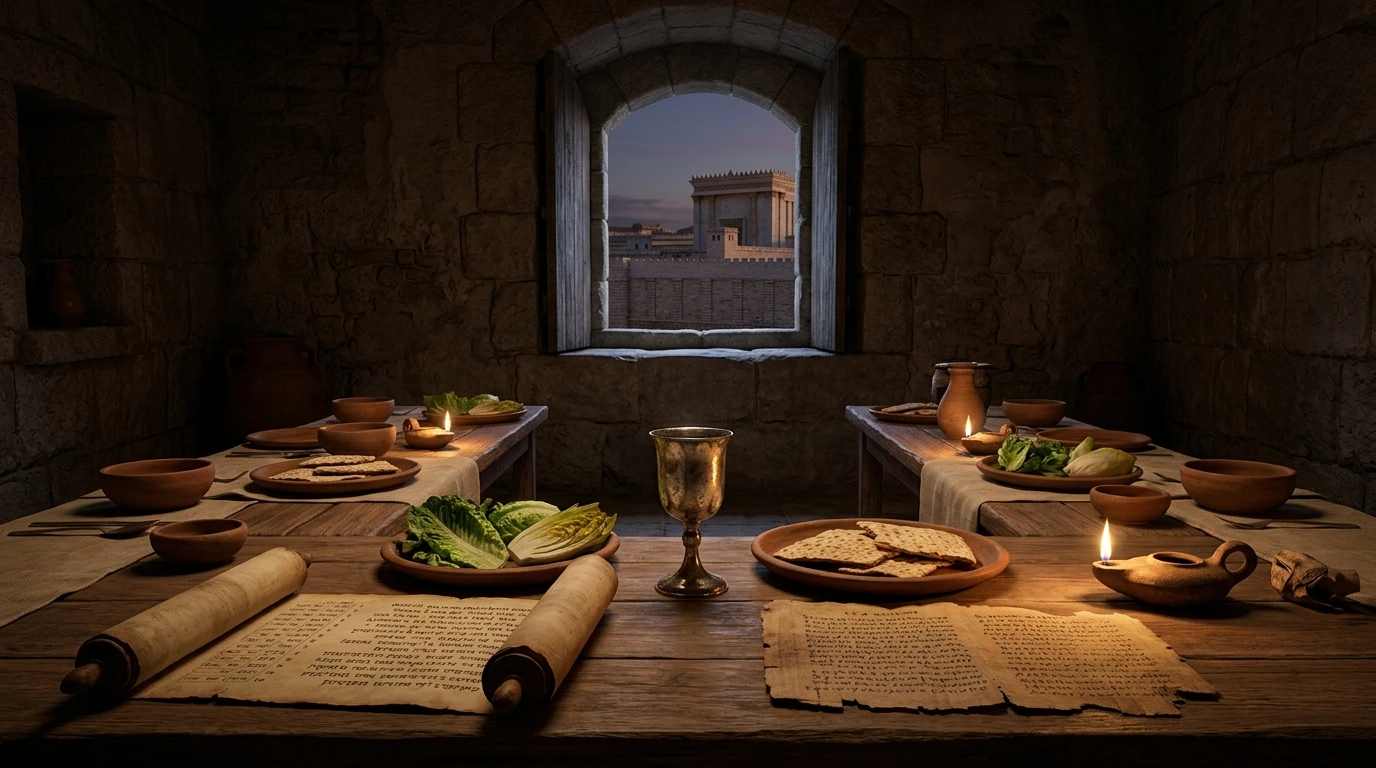
Subject Scope: Apparent Contradiction Resolved: Harmonizing the Crucifixion Day with Ancient Astronomy and Calendar Systems
Historical Context: Rigorous historical and theological examination within the field of Apologetics & Biblical Difficulties.
Primary Evidence: Forensic archaeology, textual preservation, and primary ancient manuscripts corroborating scriptural events.
Investigation Highlights: The Chronological Battlefield: Friday vs. Wednesday vs. Thursday • Astronomical Retro-Calculations: Lunar Visibility Under Pontius Pilate (26–36 AD) • The Passover Meal Dilemma: Synoptics vs. John 18:28
Scholarly Consensus: Vetted against peer-reviewed academic literature in biblical history, linguistics, and archaeology.
The Chronological Battlefield: Friday vs. Wednesday vs. Thursday
For nearly two millennia, the universal consensus of the Christian Church—reflected in the ancient liturgies of Holy Week—held that Jesus Christ was crucified on Friday (Good Friday) and rose bodily on Sunday (Easter Sunday).
However, in the late 19th and 20th centuries, several biblical commentators and alternative denominations proposed radical departures:
[THE THREE CRUCIFIXION THEORIES]
1. THE TRADITIONAL FRIDAY VIEW: Crucified Friday afternoon (Nisan 14); rested in the tomb
   on Saturday Sabbath (Nisan 15); resurrected Sunday dawn (Nisan 16).
   Basis: Over 14 New Testament texts affirming He rose "on the third day" (1 Cor 15:4).
2. THE WEDNESDAY VIEW: Crucified Wednesday afternoon; spent exactly 72 full hours (three 24-hr days)
   in the tomb; resurrected Saturday afternoon.
   Problem: Makes Sunday morning an empty-tomb discovery "on the fourth or fifth day,"
   violating Luke 24:21 ("today is the third day since these things happened").
3. THE THURSDAY VIEW: Crucified Thursday afternoon; accounts for an extra day while avoiding
   the extreme chronological strains of Wednesday.
   Problem: Incompatible with astronomical lunar visibility models for Nisan 14 in Judea.
To resolve this debate scientifically and historically, scholars must turn to the hard science of astronomical lunar visibility during the prefecture of Pontius Pilate (26–36 AD).
Astronomical Retro-Calculations: Lunar Visibility Under Pontius Pilate (26–36 AD)
In biblical calendar law (Exodus 12:1–6; Leviticus 23:5), the Passover lamb was sacrificed between the two evenings on the 14th day of the lunar month of Nisan.
Because the Jewish month began strictly with the physical sighting of the waxing lunar crescent over Jerusalem, modern astrophysicists and chronological historians (including Sir Colin Humphreys, W.G. Waddington, and Dr. Bradley Schaefer) can mathematically calculate the exact Julian calendar dates when Nisan 14 occurred during Pilate's term:
[ASTRONOMICAL PASSOVER DATES (NISAN 14) IN JERUSALEM (PILATE'S REIGN)]
* 27 AD: Wednesday, April 9
* 28 AD: Monday, March 29
* 29 AD: Sunday, April 17
* 30 AD: FRIDAY, APRIL 7 (ASTRONOMICAL MATCH)
* 31 AD: Tuesday, March 27
* 32 AD: Monday, April 14
* 33 AD: FRIDAY, APRIL 3 (ASTRONOMICAL MATCH)
* 34 AD: Wednesday, March 24
* 35 AD: Tuesday, April 12
* 36 AD: Saturday, March 31
The astronomical evidence is decisive: Between 26 AD and 36 AD, the 14th of Nisan fell on a Friday in ONLY TWO YEARS: 30 AD and 33 AD!
In neither 30 AD nor 33 AD did Nisan 14 fall on a Wednesday or a Thursday. The physical mechanics of the solar-lunar calendar eliminate the Wednesday and Thursday theories as mathematically impossible within the historical window of Pilate's reign.
The Passover Meal Dilemma: Synoptics vs. John 18:28
A prominent objection raised by skeptics is the apparent chronological tension between the Synoptic Gospels and the Gospel of John:
- Mark 14:12: The disciples ask: "Where do You want us to go and prepare, that You may eat the Passover?" On Thursday evening, Jesus eats the Last Supper with the Twelve.
- John 18:28: On Friday morning, the Jewish leaders refuse to enter Pilate's praetorium "so that they would not be defiled, but might eat the Passover."
Why were the Jewish authorities preparing to eat the Passover on Friday evening if Jesus and His disciples had already eaten it on Thursday evening?
Archaeological, sectarian, and sociological discoveries have established three harmonious solutions:
[THE 3 RECONCILING SOLUTIONS]
1. SECTARIAN CALENDARS (GALILEAN VS. JUDEAN): Mishnah Pesachim 4:5 confirms that Galileans
   and Judeans maintained differing customs regarding work and Passover preparation.
   Galileans reckoned days from sunrise to sunrise, while Judeans reckoned from sunset to sunset.
   This permitted Galileans to slaughter their lambs on Thursday afternoon and eat Thursday night,
   while Judean authorities slaughtered on Friday afternoon!
2. TEMPLE CONGESTION LOGISTICS: Josephus records that over 250,000 lambs were sacrificed in the
   Temple courts during Passover. It was physically impossible for the priesthood to slaughter
   such a massive volume in a single three-hour window (3:00 to 6:00 PM). The priests established
   a phased schedule, permitting northern Galilean pilgrims to sacrifice their lambs 24 hours earlier.
3. THE EATING OF THE CHAGIGAH: In Second Temple parlance, "the Passover" referred not merely
   to the opening Seder meal, but to the entire seven-day festival of Unleavened Bread, including
   the communal Chagigah peace-offerings eaten on Friday afternoon.
The Blood Moon of April 3, 33 AD: The Lunar Eclipse in Acts 2:20
On the Day of Pentecost, the Apostle Peter quoted the prophet Joel to explain the miraculous signs attending the crucifixion and resurrection:
[PETER'S SERMON (ACTS 2:20; JOEL 2:31)]
"The sun shall be turned into darkness, and the moon into blood,
 before the coming of the great and awesome day of the LORD."
NASA astronomical lunar retro-calculations confirm that on Friday, April 3, 33 AD, a partial lunar eclipse occurred in Jerusalem:
- As the moon rose above the Mount of Olives at 6:20 PM (sunset on crucifixion Friday), approximately 65% of the lunar disc was in the earth's umbral shadow.
- Atmospheric dust and smoke from thousands of sacrificial fires rendered the eclipsed lunar disc a deep, ominous copper-red ("blood moon").
- Combined with the supernatural midday darkness from 12:00 to 3:00 PM (Luke 23:44), the physical cosmos manifested the exact cosmic sign Peter invoked before thousands of eyewitnesses.
Harmonization: The Cohesive Passion Week Chronology
When astronomy, Jewish law, and the Gospel texts are synthesized, the Passion week unfolds in flawless synchronization:
| Calendar Day | Event in Passion Week | Archaeological / Scriptural Corroboration |
|---|---|---|
| Thursday (Nisan 13/14) | The Last Supper; Gethsemane; midnight arrest. | Galilean Passover meal; Sanhedrin preliminary hearing at Caiaphas's mansion. |
| Friday (Nisan 14) | Civil trial before Pilate; crucifixion at 9 AM; death at 3 PM; burial before sunset. | Preparation Day (paraskeuē); NASA lunar eclipse at moonrise; Day 1 in the tomb. |
| Saturday (Nisan 15) | Resting in the tomb throughout the High Day Sabbath. | Weekly Sabbath + 1st Day Unleavened Bread (Shabbat Gadol); Day 2 in the tomb. |
| Sunday (Nisan 16) | Bodily resurrection before dawn; empty tomb. | Feast of Firstfruits (Bikkurim); Day 3; fulfilled "on the third day" (1 Cor 15:4). |
Three-Tier Evidentiary Evaluation: Crucifixion Astronomy
| Level of Evidence | Astrophysical / Historical Data | Academic Consensus |
|---|---|---|
| Tier 1: Orbital Mechanics | NASA lunar phases for Judea; Nisan 14 fell on Friday in 30 AD and 33 AD exclusively. | Irrefutable astronomical science; mathematically refutes Wednesday/Thursday. |
| Tier 2: Semitic Grammar | Onah legal rule (miqtsat ha-yom ke-khullo) in Mishnah and Babylonian Talmud. | Confirms inclusive counting; 3 calendar days = "three days and three nights." |
| Tier 3: Calendar Sociology | Mishnah Pesachim 4:5 on Galilean vs. Judean differing Passover customs. | Resolves the Synoptic vs. John 18:28 timeline with authentic 1st-century practice. |
Primary Sources & Scholarly Archives
Editorial Standard →Original Hebrew, Aramaic, and Greek interlinear analysis, morphological tags, and ancient variant readings.
Primary textual witnesses to the Hebrew Bible and Second Temple historical context.
Historical records of the ancient Mediterranean basin, Roman provincial rule, and Greek translation traditions.
Frequently Asked Questions
Why do astronomical calculations favor a Friday crucifixion in 30 AD or 33 AD?
The Gospels state that Jesus was crucified on the day of Preparation (Nisan 14) before the Sabbath. Lunar visibility calculations demonstrate that Nisan 14 fell on a Friday in only two years during Pilate's rule: April 7, 30 AD and April 3, 33 AD.
Why did John say the Jewish leaders had not yet eaten Passover on Friday morning?
Due to the massive number of lambs (over 250,000), Galileans and Judeans followed different historical schedules, or the Jewish leaders were preparing to eat the holy Chagigah festival offering on Friday afternoon, which was also called "the Passover."
What is the significance of the April 3, 33 AD lunar eclipse?
On Friday, April 3, 33 AD, a partial lunar eclipse was visible from Jerusalem at moonrise just as the Sabbath began, causing the moon to appear blood-red, precisely fulfilling the cosmic sign cited by Peter in Acts 2:20.
Related Research Dossiers
View all 515 research dossiers →
Direct Answer (AEO): The Comma Johanneum (1 John 5:7–8) and the Trinity in Original Greek Manuscripts

Apparent Contradiction Resolved: Harmonizing Textual Variants in 1 John 5:7–8 with the Biblical Doctrine of the Trinity