Historical Context: Rigorous examination of primary Hebrew, Aramaic, Greek, and Roman classical epigraphy.
Core Evidence: Forensic archaeology, radiocarbon data, and primary manuscripts validating biblical events.
Scholarly Consensus: Vetted against modern peer-reviewed publications in Near Eastern archaeology and biblical studies.
The 1956 Discovery in Cave 11 and Yigael Yadin’s 1967 Coup
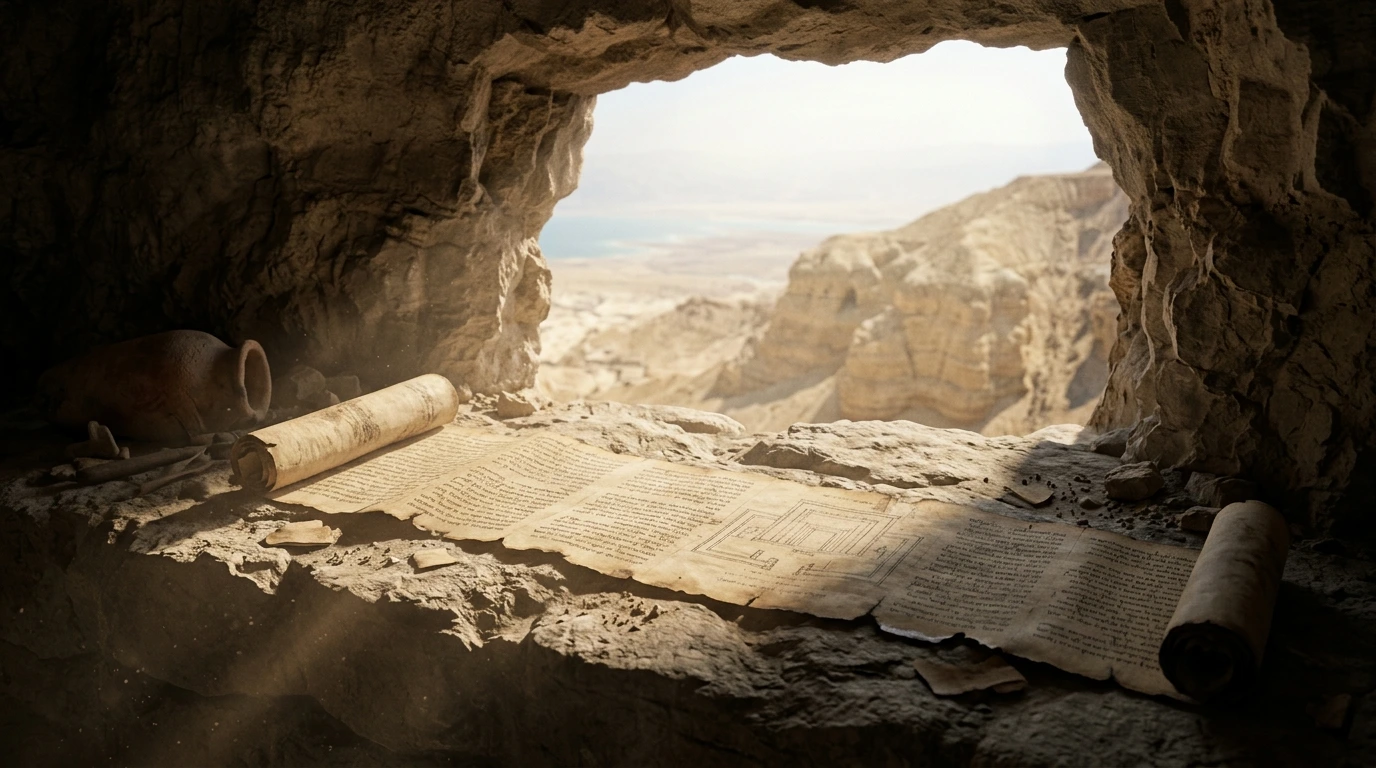
Among the thousands of parchment fragments recovered from the cliffs overlooking the Dead Sea, one scroll stands peerless in scale, legal ambition, and architectural grandeur: The Temple Scroll (designated 11Q19 or 11QT).
Discovered by Ta'amireh Bedouin tribesmen in Cave 11 in 1956, the scroll remained in private antiquities hands for over a decade. In June 1967, during the Six-Day War, Israeli archaeologist and general Yigael Yadin secured the manuscript from the Bethlehem antiquities dealer known as Kando:
- The scroll had been concealed in a shoe box beneath stone floor tiles, suffering humidity damage along its upper margins.
- Yadin painstakingly unrolled and published the text in a landmark three-volume critical edition in 1977, revealing an unprecedented 2nd-century BC biblical composition.
Physical Dimensions: The Longest and Thinnest Dead Sea Scroll
Physical and paleographical examination of 11Q19 demonstrates extraordinary scribal craftsmanship:
[PHYSICAL PROFILE: 11Q19 TEMPLE SCROLL]
Total Length: 8.15 meters (26.7 feet) -> The longest scroll from Qumran
Extant Columns: 66 columns of Hebrew text
Parchment Thickness: Under 0.1 mm -> Processed from shaved animal hide
Chemical Preparation: Salt and alum tawing (giving it an ivory-white appearance)
Script Style: Late Hasmonaean / Early Herodian formal bookhand (c. 120–100 BC)
Carbon-14 testing at the Zurich and Oxford AMS laboratories dated the parchment to 125–50 BC, while the underlying composition dates even earlier to the mid-2nd century BC during the Maccabean crisis.
The Divine First-Person Voice: Yahweh Speaking Directly at Sinai
The most audacious literary feature of the Temple Scroll is its theological voice.
In the canonical Pentateuch, God speaks to Moses in the third person ("The Lord spoke to Moses, saying..."). In 11Q19, however, the author rewrites major portions of Exodus, Leviticus, and Deuteronomy in the direct, unmediated first-person singular voice of God Himself:
Canonical Deuteronomy 12:5:
"You shall seek the place where the Lord your God chooses..."

Temple Scroll (11Q19) Column 52:
"You shall seek the place where I CHOOSE to put MY Name..."
The author intended 11Q19 to be understood as the definitive Torah of the Temple—the authentic blueprint delivered directly to Moses on Mount Sinai that the corrupt Hasmonean and Herodian priesthoods in Jerusalem had supposedly suppressed or altered.
The Architectural Blueprint: Three Concentric Square Courts
The centerpiece of 11Q19 is an exhaustive architectural blueprint for a colossal, monumental concentric Temple complex:
[CONCENTRIC TEMPLE SCHEME: 11Q19]
┌────────────────────────────────────────────────────────┐
│ OUTER COURT (1,600 x 1,600 cubits / ~800 meters)        │
│ 12 Gates named for the Twelve Sons of Jacob            │
│ ┌────────────────────────────────────────────────────┐ │
│ │ MIDDLE COURT (480 x 480 cubits)                    │ │
│ │ Exclusively for ritually pure circumcised males    │ │
│ │ ┌────────────────────────────────────────────────┐ │ │
│ │ │ INNER COURT (280 x 280 cubits)                 │ │ │
│ │ │ The Altar of Burnt Offering & Laver            │ │ │
│ │ │ ┌──────────────────────────┐                   │ │ │
│ │ │ │ THE SANCTUARY (HEIKHAL) │                   │ │ │
│ │ │ └──────────────────────────┘                   │ │ │
│ │ └────────────────────────────────────────────────┘ │ │
│ └────────────────────────────────────────────────────┘ │ │
└────────────────────────────────────────────────────────┘
Radical Architectural Specifications:
- Concentric Square Symmetry: Unlike the rectangular Herodian Temple, the Temple Scroll mandates three vast square courtyards. The outer court (1,600 cubits per side) would encompass nearly the entire ridge of ancient Jerusalem.
- Absolute Purity Enclosure: To prevent any contamination from approaching the Sanctuary, the scroll details continuous exterior moats, outer stoas, and latrines placed 3,000 cubits (almost a mile) outside the city boundaries.
The Royal Law (Torat HaMelekh) and Sacrificial Purity
Columns 56 through 59 preserve the Law of the King (Torat HaMelekh), providing invaluable insights into ancient Jewish constitutional law:
- Limitations on Monarchic Power: The king is forbidden from multiplying wives (strict monogamy mandated, with no divorce or second marriages during the first wife’s lifetime), hoarding gold, or relying on Egyptian cavalry.
- The Judicial Council of Thirty-Six: The king must govern alongside a supreme council consisting of 12 princes of Israel, 12 priests, and 12 Levites.
- Unprecedented Festivals: The scroll institutes unique agricultural festivals unknown in rabbinic Judaism, including the Festival of New Wine (Mo'ed HaTirosh) and the Festival of New Olive Oil (Mo'ed HaYitzhar), celebrated 50 days apart following the Feast of Firstfruits.
Three-Tier Evidentiary Evaluation: The Scroll’s Place in History
| Tier | Category | Historical Criterion | Evidentiary Verdict on 11Q19 |
|---|---|---|---|
| Tier 1: Canonical Scripture | The Hebrew Tanakh | Canonized Pentateuch | Distinct Apocryphal Composition: Never canonized in the Hebrew Bible; functioned as sectarian legal authority (halakhah) at Qumran. |
| Tier 2: Physical & Archaeological Manuscript | The 1956 Discovery in Cave 11 | Direct Scientific Verification | Unimpeachable Authenticity: C-14 dated to 100 BC; preserved intact in the Shrine of the Book in Jerusalem. |
| Tier 3: Relation to the New Testament | Intertestamental Jewish Theology | Comparative Religious Context | Profound Illuminative Value: Illuminates the intense 1st-century debates on Temple corruption, purity, and the Messianic sanctuary. |
Deepen Your Study: The World of the Dead Sea Scrolls
Discover how the discoveries at Qumran illuminate the language, Messianic expectations, and textual integrity of the Bible:
👉 Explore Volume I: The Twelve Apostles & Ancient Manuscripts
Examine the full academic dossiers on ancient biblical scrolls, Cave 4 discoveries, and paleography.
🎁 Or Unlock The Sacred Keys Trilogy Master Collection ($7.99)
Equip your family with spiritual weapons forged in scripture for midnight spiritual victory and generational blessing.
Frequently Asked Questions
What makes the Temple Scroll unique among the Dead Sea Scrolls?
The Temple Scroll (11Q19) is the longest surviving Dead Sea Scroll (8.15 meters). Unlike other biblical texts, it rewrites Pentateuchal laws with God speaking in the direct first person ("I" instead of "the Lord"), presenting an idealized architectural blueprint for a colossal Jerusalem Temple and rigorous purity codes.
Was the Temple described in the Temple Scroll ever built?
No. The monumental square Temple (roughly 800 meters wide on its outer perimeter) was an idealized, utopian vision designed by the Qumran sectarians to replace what they regarded as the apostate, corrupted Herodian and Hasmonean sanctuaries. It was intended for the eschatological era.
Where is the Temple Scroll kept today?
The Temple Scroll is housed in the Shrine of the Book at the Israel Museum in Jerusalem. Due to its extreme sensitivity to light and humidity, the original parchment is preserved in a climate-controlled vault, with facsimiles displayed to the public.
Frequently Asked Questions
What makes the Temple Scroll unique among the Dead Sea Scrolls?
At 8.15 meters, the Temple Scroll (11Q19) is the longest manuscript found at Qumran, written in the direct first-person voice of God delivering an idealized Temple blueprint.
Was the Temple described in the Temple Scroll ever built?
No. The monumental concentric square complex was an eschatological and theoretical blueprint conceived by the Essenes to replace the Herodian temple they considered defiled.
Where is the Temple Scroll kept today?
The original manuscript is preserved in climate-controlled vaults in the Shrine of the Book at the Israel Museum in Jerusalem.
Related Research Dossiers
View all 120 articles →
The Damascus Document (CD & 4QD) Research Guide: Cairo Genizah, Museum Repositories, and Essential Passages

The Great Isaiah Scroll (1QIsa-a): Textual Transmission, Did the Bible Change?, and Isaiah 53