Historical Context: Rigorous examination of primary Hebrew, Aramaic, Greek, and Roman classical epigraphy.
Core Evidence: Forensic archaeology, radiocarbon data, and primary manuscripts validating biblical events.
Scholarly Consensus: Vetted against modern peer-reviewed publications in Near Eastern archaeology and biblical studies.
The Celestial Enigma of Matthew 2
In the entire canon of biblical literature, no celestial event has captured the scientific imagination and astronomical scrutiny of the world more intensely than the account recorded in Matthew 2:
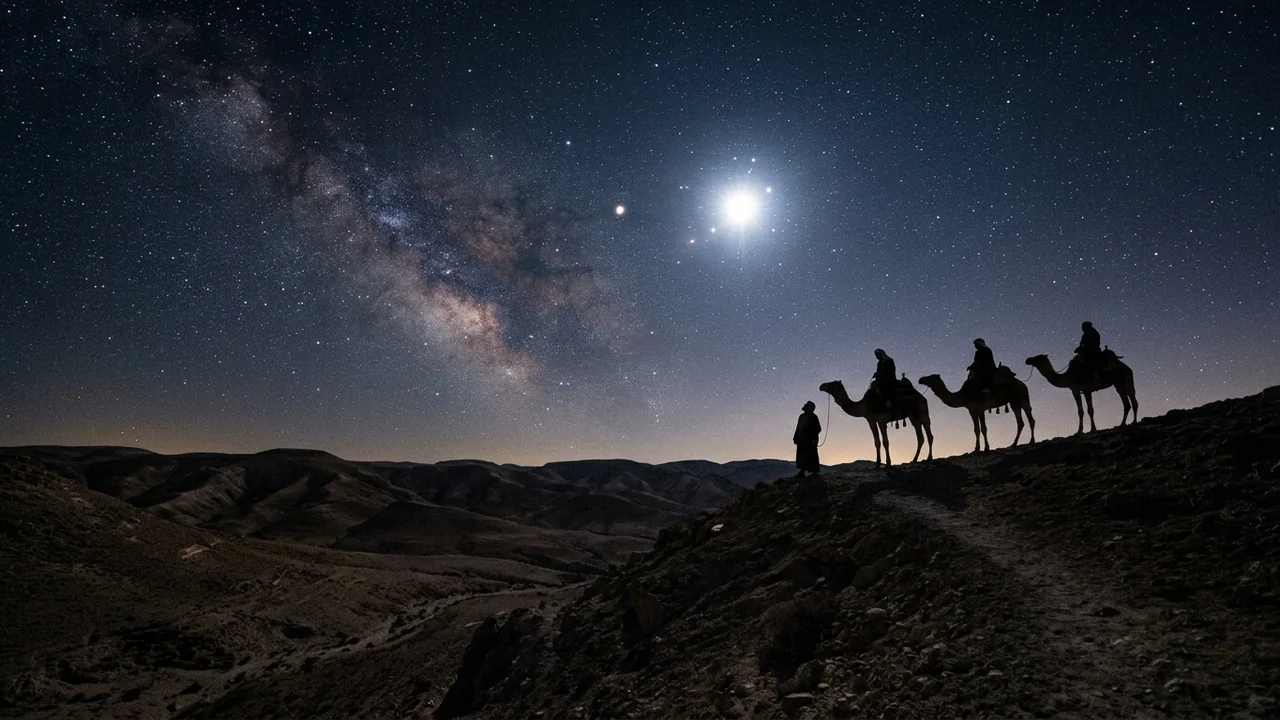
"Now when Jesus was born in Bethlehem of Judaea in the days of Herod the king, behold, there came wise men from the east to Jerusalem, Saying, 'Where is he that is born King of the Jews? for we have seen his star in the east, and are come to worship him.' When Herod the king had heard these things, he was troubled, and all Jerusalem with him... Then Herod, when he had privily called the wise men, enquired of them diligently what time the star appeared... And, lo, the star, which they saw in the east, went before them, till it came and stood over where the young child was." (Matthew 2:1–9)
For centuries, secular skeptics dismissed the "Star of Bethlehem" as a pious Christian myth—an allegorical fable borrowed from Greco-Roman conventions where omens and comets accompanied the birth of emperors like Julius Caesar or Alexander the Great.
Yet modern astrophysics, planetary orbital ephemeris, and ancient Near Eastern cuneiform astronomy reveal a startling historical truth: between 7 BC and 5 BC, a sequence of extraordinary, mathematically verified celestial events blazed across the night sky, matching every single astronomical, chronological, and theological detail described by the Gospel author.
Who Were the Magi? The Astronomer-Priests of Babylon
To understand how the star was recognized, one must first identify the observers. The biblical text designates them as magi (magoi from the East):
[The Neo-Babylonian & Persian Imperial Courts]
                        │
                        ▼
[The Caste of the Rab-Mag: Master Astronomer-Priests]
   ├── Inheritors of 1,000 years of meticulous astronomical diaries
   ├── Charted planetary motions, conjunctions, and heliacal risings on cuneiform tablets
   └── Deeply influenced by the Prophet Daniel (appointed Chief of the Magi, Daniel 5:11!)
                        │
                        ▼
[Anticipation of the Jewish Messianic King: Numbers 24:17 & Daniel 9:24–26]
   "There shall come a Star out of Jacob, and a Sceptre shall rise out of Israel"
- Not Wandering Sorcerers: The Magi were the elite scholarly, political, and astronomical caste of the Parthian/Persian Empire. They served as kingmakers and royal advisers whose duties included observing every degree of planetary movement across the zodiac.
- The Danielic Heritage: Five centuries earlier, the Hebrew prophet Daniel had been elevated by King Nebuchadnezzar as Rab-Mag—the chief master over all the wise men, astrologers, and Chaldeans of Babylon (Daniel 2:48; 5:11). Daniel introduced the Babylonian academies to the Hebrew Scriptures, including the messianic timeline of the Seventy Weeks (Daniel 9:24–27) and the ancient prophecy of Balaam: "There shall come a Star out of Jacob, and a Sceptre shall rise out of Israel" (Numbers 24:17).
- Meticulous Observers: The Magi did not look for a dramatic Hollywood spotlight shining from the clouds. They monitored subtle, highly significant planetary conjunctions and heliacal risings that held profound geopolitical meaning.
Johannes Kepler and the Triple Conjunction of 7 BC
In December 1603, the renowned German mathematician and astronomer Johannes Kepler—the father of modern planetary motion laws—was observing the night sky through a telescope in Prague. He watched a rare planetary alignment: the gas giants Jupiter and Saturn drew together in a brilliant conjunction in the constellation of Pisces, followed by the appearance of a bright supernova in 1604.
Intrigued, Kepler applied his mathematical orbital formulas to calculate backward through time. His calculations revealed an astonishing discovery: in the year 7 BC, a phenomenally rare triple conjunction of Jupiter and Saturn occurred in the constellation of Pisces!
                   [THE 7 BC TRIPLE CONJUNCTION EPHEMERIS]
                                      │
         ┌────────────────────────────┼────────────────────────────┐
         ▼                            ▼                            ▼
[MAY 29, 7 BC]               [OCTOBER 3, 7 BC]            [DECEMBER 4, 7 BC]
├── First Conjunction        ├── Second Conjunction       ├── Third Conjunction
├── Heliacal rising in dawn  ├── Retrograde opposition    ├── Stationary retrograde point
└── Planets within 1 degree  ├── Blazing bright at zenith └── High in southern sky over
    in eastern morning sky       all night long (Midnight)    Jerusalem-to-Bethlehem route!
The Celestial Mechanics of a Triple Conjunction
A single conjunction of Jupiter and Saturn occurs roughly every 20 years. However, a triple conjunction—where Earth’s orbital speed causes the two outer planets to undergo apparent retrograde motion, passing each other three separate times within a single year—occurs only once every 800 to 900 years!
- First Conjunction (May 29, 7 BC): Jupiter and Saturn aligned in the morning sky at dawn ("we have seen his star in the east [en tē anatolē, the heliacal rising]", Matthew 2:2).
- Second Conjunction (October 3, 7 BC): The two planets aligned at opposition, rising at sunset and blazing together at maximum brightness throughout the entire night.
- Third Conjunction (December 4, 7 BC): The planets closed within one degree of each other, forming a brilliant, radiant celestial beacon visible in the southern sky!
Astrological Decryption: Jupiter, Saturn, and the Constellation of Pisces
Why would a conjunction of Jupiter and Saturn cause Persian astronomers to pack a caravan of camels, cross 800 miles of hostile desert, and arrive in Jerusalem asking for the "King of the Jews"?
In ancient Near Eastern judicial astrology and astronomical symbolism, every celestial body and zodiacal constellation possessed an immutable geopolitical meaning:
[JUPITER: Sedeq / The King Planet]
   ├── Known to Hebrews as Sedeq ("Righteousness")
   └── Recognized throughout Babylon as the star of the supreme royal monarch.
                         +
[SATURN: Kewan / The Shield of Israel]
   ├── Associated in ancient Near Eastern astronomy with the Sabbath and the Hebrews.
   └── Tacitus and modern scholars confirm Saturn was the cosmic patron of the Jewish nation.
                         +
[PISCES: The House of the Hebrews / End of Days]
   ├── The water sign associated with Moses, Palestine, and the Mediterranean coast.
   └── In Babylonian astrological geography, Pisces governed the lands of Syria-Palestine!
                         │
                         ▼  THE UNAMBIGUOUS ASTRONOMICAL MESSAGE:
["A Supreme Righteous Royal King is Born in the Land of Israel / Judea!"]
To the Babylonian Magi, this triple alignment in Pisces was not a vague omen. It was an unmistakable, flashing cosmic billboard:
- Jupiter (The King) meets Saturn (The Protector of Israel).
- In Pisces (The Constellation of Judea/Palestine).
- Occurring during the exact historical window predicted by Daniel’s seventy weeks!
The Babylonian Cuneiform Almanac of Sippar
One of the most spectacular archaeological confirmations of this event was discovered in modern Iraq: the Sippar Astronomical Almanac.
Excavated from the ancient temple city of Sippar (near modern Baghdad) and preserved on cuneiform clay tablets in the British Museum (Tablets BM 35760, BM 35782, and BM 35789), this ancient astronomical calendar dates precisely to the year 7 BC:
    ┌────────────────────────────────────────────────────────┐
    │       THE SIPPAR CUNEIFORM ALMANAC (7 BC / BM 35789)   │
    │                                                        │
    │   Akkadian Cuneiform Text:                             │
    │   "Month of Ajaru: Jupiter and Saturn in Pisces...    │
    │    Month of Ululu: Retrograde motion of the two gods...│
    │    Month of Arahsamna: Close conjunction observed      │
    │    in the western sky..."                              │
    └────────────────────────────────────────────────────────┘
The Sippar tablet proves beyond all academic doubt that Babylonian astronomers were actively tracking, calculating, and recording the 7 BC triple conjunction of Jupiter and Saturn in Pisces during the exact era of King Herod the Great! The Magi did not need to invent an astrological phenomenon; the event was officially documented in state cuneiform archives.
The Chinese Supernova of 5 BC: The Han Dynasty Records
While the 7 BC triple conjunction alerted the Magi to set out on their long journey across the desert, what was the star that Matthew records as reappearing when they left Jerusalem for Bethlehem?
Historical astronomy preserves an astonishing extra-biblical record from the Far East. In the official imperial annals of the Han Dynasty (Ch'ien-han-shu, Book 26, the Astronomical Treatise), imperial Chinese court astronomers recorded:
"In the second year of the Chien-p'ing reign period [March/April 5 BC], in the second lunar month, a hui-hsing [a blazing broom-star / nova] appeared in the constellation of Ch'ien-niu [Capricorn/Aquila] for more than seventy days." — Ch'ien-han-shu (Han Dynasty Annals)
[7 BC: Triple Conjunction of Jupiter & Saturn in Pisces] ──► Alerts Magi; Caravan departs Babylon.
                                                                     │
                                                                     ▼  18-to-24-Month Journey
[5 BC: Radiant Nova / Supernova Ignites in Eastern Sky] ────► Reappears to Magi as they reach Jerusalem!
Astronomers like Dr. Colin Humphreys (Cambridge University) propose that the "Star of Bethlehem" was an extraordinary celestial crescendo:
- The 7 BC Triple Conjunction in Pisces initiated the Magi’s journey.
- Followed by a rare massing of three planets (Jupiter, Saturn, and Mars) in 6 BC.
- Culminating in the spring of 5 BC with a brilliant, long-lasting nova/supernova that blazed stationary in the southern morning sky for over two months, guiding the Magi from Jerusalem down to Bethlehem!
Comparative Astronomical Hypotheses: Star of Bethlehem Candidates
| Celestial Phenomenon | Proposed Astronomical Date | Physical / Visual Characteristics | Strengths as "Star of Bethlehem" | Fatal Scientific / Historical Flaws |
|---|---|---|---|---|
| Triple Conjunction (Jupiter-Saturn) | 7 BC (May, Oct, Dec) | Planetary alignment in Pisces; slow, radiant retrograde dance | Proven by Kepler & Sippar cuneiform tablet; specific Jewish astrological meaning. | Planets do not physically merge into a single pinpoint star. |
| Han Dynasty Nova / Supernova | 5 BC (March–April) | Sudden, blazing stationary stellar explosion; lasted 70 days | Recorded in ancient Chinese imperial annals; explains why star "stood over" a location. | Occurred in Capricorn; lacked the specific Judean royal symbolism of Pisces. |
| Halley’s Comet | 12 BC | Sweeping gaseous coma and long visible dust tail | Spectacular, unmistakable visibility to the naked eye. | Chronologically too early (12 BC); comets were universally viewed as bad omens of doom. |
| Jupiter-Venus Conjunction | 3–2 BC | Extremely close alignment; appeared as single blazing star | Brilliant brightness; visually stunning in western sky. | Chronologically too late; King Herod the Great died in 4 BC (Josephus, Ant. 17.167). |
| Purely Mythological Invention | N/A | Fictional literary metaphor invented by early church | Requires zero astronomical correlation. | Refuted by archaeology: Sippar cuneiform tablets prove 7 BC alignment was tracked! |
How the Star "Stood Over" Bethlehem: Retrograde Motion Physics
One of the most perplexing phrases in Matthew 2:9 is: "and, lo, the star... went before them, till it came and stood over where the young child was." Skeptics often argue that stars cannot "stop" or stand over a specific town.
In planetary orbital mechanics, this phenomenon is well known: it is called a stationary retrograde point:
                                 [THE RETROGRADE LOOP MECHANICS]
                                                │
                                                ▼
                   Earth (Fast Orbit) Overtakes Outer Planet (Jupiter)
                                                │
                                                ▼
     [Normal Prograde Motion (West to East)] ──► [Apparent Stationary Point (STAR STOPS!)]
                                                │
                                                ▼
     [Apparent Retrograde Motion (East to West)] ──► [Second Stationary Point]
The Geometry of the Jerusalem-to-Bethlehem Road
- The Southward Heading: Bethlehem lies exactly 6 miles due south of Jerusalem.
- The Stationary Point: When an outer planet like Jupiter reaches the terminus of its retrograde loop, its apparent motion against the background stars slows down, halts completely, and remains optically stationary for several consecutive days.
- The Night Sky Alignment: In late 7 BC or early 5 BC, as a traveler walked south along the road from Jerusalem to Bethlehem, Jupiter reached its stationary retrograde point directly in the southern meridian—standing directly over the southern horizon of Bethlehem ahead of them!
The Magi were not following a magical optical illusion hovering ten feet off the ground; they were tracking a masterclass in celestial choreography ordained by the Architect of the cosmos.
The heavens do declare the glory of God. Across thousands of miles of desert and thousands of years of human history, the stones of Sippar, the orbital mathematics of Johannes Kepler, and the ancient scrolls of Matthew converge to testify: the King was born, and the cosmos bowed to herald His arrival.
Discover the Full Astronomical and Cuneiform Dossiers
The Star of Bethlehem is one of dozens of ancient biblical wonders where modern astrophysics, Babylonian cuneiform tablets, and historical chronology intersect. To examine complete orbital simulation charts of the 7 BC triple conjunction, cuneiform transliterations of the Sippar Almanac, and translations of Han Dynasty stellar records:
👉 Discover Volume IV: Scientific Miracles & Ancient Prophecies ($2.99)
Features high-resolution planetarium sky maps of 7–5 BC Judea, ancient cuneiform clay tablet photographic plates, and chronological calculations of King Herod's death.
Frequently Asked Questions
Did Johannes Kepler really calculate the Star of Bethlehem?
Yes. In 1604, German mathematician and astronomer Johannes Kepler calculated that a rare triple conjunction of Jupiter and Saturn occurred in the constellation of Pisces in 7 BC. He proposed that this planetary alignment, accompanied by a bright nova, was the historical catalyst that alerted the Magi to the birth of the Messiah.
What is the Sippar Cuneiform Almanac?
The Sippar Almanac consists of ancient Babylonian clay tablets excavated in Iraq and preserved in the British Museum. Inscribed in Akkadian cuneiform and dated precisely to 7 BC, the tablets prove that ancient Babylonian astronomers were actively tracking and recording the exact triple conjunction of Jupiter and Saturn in Pisces identified by modern astronomers.
Why was a conjunction in the constellation of Pisces significant to the Magi?
In ancient Near Eastern astronomy, Jupiter was the "King Planet" (representing royalty), Saturn was associated with the Sabbath and the Jewish nation, and the constellation of Pisces was astronomically linked to the geographic territory of Syria-Palestine (Judea). The alignment communicated: "A royal, righteous King is born in the land of Judea."
Could the star have been a comet like Halley's Comet?
Halley's Comet passed Earth in 12 BC, which is chronologically too early for the birth of Jesus (c. 7 to 4 BC). Furthermore, in the ancient Near East, comets were universally feared as terrifying omens of destruction, plague, and military defeat, rather than heralds of a glorious royal birth.
Frequently Asked Questions
Did Johannes Kepler really calculate the Star of Bethlehem?
Yes. In 1604, German mathematician and astronomer Johannes Kepler calculated that a rare triple conjunction of Jupiter and Saturn occurred in the constellation of Pisces in 7 BC. He proposed that this planetary alignment, accompanied by a bright nova, was the historical catalyst that alerted the Magi to the birth of the Messiah.
What is the Sippar Cuneiform Almanac?
The Sippar Almanac consists of ancient Babylonian clay tablets excavated in Iraq and preserved in the British Museum. Inscribed in Akkadian cuneiform and dated precisely to 7 BC, the tablets prove that ancient Babylonian astronomers were actively tracking and recording the exact triple conjunction of Jupiter and Saturn in Pisces identified by modern astronomers.
Why was a conjunction in the constellation of Pisces significant to the Magi?
In ancient Near Eastern astronomy, Jupiter was the "King Planet" (representing royalty), Saturn was associated with the Sabbath and the Jewish nation, and the constellation of Pisces was astronomically linked to the geographic territory of Syria-Palestine (Judea). The alignment communicated: "A royal, righteous King is born in the land of Judea."
Could the star have been a comet like Halley's Comet?
Halley's Comet passed Earth in 12 BC, which is chronologically too early for the birth of Jesus (c. 7 to 4 BC). Furthermore, in the ancient Near East, comets were universally feared as terrifying omens of destruction, plague, and military defeat, rather than heralds of a glorious royal birth.
Related Research Dossiers
View all 120 articles →
Hematidrosis in Gethsemane: What Causes Human Sweat Glands to Bleed Under Severe Anguish?

The Effusion of Blood and Water: Forensic Confirmation of Acute Cardiac Rupture on the Cross