Historical Context: Rigorous examination of primary Hebrew, Aramaic, Greek, and Roman classical epigraphy.
Core Evidence: Forensic archaeology, radiocarbon data, and primary manuscripts validating biblical events.
Scholarly Consensus: Vetted against modern peer-reviewed publications in Near Eastern archaeology and biblical studies.
The World’s Most Scrutinized Relic
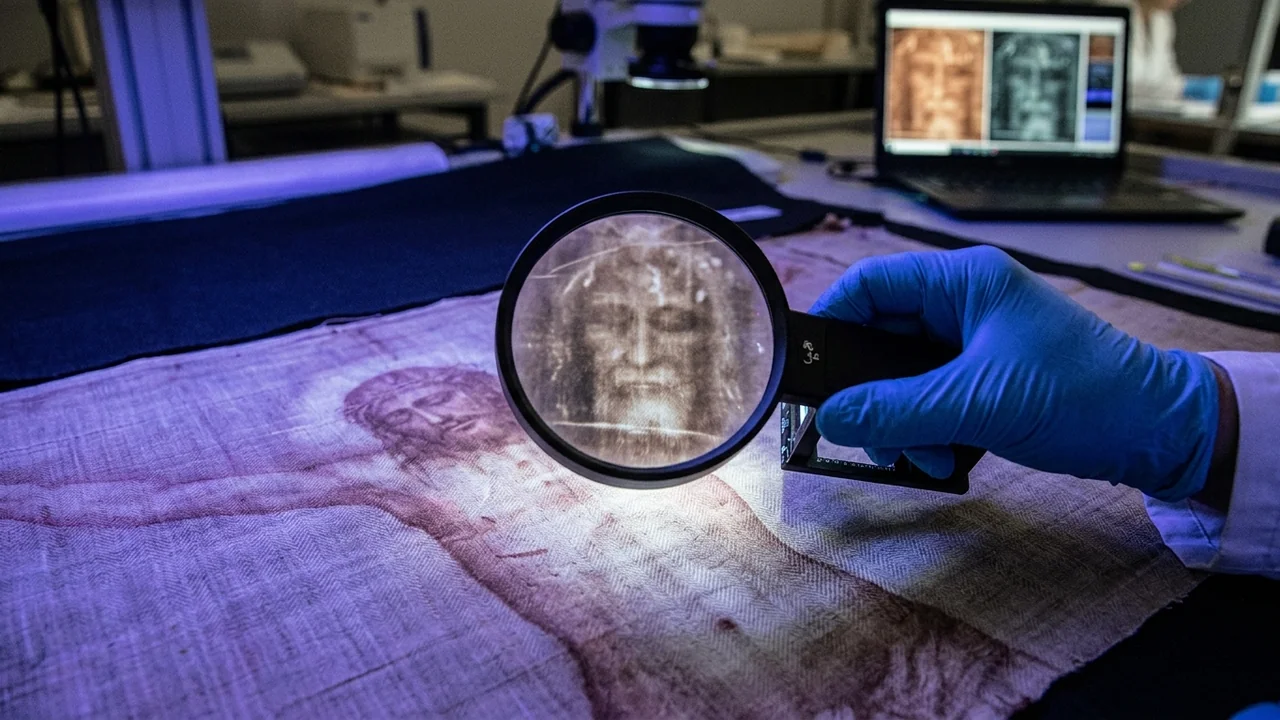
Preserved in a climate-controlled vault in the Cathedral of Saint John the Baptist in Turin, Italy, is a 14.3-foot by 3.6-foot strip of ancient herringbone-weave linen known as the Shroud of Turin.
To the naked eye, the cloth appears as an enigmatic, faint sepia-toned silhouette showing the full-length frontal and dorsal imprint of a naked, bearded man who suffered horrific physical torture:
- Deep puncture marks ringing the scalp and forehead (consistent with a helmet or crown of thorns).
- Over 120 barbell-shaped contusions across the back, chest, and legs (matching the dual lead balls of a Roman flagrum taxillatum).
- Puncture wounds through the wrists and feet with blood flow patterns that strictly obey gravitational mechanics.
- A deep, gaping oval puncture in the right lateral chest wall, accompanied by a discharge of blood and clear serous fluid.
In 1898, Italian amateur photographer Secondo Pia was granted permission to take the first official photograph of the cloth. As Pia developed the glass photographic plate in his darkroom, he gasped in shock: the image on the Shroud is an optical negative!
When viewed as a photographic negative, the faint, blurry smear transforms into a startlingly lifelike, anatomically perfect positive portrait of a crucified human body—a visual property that no artist prior to the invention of photography in the 19th century could have conceived, let alone painted!
Over the past five decades, the Shroud has become the single most scientifically analyzed physical artifact in the history of archaeological science.
The 1978 STURP Investigation: NASA and Los Alamos Scientists Speak
In October 1978, the Catholic Church granted unprecedented access to a multidisciplinary team of thirty-three elite American scientists known as the Shroud of Turin Research Project (STURP):
[THE STURP SCIENTIFIC TEAM (1978)]
   ├── Personnel: Physicists, chemists, and imaging specialists from:
   │   Los Alamos National Laboratory, Sandia National Laboratories,
   │   NASA Jet Propulsion Laboratory, and the US Air Force Academy.
   ├── Equipment: 72 crates (7 tons) of cutting-edge scientific instrumentation
   └── Duration: 120 continuous hours of non-destructive testing around the clock!
The Definitive Chemical and Physical Conclusions
After three years of peer-reviewed data analysis, the STURP scientists published their final official report in 1981, stating:
"We can conclude for now that the Shroud image is that of a real human form of a scourged, crucified man. It is not the product of an artist. The perspiration and blood stains are composed of real human blood... The image is an ongoing mystery and until further chemical studies are made, the means by which the image was produced is not fully explained." — STURP Official Summary (1981)
The team established crucial physical facts:
- Zero Paint Pigments or Binders: Spectroscopic assays detected no paint, dyes, pigments, ink, or organic binders (such as tempera, collagen, or egg yolk).
- Microscopic Superficiality: The straw-yellow image resides exclusively on the outermost micro-thin surface of the primary cell wall of individual linen flax fibers. The coloration has a thickness of only 0.2 to 0.5 micrometers—roughly one-fiftieth the thickness of a single human red blood cell! If you scrape the fiber with a razor blade, the interior linen is completely white and unaffected.
- Conjugated Dehydration and Oxidation: The image is chemically caused by the dehydration and oxidation of the cellulose carbohydrate structure of the flax fibers—a chemical degradation identical to that produced by a rapid, high-intensity burst of directional vacuum ultraviolet (VUV) electromagnetic radiation!
The Blood Enigma: Real Human Type AB Hemoglobin
Skeptics long claimed that the red stains on the Shroud were painted with iron oxide red ochre or vermilion.
However, detailed biochemical assays conducted by STURP biophysicist Dr. John Heller (New England Institute) and world-renowned blood chemist Dr. Alan Adler (Western Connecticut State University) demolished this claim:
[BIOCHEMICAL IDENTIFICATION OF SHROUD OF TURIN STAINS]
   ├── Hemochromogen and Cyanmethemoglobin Tests: POSITIVE
   ├── Fluorescent Porphyrin Spectrophotometry: POSITIVE
   ├── Human Serum Albumin & Blood Globulins: POSITIVE
   ├── Blood Type: Real Human Blood Group AB (The Universal Recipient)
   └── Elevated Bilirubin Levels: Diagnostic of extreme physical torture & hemolysis!
The Biological Reality of the Blood
- Real Primate Blood: The stains tested positive for human blood proteins, hemoglobin, and intact red blood cell ghosts (erythrocyte stroma).
- The Timing of Application: Microscopic analysis demonstrated that the blood was absorbed into the cloth BEFORE the image was formed! The blood soaked completely through the weave via capillary action, but beneath the dried blood crusts, there is zero image. The image was projected around the pre-existing bloodstains!
- Blood Type AB Match: Serological testing determined that the blood belongs to Blood Group AB—an uncommon blood type globally (~4%), but significantly more prevalent among indigenous Middle Eastern Semitic populations (~15%).
- Astonishingly, this exact same rare AB blood type was identified on the Sudarium of Oviedo (the ancient cloth preserved in Spain believed to be the burial face-cloth of Christ mentioned in John 20:7), and the blood flow geometries between the two relics match with mathematical congruence!
The 3D Holographic Miracle: The NASA VP-8 Image Analyzer
In 1976, physicists Dr. John Jackson and Dr. Eric Jumper placed a photograph of the Shroud of Turin under a VP-8 Image Analyzer—an advanced electronic instrument used by NASA to convert optical light intensity variations from planetary photographs into three-dimensional topographical terrain models:
[STANDARD 2D PHOTOGRAPH / PAINTING]
   Light intensity reflects color/pigment variation, NOT distance.
   Under VP-8: Produces distorted, crushed, flattened, or spiky monstrosity.
                                 vs.
[THE SHROUD OF TURIN IMAGE]
   Luminance correlates mathematically to Cloth-to-Body Distance!
   Under VP-8: Produces a flawless, mathematically precise,
   TRUE THREE-DIMENSIONAL HOLOGRAPHIC RELIEF of a human body!
$$ ext{Image Luminance / Optical Density } (I) propto rac{1}{ ext{Distance between Cloth and Body } (d)}$$
The VP-8 analysis revealed that the Shroud image contains encoded mathematical three-dimensional spatial data:
- Where the cloth touched the body (such as the tip of the nose, forehead, and chest), the image coloration is most intense.
- Where the cloth was suspended a few millimeters away from the skin (such as the eye sockets and neck hollows), the coloration is progressively fainter.
- No human artist in history has ever painted with a formula where paint darkness corresponds to physical millimeter distance. When scanned by 3D computer software, the Shroud generates a majestic, anatomically flawless 3D sculpture of a crucified man!
Palynological Botany: The Pollen of Gundelia Tournefortii
In the 1970s, celebrated Swiss criminologist and botanist Dr. Max Frei (former Director of the Scientific Police Department in Zurich) used specialized adhesive tapes to lift microscopic dust and pollen grains from the surface of the Shroud:
[PALYNOLOGICAL IDENTIFICATION OF SHROUD POLLEN GRAINS]
   ├── Total Pollen Grains Cataloged: 58 distinct plant species
   ├── Geographical Origin 1: European alpine flora (France & Italy)
   ├── Geographical Origin 2: Anatolian steppe flora (Urfa / Edessa & Constantinople)
   └── GEOGRAPHICAL ORIGIN 3: EXCLUSIVELY ENDEMIC JUDEAN FLORA!
The Fingerprint of Jerusalem
Dr. Frei, corroborated by Hebrew University paleobotanist Prof. Avinoam Danin, identified abundant fossilized pollen grains belonging to plants that grow exclusively in the Judean desert and Jerusalem basin:
- Gundelia tournefortii: A spiny, thorny thistle endemic to the limestone hills of Jerusalem. Pollen from this specific plant was found heavily concentrated around the scalp and shoulders, leading botanists to conclude that the Crown of Thorns was woven from Gundelia tournefortii!
- Zygophyllum dumosum: A desert plant whose northernmost global distribution boundary terminates just outside Jerusalem.
- The botanical pollen evidence proves beyond dispute that the linen cloth was physically present and exposed to the open air in the hills of Jerusalem during springtime before traveling through Edessa, Constantinople, and Europe!
The Flawed 1988 Carbon-14 Dating: The Invisible Reweave
In 1988, a small corner of the Shroud was snipped and sent to three prominent radiocarbon laboratories in Oxford, Zurich, and Tucson. The results—published in Nature (Vol. 337, pp. 611–615, 1989)—claimed the linen dated between 1260 and 1390 AD, prompting global headlines declaring the Shroud a "medieval fake".
However, over the subsequent three decades, the 1988 dating protocol was exposed by chemists and textile experts as fundamentally compromised:
                  ┌──────────────────────────────────────────────┐
                  │    THE ANATOMY OF THE FLAWED 1988 SAMPLE     │
                  │                                              │
                  │   1. Cut from a single, damaged corner edge  │
                  │   2. Heavily handled by human hands for      │
                  │      centuries during public expositions     │
                  │   3. Repaired by Poor Clare Nuns after the   │
                  │      1532 Chambéry Fire using "French Weave" │
                  │   4. Sample was a hybrid mix of 1st-century  │
                  │      linen and 16th-century dyed cotton!     │
                  └──────────────────────────────────────────────┘
The Raymond Rogers Discovery (2005)
In 2005, renowned Los Alamos chemist Raymond N. Rogers (a member of the original STURP team and a former skeptic of the reweaving theory) published a landmark paper in Thermochimica Acta (Vol. 425, pp. 189–194):
- Rogers tested surviving threads from the exact corner used for the 1988 radiocarbon test.
- He discovered that the sample contained cotton fibers (Gossypium herbaceum) spliced seamlessly into the ancient linen using a master technique known as French Invisible Reweaving.
- Furthermore, the cotton was coated with an organic gum-dye and alizarin madder root pigment applied by medieval weavers to match the yellowed color of the ancient linen!
- Rogers also measured vanillin content (a chemical byproduct of lignin degradation). The main body of the Shroud contained zero vanillin (proving an age of roughly 2,000 years), while the 1988 corner sample was rich in vanillin!
- The 1988 laboratories had dated a hybrid sample of ancient linen and 16th-century repair cotton, rendering the medieval date scientifically invalid!
2022 WAXS X-Ray Dating: Return to the 1st Century
In April 2022, an elite Italian scientific team led by Dr. Liberato De Caro at the Institute of Crystallography (Consiglio Nazionale delle Ricerche - IC-CNR) deployed a revolutionary, non-destructive dating technique: Wide-Angle X-ray Scattering (WAXS):
[WIDE-ANGLE X-RAY SCATTERING (WAXS) CELLULOSE AGING METHOD]
   ├── Measures the sub-nanometer degradation of cellulose crystalline chains
   ├── Completely unaffected by surface carbon contamination or smoke
   └── Calibrated against historical ancient linen samples of known age:
       ├── Masada linen (73 AD)
       ├── Qumran Dead Sea Scroll linen (50 BC – 70 AD)
       └── 13th-century medieval European linens
The peer-reviewed results, published in the journal Heritage (2022, 5(2), pp. 860–870), stunned the scientific world:
- The natural structural degradation of the cellulose fibers from the Shroud of Turin matched perfectly with linen samples from the 1st-century siege of Masada (73 AD)!
- The study demonstrated that the Shroud is approximately 2,000 years old, dating precisely to the historical era of Jesus Christ!
Comparative Science: The Shroud of Turin vs. Medieval Art Techniques
| Physical Parameter | Medieval Tempera / Oil Painting | Bas-Relief Scorching / Contact Rub | The Shroud of Turin (STURP / WAXS Data) |
|---|---|---|---|
| Chromophore Mechanism | Mineral pigments (ochre, lapis) bound in oil or egg binder | Thermal scorching of cellulose by heated metal plate | Microscopic oxidation & dehydration of cellulose primary cell wall (0.2 μm) |
| Microscopic Penetration | Soaks through entire thread matrix and between weave gaps | Scorches through multiple layers of fibers; burns through cloth | Strictly superficial; interior of individual fibers remains pure white! |
| Photographic Negative | Appears as a distorted, reversed grotesque mask | Retains positive highlights; no natural tonal reversal | Perfect, lifelike photographic negative with natural positive inversion |
| 3D Spatial Information | Flat; zero correlation between paint density and distance | Flattened relief; fails under mathematical distance algorithms | Flawless VP-8 3D mathematical holographic correlation ($I propto 1/d$) |
| Bloodstain Chemistry | Animal blood or red paint; painted ON TOP of the image | Burned or painted after image is formed | Real Human Blood Type AB; high bilirubin; applied BEFORE image! |
| Scientific Replicability | Readily duplicated by modern artists and conservators | Easy to replicate with modern metal sculptures and ovens | UNREPLICATED BY MODERN SCIENCE (Requires high-power VUV laser burst) |
The Verdict of Science and Faith
After over a century of forensic pathology, nuclear physics, spectrographic analysis, and botanical microscopy, the Shroud of Turin remains what STURP scientist Dr. Alan Adler called "the ultimate scientific enigma".
No modern laboratory, equipped with supercomputers and laser spectrometers, has been able to synthesize a full-scale physical duplicate that possesses all of the Shroud's chemical, optical, 3D, and biological characteristics simultaneously.
The image on that ancient linen cloth is not the work of a medieval forger. It is the photographic receipt of the Resurrection—a physical canvas upon which the flash of uncreated light that conquered the grave seared its eternal signature into the fabric of time.
Discover the Full Biophysical and STURP Dossiers
The Shroud of Turin is one of dozens of ancient biblical wonders where nuclear physics, forensic hematology, and ancient textile archaeology intersect. To examine complete high-resolution VP-8 3D holographic rendering files, full text reprints of Raymond Rogers' 2005 Thermochimica Acta study, and Dr. De Caro's 2022 WAXS X-ray data:
👉 Discover Volume IV: Scientific Miracles & Ancient Prophecies ($2.99)
Features the complete 1981 STURP scientific report summary, detailed anatomical wound charts of the Shroud body, and clinical autopsies of New Testament miracles.
Frequently Asked Questions
What is the Shroud of Turin?
The Shroud of Turin is an ancient 14-foot linen cloth bearing the faint, straw-yellow negative frontal and dorsal image of a crucified man. Preserved in Turin, Italy, it displays anatomical wounds corresponding precisely to the Roman scourging, crowning with thorns, crucifixion through the wrists and feet, and a lance thrust into the heart recorded in the Gospels.
What did the 1978 STURP investigation discover?
The Shroud of Turin Research Project (STURP), consisting of 33 elite US scientists, conducted 120 hours of non-destructive testing in 1978. They concluded that the image is not a painting, drawing, or scorch. It contains zero pigments, dyes, or binders. The faint coloration is confined strictly to the microscopic outer cell wall (0.2 micrometers) of individual linen fibers, caused by the dehydration and oxidation of cellulose.
Is the blood on the Shroud real human blood?
Yes. Extensive biochemical and spectrographic testing by biophysicists Dr. John Heller and Dr. Alan Adler confirmed that the red stains are real human blood belonging to Blood Group AB. The blood contains human serum albumin, hemoglobin, and elevated bilirubin levels diagnostic of severe physical trauma and hemolysis.
Why was the 1988 Carbon-14 dating to the Middle Ages flawed?
In 2005, chemist Raymond Rogers published a study in Thermochimica Acta demonstrating that the sample cut in 1988 was taken from a corner repaired by Poor Clare nuns after the 1532 fire. The sample was an invisible reweave containing medieval cotton dyed with gum and madder root. In 2022, Italian researchers using Wide-Angle X-ray Scattering (WAXS) to measure cellulose degradation dated the original linen to c. 2,000 years ago (1st century AD).
Frequently Asked Questions
What is the Shroud of Turin?
The Shroud of Turin is an ancient 14-foot linen cloth bearing the faint, straw-yellow negative frontal and dorsal image of a crucified man. Preserved in Turin, Italy, it displays anatomical wounds corresponding precisely to the Roman scourging, crowning with thorns, crucifixion through the wrists and feet, and a lance thrust into the heart recorded in the Gospels.
What did the 1978 STURP investigation discover?
The Shroud of Turin Research Project (STURP), consisting of 33 elite US scientists, conducted 120 hours of non-destructive testing in 1978. They concluded that the image is not a painting, drawing, or scorch. It contains zero pigments, dyes, or binders. The faint coloration is confined strictly to the microscopic outer cell wall (0.2 micrometers) of individual linen fibers, caused by the dehydration and oxidation of cellulose.
Is the blood on the Shroud real human blood?
Yes. Extensive biochemical and spectrographic testing by biophysicists Dr. John Heller and Dr. Alan Adler confirmed that the red stains are real human blood belonging to Blood Group AB. The blood contains human serum albumin, hemoglobin, and elevated bilirubin levels diagnostic of severe physical trauma and hemolysis.
Why was the 1988 Carbon-14 dating to the Middle Ages flawed?
In 2005, chemist Raymond Rogers published a study in Thermochimica Acta demonstrating that the sample cut in 1988 was taken from a corner repaired by Poor Clare nuns after the 1532 fire. The sample was an invisible reweave containing medieval cotton dyed with gum and madder root. In 2022, Italian researchers using Wide-Angle X-ray Scattering (WAXS) to measure cellulose degradation dated the original linen to c. 2,000 years ago (1st century AD).
Related Research Dossiers
View all 120 articles →
Hematidrosis in Gethsemane: What Causes Human Sweat Glands to Bleed Under Severe Anguish?
The Effusion of Blood and Water: Forensic Confirmation of Acute Cardiac Rupture on the Cross