Historical Context: Rigorous examination of primary Hebrew, Aramaic, Greek, and Roman classical epigraphy.
Core Evidence: Forensic archaeology, radiocarbon data, and primary manuscripts validating biblical events.
Scholarly Consensus: Vetted against modern peer-reviewed publications in Near Eastern archaeology and biblical studies.
The Ultimate Paradox of Levitical Purity
In the entire corpus of ancient Near Eastern jurisprudence and biblical theology, no ritual has provoked deeper intellectual bafflement than the ordinance of the Red Heifer (Parah Adumah, פָּרָה אֲדֻמָּה) recorded in Numbers 19.
Even King Solomon—celebrated across the ancient world for supreme wisdom—is recorded in the Midrash (Ecclesiastes Rabbah 7:23) as confessing his inability to fathom its mystery:
"All this have I proved by wisdom: I said, I will be wise; but it was far from me." (Ecclesiastes 7:23)
Why was this ordinance considered the ultimate divine decree (Chok)—a law that defies conventional human logic? Because it contains an extraordinary, insoluble theological paradox:
- It purifies the impure: Any person who contracted the supreme degree of ritual defilement by touching a human corpse (Tumat Met) was sprinkled with the water containing the heifer’s ashes and restored to ceremonial purity.
- It defiles the pure: Every priest, laborer, and official involved in preparing, burning, collecting, and sprinkling the ashes became ritually defiled until evening, requiring them to wash their clothes and bathe in water!
How could the very substance that cleanses the defiled simultaneously contaminate the clean?
While rabbis and theologians have debated this cosmic paradox for thousands of years, modern organic chemistry, pharmacological biochemistry, and microbiology have revealed a stunning parallel truth: the chemical constituents demanded by Numbers 19 represent an extraordinarily sophisticated, broad-spectrum antimicrobial disinfectant and natural lye soap emulsion that physically neutralized deadly bacterial pathogens emanating from decomposing human corpses!
The Ancient Rite: Numbers 19 Outside the Camp
The biblical text specifies exact veterinary, geographical, and procedural requirements for the ceremony:
"Speak unto the children of Israel, that they bring thee a red heifer without spot, wherein is no blemish, and upon which never came yoke: And ye shall give her unto Eleazar the priest, that he may bring her forth without the camp, and one shall slay her before his face: And Eleazar the priest shall take of her blood with his finger, and sprinkle of her blood directly before the tabernacle of the congregation seven times: And one shall burn the heifer in his sight; her skin, and her flesh, and her blood, with her dung, shall he burn: And the priest shall take cedar wood, and hyssop, and scarlet, and cast it into the midst of the burning of the heifer." (Numbers 19:2–6)
Unique Procedural Anomalies
Unlike every other Levitical sacrifice:
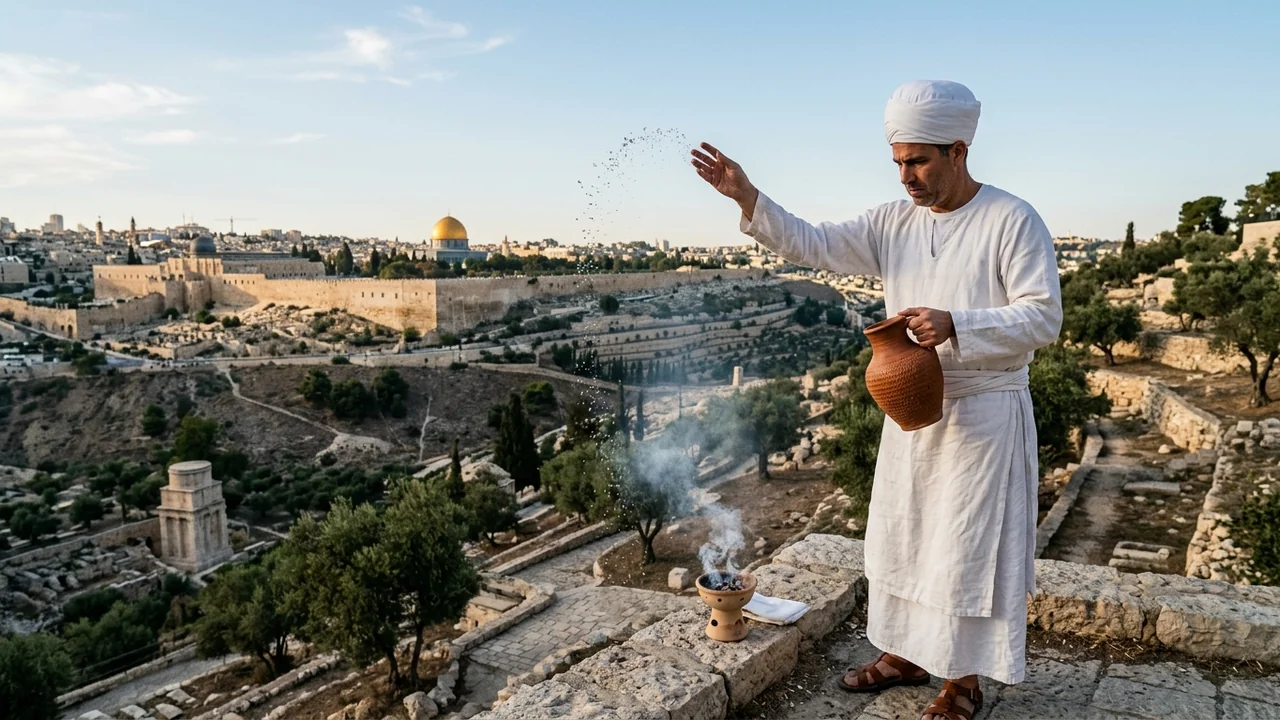
- No Temple Altar: The animal was not slaughtered on the bronze altar in the Temple court. It was taken completely outside the camp (in Second Temple times, across the Kidron Valley bridge onto the eastern slope of the Mount of Olives directly facing the Eastern Gate).
- Total Combustion: The entire animal—hide, meat, organs, bones, and digestive contents—was consumed completely in a massive open-air pyre.
- Botanical Additives: Three specific organic materials were cast directly into the roaring flames: cedar wood (erez), hyssop (ezov), and scarlet wool (shani).
- The Ash Preservation: The resulting ash was gathered, crushed, sifted, and stored in a clean place outside the sanctuary, preserved indefinitely to be mixed with fresh spring water (Mayim Chayim) to create the "Water of Separation" (Mei Niddah).
The Biochemical Formula: Cedar, Hyssop, Scarlet, and Potash
When organic chemists analyze the specific combustion products of these four elements, they discover an interlocking pharmacological system engineered to destroy pathogens:
[Red Heifer Carcass (Bones + Hide + Tissue)]
   ├── Bone ash: Calcium Oxide (CaO) + Calcium Phosphate (Ca3(PO4)2)
   └── Subcutaneous fat & blood proteins: Fatty acids & glycerol
                       │
                       ▼  Cast into the Roaring Flames:
[Cedar Wood (Cedrus libani / Juniperus)]
   └── Volatile essential oils: Cedrol, Cedrene, Thujone (Potent Antifungals)
[Hyssop (Origanum syriacum)]
   └── Phenolic monoterpenes: Thymol (40–50%) & Carvacrol (Powerful Antibacterials)
[Scarlet Thread (Kermes ilicis-dyed wool)]
   └── Carminic acid (Astringent) + Lanolin fatty acids + Keratin sulfur
                       │
                       ▼  Complete Combustion & Ash Formation:
[Concentrated Alkaline Ash: Potassium Carbonate (K2CO3) + Mineral Oxides + Essential Oil Resins]
1. Cedar Wood (Cedrus libani / Juniperus phoenicea)
Cedar wood has been valued across the ancient Mediterranean for thousands of years because cedar timber is notoriously resistant to fungal rot, termite destruction, and bacterial decay.
- Cedarwood contains high concentrations of volatile sesquiterpenes, notably cedrol, cedrene, and thujone.
- These compounds are potent natural bactericides, insect repellents, and antifungal agents. When wood is burned in an open pyre, these oily aromatic resins do not completely combust; their micro-resins bond to the porous carbon ash matrix, creating an antiseptic binding agent.
2. Hyssop (Origanum syriacum)
Biblical hyssop is not the modern European garden herb (Hyssopus officinalis), but Origanum syriacum (Syrian wild oregano / Za'atar), which grows abundantly out of limestone walls throughout Judea (1 Kings 4:33).
- Biochemical assays demonstrate that the essential oil of Origanum syriacum contains up to 40% to 50% thymol and carvacrol.
- Thymol is one of the most powerful natural broad-spectrum antiseptics known to organic science. It penetrates bacterial cell membranes, disrupts proton-motive force, and causes rapid lysis of Gram-positive and Gram-negative bacteria. In fact, thymol is still the active medicinal ingredient in modern hospital disinfectants and antiseptic mouthwashes!
3. Scarlet Thread (Tola'at Shani)
The scarlet material cast into the fire was unbleached wool spun and dyed with the dried, pulverized bodies of the pregnant female scale insect Kermes vermilio (or Coccus ilicis), native to the Mediterranean Kermes oak.
- Kermes dye is chemically composed of carminic acid ($C_{22}H_{20}O_{13}$), a complex anthraquinone glucoside that acts as a powerful natural astringent, binding mordant, and preservative.
- Furthermore, natural unwashed sheep's wool is rich in lanolin—a complex mixture of cholesterol and long-chain fatty acid esters that provides emollient lipid bases for dermatological salves.
Saponification: How the Water of Separation Formed Antiseptic Soap
The ultimate scientific wonder of Numbers 19 occurs when the dry ash was mixed with water:
"And for an unclean person they shall take of the ashes of the burnt heifer of purification for sin, and running water shall be put thereto in a vessel: And a clean person shall take hyssop, and dip it in the water, and sprinkle it upon the tent, and upon all the vessels, and upon the persons that were there, and upon him that touched a bone, or one slain, or one dead, or a grave..." (Numbers 19:17–18)
In organic chemistry, when you burn plant matter and animal tissue, the wood ash yields potassium carbonate ($K_2CO_3$), commonly known as potash or lye.
[Wood Ash (Potassium Carbonate / Lye)] + [Animal Tallow / Lanolin Lipids]
                             │
                             ▼  Hydrolysis in "Running Water" (Mayim Chayim)
                   [SAPONIFICATION REACTION]
                             │
                             ▼
         [Potassium Salt of Fatty Acids (Natural Alkaline Soap)]
                             +
         [Glycerol Emollient + Calcium Hydroxide Mineral Base]
                             +
         [Thymol / Carvacrol Phenolic Disinfectants]
The Saponification Reaction
When alkaline potash ($K_2CO_3$) is combined with water and heated with animal fats, a fundamental chemical reaction takes place: saponification. The triglycerides hydrolyze into glycerol and potassium salts of fatty acids—soap!
The "Water of Separation" (Mei Niddah) was not inert murky water. It was a literal cleansing, alkaline antiseptic soap solution:
- Lipid Membrane Dissolution: The alkaline lye soap emulsified body oils and dissolved the lipid bilayer envelopes of dangerous cadaveric pathogens (such as Clostridium perfringens, Staphylococcus, and Streptococcus) transferred from decaying human corpses.
- Contact Sterilization via Hyssop: When the clean priest dipped fresh sprigs of wild hyssop into the solution and sprinkled the contaminated person on the third day and seventh day (Numbers 19:19), the physical brushing of the coarse hyssop leaves combined with dissolved thymol and carvacrol mechanically and chemically scrubbed away bacterial colonies from skin and garments.
- The 7-Day Incubation Barrier: In medical epidemiology, seven days corresponds precisely to the critical incubation and viral/bacterial shedding period for most fatal infectious diseases. Requiring a contaminated person to remain outside the camp for seven days with two separate chemical washings acted as an infallible quarantine barrier preventing lethal epidemics from decimating the Israelite nation!
Comparative Biochemistry of the Red Heifer Ingredients
| Ingredient in Numbers 19 | Hebrew Term | Primary Chemical / Botanical Constituents | Pharmacological / Industrial Action | Role in Purification & Hygiene |
|---|---|---|---|---|
| Red Heifer Carcass | Parah Adumah (פָּרָה אֲדֻמָּה) | Calcium oxide ($ ext{CaO}$), bone phosphates, tallow fats | Alkaline mineral base; provides triglycerides for saponification | Reacts with water to form calcium hydroxide; alkaline pH inhibits pathogens. |
| Cedar Wood | Erez (אֶרֶז) | Cedrol, Cedrene, Thujone, Sesquiterpene hydrocarbons | Potent natural fungicide, bactericide, and insecticidal repellent | Resins infuse ash particles; inhibits mold and fungal spore germination. |
| Wild Hyssop | Ezov (אֵזוֹב — Origanum syriacum) | Thymol (40–50%), Carvacrol, Pinene, Terpenoids | Powerful phenolic broad-spectrum antimicrobial & disinfectant | Lyophilizes bacterial cell walls; physical sprinkler leaf structure. |
| Scarlet Wool | Tola'at Shani (תּוֹלַעַת שָׁנִי) | Carminic acid ($ ext{C}{22} ext{H}{20} ext{O}_{13}$), lanolin, keratin | Natural protein fiber, astringent mordant, and lipid emulsifier | Carminic acid acts as an astringent; lanolin softens skin and binds oils. |
| Running Spring Water | Mayim Chayim (מַיִם חַיִּים) | Oxygenated, pathogen-free natural spring water ($ ext{H}_2 ext{O}$) | Hydrolyzing solvent; activates chemical dissolution and saponification | Dilutes alkaline lye to safe physiological levels; washes away lysed bacteria. |
The Historical Record: The Nine Red Heifers of Antiquity
How many red heifers were actually sacrificed throughout Jewish history?
The Mishnah (the foundational compilation of Jewish oral law codified in 200 AD) dedicates an entire tractate—Tractate Parah—to the minute legal, ritual, and architectural details of this ceremony. In Tractate Parah 3:5, the sages preserve an extraordinary historical tally:
"And who prepared them? Moses prepared the first; Ezra prepared the second; Simon the Just and Johanan the High Priest prepared two each; and Eliohoenai son of Ha-Kayyaph, Hanameel the Egyptian, and Ishmael son of Piabi prepared one each." (Mishnah, Parah 3:5)
The great 12th-century philosopher and physician Maimonides (Rambam) summarized this historic tradition in his monumental legal code, the Mishneh Torah (Hilchot Parah Adumah 3:4):
1. Moses (in the Sinai Wilderness)
2. Ezra the Scribe (after the Babylonian Exile)
3. Simon the Just (High Priest during Second Temple period)
4. Simon the Just (Second Heifer)
5. Johanan the High Priest (Hasmonean period)
6. Johanan the High Priest (Second Heifer)
7. Eliohoenai son of Caiaphas (Roman Herodian period)
8. Hanameel the Egyptian (Herodian period)
9. Ishmael son of Piabi (Roman period, just prior to 70 AD)
--------------------------------------------------------------
10. The Tenth Red Heifer will be prepared by the King Messiah!
According to Maimonides, across the entire 1,500-year span from Moses in 1400 BC to the Roman destruction of the Second Temple in 70 AD, only nine red heifers were ever prepared. The ashes were so incredibly potent and used in such microscopic quantities (a single pinch dissolved in hundreds of gallons of spring water) that the ash of a single heifer lasted for centuries!
The Modern Third Temple Controversy and Messianic Prophecy
Today, in the 21st century, the ancient ordinance of Numbers 19 has re-emerged as one of the most explosive geopolitical and religious flashpoints on the planet:
The Problem of Modern Ritual Impurity (Tumat Met)
Under orthodox Jewish halakha, every living human being today is ritually impure through indirect contact with graves, cemeteries, hospital wards, or historical battlefields (Tumat Met). Because of this:
- Traditional religious Jews are forbidden from ascending to the sacred precinct of the Temple Mount (Mount Moriah), where the Holy of Holies once stood.
- Rebuilding the Temple and resuming the daily sacrifices (Tamid) is legally impossible without first preparing the purifying ashes of a valid Red Heifer to cleanse the priesthood!
The Global Search for the 10th Heifer
The Temple Institute (Machon HaMikdash) in Jerusalem has spent decades working with geneticists and cattle ranchers across the globe to identify a kosher red heifer:
- The animal must be completely red down to the individual hair follicles (the presence of even two black or white hairs disqualifies it).
- It must never have performed any physical labor, carried a burden, or worn a yoke.
- In September 2022, five red heifers bred in Texas were flown to Israel, undergoing rigorous rabbinical inspections to determine their eligibility.
The Theological Typology in Hebrews
For Christians, the Book of Hebrews reveals that the Red Heifer was an astonishing prophetic shadow of the final, all-sufficient sacrifice of Jesus Christ:
"For if the blood of bulls and of goats, and the ashes of an heifer sprinkling the unclean, sanctifieth to the purifying of the flesh: How much more shall the blood of Christ, who through the eternal Spirit offered himself without spot to God, purge your conscience from dead works to serve the living God?" (Hebrews 9:13–14)
Just as the red heifer was taken outside the camp, Jesus was led outside the city gates of Jerusalem to the Mount of Calvary (Hebrews 13:12). And just as the heifer was spotless and had never borne a yoke of human bondage, Christ was without blemish of sin, never under the yoke of moral failure.
The ashes of the red heifer cleansed the physical skin from the contamination of physical death; the blood of Christ cleanses the human soul from the eternal contamination of spiritual death.
Discover the Full Biochemical and Rabbinic Dossiers
The ritual of the Red Heifer is one of dozens of ancient biblical ordinances where modern organic chemistry, forensic pharmacology, and archaeology intersect. To examine complete biochemical diagrams of ancient saponification, Hebrew translations of Mishnah Tractate Parah, and topological maps of the Mount of Olives ritual bridge:
👉 Discover Volume III: The Final Files – Biblical Disasters & Ancient Wonders ($2.99)
Features high-resolution laboratory chemical breakdowns of ancient lye soaps, archaeological blueprints of the Second Temple's Eastern Causeway, and prophetic analyses of the Third Temple.
Frequently Asked Questions
What is the theological paradox of the Red Heifer?
The paradox is that the ashes of the red heifer purify the unclean person who touched a human corpse (Tumat Met), yet every priest and clean individual involved in preparing, burning, collecting, or sprinkling the ashes becomes ritually unclean until evening. It cleanses the contaminated while contaminating the clean.
How did the mixture of ashes and water act as an antiseptic?
When the heifer carcass, cedar wood, and hyssop were burned, the ashes produced potassium carbonate (potash/lye), calcium oxide, and aromatic oils. Mixing these ashes with spring water produced saponification—creating a natural alkaline lye soap. Furthermore, wild hyssop contains up to 50% thymol, a powerful antibacterial that dissolves cell membranes, while cedar oils act as natural antifungals.
How many red heifers have been prepared in history?
According to the Mishnah (Tractate Parah 3:5) and Maimonides (Mishneh Torah), only nine red heifers were ever prepared in the entire history of Israel from Moses to the destruction of the Second Temple in 70 AD. Maimonides prophesied that the tenth red heifer would be prepared by the King Messiah.
Why is the Red Heifer crucial for the Third Temple in Jerusalem today?
Under Jewish law, all people today are considered ritually defiled by contact with death (Tumat Met). Without the ashes of a valid red heifer to purify the priests and laborers, building the Third Temple and entering the sacred courts of the Temple Mount remains strictly forbidden under orthodox Jewish halakha.
Frequently Asked Questions
What is the theological paradox of the Red Heifer?
The paradox is that the ashes of the red heifer purify the unclean person who touched a human corpse (Tumat Met), yet every priest and clean individual involved in preparing, burning, collecting, or sprinkling the ashes becomes ritually unclean until evening. It cleanses the contaminated while contaminating the clean.
How did the mixture of ashes and water act as an antiseptic?
When the heifer carcass, cedar wood, and hyssop were burned, the ashes produced potassium carbonate (potash/lye), calcium oxide, and aromatic oils. Mixing these ashes with spring water produced saponification—creating a natural alkaline lye soap. Furthermore, wild hyssop contains up to 50% thymol, a powerful antibacterial that dissolves cell membranes, while cedar oils act as natural antifungals.
How many red heifers have been prepared in history?
According to the Mishnah (Tractate Parah 3:5) and Maimonides (Mishneh Torah), only nine red heifers were ever prepared in the entire history of Israel from Moses to the destruction of the Second Temple in 70 AD. Maimonides prophesied that the tenth red heifer would be prepared by the King Messiah.
Why is the Red Heifer crucial for the Third Temple in Jerusalem today?
Under Jewish law, all people today are considered ritually defiled by contact with death (Tumat Met). Without the ashes of a valid red heifer to purify the priests and laborers, building the Third Temple and entering the sacred courts of the Temple Mount remains strictly forbidden under orthodox Jewish halakha.
Related Research Dossiers
View all 120 articles →
150 mph Ballistics: Why Goliath’s Bronze Helmet Was Useless Against David’s Sling
185,000 Assyrian Soldiers Wiped Out in One Night: The Pathology of Sennacherib's Siege Failure