Historical Context: Rigorous examination of primary Hebrew, Aramaic, Greek, and Roman classical epigraphy.
Core Evidence: Forensic archaeology, radiocarbon data, and primary manuscripts validating biblical events.
Scholarly Consensus: Vetted against modern peer-reviewed publications in Near Eastern archaeology and biblical studies.
The Strategic Four-Day Delay in Bethany
In John 11, the Gospel narrative records what is arguably the most climactic, legally irrefutable public miracle of Jesus’s ministry: the resurrection of Lazarus of Bethany.
When word reached Jesus across the Jordan that his beloved friend was critically ill, Christ performed an action that seemed completely incomprehensible, even cruel, to onlookers:
"When he had heard therefore that he was sick, he abode two days still in the same place where he was. Then after that saith he to his disciples, 'Let us go into Judaea again... Our friend Lazarus sleepeth; but I go, that I may awake him out of sleep.'" (John 11:6–11)
By the time Jesus finally arrived at the rocky hill town of Bethany—located less than two miles east of Jerusalem on the slopes of the Mount of Olives—the tragedy had hardened into permanent finality:
"Then when Jesus came, he found that he had lain in the grave four days already... Martha, the sister of him that was dead, saith unto him, 'Lord, by this time he stinketh: for he hath been dead four days.'" (John 11:17, 39)
Why did Jesus deliberately wait until Lazarus had been dead for four full days?
Through the twin lenses of ancient rabbinic thanatology and modern forensic microbiology, the answer becomes dazzlingly clear: four days was the absolute, non-negotiable threshold separating medical uncertainty from irreversible biological decay. Jesus waited so that no skeptic, no physician, and no member of the Sanhedrin could claim that Lazarus had merely fainted into a coma!
Rabbinic Thanatology: The Three-Day Soul Tradition
In 1st-century Jewish culture, medical science possessed no electrocardiograms, electroencephalograms, or stethoscopes to detect faint heartbeats. Because individuals occasionally lapsed into deep cataleptic comas, severe hypothermia, or profound syncope—only to wake up hours later—the ancient world was terrified of premature burial.
To prevent burying living people, Jewish law codified a strict three-day mourning and inspection protocol, preserved in the Jerusalem Talmud (Talmud Yerushalmi, Moed Katan 3:5) and the Midrash (Genesis Rabbah 100:7):
┌────────────────────────────────────────────────────────────────────────┐
│             THE RABBINIC THREE-DAY DOCTRINE OF THE SOUL                │
│                                                                        │
│ "Bar Kappara taught: The full intensity of mourning lasts for three   │
│  days. Why? For three days the soul hovers over the body, thinking     │
│  that it may return into it.                                           │
│  But as soon as it sees that the appearance of the face has changed,   │
│  it departs and leaves the body forever."                             │
│                                — Jerusalem Talmud (Moed Katan 3:5)     │
└────────────────────────────────────────────────────────────────────────┘
The Three-Day Threshold of Hope
- Days 1 to 3: Family members and mourners regularly visited the rock-cut burial cave to weep, look through the tomb entrance, and ensure the deceased had not merely fallen into a deep trance. During these first seventy-two hours, popular belief held that the spirit still lingered nearby, holding open the faint possibility of revival.
- The Fourth Day: By Day 4, all hope was officially, legally terminated. In Middle Eastern heat, seventy-two hours of post-mortem bacterial putrefaction drastically distorts the facial features. The soft tissues of the nose, lips, and cheeks collapse, turning greenish-black. The soul was believed to depart permanently, and biological death was certified as absolute and irreversible.
If Jesus had arrived on Day 1, Day 2, or Day 3, cynical critics would have scoffed: "He was not truly dead! He was merely asleep or in a diabetic coma, and the cooler air of the cave revived him!" By arriving on Day 4, Jesus stripped away every shred of rationalistic evasion.
Forensic Microbiology: The Biological Cascade of Decomposition
What physically happens inside a human corpse sealed within an un-refrigerated Judean limestone cave tomb over four days at ambient temperatures of 25°C to 30°C (77°F to 86°F)?
In forensic pathology, human decomposition is a violent, predictable biological cascade:
[DEATH: Circulatory & Respiratory Cessation]
                     │
                     ▼  HOURS 0–24 (Day 1)
[Algor Mortis (Cooling) + Rigor Mortis (Rigor peak @ 12h) + Livor Mortis]
                     │
                     ▼  HOURS 24–48 (Day 2)
[AUTOLYSIS (Cellular Self-Destruction)]
   ├── Intracellular lysosomes rupture, releasing hydrolytic digestive enzymes
   ├── Cells digest themselves from within; pH drops to severe acidity
   └── Microvascular endothelium disintegrates, leaking cellular fluids
                     │
                     ▼  HOURS 48–72 (Day 3)
[PUTREFACTION & BACTERIAL PROLIFERATION]
   ├── Anaerobic gut microbes (Clostridium perfringens) invade blood vessels
   ├── Production of massive sulfurous gases: Hydrogen Sulfide (H2S) & Methane
   └── Chemical synthesis of PUTRESCINE & CADAVERINE (Horrific Cadaveric Fetor)
                     │
                     ▼  HOURS 72–96 (DAY 4: The Lazarus State)
[EPIDERMOLYSIS & ADVANCED CELLULAR LIQUEFACTION]
   ├── Massive bloating; skin slippage ("glove formation")
   ├── Abdominal viscera, brain, and lungs liquefy into dark purge fluid
   └── Total facial collapse; ocular globes sink into orbits
The Chemical Anatomy of "He Stinketh" (Ēdē Ozei)
When Martha protested to Jesus outside the tomb—"Lord, by this time he stinketh [ēdē ozei, literally 'already he reeks of rotten putrefaction']"—she was not guessing. She was stating an inescapable olfactory and biological fact:
- Putrescine (1,4-diaminobutane) and Cadaverine (1,5-diaminopentane): These toxic, foul-smelling diamine compounds are produced by the bacterial decarboxylation of amino acids (ornithine and lysine) in decaying flesh.
- Sulfhemoglobin Formation: Bacteria breaking down red blood cells produce hydrogen sulfide gas ($H_2S$), which binds with hemoglobin to produce sulfhemoglobin, staining the veins and skin with a grotesque greenish-black network known as "marbling".
- On Day 4, the interior of the rock tomb was filled with heavy, nauseating, pressurized gases of active decay. Opening the stone slab released an unbearable stench that was physically unmistakable.
Day Four in the Limestone Tomb: Martha’s Clinical Observation
Martha’s desperate intervention in John 11:39 reveals the raw horror of ancient burial:
"Jesus said, 'Take ye away the stone.' Martha, the sister of him that was dead, saith unto him, 'Lord, by this time he stinketh: for he hath been dead four days.'" (John 11:39)
Why did Martha protest so violently?
- The Preservation of Family Dignity: In Jewish burial practice, exposing a decomposing relative whose face had collapsed and whose abdomen had bloated under gas pressure was considered the ultimate desecration (kavod ha-met).
- The Finality of the Senses: Martha loved Jesus and believed in his power to heal the sick. But to her logical mind, there was a boundary that even miracles could not cross: molecular entropy. A sick man can be healed; a freshly dead man might be revived; but a man whose internal organs had liquefied into bacterial soup was beyond all hope!
Jesus responded with a majestic rebuke that shifted the entire dialogue from biological decay to cosmic sovereignty:
"Said I not unto thee, that, if thou wouldest believe, thou shouldest see the glory of God?" (John 11:40)
Comparative Thanatology: The Post-Mortem Timeline
| Time Elapsed | Pathological Stage | Cellular / Microscopic State | Physical / Olfactory Symptoms | Rabbinic & Forensic Status |
|---|---|---|---|---|
| Hours 0 – 12 | Early Post-Mortem | Oxygen depletion; ATP exhaustion; cellular ischemia | Algor mortis; primary flaccidity followed by jaw and limb stiffening | Senses active; mourning begins; tomb checked for signs of life. |
| Hours 12 – 24 (Day 1) | Peak Rigor Mortis | Extensive cellular hypoxia; lactic acid build-up | Full rigor mortis; fixed purple livor mortis; body is cold | Burial must occur before sunset; body wrapped in linen with myrrh and aloes. |
| Hours 24 – 48 (Day 2) | Onset of Autolysis | Lysosomal membrane rupture; enzymatic self-digestion | Rigor subsides; abdominal skin turns pale green over cecum | Mourners continue visiting tomb; soul believed to hover above body. |
| Hours 48 – 72 (Day 3) | Active Putrefaction | Anaerobic bacterial invasion of vascular tree (C. perfringens) | Marbling of veins; production of putrescine & cadaverine | Final day of potential soul return; mourning reaches peak intensity. |
| Hours 72 – 96 (Day 4: Lazarus) | Advanced Putrefaction & Liquefaction | Irreversible tissue breakdown; DNA fragmentation | Foul cadaveric fetor (ēdē ozei); skin slippage; facial collapse | Soul departs forever; death is 100% irreversible under Jewish & Roman law. |
Reversing Cellular Liquefaction: The Irreducible Miracle
When Jesus stood before the open mouth of the dark cave and cried with a loud voice: "Lazarus, come forth!" (Lazare, deuro exō), what had to occur at the sub-cellular, molecular, and biological level?
[THE COMMAND: "LAZARUS, COME FORTH!"]
                   │
                   ▼  Instantaneous Sub-Cellular Reconstruction
         ┌─────────────────────────────────────────────────────────┐
         │ 1. Complete clearing of putrescine, cadaverine & H2S   │
         │ 2. Instant resynthesis of fragmented DNA strands        │
         │ 3. Regeneration of lysed cell membranes & organelles    │
         │ 4. Reconstitution of fresh blood volume & hemoglobin    │
         │ 5. Full restoration of brain architecture & memories    │
         │ 6. Restarting of electrical sinus rhythm in myocardium  │
         └─────────────────────────────────────────────────────────┘
                   │
                   ▼
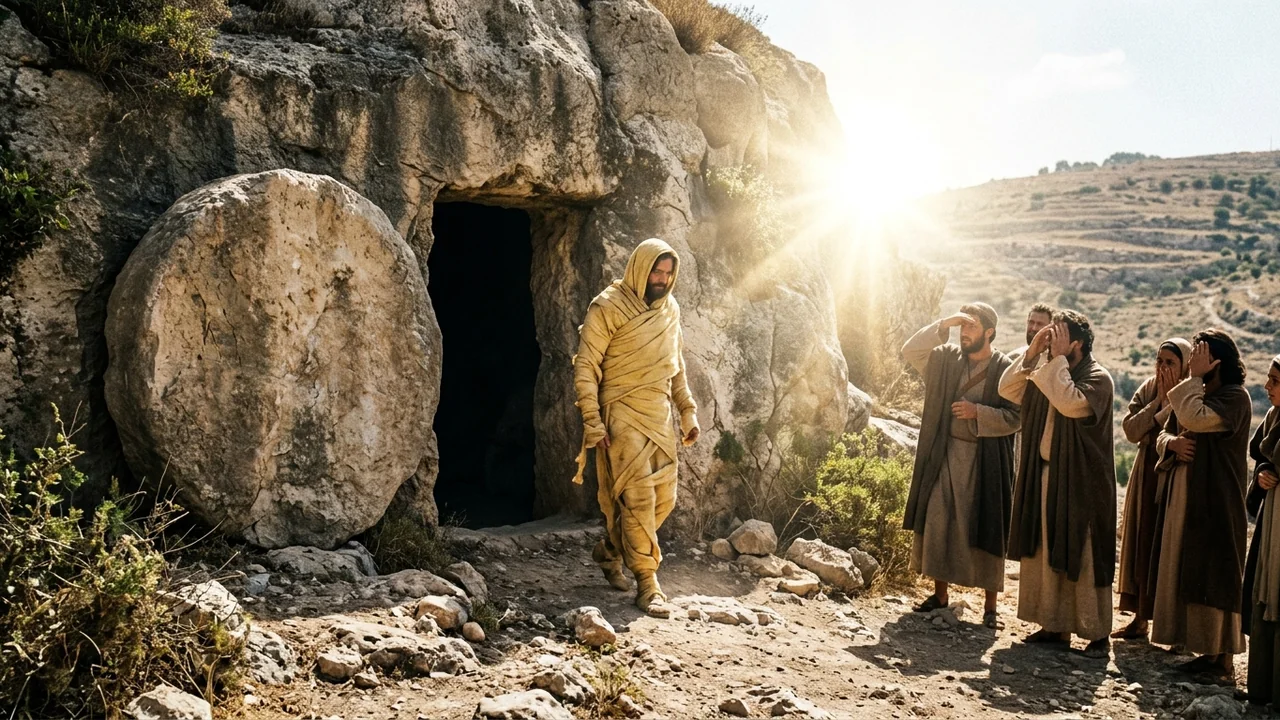
[Lazarus Sits Up, Breathes, Stands, and Walks Out of the Tomb!]
This was not a simple cardiac resuscitation or defibrillation of an arrested heart.
- It was an instantaneous reversal of entropy ex nihilo.
- Billions of decomposed cells that had disintegrated into liquefied sludge were instantly reassembled, repaired, and infused with biological life.
- The trillion anaerobic bacteria that were devouring his liver and intestines were instantly purged or returned to benign homeostasis.
- Brain synapses containing thirty years of memories, language, personality, and love were restored with pristine clarity.
Lazarus did not stagger out as an infected, brain-damaged survivor of anoxic brain injury. He walked out in full, robust biological health!
The Linen Bindings and the Sudarium: Medical Proof of Movement
The final detail recorded in John 11 provides a striking forensic signature of authentic eyewitness testimony:
"And he that was dead came forth, bound hand and foot with graveclothes: and his face was bound about with a napkin. Jesus saith unto them, 'Loose him, and let him go.'" (John 11:44)
In 1st-century Jewish burial custom:
- The Grave Clothes (Keiriai): The body was wrapped mummy-style in long strips of linen bandage, with aromatic spices (myrrh and aloes) layered between the cloth to retard the odor of decay. The arms and legs were individually bound.
- The Face Napkin (Soudarion): A separate square piece of linen cloth was wrapped around the jaw to keep the mouth closed in death, covering the face.
When Lazarus heard the command of the Son of God:
- He had to physically sit up, swing his legs off the rock burial shelf (arcosolium), and shuffle or hop out through the low entrance of the tomb while still wrapped like a mummy!
- He could not see where he was going because the soudarion was still tied over his eyes and face.
- Jesus commanded the terrified onlookers: "Loose him, and let him go." They had to physically step forward, untie the linen strips, peel away the spice-soaked wrappings, and touch the warm, smooth, breathing, living flesh of the man they had buried four days earlier!
The raising of Lazarus on the fourth day was so public, so undeniable, and so scientifically catastrophic for the skeptical establishment that John 12:10 records: "the chief priests consulted that they might put Lazarus also to death; because that by reason of him many of the Jews went away, and believed on Jesus."
They could not dispute the science; they could not deny the decomposition; they could not refute the four days. They could only seek to kill the living evidence that Jesus Christ is the Resurrection and the Life!
Discover the Full Thanatology and Forensic Dossiers
The raising of Lazarus is one of dozens of ancient biblical wonders where modern forensic pathology, biochemistry, and rabbinic history intersect. To examine complete histological decomposition charts, ancient Talmudic burial legal codes, and 3D architectural models of 1st-century Judean cave tombs:
👉 Discover Volume IV: Scientific Miracles & Ancient Prophecies ($2.99)
Features detailed thanatological flowcharts of human decomposition, full translations of Jerusalem Talmud tractates on death, and clinical autopsies of New Testament resurrections.
Frequently Asked Questions
Why did Jesus wait four days before traveling to Lazarus's tomb?
Under 1st-century Jewish tradition (preserved in the Jerusalem Talmud, Moed Katan 3:5), mourners visited the tomb for three days because the soul was believed to linger near the body. By the fourth day, visible decomposition distorted the face and the soul departed permanently. Jesus waited four days so that biological death was officially, legally, and scientifically indisputable.
What did Martha mean by "he stinketh" in John 11:39?
Martha used the Greek word ēdē ozei ("already he reeks"). In Middle Eastern heat (25°C–30°C), seventy-two hours of post-mortem decay produces massive bacterial putrefaction, releasing volatile sulfurous gases, putrescine, and cadaverine. She knew that opening the tomb would release an overwhelming, nauseating stench of active decomposition.
Could Lazarus have been in a temporary coma?
No. An individual in a deep cataleptic coma or syncope sealed inside a cold, oxygen-poor rock tomb without water or food would either die of asphyxiation or dehydrate within 72 to 96 hours. Furthermore, Martha and the family specifically identified the odor of advanced decomposition, which only occurs after active bacterial autolysis and tissue liquefaction.
Why was Lazarus bound in grave clothes?
Jewish burial customs required wrapping the limbs in long strips of linen (keiriai) embedded with aromatic spices, while a cloth (soudarion) was wrapped around the head to keep the mouth closed. When Jesus called him forth, Lazarus had to shuffle out of the tomb while still physically bound, requiring the astonished crowd to untie him.
Frequently Asked Questions
Why did Jesus wait four days before traveling to Lazarus's tomb?
Under 1st-century Jewish tradition (preserved in the Jerusalem Talmud, Moed Katan 3:5), mourners visited the tomb for three days because the soul was believed to linger near the body. By the fourth day, visible decomposition distorted the face and the soul departed permanently. Jesus waited four days so that biological death was officially, legally, and scientifically indisputable.
What did Martha mean by "he stinketh" in John 11:39?
Martha used the Greek word ēdē ozei ("already he reeks"). In Middle Eastern heat (25°C–30°C), seventy-two hours of post-mortem decay produces massive bacterial putrefaction, releasing volatile sulfurous gases, putrescine, and cadaverine. She knew that opening the tomb would release an overwhelming, nauseating stench of active decomposition.
Could Lazarus have been in a temporary coma?
No. An individual in a deep cataleptic coma or syncope sealed inside a cold, oxygen-poor rock tomb without water or food would either die of asphyxiation or dehydrate within 72 to 96 hours. Furthermore, Martha and the family specifically identified the odor of advanced decomposition, which only occurs after active bacterial autolysis and tissue liquefaction.
Why was Lazarus bound in grave clothes?
Jewish burial customs required wrapping the limbs in long strips of linen (keiriai) embedded with aromatic spices, while a cloth (soudarion) was wrapped around the head to keep the mouth closed. When Jesus called him forth, Lazarus had to shuffle out of the tomb while still physically bound, requiring the astonished crowd to untie him.
Related Research Dossiers
View all 120 articles →
Hematidrosis in Gethsemane: What Causes Human Sweat Glands to Bleed Under Severe Anguish?
The Effusion of Blood and Water: Forensic Confirmation of Acute Cardiac Rupture on the Cross