Historical Context: Rigorous examination of primary Hebrew, Aramaic, Greek, and Roman classical epigraphy.
Core Evidence: Forensic archaeology, radiocarbon data, and primary manuscripts validating biblical events.
Scholarly Consensus: Vetted against modern peer-reviewed publications in Near Eastern archaeology and biblical studies.
The Shadow of the Gevirah: The Power of the Queen Mother in Judah
In the political architecture of the ancient Kingdom of Judah, the most powerful woman in the realm was never the king’s wife; it was the king’s mother. Known in the Hebrew text by the official constitutional title Ha-Gevirah (literally, "The Great Lady" or "The Queen Mother"), this office possessed immense constitutional, religious, and executive authority.
In an ancient royal court where monarchs practiced polygamy and fathered scores of children by numerous wives and concubines, no single queen consort held legal supremacy. However, the mother of the reigning king occupied a formalized royal office:
- She wore an official royal diadem (nezer).
- She sat upon an elevated throne placed at the right hand of the monarch (1 Kings 2:19).
- She served as the chief political counselor to the crown and was the official patroness of royal temple cults.
In the late 10th and early 9th centuries BC, that supreme matriarchal office was held with an iron grip by one of the most formidable women in biblical history: Queen Maacah.
Queen Maacah: Royal Bloodlines of Absalom and Rehoboam
Maacah was the granddaughter of Prince Absalom (the rebellious son of King David) through his beautiful daughter Tamar (2 Samuel 14:27; 2 Chronicles 11:20). Married to King Rehoboam (the son of Solomon), Maacah became Rehoboam's favorite wife:
"And Rehoboam loved Maacah the daughter of Absalom above all his wives and his concubines... and Rehoboam made Abijah the son of Maacah the chief, to be ruler among his brethren: for he thought to make him king." (2 Chronicles 11:21–22)
Following Rehoboam’s death, her son Abijah (Abijam) reigned for three short, wicked years, during which Maacah consolidated her religious network. When Abijah died young, his son Asa ascended the throne as a young boy around 911 BC.
Because Asa was still a minor, Queen Dowager Maacah ruled as the de facto regent and supreme Gevirah of Jerusalem.
Under her patronage, the religious syncretism that had begun in Solomon’s later years exploded into institutional state apostasy. Maacah filled Jerusalem with pagan altars, introduced sacred male prostitutes (qedeshim) into temple precincts, and personally commissioned the construction of a notorious, grotesque cultic idol dedicated to the Canaanite fertility goddess Asherah.
The "Horror" in the Grove: What Was the Miphletseth?
The biblical chroniclers describe Maacah's private idol with unique linguistic revulsion. In 1 Kings 15:13 and 2 Chronicles 15:16, the Hebrew text records:
"And also concerning Maacah the mother of Asa the king, he removed her from being queen, because she had made an idol in a grove; and Asa cut down her idol, and stamped it, and burnt it at the brook Kidron."
The word translated as "an idol in a grove" in the Hebrew text is miphletseth le-Asherah (literally, "a horror", "a shuddering thing", or "an object of trembling for Asherah").
The term miphletseth appears nowhere else in the entire Hebrew Bible. Derived from the root p-l-ts ("to shudder", "convulse", or "tremble with horror"), ancient rabbinic and patristic scholars investigated what this object actually was:
- The Latin Vulgate (Saint Jerome): Jerome translated the phrase as simulacrum Priapi—an explicit effigy of Priapus, the Greco-Roman god of fertility characterized by an exaggerated, grotesque phallic form!
- The Talmudic Tradition (Tractate Avodah Zarah 44a): The Jewish sages record that Maacah fashioned an obscene, life-sized phallic fertility monstrosity designed for ecstatic, sexually explicit ritual worship in the sacred grove: "What is a miphletseth? Rabbi Joseph taught: She made a phallic carving which she embraced and venerated daily."
- Canaanite Asherah Pole: Archaeological excavations across Iron Age Judah have confirmed that Asherah was worshiped through carved wooden poles and living sacred groves (asherim), representing the primordial goddess of fertility, motherhood, and raw sexual vitality. Maacah had taken this ancient pagan fertility cult and placed an obscene, monumental effigy at the very gates of Solomon’s Temple!
[Queen Mother Maacah (Ha-Gevirah)]
                     │
                     ├──► Supreme Constitutional Power at King's Right Hand
                     │
                     ├──► Commissioned the "Miphletseth" (Grotesque Asherah Idol)
                     │         └── Phallic / Fertility wooden monstrosity
                     │
                     ├──► King Asa's Daring Coup d'État (900 BC)
                     │         └── Stripped grandmother of the title "Gevirah"
                     │
                     └──► The Kidron Purge & Incineration
                               └── Idol chopped down, crushed to dust, burned in Kidron
The Coup of King Asa: Stripping the Crown from His Grandmother
As King Asa grew into manhood, he experienced a radical spiritual awakening. Influenced by the prophetic preaching of Azariah son of Oded (2 Chronicles 15:1–7), Asa resolved to purge the kingdom of idolatry and restore covenant fidelity to Yahweh.
Yet, to cleanse the nation, Asa had to confront the most powerful, intimidating person in his kingdom: his own grandmother, Queen Mother Maacah.
In an extraordinary display of moral courage that shocked the royal court of Jerusalem, Asa executed a royal constitutional purge:
"And also Maacah his mother, even her he removed from being queen (hesirah mi-gevirah), because she had made an abominable idol for Asherah: and Asa cut down her idol, and crushed it, and burnt it at the brook Kidron." (2 Chronicles 15:16)
The phrase hesirah mi-gevirah means literally: "He deposed her from the office of Great Lady."
Asa stripped Maacah of her royal diadem, revoked her constitutional privileges, evicted her from her official court chambers, and abolished the office of the Queen Mother! For a young monarch in the patriarchal ancient Near East to publicly depose his own grandmother was an act of revolutionary political daring that sent shockwaves across Judah.
The Kidron Incinerator: Sacred Geography of Purification
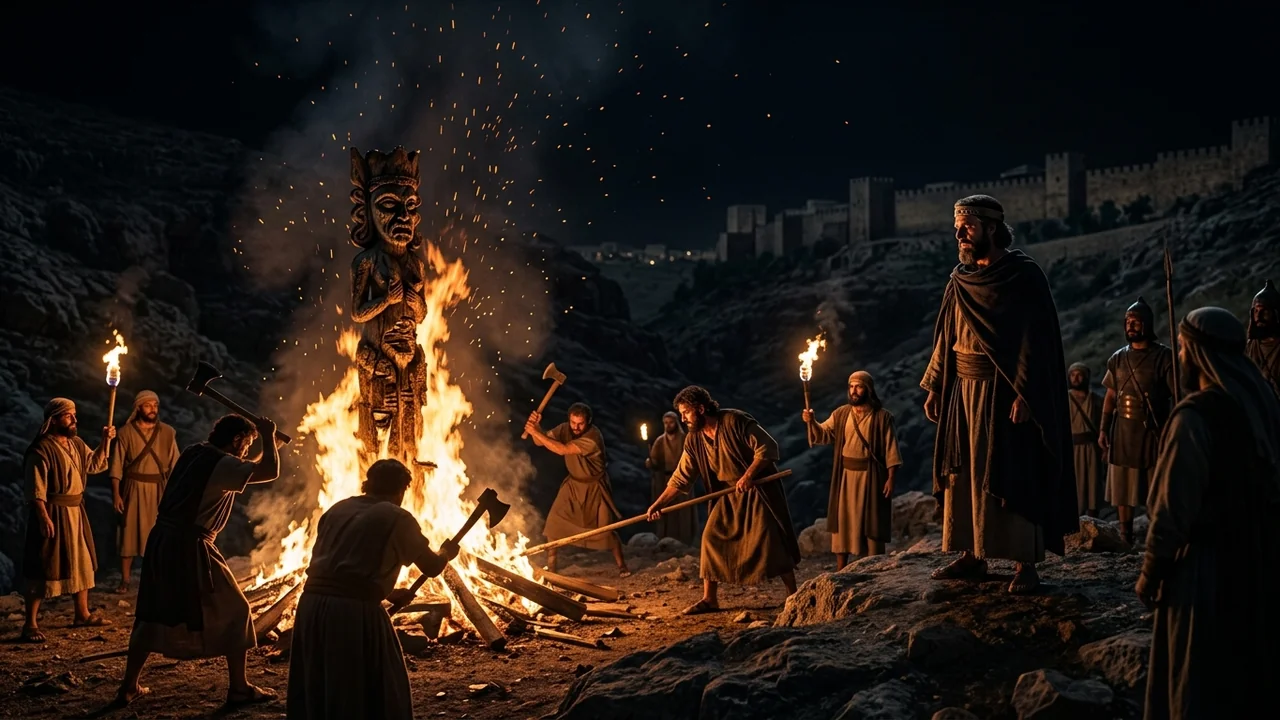
Having deposed the Queen Mother, Asa took the grotesque wooden idol (miphletseth) and led his guards out of the city walls to the Brook Kidron (Nahal Qidron):
"And Asa cut down her idol, and stamped it, and burnt it at the brook Kidron." (1 Kings 15:13)
The Hebrew text notes a three-stage mechanical destruction:
- Va-yikhrot ("He cut it down"): The heavy wooden pole was felled with axes.
- Va-yadeq ("He crushed it / stamped it to powder"): The wood was shattered and pulverized into tiny splinters.
- Va-yisrof ("He burned it with fire"): The debris was consumed in an enormous bonfire by the waters of the Kidron.
The Kidron Valley, located immediately east of the Temple Mount and City of David, functioned as ancient Jerusalem’s sacred purification incinerator and public refuse dump:
- King Hezekiah later dumped the defiled altars of Ahaz into the Kidron (2 Chronicles 29:16).
- King Josiah pulverized the altars of Baal and the Asherah poles, casting their dust upon the graves of the common people in the Kidron (2 Kings 23:4–12).
- The ashes of the Red Heifer were sprinkled over the Kidron slopes.
By incinerating Maacah’s idol in the Kidron refuse dump, Asa declared that the supreme goddess of pagan Canaan was nothing more than biological sewage and burning trash in the sight of the Living God.
Archaeological Excavations: Cultic Figurines in Jerusalem
Archaeological excavations throughout Iron Age II strata in Jerusalem have provided vivid material confirmation of the pervasive Asherah cult denounced in 1 Kings 15:
- Judean Pillar Figurines (JPFs): Excavations led by Dame Kathleen Kenyon, Yigal Shiloh, and the Israel Antiquities Authority in the City of David have unearthed over 1,000 Judean Pillar Figurines dating from the 10th through 7th centuries BC! These hand-modeled terracotta figurines depict a female goddess with exaggerated breasts supported by her hands, resting atop a columnar pillar base resembling a tree trunk—tangible proof of the private Asherah fertility cult sponsored by Queen Maacah!
- Kuntillet Ajrud Inscriptions: In 1975–1976, excavations at the 8th-century BC Judean desert outpost of Kuntillet Ajrud uncovered large storage jars (pithoi) bearing famous paleo-Hebrew inscriptions: "I bless you by Yahweh of Samaria and by His Asherah"—demonstrating the tragic theological syncretism that King Asa risked his crown to eradicate.
King Asa’s courageous reformation set a gold standard for biblical leadership: proving that true devotion to God requires dismantling compromise, even when it sits upon the royal throne of one’s own family.
Discover the Complete History of the Biblical Reformations
King Asa’s purge of Queen Maacah is the opening chapter of the great monotheistic reformations that preserved the faith of ancient Israel. To explore the complete archaeological catalogs, ancient inscriptions, and political chronicles of Kings Asa, Hezekiah, and Josiah:
👉 Discover Volume II: Kings & Prophets – Tragic Ends & Medical Mysteries ($2.99)
Includes exhaustive archaeological catalogs of Judean Pillar Figurines, site maps of the Kidron Valley incinerators, and complete historical profiles of ancient biblical rulers.
Frequently Asked Questions
Who was Queen Maacah?
Queen Maacah was the granddaughter of Prince Absalom through his daughter Tamar. She married King Rehoboam (son of Solomon) and served as the supreme Gevirah (Queen Mother) during the reigns of her son King Abijah and her grandson King Asa in the Kingdom of Judah.
What was the "Miphletseth" that Maacah made?
The Hebrew word miphletseth (1 Kings 15:13) means a "horror" or "shuddering thing." Ancient rabbinic tradition and the Latin Vulgate translate it as an obscene, grotesque phallic fertility effigy dedicated to the Canaanite goddess Asherah, used for ecstatic sexual rituals in the sacred grove.
Why did King Asa depose his grandmother?
King Asa was a godly monarch dedicated to covenant monotheism. When he launched his sweeping religious reforms in Judah, he refused to grant royal immunity to his own grandmother, courageously stripping Maacah of her constitutional title as Queen Mother (Gevirah) and destroying her idol.
What did King Asa do with Maacah's idol?
Asa chopped down the wooden idol, stamped it into fine splinters, and incinerated it in an enormous bonfire in the Kidron Valley outside the walls of Jerusalem. The Kidron Valley served as ancient Jerusalem's sacred purification incinerator and public refuse dump for defiled pagan artifacts.
Frequently Asked Questions
Who was Queen Maacah?
Queen Maacah was the granddaughter of Prince Absalom through his daughter Tamar. She married King Rehoboam (son of Solomon) and served as the supreme Gevirah (Queen Mother) during the reigns of her son King Abijah and her grandson King Asa in the Kingdom of Judah.
What was the "Miphletseth" that Maacah made?
The Hebrew word miphletseth (1 Kings 15:13) means a "horror" or "shuddering thing." Ancient rabbinic tradition and the Latin Vulgate translate it as an obscene, grotesque phallic fertility effigy dedicated to the Canaanite goddess Asherah, used for ecstatic sexual rituals in the sacred grove.
Why did King Asa depose his grandmother?
King Asa was a godly monarch dedicated to covenant monotheism. When he launched his sweeping religious reforms in Judah, he refused to grant royal immunity to his own grandmother, courageously stripping Maacah of her constitutional title as Queen Mother (Gevirah) and destroying her idol.
What did King Asa do with Maacah's idol?
Asa chopped down the wooden idol, stamped it into fine splinters, and incinerated it in an enormous bonfire in the Kidron Valley outside the walls of Jerusalem. The Kidron Valley served as ancient Jerusalem's sacred purification incinerator and public refuse dump for defiled pagan artifacts.
Related Research Dossiers
View all 120 articles →
The Three Piercing Darts: The Defeat and Death of Prince Absalom in the Forest of Ephraim
The Rotten Girdle of the Euphrates: The Buried Prophecies of Jeremiah Unearthed