When was the Second Temple Pool of Siloam discovered?
The authentic Second Temple Pool of Siloam was discovered in autumn 2004 during municipal sewer line excavations by archaeologists Ronny Reich and Eli Shukron at the southern end of the City of David in Jerusalem.
Ancient patristic witnesses, Second Temple manuscripts, and classical annals.
Stratigraphic digs, monumental epigraphy, and artifact forensics in the Levant.
Distinguishing canonical Scripture text from historical patristic traditions.
Subject Scope: The Pool of Siloam and Hezekiah's Tunnel: Where Jesus Healed the Man Born Blind
Historical Context: Primary Roman legal transcripts, imperial annals (Tacitus, Suetonius), and early patristic martyrologies.
Primary Evidence: Forensic trauma biomechanics, historical Roman execution praxis, and classical epigraphic inscriptions.
Investigation Highlights: The Skeptic’s Challenge to John 9 • The Accidental 2004 Discovery in the City of David • Hezekiah’s Tunnel (701 BC) and the Paleo-Hebrew Inscription
Scholarly Consensus: Cross-referenced against Roman imperial records and Mediterranean early Christian archaeological sites.
The Skeptic’s Challenge to John 9
For over a century, liberal New Testament commentators routinely claimed that the Gospel of John was a late, highly allegorized theological drama written by an anonymous Greek mystic living in Ephesus around 120–150 AD who had little to no firsthand knowledge of first-century Jerusalem geography. Critics pointed to John 9:7—where Jesus commands a man born blind to 'Go, wash in the pool of Siloam (which is by interpretation, Sent)'—as a prime example of literary allegory. They argued that the 'Pool of Siloam' was merely a spiritualized metaphor for the waters of Christian baptism, not a physical site.
Then, during an autumn afternoon in 2004, a municipal backhoe hit a stone ledge in southern Jerusalem.
Direct Historical Answer Box:
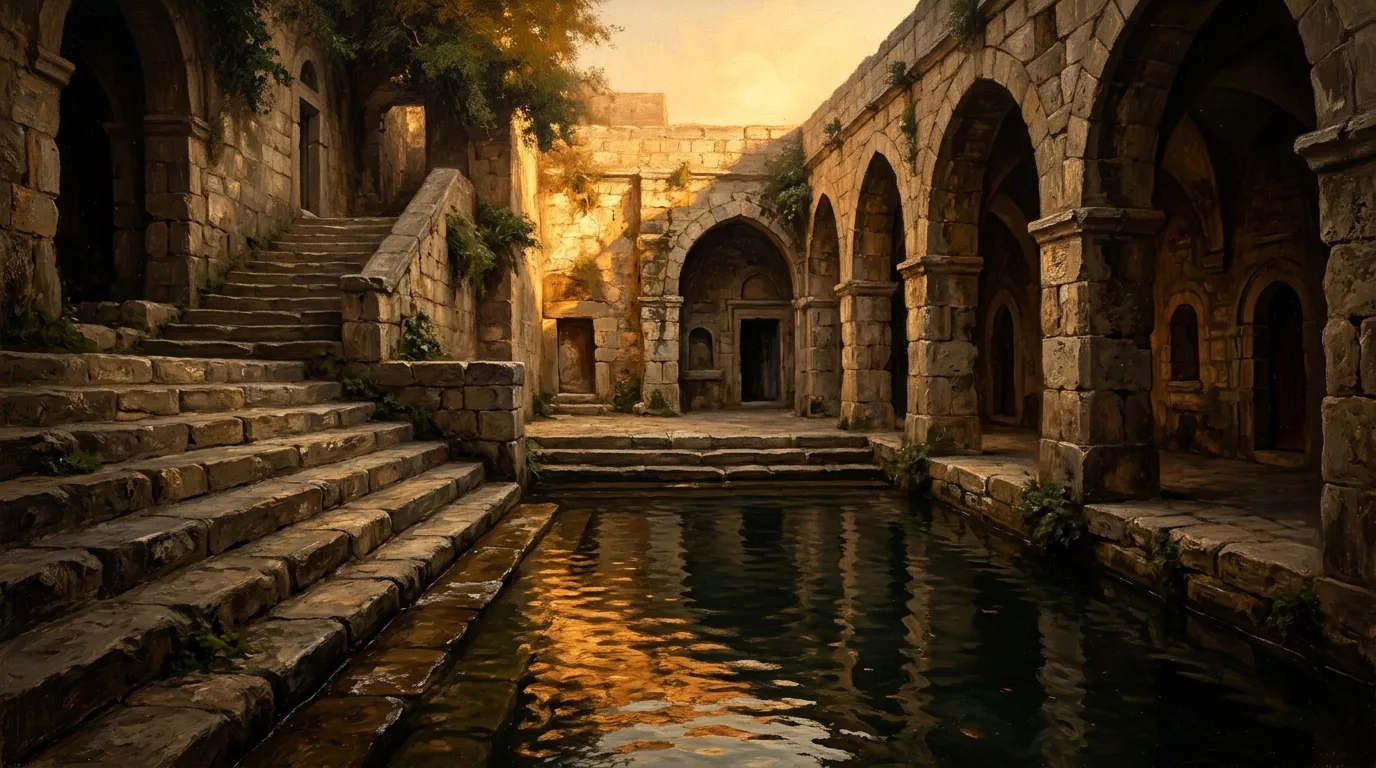
In autumn 2004, during municipal repairs on a burst sewer pipe south of the City of David, archaeologists Ronny Reich and Eli Shukron uncovered the monumental limestone tiers of the authentic Second Temple Pool of Siloam. Excavations revealed a massive 225-foot trapezoidal stone reservoir featuring three distinct tiers of five steps each, fed by Hezekiah's Tunnel (2 Chronicles 32:30). Beneath the plaster steps, archaeologists found bronze coins of Alexander Jannaeus and Pontius Pilate, proving the pool was actively used during the earthly ministry of Jesus Christ.
The discovery transformed John 9 from a disputed allegory into a concrete, touchable archaeological site where pilgrims purified themselves before ascending to the Temple Mount.
The Accidental 2004 Discovery in the City of David
Prior to 2004, tourists were shown a small, fifth-century Byzantine church pool built by Empress Eudocia, which was mistakenly identified as Siloam. But the true Second Temple pool lay completely buried under ten feet of alluvial silt in an adjacent orchard known as the King's Garden.
Key forensic architectural elements uncovered by Reich and Shukron:
- Monumental Stone Tiering: The pool featured three sets of five stone steps separated by wide landing platforms. This allowed thousands of Jewish pilgrims to step into varying water depths during major pilgrimage festivals (Passover, Pentecost, and Sukkot).
- The Immersion Function (Mikveh): The Pool of Siloam served as Jerusalem's largest public mikveh (ritual immersion bath). Pilgrims arriving from throughout the Roman Empire immersed in its living waters before ascending the 2,000-foot stepped Pilgrimage Road leading directly to the Hulda Gates of the Temple.
- Numismatic Chronological Seal: Excavators found bronze coins of Hasmonean King Alexander Jannaeus (103–76 BC) sealed beneath the foundation stones, establishing its construction date, while coins from the First Jewish Revolt (66–70 AD) were embedded in the final plaster layer, proving its destruction by Titus' Roman legions in 70 AD.
Hezekiah’s Tunnel (701 BC) and the Paleo-Hebrew Inscription
Where did the fresh, living water of Siloam come from? It was channeled from the Gihon Spring through one of the greatest engineering feats of the ancient world:
- 2 Chronicles 32:30: 'This same Hezekiah also stopped the upper watercourse of Gihon, and brought it straight down to the west side of the city of David.'
To survive Sennacherib's 701 BC siege, King Hezekiah ordered miners to carve a 1,750-foot (533-meter) S-shaped subterranean aqueduct through solid limestone bedrock. In 1880, a boy swimming in the tunnel discovered the Siloam Inscription—a 6-line paleo-Hebrew text carved into the bedrock wall describing the dramatic moment the two tunneling teams, carving from opposite ends, heard the sound of each other's pickaxes and met in the middle.
When Jesus sent the blind man to Siloam, He sent him to water that had been flowing through solid rock since the days of the Judean kings.
The Forensic Medicine of Congenital Blindness (John 9)
Consider the clinical and spiritual depth of the miracle in John 9:
- Congenital Blindness (Typhlos ek Genetes): In verse 1, John specifies that the man was blind from birth. Congenital blindness involves complete developmental absence of neural pathways between the retina, the optic nerve, and the visual cortex in the brain's occipital lobe.
- The Spittle and Clay (Pelon Epechrisen): Jesus spat on the ground and made clay with saliva, rubbing it onto the man's eyes. In ancient Jewish culture, dust was the raw material of Adam's creation (Genesis 2:7). By making clay, Christ demonstrated His sovereign identity as the Creator who formed human eyes from the dust.
- The Walk of Obedience: The blind man had to walk approximately half a mile down the steep Central Valley stepped street to Siloam with wet clay on his face. Obedience preceded physical manifestation.
When the man washed in the living waters of Siloam (Shiloach — 'Sent'), the miracle was twofold: God instantaneously created working ocular hardware in his eyes and working neurological software in his visual cortex, allowing him to interpret light, perspective, and color for the first time in his life.
Spoken Prayer for Spiritual Illumination
Proclaim this prayer of covenant sight:
"Lord Jesus Christ, Light of the World and Miracle Worker of Siloam, You who formed human eyes from the dust of the earth and command living waters to flow in dry places, I bow before You tonight. I thank You that Your miracles are grounded in real history, real stone, and real power.
Where my spiritual vision has been blinded by anxiety, cynicism, or worldliness, wash my eyes with the water of Your Word. Anoint my understanding to see Your hand moving in my family and circumstances. Give me the faith to walk in obedience even when the path is steep, and grant me spiritual clarity to walk in Your marvelous light. In Your holy name, Amen."
Forensic Medicine & Scientific Inquests
Contemporary clinical pathologists and forensic medical examiners analyzing traumatic biomechanics and physical phenomena in Scripture. Each investigation in this pillar is corroborated by primary classical manuscripts, epigraphy, and peer-reviewed historical forensics.
Pillar Dossiers in this Corpus
The Death of King Herod Agrippa I: First-Century Medical Accounts in Acts and Josephus
9 min read · Verified Primary DossierHematidrosis: The Medical Science Behind Jesus Sweating Blood in Gethsemane
10 min read · Verified Primary DossierThe Effusion of Blood and Water: Forensic Confirmation of Acute Cardiac Rupture on the Cross
15 min read · Verified Primary DossierThe Forensic Truth About Roman Scourging: Why Flagrum Whips Were Lethal Before the Cross
14 min read · Verified Primary DossierThe Unwritten Gospel: Volume IV — Scientific Miracles
Modern medical forensics analyzing microvascular hemorrhage, physiological asphyxiation, and geo-physical events in Scripture.
Primary Sources & Scholarly Archives
Editorial Standard →Primary source corpus including Tacitus (Annales), Suetonius, and early Roman provincial administrative records.
Complete verified English translations of Eusebius Pamphili, Clement of Rome, Polycarp, and Tertullian.
Subterranean Roman necropolis documentation, epigraphic graffiti, and early Christian funerary stelae.
Frequently Asked Questions
When was the Second Temple Pool of Siloam discovered?
The authentic Second Temple Pool of Siloam was discovered in autumn 2004 during municipal sewer line excavations by archaeologists Ronny Reich and Eli Shukron at the southern end of the City of David in Jerusalem.
What is the theological meaning of 'Siloam'?
John 9:7 translates Siloam from the Hebrew Shiloach (שִׁלֹחַ), meaning 'Sent.' The pool pointed prophetically to Jesus Christ, the One sent by the Father to bring spiritual illumination and cleansing to a spiritually blind world.
How long is Hezekiah's Tunnel and can you walk through it today?
Hezekiah's Tunnel is approximately 1,750 feet (533 meters) long, carved through solid limestone bedrock in 701 BC. Visitors to the City of David National Park in Jerusalem can still walk through the tunnel today in knee-deep water flowing from the Gihon Spring.
Archaeological Study Guides & Master Resources {#archaeological-study-resources}
Explore the comprehensive library of forensic archaeological investigations:- Discover all four volumes of forensic biblical evidence in The Unwritten Gospel: 4-Volume Master Bundle ($9.00).
- Investigate 40 examined historical challenges in Is That Really in the Bible? ($9.00).
- For the full set of digital study guides, explore The Sacred Keys Trilogy Master Bundle ($7.99).
Related Research Dossiers
View all 572 research dossiers →
The Death of King Herod Agrippa I: First-Century Medical Accounts in Acts and Josephus
Hematidrosis: The Medical Science Behind Jesus Sweating Blood in Gethsemane