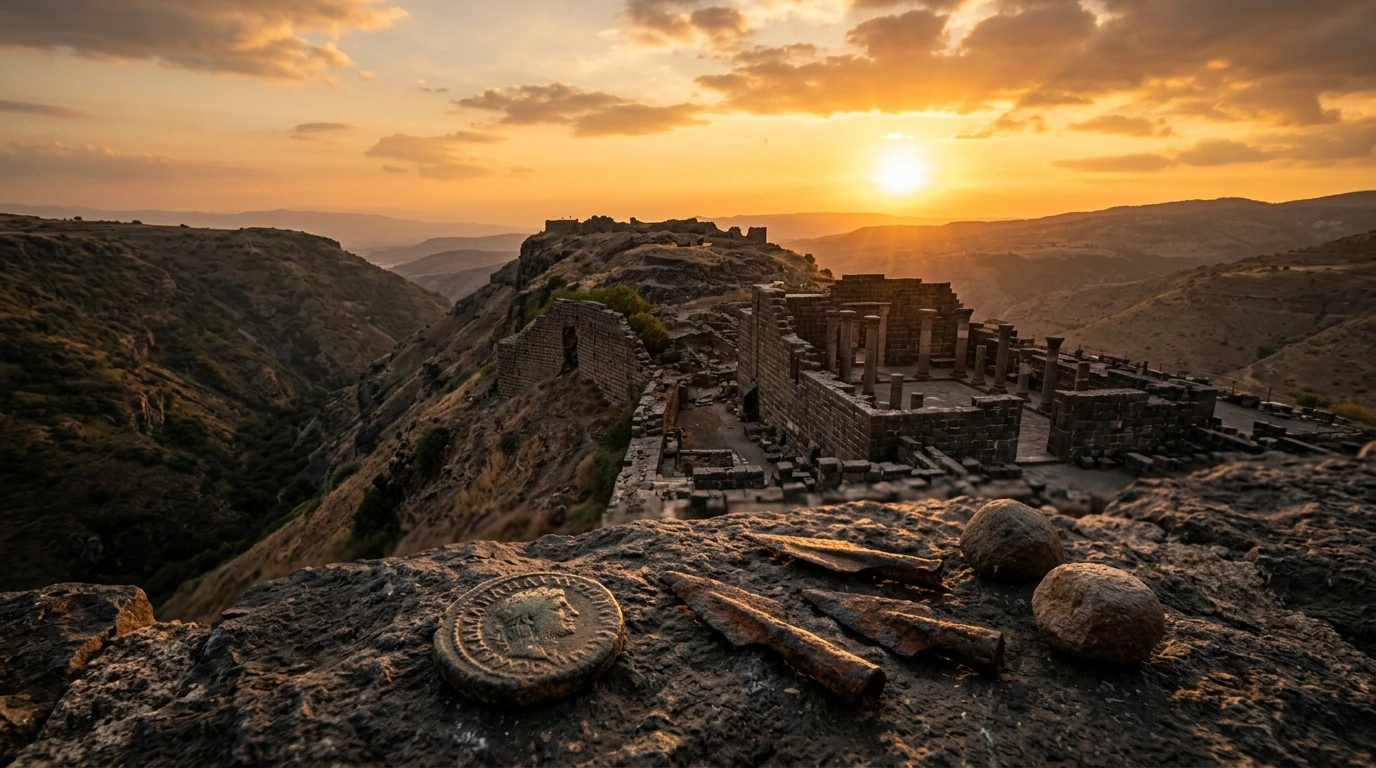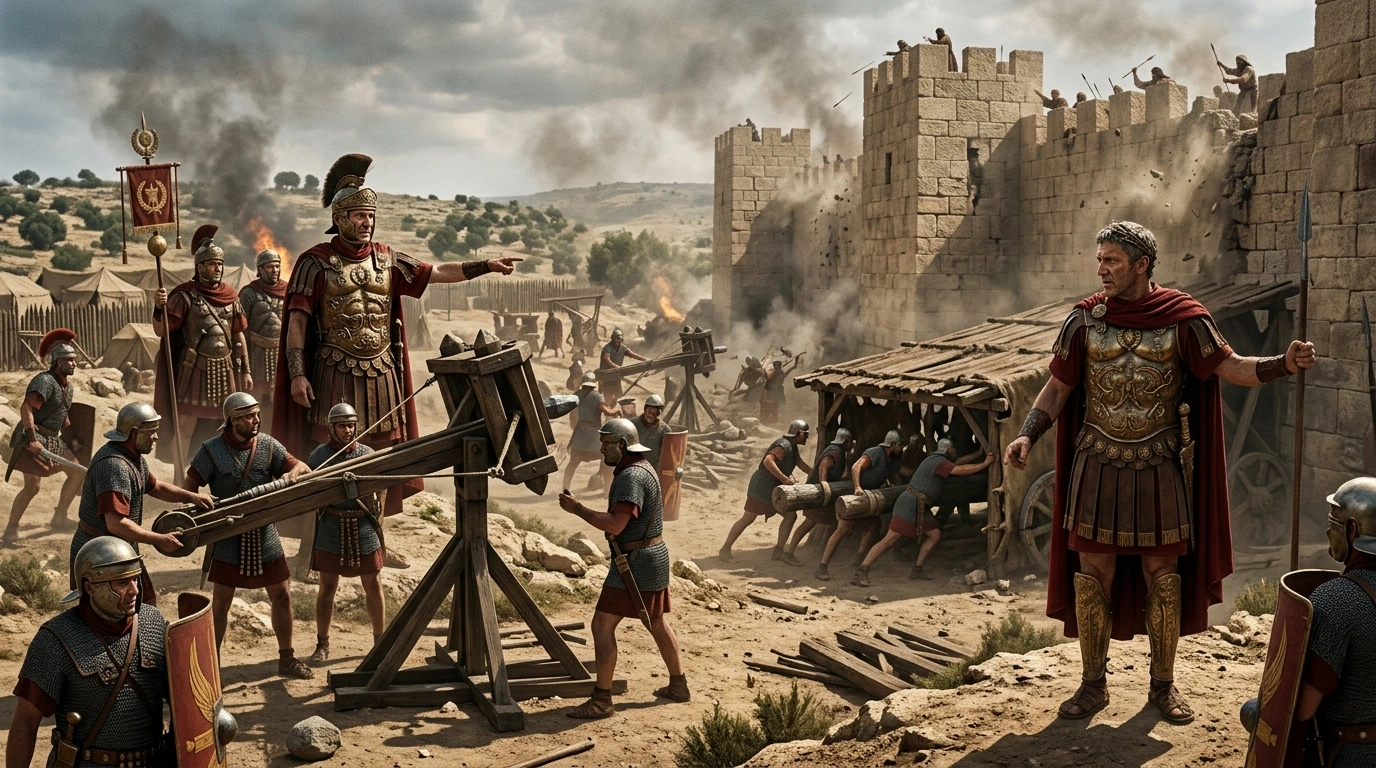
Subject Scope: Military History of the Bible: Tactics, Engineering, and Archaeology of Pompey's Siege of Jerusalem (63 BC)
Historical Context: Ancient Near Eastern stratigraphy, Levant archaeological surveys, and Semitic epigraphy.
Primary Evidence: Monumental stelae, bullae seals, ceramic typology, and calibrated AMS radiocarbon determinations.
Investigation Highlights: The Hasmonean Civil War: Hyrcanus II vs. Aristobulus II • Pompey the Great Enters the Levant: Roman Geopolitics • The Three-Month Investment of the Temple Mount
Scholarly Consensus: Aligned with published excavation reports from leading Near Eastern archaeological institutes.
The Hasmonean Civil War: Hyrcanus II vs. Aristobulus II
In 67 BC, Queen Salome Alexandra, the pious ruler of the Hasmonean Jewish kingdom, died in Jerusalem. Her death unleashed a fratricidal civil war between her two sons that destroyed Jewish national independence:
- Hyrcanus II (The Eldest): Possessing a mild, passive disposition, Hyrcanus was appointed High Priest. He was supported by the Pharisees and manipulated by his scheming chief advisor, Antipater the Idumean (the father of Herod the Great).
- Aristobulus II (The Younger): Ambitious, energetic, and aggressive, Aristobulus seized the royal army, allied with the Sadducees, and forced his elder brother to abdicate the throne.
Civil war raged across Judea. Antipater persuaded Hyrcanus to flee to Petra and enlist the military support of the Nabataean Arab king, Aretas III. Aretas marched an army of 50,000 horsemen and infantry into Judea, besieging Aristobulus inside the Temple Mount in Jerusalem.
Disgusted by the corruption and mutual slaughter of the Hasmonean royalty, the ordinary Jewish population looked for external arbitration.
Pompey the Great Enters the Levant: Roman Geopolitics
While Judea tore itself apart, the Roman Republic's greatest military commander, Gnaeus Pompeius Magnus (Pompey the Great), was redrawing the map of the ancient Near East.
Between 66 and 64 BC, Pompey extinguished the Seleucid Empire, reduced Syria to a Roman province, and established Roman hegemony across Asia Minor.
In 63 BC, while wintering in Damascus, Pompey received three separate delegations from Judea:
- Envoys from Aristobulus II, bearing a magnificent golden vine valued at 500 talents of gold (called "The Delight", Terpole).
- Envoys from Hyrcanus II and Antipater, accusing Aristobulus of lawlessness and piracy.
- A delegation from the Jewish people, begging Pompey to depose both Hasmonean brothers and abolish the monarchy entirely, restoring the traditional priestly theocracy.
Pompey marched his Roman legions south through Pella and Jericho to Jerusalem. When Aristobulus's partisans refused to surrender the fortified Temple Mount, Pompey placed Jerusalem under formal Roman military siege.
The Three-Month Investment of the Temple Mount
The Jewish population within the lower city opened the municipal gates to the Romans. However, Aristobulus's fanatical supporters severed the wooden bridge connecting the Western Hill to the Temple Mount (at Wilson's Arch), barricading themselves within the fortified Temple sanctuary:
[THE TOPOGRAPHICAL DILEMMA (JOSEPHUS, JEWISH WAR I.141–143)]
"For the temple was fortified all around on its precipitous sides,
 having a great ditch on its north side that was broad and deep.
 This ditch was cut out of the solid rock, and the towers that stood on the wall
 were of immense size, being built of squared stones."
To breach the northern wall of the Temple Mount—the sole point of land access:
- The Roman Dike: Pompey's legionaries cut down all the timber around Jerusalem to construct a massive circumvallation rampart.
- Filling the Rock-Cut Trench: The Romans labored for weeks filling the colossal northern rock-cut moat (which measured over 250 feet wide and 60 feet deep) with earth, stones, and timber balks.
- Heavy Artillery: Pompey brought specialized siege engines and iron-plated battering rams from the Roman coastal naval base at Tyre, alongside mechanical catapults (ballistae) that launched 50-pound limestone boulders into the Temple courts.
The Sabbath Tactic: Roman Engineering on the Day of Rest
The breakthrough in the siege came from Pompey's shrewd exploitation of Jewish Sabbath halakhah.
Since the Maccabean revolt (1 Maccabees 2:41), Jewish law permitted soldiers to defend their physical lives on the Sabbath if directly attacked with lethal weapons. However, Jewish defenders refused to engage in active combat on the Sabbath to prevent defensive earthworks from being constructed:
[THE SABBATH EXPLOITATION (JOSEPHUS, ANTIQUITIES XIV.63–64)]
"If it had not been our custom to rest on the seventh day, the Romans could never have completed
 their siege bank. For the law permits us to defend ourselves against those who attack us,
 but not to strike against those who are merely laboring on their siege works.
 The Romans understood this: on the days which we call the Sabbath, they hurled no weapons
 at the Jews, nor engaged in open combat, but raised up their earthworks, advanced their engines,
 and positioned their battering rams, so that on the following day they were ready to strike."
Every Saturday for nearly three months, Roman soldiers worked unhindered, raising the siege mounds, advancing iron rams, and rolling armored siege towers directly against the northern Temple towers.
The Breach, the Slaughter, and Pompey in the Holy of Holies
In the third month of the siege (in June or July 63 BC), on the Day of Fasting (the fast of the 23rd of Sivan or 9th of Tammuz):
- The Fall of the Great Tower: The largest northern Temple tower, weakened by the relentless pounding of the Roman battering rams, collapsed with a tremendous crash, bringing a broad section of the wall down with it.
- The Assault of Faustus Cornelius Sulla: Led by Faustus Sulla (the son of the Roman dictator Sulla), Roman legionaries poured through the breach, sword in hand.
- The Slaughter of the Priesthood: Over 12,000 Jews were slain in the Temple courts. Flavius Josephus records with profound reverence that the priests officiating at the golden altar continued offering daily sacrifices and burning incense even as Roman swords cut them down at the altar, their blood mixing with the sacrificial libations.
- Pompey Enters the Sanctum Sanctorum: Pompey committed the ultimate religious transgression: he marched with his military officers directly past the sacred veil into the Holy of Holies (Qodesh HaQodashim), where only the High Priest was permitted to enter once a year on Yom Kippur.
[THE SHOCK OF EMPTINESS (TACITUS, HISTORIES V.9)]
"Pompey was the first of our citizens who subdued the Jews.
 By right of conquest he entered their Temple. It is a known fact that he found within
 no image of any gods, but an empty sanctuary and an unoccupied holy place
 [vacuam sedem et inania arcana]."
Pompey was astonished. Accustomed to Greco-Roman temples filled with colossal gold-and-ivory cult statues, he found absolute emptiness. Yahweh was the transcendent, unpicturable Creator of the universe.
In an unexpected display of Roman political restraint, Pompey did not touch the Temple's golden treasures or the sacred treasury of 2,000 talents. He ordered the Temple cleansed the following day and reinstated Hyrcanus II as High Priest—stripping him of the royal crown and reducing Judea to a Roman client protectorate.
Three-Tier Evidentiary Evaluation: Pompey's Siege (63 BC)
Tier 1: Material and Physical Archaeology
- The Northern Temple Moat: Archaeological excavations along the northern wall of the Temple Mount (near the Antonia Fortress) have uncovered the massive bedrock trench cut by the Hasmoneans and filled by Pompey's legionaries.
- Hasmonean Fortifications: Stratigraphic confirmation of Hasmonean defensive towers displaying ballista projectile impact scars and reconstruction layers dating to the 1st century BC.
Tier 2: Textual and Internal Epigraphy
- Flavius Josephus (Antiquities XIV & Jewish War I): Provides comprehensive tactical military descriptions corroborated by Roman historians Strabo (Geography XVI), Cassius Dio (Roman History XXXVII), and Tacitus (Histories V).
- The Psalms of Solomon (Psalms 2 & 17): Contemporary 1st-century BC Hebrew poetry lamenting the battering rams, the trampling of the altar by Gentiles, and Pompey's subsequent assassination in Egypt.
Tier 3: Theological and Canonical Transmission
- End of Hasmonean Independence: Terminated a century of Jewish national autonomy initiated by Judas Maccabeus in 164 BC.
- Inauguration of the Roman Era: Brought Judea directly under the imperial shadow of Rome, preparing the geopolitical stage for the birth of Jesus of Nazareth under Augustus Caesar (Luke 2:1).
Frequently Asked Questions
Did Pompey loot the gold of the Temple?
No. Flavius Josephus and Cicero (Pro Flacco) explicitly record that Pompey displayed admirable restraint, refusing to touch the golden menorah, the table of showbread, the golden censers, or the sacred treasury of 2,000 talents.
What happened to Pompey after the siege?
Fifteen years later, during the Roman Civil War against Julius Caesar, Pompey was defeated at the Battle of Pharsalus (48 BC) and fled to Egypt. Upon landing at Pelusium, he was murdered and beheaded by Egyptian courtiers seeking Caesar's favor. Jewish authors (such as the author of the Psalms of Solomon) saw his mutilated, unburied body as divine vengeance for desecrating the Holy of Holies.
How did Antipater and Herod profit from Pompey's siege?
Antipater the Idumean ingratiated himself with the Romans by supplying food, water, and intelligence to Pompey's legions. The Romans rewarded Antipater with Roman citizenship and tax exemption, laying the political foundation for his son, Herod the Great, to be crowned King of the Jews by the Roman Senate in 40 BC.
Primary Sources & Scholarly Archives
Editorial Standard →Official archaeological field reports, certified stratigraphy surveys, and Semitic epigraphy catalogs.
Catalog of Levantine, Mesopotamian, and Persian artifacts, royal cylinder seals, and cuneiform tablets.
Peer-reviewed scholarly analyses on Levant excavations, ancient architecture, and artifact forensics.
Frequently Asked Questions
Did Pompey loot the gold of the Temple?
No. Flavius Josephus and Cicero (*Pro Flacco*) explicitly record that Pompey displayed admirable restraint, refusing to touch the golden menorah, the table of showbread, the golden censers, or the sacred treasury of 2,000 talents.
What happened to Pompey after the siege?
Fifteen years later, during the Roman Civil War against Julius Caesar, Pompey was defeated at the Battle of Pharsalus (48 BC) and fled to Egypt. Upon landing at Pelusium, he was murdered and beheaded by Egyptian courtiers seeking Caesar's favor. Jewish authors (such as the author of the *Psalms of Solomon*) saw his mutilated, unburied body as divine vengeance for desecrating the Holy of Holies.
How did Antipater and Herod profit from Pompey's siege?
Antipater the Idumean ingratiated himself with the Romans by supplying food, water, and intelligence to Pompey's legions. The Romans rewarded Antipater with Roman citizenship and tax exemption, laying the political foundation for his son, Herod the Great, to be crowned King of the Jews by the Roman Senate in 40 BC.
Related Research Dossiers
View all 515 research dossiers →
Prophecy, Geopolitics, and Redemptive History: The Theological Impact of the Siege of Jotapata (67 AD)
Military History of the Bible: Tactics, Engineering, and Archaeology of the Siege of Gamla ('The Masada of the North', 67 AD)