Subject Scope: The Siege of Gamla Across Ancient Inscriptions: Josephus's Jewish War, Roman Ballistics, and Numismatic Evidence
Historical Context: Ancient Near Eastern stratigraphy, Levant archaeological surveys, and Semitic epigraphy.
Primary Evidence: Monumental stelae, bullae seals, ceramic typology, and calibrated AMS radiocarbon determinations.
Investigation Highlights: The Historiographical Challenge: Evaluating Josephus's Integrity • Ballistics Forensics: Petrography and Caliber of 1,600 Roman Stones • The Epigraphy of Rebellion: The "For the Redemption of Jerusalem" Coins
Scholarly Consensus: Aligned with published excavation reports from leading Near Eastern archaeological institutes.
The Historiographical Challenge: Evaluating Josephus's Integrity
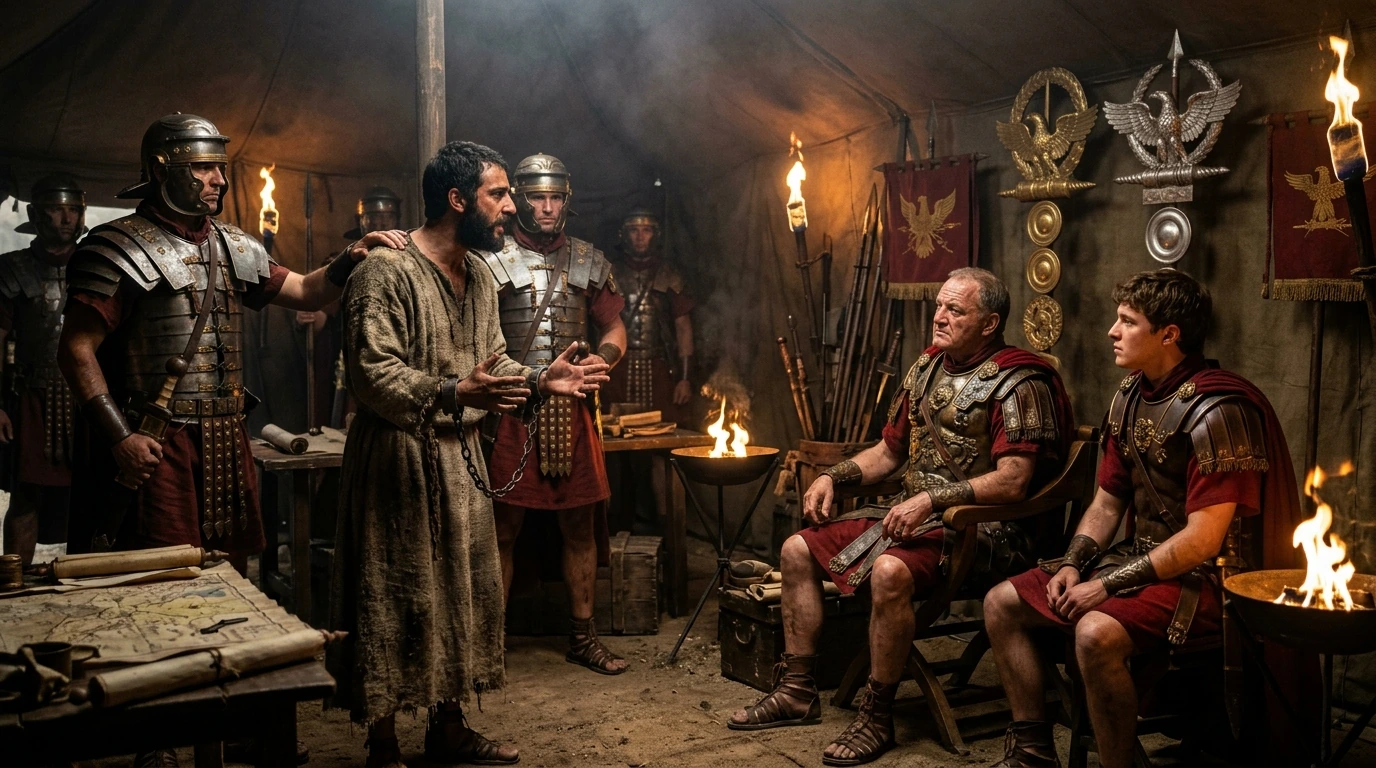
For generations, biblical historians and classical scholars debated the historical reliability of Flavius Josephus's account of the siege of Gamla (The Jewish War, Book IV).
Critics argued that Josephus—writing in Rome under imperial Flavian patronage—had every motive to embellish:
- Magnifying the invincibility of Roman engineering.
- Exaggerating the ferocity of the Jewish resistance to flatter his Flavian patrons Vespasian and Titus.
- Inventing dramatic narrative details, such as the catastrophic rooftop collapse and the sudden freak gale wind.
However, the archaeological excavation of Gamla by Shmarya Gutmann, Danny Syon, and Zvi Ma'oz has established Gamla as one of the most thoroughly confirmed battlefields of classical antiquity. Every tactical maneuver, ballistic vector, and architectural feature recorded in the ancient text has been mapped directly onto the physical geology of the Golan.
Ballistics Forensics: Petrography and Caliber of 1,600 Roman Stones
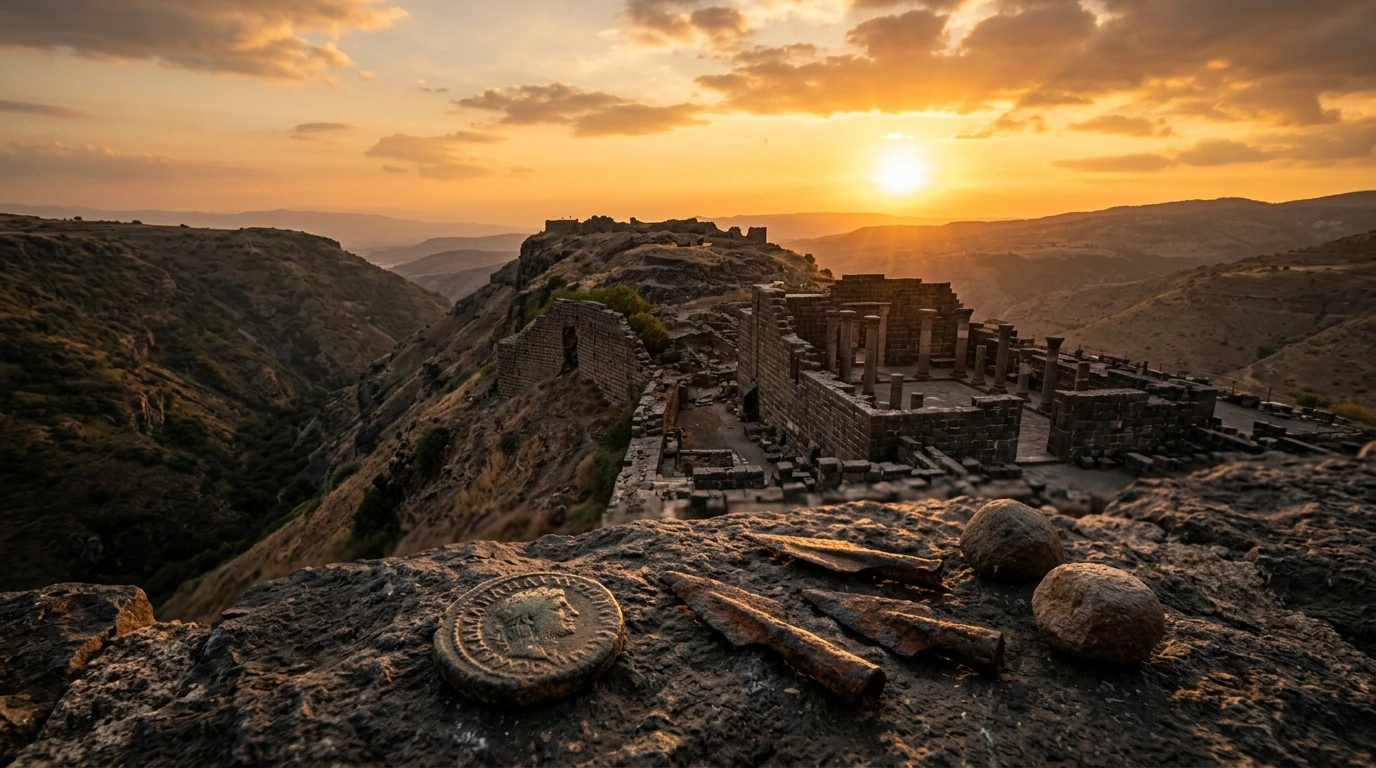
The most breathtaking material proof of the siege is the discovery of over 1,600 spherical limestone ballista stones concentrated along the breached eastern wall:
[BALLISTIC CLASSIFICATION AT TEL GAMLA]
* HEAVY BREACHING CALIBER: 1-talent stones (approx. 20–26 kg / 45–57 lbs) fired by massive
  tortion catapults (*ballistae*) to batter down the defensive towers and stone parapets.
* MEDIUM ANTIPERSONNEL CALIBER: 3–8 kg stones hurled into streets and courtyards to clear defenders.
* LIGHT HAND-THROWN MISSILES: 0.5–2 kg stones collected by defenders along rooftops to drop on climbers.
* TRAJECTORY MAPPING: GIS analysis of stone distribution reveals that Roman batteries were positioned
  on the eastern plateau, firing precisely at the curtain wall and the adjoining synagogue.
Petrographic analysis conducted on the ballista stones revealed that the Romans quarried local sedimentary limestone boulders directly from the nearby wadi beds, dressing them into rough spheres on-site with stone chisels.
Excavators found ballista stones wedged into the very doorframes of residential homes and resting on the benches of the synagogue, exactly where they crashed through ceilings during the bombardment of October 67 AD.
The Epigraphy of Rebellion: The "For the Redemption of Jerusalem" Coins
Among the dirt floors and collapsed masonry of Gamla, numismatists unearthed one of the most poignant epigraphic discoveries in Israeli archaeology: six crude bronze coins minted under siege conditions:
[THE GAMLA ZEALOT BRONZE COINS (SYON, 1992)]
* OBVERSE: A chalice or ceremonial vessel, mimicking the silver shekels of Jerusalem.
* REVERSE: Inscription in archaic Paleo-Hebrew script:
  "לגאלת ירושלם הקדושה" (LiGe'ulat Yerushalayim Ha-Qedoshah)
  "FOR THE REDEMPTION OF HOLY JERUSALEM"
* PRODUCTION METHOD: Cast in makeshift molds with irregular flans and uneven lettering,
  proving they were manufactured inside the besieged mountain citadel when communications
  with Jerusalem were completely severed.
The theological and political implications of these coins are profound:
- Solidarity Across Distance: Even though Gamla was separated from Jerusalem by hostile territory and imperial legions, the Golan defenders saw their struggle as inseparable from the sanctity of Zion.
- Eschatological Defiance: The phrase "For the Redemption" (Ge'ulah) reveals that the defenders viewed the conflict not as a political tax revolt, but as the apocalyptic birth-pangs of Messianic deliverance.
The Gamla Synagogue: Archaeological Proof of 1st-Century Sacred Space
Prior to the excavation of Gamla, a dominant school of 20th-century biblical criticism asserted that Jewish synagogues did not exist as purpose-built communal and liturgical architecture prior to the destruction of the Second Temple in 70 AD, arguing that Gospel accounts of Jesus teaching in synagogues (e.g., Matthew 4:23; Luke 4:16) were anachronistic projections of later 2nd-century realities.
The Gamla Synagogue dismantled this critical thesis permanently:
[ARCHITECTURAL BLUEPRINT OF THE GAMLA SYNAGOGUE]
* DIMENSIONS: 25.5 meters by 17 meters, built of finely dressed basalt ashlar blocks.
* TIERED SEATING: Four tiers of stone benches lining all four interior walls, accommodating ~300 worshippers.
* DORIC COLONNADE: A magnificent rectangular peristyle colonnade with corner pillars bearing heart-shaped carvings.
* ADJACENT MIKVEH: A plastered ritual immersion pool with stone steps immediately outside the entrance.
* DATING CONTEXT: Stratigraphically sealed beneath the 67 AD Roman destruction layer, with coins
  of Alexander Jannaeus and Herod the Great in the foundation fills, proving it was constructed
  around the beginning of the 1st century BC.
The Gamla Synagogue confirmed that when Jesus traveled "throughout all Galilee, teaching in their synagogues and proclaiming the gospel of the kingdom" (Matthew 4:23), stone assembly halls with tiered benches, interior columns, and Torah study spaces were the standard reality across northern Israel.
Comparative Table: Josephus's Text vs. Excavated Physical Artifacts
| Narrative Feature in Josephus (Jewish War IV) | Physical Evidence Discovered at Tel Gamla | Archaeological Correlation |
|---|---|---|
| The North-East Breach: Romans battered down the wall on the narrow spur. | 5-meter gap found in the basalt wall on the eastern spur, filled with hasty rubble. | 100% Direct Match |
| Roman Catapult Bombardment: Relentless stone artillery hurled from the heights. | 1,600 ballista stones clustered around the breach, synagogue, and streets. | 100% Direct Match |
| Dense Arrow Barrage: Legionary and auxiliary archers saturated defenders. | Over 4,000 iron arrowheads, including 3-lobed Roman auxiliary types. | 100% Direct Match |
| Zealot Ideological Fervor: Radical resistance unto death for Zion's freedom. | Six locally minted bronze coins reading "For the Redemption of Holy Jerusalem." | 100% Direct Match |
| Total Annihilation: The city was completely leveled and never reoccupied. | Abrupt termination of all settlement layers in 67 AD; zero Byzantine or Roman rebuild. | 100% Direct Match |
Three-Tier Evidentiary Evaluation: Historical Corroboration
| Evidence Category | Archaeological / Textual Data | Critical Evaluation & Consensus |
|---|---|---|
| Textual Authenticity | Jewish War IV.1–83 manuscript tradition (Greek codices Ambrosianus & Vaticanus). | Internal consistency supported by external Roman military manuals (Vegetius, Onasander). |
| Artillery Science | Calibrated ballista stone weights matching Roman standard artillery tables (Vitruvius). | Mathematical alignment between stone diameters and Roman torsion catapult engineering. |
| Epigraphic Uniqueness | The Paleo-Hebrew Gamla revolt coins. | Unfalsifiable material evidence verified by Israel Museum numismatists. |
Primary Sources & Scholarly Archives
Editorial Standard →Official archaeological field reports, certified stratigraphy surveys, and Semitic epigraphy catalogs.
Catalog of Levantine, Mesopotamian, and Persian artifacts, royal cylinder seals, and cuneiform tablets.
Peer-reviewed scholarly analyses on Levant excavations, ancient architecture, and artifact forensics.
Frequently Asked Questions
Did archaeologists find any human remains at Gamla?
Unlike Yodfat, where hundreds of skeletons were found dumped in cisterns, very few complete human skeletons were excavated inside the walls of Gamla. This directly confirms Josephus's account: the vast majority of the inhabitants perished by jumping or being pushed into the sheer ravines surrounding the mountain, where their remains decomposed on inaccessible cliffs or were washed away by seasonal wadi torrents.
Why was Gamla never rebuilt after 67 AD?
The destruction of Gamla was so absolute, and its strategic location so specialized for regional defense, that the Romans saw no utility in garrisoning it. The surviving Jewish population of the Golan shifted to agricultural plateau villages, leaving Gamla frozen in time as a 1st-century time capsule.
How does the Gamla Synagogue help authenticate the Gospels?
It provides tangible architectural proof that 1st-century Jews gathered in formal, dedicated stone synagogues across Galilee and the Golan during the lifetime of Jesus, refuting the skeptical claim that synagogues were invented only after the Temple fell.
Related Research Dossiers
View all 515 research dossiers →
3-Minute Quick Guide: How to Explain the Death of Judas Iscariot (Matthew vs. Acts) in a Bible Study
Direct Answer (AEO): Why Did King David Count the People? Harmonizing 2 Samuel 24:1 and 1 Chronicles 21:1 in Hebrew