Subject Scope: Step-by-Step Tactical Reconstruction: How Pompey the Great Breached the Temple Mount in Jerusalem (63 BC)
Historical Context: Rigorous historical and theological examination within the field of Bible Study Guides & Theology.
Primary Evidence: Forensic archaeology, textual preservation, and primary ancient manuscripts corroborating scriptural events.
Investigation Highlights: Phase 1: The Fratricidal Invitation to Damascus • Phase 2: The Two Factions and the Divided City • Phase 3: The Fortress of the Temple Mount: Tactical Anatomy
Scholarly Consensus: Vetted against peer-reviewed academic literature in biblical history, linguistics, and archaeology.
Phase 1: The Fratricidal Invitation to Damascus
In the spring of 63 BC, Roman proconsul Gnaeus Pompeius Magnus (Pompey the Great) was camped in Damascus, Syria, having swept away the remnants of the Seleucid Empire:
- The Two Brothers: Hasmonean brothers Hyrcanus II and Aristobulus II appeared in person before Pompey, each demanding Roman military intervention to secure the crown of Judea.
- The Bribe: Aristobulus presented Pompey with a solid-gold sculptured vine valued at 500 gold talents. Hyrcanus's advisor, Antipater the Idumean, accused Aristobulus of being a usurper and tyrant.
- The People's Appeal: A third delegation of Jewish elders pleaded with Pompey to depose both brothers and restore priestly theocratic rule.
Pompey delayed his decision and marched his Roman legions south into the Jordan Valley. When Aristobulus vacillated and his hot-headed followers retreated into the fortress of Jerusalem to resist, Pompey placed the city under formal siege.
Phase 2: The Two Factions and the Divided City
When Pompey's legions arrived outside Jerusalem, the city immediately fractured along political and religious fault lines:
- The Peace Party (Hyrcanus's Partisans): Controlled the Lower City and the Upper City on the Western Hill. Terrified of Roman wrath, they opened the city gates and surrendered the municipal quarters to Pompey.
- The War Party (Aristobulus's Partisans): Cut the wooden bridge spanning the Tyropoeon Valley (at Wilson's Arch), barricading themselves inside the fortified Temple Mount sanctuary, prepared to fight to the death.
Pompey garrisoned the Upper City with Roman troops under his lieutenant Piso, while deploying his main legionary combat engineers against the isolated Temple fortress.
Phase 3: The Fortress of the Temple Mount: Tactical Anatomy
The Temple Mount in 63 BC was a self-contained military fortress:
- East, South, and West: Protected by sheer, precipitous valley cliffs (the Kidron and Tyropoeon ravines). Direct assault from these three directions was physically impossible.
- The North: The sole point of land access, but heavily fortified with a colossal rock-cut moat measuring 250 feet wide and 60 feet deep, backed by high ashlar defensive towers and walls.
- The Garrison: Thousands of fanatical Jewish soldiers, well-provisioned with Temple granaries and cistern water, determined to defend the sacred courts of Yahweh.
Phase 4: Filling the Great Northern Rock-Cut Trench
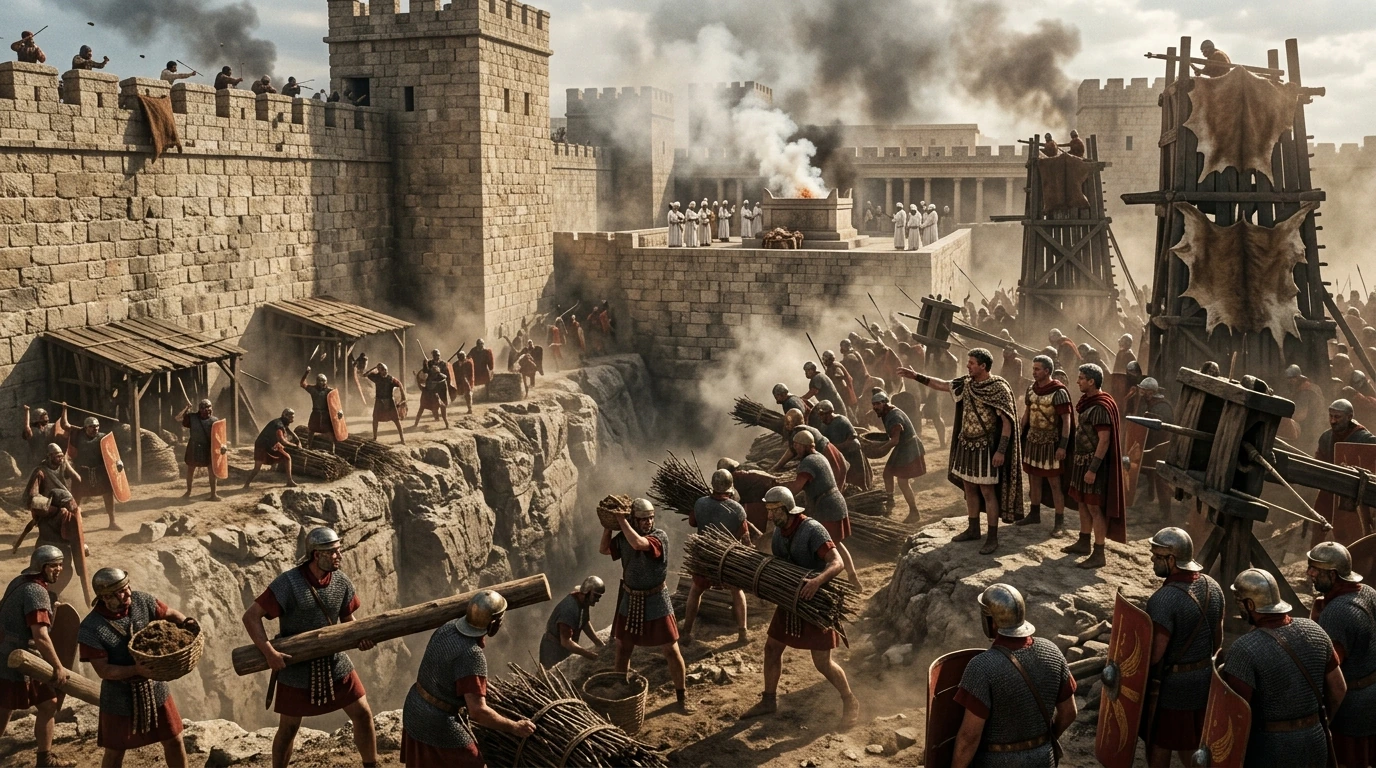
To bring battering rams against the northern Temple towers, Pompey's legionaries had to fill the colossal rock-cut trench:
[THE ROMAN ENGINEERING CORPS IN ACTION]
1. CLEARING TIMBER: Roman soldiers stripped the surrounding hills of Judea, cutting down all olive groves and cedar trees within miles of Jerusalem.
2. CONSTRUCTING CAISSONS: Timber cribbing and hurdles were built inside the ditch to retain backfill.
3. INFILLING: Day and night, thousands of legionaries carried boulders, soil, and rubble, dumping them into the 60-foot chasm under heavy missile fire from Jewish archers atop the battlements.
The labor was agonizingly slow and deadly—until Roman military intelligence discovered the Jewish Sabbath observance.
Phase 5: The Sabbath Engineering Advantage
Flavius Josephus (Antiquities XIV.63–64) and Cassius Dio (Roman History XXXVII) reveal the decisive tactical breakthrough:
- The Halakhic Constraint: Under Jewish military law, soldiers could engage in lethal self-defense if an enemy directly charged them with drawn swords. However, they refused to strike soldiers who were merely performing construction or engineering work on the Sabbath.
- The Roman Exploitation: Pompey ceased all catapult attacks on the seventh day (Saturday). Instead, Roman engineers mobilized exclusively on the Sabbath, advancing siege mounds, hauling iron battering rams across the filled trench, and positioning heavy siege towers directly against the walls without facing a single defensive arrow.
Through twelve consecutive Sabbaths, the Roman siege bank rose steadily until the iron rams were touching the northern battlements.
Phase 6: The Fall of the Great Tower and Pompey's Entry
In the third month of the siege (June/July 63 BC), during the Day of Fasting:
- The Collapse of the Tower: The largest northern Temple tower, weakened by the relentless pounding of the Roman iron-headed ram, collapsed into the ditch, bringing down a massive section of the curtain wall.
- The Storming: Faustus Cornelius Sulla (son of the Roman dictator) led the vanguard through the breach, followed by centurions Furius and Fabius.
- The Unbroken Sacrifices: Even as Roman legionaries slaughtered their way through the Temple courtyards, the officiating priests refused to abandon their liturgical posts, continuing to burn incense and offer the daily morning sacrifices until they were slain at the altar, their blood splashing upon the sacred vessels.
- Pompey in the Holy of Holies: Pompey marched past the veil into the Sanctum Sanctorum, discovering the astonishing empty sanctuary that baffled the Roman world.
Frequently Asked Questions
How many people died in the siege?
Flavius Josephus records that 12,000 Jews were killed in the fighting, primarily in the Temple courtyards, while Roman casualties were remarkably light.
Did Pompey take prisoners to Rome?
Yes. Pompey deported King Aristobulus II, his sons (Alexander and Antigonus), and thousands of Jewish captives to Rome. These Jewish captives were paraded through Rome in Pompey's magnificent Triumph of 61 BC, subsequently freed, and established the vibrant Jewish community in Rome that would later receive the Apostle Paul.
What was the political settlement after the siege?
Pompey stripped Judea of its coastal and Hellenistic cities (the Decapolis), dismantled the Hasmonean monarchy, confirmed Hyrcanus II solely as High Priest (Ethnarch, not King), and imposed annual Roman taxation under the oversight of the governor of Syria.
Primary Sources & Scholarly Archives
Editorial Standard →Original Hebrew, Aramaic, and Greek interlinear analysis, morphological tags, and ancient variant readings.
Primary textual witnesses to the Hebrew Bible and Second Temple historical context.
Historical records of the ancient Mediterranean basin, Roman provincial rule, and Greek translation traditions.
Frequently Asked Questions
How many people died in the siege?
Flavius Josephus records that **12,000 Jews** were killed in the fighting, primarily in the Temple courtyards, while Roman casualties were remarkably light.
Did Pompey take prisoners to Rome?
Yes. Pompey deported King Aristobulus II, his sons (Alexander and Antigonus), and thousands of Jewish captives to Rome. These Jewish captives were paraded through Rome in Pompey's magnificent **Triumph of 61 BC**, subsequently freed, and established the vibrant Jewish community in Rome that would later receive the Apostle Paul.
What was the political settlement after the siege?
Pompey stripped Judea of its coastal and Hellenistic cities (the Decapolis), dismantled the Hasmonean monarchy, confirmed Hyrcanus II solely as High Priest (*Ethnarch*, not King), and imposed annual Roman taxation under the oversight of the governor of Syria.
Related Research Dossiers
View all 515 research dossiers →
Special Family & Study Group Edition: The Book of Exodus, Plagues of Egypt, and Tabernacle Interactive Quiz (With Complete Scripture Key)
Advanced Scripture Knowledge Challenge: The Life of King David and Psalms Interactive Quiz (With Comprehensive Biblical Answers)