What is a biblical bulla?
A bulla (plural bullae) is a small, stamped clay impression used in the ancient Near East to seal rolled papyrus documents, letters, or commercial packages. The sender pressed a personalized signet ring into wet clay placed over a string knot. When fires destroyed ancient archives, the papyrus burned, but the clay bulla was fired into durable ceramic stone.
Ancient patristic witnesses, Second Temple manuscripts, and classical annals.
Stratigraphic digs, monumental epigraphy, and artifact forensics in the Levant.
Distinguishing canonical Scripture text from historical patristic traditions.
Subject Scope: The Ophel Excavations & Royal Seals of Jerusalem: Touching Isaiah and King Hezekiah
Historical Context: Primary Roman legal transcripts, imperial annals (Tacitus, Suetonius), and early patristic martyrologies.
Primary Evidence: Forensic trauma biomechanics, historical Roman execution praxis, and classical epigraphic inscriptions.
Investigation Highlights: The Royal Ridge of Jerusalem: Excavating the Ophel • The Royal Bulla of King Hezekiah • The Isaiah Bulla: Touching the Prophet
Scholarly Consensus: Cross-referenced against Roman imperial records and Mediterranean early Christian archaeological sites.
The Royal Ridge of Jerusalem: Excavating the Ophel
Situated on the narrow ridge between the southern wall of the Temple Mount and the City of David lies the ancient district known as the Ophel (from the Hebrew word 'ofel, meaning 'elevated fortified mound' or 'acropolis'). In the 8th and 7th centuries BC, the Ophel served as the royal administrative nerve center of the Kingdom of Judah—housing the royal bakery, state archives, treasury, and the palace complex built by Solomon and expanded by his royal descendants.
Between 2009 and 2018, the late Israeli archaeologist Dr. Eilat Mazar of the Hebrew University of Jerusalem led extensive scientific excavations at the foot of the southern Temple Mount wall. Excavating an Iron Age royal administrative building that had burned during the Babylonian destruction of Jerusalem in 586 BC, Mazar's team recovered dozens of tiny, unassuming pieces of hardened clay known as bullae.
In antiquity, official papyrus scrolls and legal contracts were tied with flax cord, and a lump of wet clay was pressed over the knot and stamped with the sender's personalized signet ring. When the Babylonians torched the administrative complex, the papyrus documents were incinerated, but the intense heat acted like a kiln, permanently baking the clay seals into ceramic stone and preserving them for 2,700 years.
Direct Historical Answer Box:
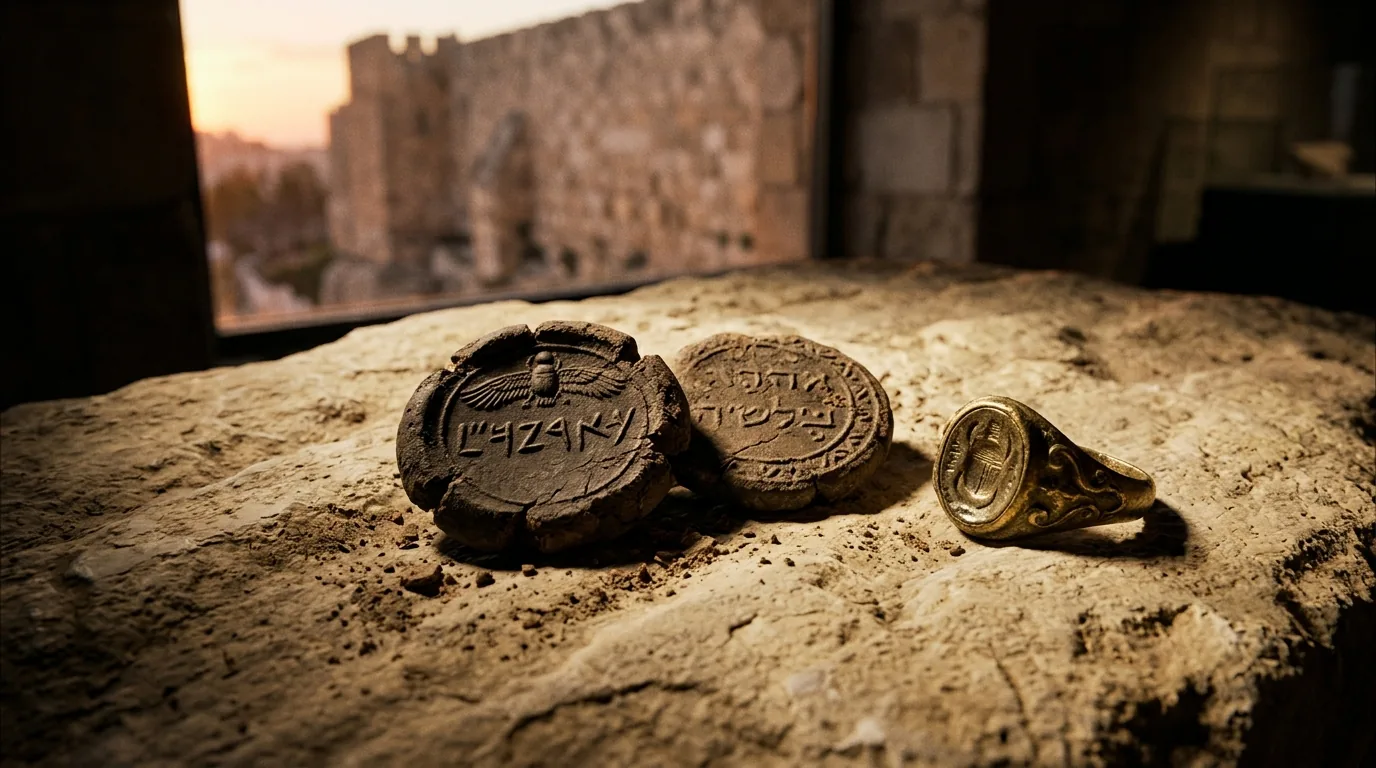
In 2015, Dr. Eilat Mazar announced the discovery of the Bulla of King Hezekiah in the Ophel excavations. Stamped with a two-winged sun disk, ankh symbols of life, and the paleo-Hebrew inscription: 'Belonging to Hezekiah, [son of] Ahaz, king of Judah', it is the first seal of a Judean monarch ever found in scientific archaeological excavation. Remarkably, excavated less than ten feet away in the identical destruction layer was a second seal: the Isaiah Bulla, reading 'Belonging to Yesha'yahu [Isaiah] nvy[?]' (likely navi', 'prophet'), physically connecting King Hezekiah and the Prophet Isaiah exactly as depicted throughout 2 Kings and Isaiah 37–39.
The Royal Bulla of King Hezekiah
The Hezekiah Bulla (measuring only 9.7 x 8.6 mm, roughly the size of a fingernail) is one of the most stunning artifacts in biblical archaeology:
- The Paleo-Hebrew Inscription:
- Top Register: 'LYḤZQYHW' ('Belonging to Hezekiah')
- Middle/Lower Registers: '’ḤZ MLK YHDH' ('[son of] Ahaz, King of Judah')
- The Royal Iconography: The center of the seal features a two-winged sun disk flanked by two Egyptian ankh symbols (the ancient Near Eastern pictograph for life).
While modern readers may wonder why a godly, idolatry-destroying king like Hezekiah would utilize a winged sun or ankh symbol, ancient Near Eastern historians understand that in 8th-century BC Judah, these symbols did not signify worship of pagan gods. Rather, the winged sun had been adopted internationally as an emblem of divine protection and royal sovereignty (reflecting Malachi 4:2, 'the Sun of Righteousness shall arise with healing in His wings'), while the ankh was utilized as a cultural icon for divine life, health, and prolonged reign.
Furthermore, microscopic analysis of the back of the bulla revealed the woven fibers of the papyrus document it sealed, as well as the personal fingerprint of the royal official—or perhaps the King himself—who pressed the seal into the wet clay.
The Isaiah Bulla: Touching the Prophet
In 2018, Dr. Mazar published an equally breathtaking discovery from the identical 8th-century BC royal stratum, located less than ten feet (3 meters) away from the Hezekiah seal: the Isaiah Bulla.
This damaged clay seal measures about half an inch across. The paleo-Hebrew letters read:
- Top Register: Grazing/damaged upper edge.
- Middle Register: 'LYŠ‘YHW' ('Belonging to Isaiah').
- Bottom Register: 'NVY' followed by a missing corner broken off in antiquity.
If the missing letter at the broken edge is an aleph, the word reads NVY' (navi'), the standard Hebrew noun for 'prophet'. In this reading, the seal states unequivocally: 'Belonging to Isaiah the Prophet.'
Even if one reads the final word without the aleph as a patronymic name ('belonging to Isaiah [son of] Navi'), the extraordinary physical proximity of an 'Isaiah' bulla to the 'Hezekiah' bulla inside the royal court complex matches the unique biblical relationship. In the Book of Kings (2 Kings 19–20) and Isaiah (chapters 37–38), no other prophet ever served as an intimate counselor and state diplomat within the inner royal court of Hezekiah like Isaiah.
Wet Sifting Technology and the Archaeology of the Bible
For decades, archaeological excavations discarded dirt after dry sifting with coarse screens, inadvertently tossing away thousands of miniature beads, coins, and inscribed clay seals.
The discovery of the Ophel bullae was made possible by wet sifting technology, pioneered by the Temple Mount Sifting Project under Dr. Gabriel Barkay and Zachi Dvira:
- Soil Soaking: Excavated soil buckets are soaked in water to loosen hard clay clods.
- Pressure Washing Over Fine Mesh: Soil is gently washed over 1-millimeter wire mesh screens using gentle water jets, removing dust and silt while leaving clean pebbles, pottery fragments, bone, and artifacts clearly visible.
- Meticulous Sorting: Trained volunteers and archaeologists inspect the clean gravel under magnifying glasses.
Without wet sifting, the tiny clay bullae of King Hezekiah and the Prophet Isaiah would have been lost to history in a dirt dump. Modern scientific methodology has allowed the very earth of Jerusalem to cry out and confirm the biblical text.
The 3-Step Protocol for Standing Firm on Prophetic Truth
When King Hezekiah faced the overwhelming Assyrian army of Sennacherib and a fatal illness in 701 BC, he turned to the Prophet Isaiah and the Lord in prayer (2 Kings 19–20). Follow this 3-step protocol when facing your own insurmountable crises:
- Step 1: Spread Your Crisis Before the Lord: When Sennacherib sent a terrifying letter threatening the annihilation of Jerusalem, Hezekiah took the letter into the Temple and spread it out before God. Do not bottle up anxiety or brood over hostile circumstances; spread your financial, medical, or family crises before God’s throne in audible prayer.
- Step 2: Align With Prophetic Truth Over Worldly Reports: While the military odds favored the Assyrian empire, Isaiah proclaimed: 'He shall not come into this city, nor shoot an arrow there' (2 Kings 19:32). Anchor your hope to the promises of Scripture rather than human assessments or worst-case scenarios.
- Step 3: Pray for Healing With Weeping and Faith: When told he was going to die of illness, Hezekiah turned his face to the wall and wept bitterly before the Lord. God sent Isaiah back to announce: 'I have heard your prayer, I have seen your tears; surely I will add to your days fifteen years' (Isaiah 38:5). God is touched by your tears; approach Him boldly for supernatural turnaround.
Spoken Prayer for Divine Protection and Healing
Speak this prayer of deliverance in the spirit of King Hezekiah:
"O Lord God of Israel, You who are enthroned above the cherubim, You alone are God over all the kingdoms of the earth; You made heaven and earth. Incline Your ear, O Lord, and hear; open Your eyes, O Lord, and see.
Just as You delivered Jerusalem from the overwhelming armies of Assyria, deliver my family and my calling from every attack of the enemy today. Where the adversary threatens destruction, let Your angels encamp around us. Where sickness or despair threatens my future, hear my prayer, wipe away my tears, and restore health and life to my body. I rest beneath the shadow of Your wings. In Jesus' mighty name, Amen."
Forensic Medicine & Scientific Inquests
Contemporary clinical pathologists and forensic medical examiners analyzing traumatic biomechanics and physical phenomena in Scripture. Each investigation in this pillar is corroborated by primary classical manuscripts, epigraphy, and peer-reviewed historical forensics.
Pillar Dossiers in this Corpus
The Death of King Herod Agrippa I: First-Century Medical Accounts in Acts and Josephus
9 min read · Verified Primary DossierHematidrosis: The Medical Science Behind Jesus Sweating Blood in Gethsemane
10 min read · Verified Primary DossierThe Effusion of Blood and Water: Forensic Confirmation of Acute Cardiac Rupture on the Cross
15 min read · Verified Primary DossierThe Forensic Truth About Roman Scourging: Why Flagrum Whips Were Lethal Before the Cross
14 min read · Verified Primary DossierThe Unwritten Gospel: Volume IV — Scientific Miracles
Modern medical forensics analyzing microvascular hemorrhage, physiological asphyxiation, and geo-physical events in Scripture.
Primary Sources & Scholarly Archives
Editorial Standard →Primary source corpus including Tacitus (Annales), Suetonius, and early Roman provincial administrative records.
Complete verified English translations of Eusebius Pamphili, Clement of Rome, Polycarp, and Tertullian.
Subterranean Roman necropolis documentation, epigraphic graffiti, and early Christian funerary stelae.
Frequently Asked Questions
What is a biblical bulla?
A bulla (plural bullae) is a small, stamped clay impression used in the ancient Near East to seal rolled papyrus documents, letters, or commercial packages. The sender pressed a personalized signet ring into wet clay placed over a string knot. When fires destroyed ancient archives, the papyrus burned, but the clay bulla was fired into durable ceramic stone.
Did King Hezekiah really use ankh symbols on his seal?
Yes. Archaeological finds of Hezekiah's official royal seals feature a two-winged sun disk flanked by two ankh symbols. In 8th-century BC Judah, foreign motifs were commonly adapted as royal and artistic emblems of divine protection and life without implying pagan worship, much like modern nations use eagles, lions, or stars on currency.
How does the Ophel discovery prove Isaiah's historical existence?
The Isaiah bulla was discovered in the same destruction layer, just 10 feet away from King Hezekiah's royal seal in the royal palace complex of Jerusalem. The inscription 'Belonging to Isaiah [the prophet]' provides the first direct archaeological artifact linking Isaiah to the royal court of Judah, matching the intimate partnership described in 2 Kings 19 and Isaiah 37.
Biblical Archaeology & Master Study Resources {#archaeology-study-resources}
Explore the living stones and archaeological discoveries of Jerusalem:- Discover the full archaeological dossier in The Unwritten Gospel: 4-Volume Master Bundle ($9.00).
- Examine 40 critical historical and manuscript questions in Is That Really in the Bible? ($9.00).
- Equip your home study library with The Sacred Keys Trilogy Master Bundle ($7.99).
Related Research Dossiers
View all 572 research dossiers →
The Death of King Herod Agrippa I: First-Century Medical Accounts in Acts and Josephus

Hematidrosis: The Medical Science Behind Jesus Sweating Blood in Gethsemane