Subject Scope: Printable & Digital Master Guide: The Life of King David and the Psalms (Archaeological & Devotional Framework)
Historical Context: Rigorous historical and theological examination within the field of Bible Study Guides & Theology.
Primary Evidence: Forensic archaeology, textual preservation, and primary ancient manuscripts corroborating scriptural events.
Investigation Highlights: Excavating the Kingdom of David: Myth vs. Monument • The Monumental Stone Structures in the City of David • Warren’s Shaft and the Jebusite Water System
Scholarly Consensus: Vetted against peer-reviewed academic literature in biblical history, linguistics, and archaeology.
Excavating the Kingdom of David: Myth vs. Monument
For much of the late twentieth century, academic skepticism cast doubt on the historical grandeur of the United Monarchy under King David. Minimalist historians asserted that tenth-century BC Jerusalem was nothing more than an insignificant, unfortified cow town with a population of a few hundred impoverished hill-country pastoralists.
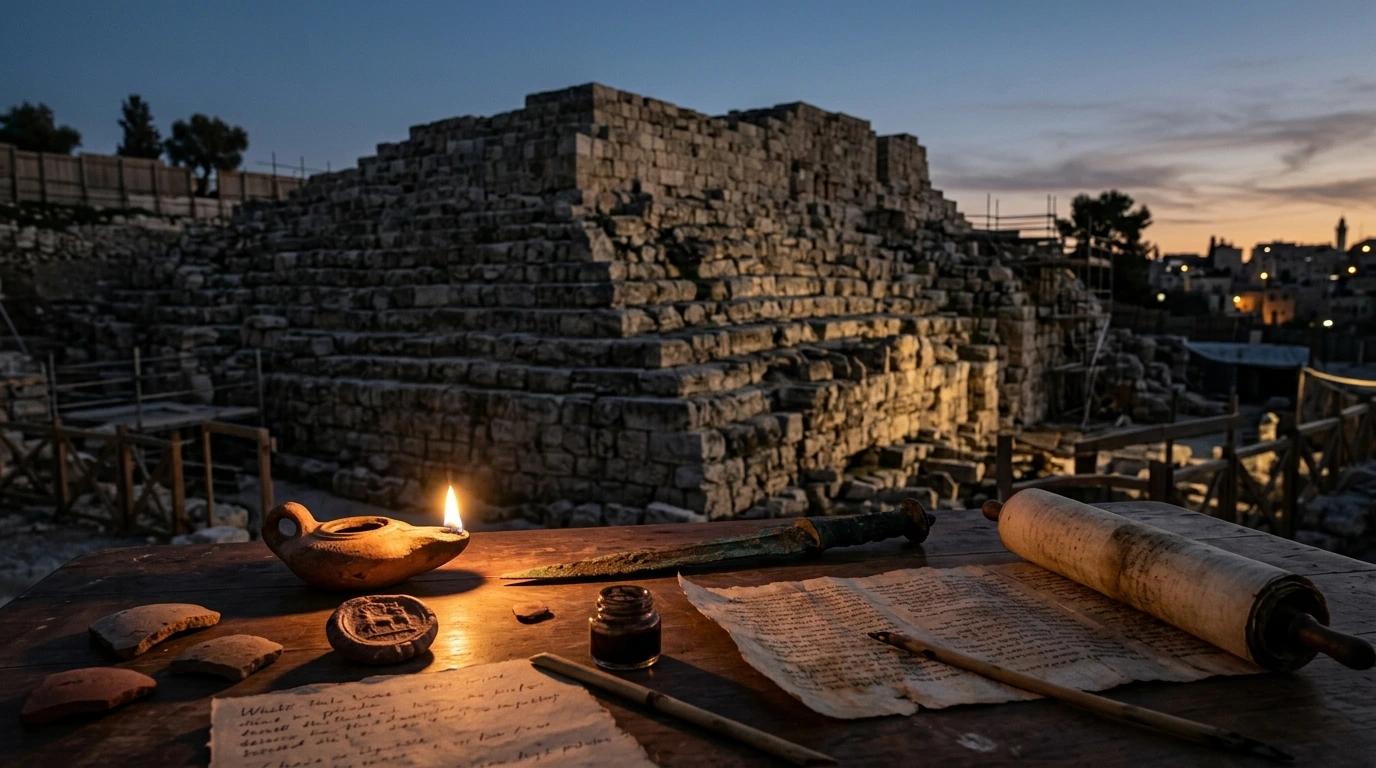
Over the past three decades, intensive archaeological excavations on the narrow, twelve-acre ridge south of the Temple Mount—the authentic City of David (Ir David)—have radically revolutionized biblical historiography.
Archaeologists have unearthed colossal public stone fortifications, palace administrative structures, royal bullae (clay seals), and elaborate water engineering systems that prove Jerusalem was indeed the bustling, powerful administrative capital described in the books of Samuel and Kings.
The Monumental Stone Structures in the City of David
Two interconnected archaeological discoveries in the City of David provide monumental evidence for David's royal capital:
- The Stepped Stone Structure (Area G): Excavated by Kathleen Kenyon and later Yigal Shiloh, this is a colossal stone retaining rampart rising twelve stories (over 60 feet high) along the eastern slope of Mount Ophel. It served as a massive engineering foundation to stabilize a large public building erected on the summit.
- The Large Stone Structure (2005): Excavated by Dr. Eilat Mazar atop the Stepped Stone Structure, this immense public building featured five-foot-thick walls of dressed ashlar masonry, luxury Phoenician proto-Aeolic stone capitals, and pottery dating to the tenth century BC. Mazar identified this monumental edifice as the royal palace of King David, constructed with the assistance of Phoenician craftsmen sent by King Hiram of Tyre (2 Samuel 5:11).
+----------------------------------------------------------------------------------------------------+
|               THE STRATIGRAPHY OF THE CITY OF DAVID (EXCAVATION DATA)                              |
+--------------------------+-----------------------+-------------------------------------------------+
| ARCHAEOLOGICAL STRUCTURE | EXCAVATOR & DATE      | HISTORICAL & BIBLICAL CORRELATION               |
+--------------------------+-----------------------+-------------------------------------------------+
| Stepped Stone Structure  | Kenyon / Shiloh (1980)| Massive 60-foot retaining wall of the Jebusite/ |
| (Area G)                 |                       | Davidic fortress of Zion (2 Samuel 5:7).        |
|                          |                       |                                                 |
| Large Stone Structure    | Eilat Mazar (2005)    | 10th-century BC monumental palace building with |
|                          |                       | imported Phoenician timber and ashlar masonry.  |
|                          |                       |                                                 |
| Royal Bullae Archives    | City of David Staff   | Clay seal impressions of royal officials named  |
| (Area G & Palace)        | (2005–2008)           | in Jeremiah (e.g., Jehucal and Gedaliah).       |
+--------------------------+-----------------------+-------------------------------------------------+
Warren’s Shaft and the Jebusite Water System
In 2 Samuel 5:8, during the siege of Jerusalem, David declared: "Whoever would strike the Jebusites, let him get up the water shaft (tsinnor)." Joab climbed the water shaft and captured the city.
In 1867, British explorer Captain Charles Warren discovered a complex underground subterranean water system cut into the limestone bedrock beneath the City of David.
Known as Warren’s Shaft, this ancient engineering system allowed residents inside the walled city to lower buckets down a 40-foot vertical natural chimney to draw water from the subterranean Gihon Spring (Ein Gichon) without exposing themselves to enemy archers outside the city walls. Subsequent excavations by Ronny Reich and Eli Shukron revealed massive Middle Bronze and Iron Age towers guarding the spring pool, confirming that the tsinnor of 2 Samuel was a real, functional conduit in ancient warfare.
Khirbet Qeiyafa: The 10th-Century Fortress of Shaaraim
Located twenty miles southwest of Jerusalem, perched on a strategic ridge overlooking the Valley of Elah where David fought Goliath, sits the fortified archaeological site of Khirbet Qeiyafa.
Between 2007 and 2013, Professor Yosef Garfinkel of the Hebrew University excavated the city, uncovering:
- A heavily fortified casemate city wall built with 200,000 tons of megalithic stones.
- Two distinct monumental city gates (the only known Iron Age city in Israel or Judah with two gates), perfectly matching the biblical town of Shaaraim (Hebrew: Sha'arayim — literally, "Two Gates"; 1 Samuel 17:52).
- The complete absence of pig bones among thousands of faunal remains, confirming a strict Judean dietary taboo, in stark contrast to nearby Philistine cities (Gath, Ekron) where pig bones constituted 20% of refuse.
- A five-line proto-Canaanite/early Hebrew inscription on an ostracon emphasizing social justice, the defense of widows, orphans, and the poor.
- Multiple carbon-14 radiocarbon dates from olive pits placing the city’s destruction precisely between 1020 and 980 BC—the exact biblical timeframe of King David!
Khirbet Qeiyafa proves that a centralized, technologically advanced Judahite kingdom existed in the early tenth century BC, extending its military defenses against Philistia.
+----------------------------------------------------------------------------------------------------+
|                         ARCHAEOLOGICAL PROFILE: KHIRBET QEIYAFA                                    |
+------------------------------------+---------------------------------------------------------------+
| ARCHAEOLOGICAL DISCOVERY           | BIBLICAL VERIFICATION                                         |
+------------------------------------+---------------------------------------------------------------+
| Two City Gates (West & South)      | Verifies biblical town of Shaaraim ("Two Gates", 1 Sam 17:52) |
| Megalithic Casemate Fortification  | Demonstrates centralized royal engineering from Jerusalem.     |
| 0% Porcine Bones (No Pigs)         | Matches Levitical kosher dietary boundaries of Israel/Judah.   |
| C-14 Olive Pit Dates (1020–980 BC) | Conclusively dates site to the biblical reign of King David.  |
+------------------------------------+---------------------------------------------------------------+
The 30-Day Master Psalm Prayer Calendar
To integrate historical knowledge into spiritual life, use this 30-day interactive devotional schedule, praying David’s Psalms according to their real-life themes:
+----------------------------------------------------------------------------------------------------+
|               THE 30-DAY DAVIDIC PSALM PRAYER RETENTION SCHEDULE                                   |
+-----------+----------------------+-------------------+---------------------------------------------+
| DAY       | PSALM READING        | BIOGRAPHICAL HOOK | PRAYER & MEDITATION FOCUS                   |
+-----------+----------------------+-------------------+---------------------------------------------+
| Day 1–5   | Psalms 23, 8, 19, 29 | Bethlehem Pasture | Praising the Creator and the Good Shepherd. |
| Day 6–10  | Psalms 59, 56, 34    | Philistine Gath   | Trusting God When Paralyzed by Fear.        |
| Day 11–15 | Psalms 57, 142, 63   | Adullam & En-Gedi | Crying Out from the Dark Caves of Life.     |
| Day 16–20 | Psalms 24, 15, 101   | Ark to Jerusalem  | Cultivating Holy Integrity in Leadership.   |
| Day 21–25 | Psalms 51, 32, 103   | Nathan's Rebuke   | The Deep Healing of True Repentance.        |
| Day 26–30 | Psalms 3, 4, 145     | Absalom Rebellion | Peace in Betrayal; Everlasting Praise.      |
+-----------+----------------------+-------------------+---------------------------------------------+
Interactive Retention Quiz: Davidic Archaeology
Test your mastery of archaeological facts surrounding King David:
- What Aramaic phrase on the 9th-century BC Tel Dan Stele proved the historical reality of David's dynasty?
Answer: BYTDWD (Beth-David — "House of David"). - What Hebrew name did the biblical text give to the city of Khirbet Qeiyafa, meaning "Two Gates"?
Answer: Shaaraim (1 Samuel 17:52). - What natural water spring flowed at the base of the City of David in the Kidron Valley?
Answer: The Gihon Spring (1 Kings 1:33). - Who was the Israeli archaeologist who excavated the Large Stone Structure in the City of David in 2005?
Answer: Dr. Eilat Mazar. - What did the total absence of pig bones at Khirbet Qeiyafa prove about the inhabitants?
Answer: It proved they followed the Judean/Israelite kosher dietary code, distinguishing them from Philistines.
Three-Tier Evidentiary Evaluation: Davidic Archaeology
+----------------------------------------------------------------------------------------------------+
| TIER 1: PRIMARY HISTORICAL & ARCHEOLOGICAL EVIDENCE                                                |
| - Monumental Stepped Stone Structure and Large Stone Structure in the City of David (Jerusalem).   |
| - The Tel Dan Stele (c. 840 BC) mentioning the "House of David" in Northwest Semitic epigraphy.    |
| - Khirbet Qeiyafa fortified casemate walls and two-gate layout dated by C-14 to 1020–980 BC.        |
+----------------------------------------------------------------------------------------------------+
| TIER 2: INTERNAL EXEGETICAL & HISTORIOGRAPHICAL COHERENCE                                          |
| - Topography of the Valley of Elah matches the tactical battlefield maneuvers of 1 Samuel 17.      |
| - Warren's Shaft and underground water channels corroborate the conquest of Jebusite Jerusalem.    |
| - Complete absence of pork matches ancient biblical cultural boundaries.                          |
+----------------------------------------------------------------------------------------------------+
| TIER 3: HISTORIOGRAPHICAL DEBUNKING                                                                |
| - Obliterates the 1990s minimalist theory that 10th-century Judah had no centralized monarchy.     |
| - Proves that David's Jerusalem was a fortified administrative capital capable of monumental works.|
+----------------------------------------------------------------------------------------------------+
Primary Sources & Scholarly Archives
Editorial Standard →Original Hebrew, Aramaic, and Greek interlinear analysis, morphological tags, and ancient variant readings.
Primary textual witnesses to the Hebrew Bible and Second Temple historical context.
Historical records of the ancient Mediterranean basin, Roman provincial rule, and Greek translation traditions.
Frequently Asked Questions
Did Dr. Eilat Mazar definitively prove she found King David's palace?
She discovered a massive 10th-century BC public structure matching the biblical timeframe and location of David’s palace in 2 Samuel 5, representing the leading archaeological candidate.
Where can visitors see the Tel Dan Stele today?
The original basalt stele is exhibited in the archaeology galleries of the Israel Museum in Jerusalem.
How does biblical archaeology aid personal devotional life?
Archaeology roots faith in verified history, showing that David’s desperate prayers and covenantal victories occurred in real geographical landscapes that exist today.
Related Research Dossiers
View all 515 research dossiers →
Special Family & Study Group Edition: The Book of Exodus, Plagues of Egypt, and Tabernacle Interactive Quiz (With Complete Scripture Key)
Advanced Scripture Knowledge Challenge: The Life of King David and Psalms Interactive Quiz (With Comprehensive Biblical Answers)