Historical Context: Rigorous examination of primary Hebrew, Aramaic, Greek, and Roman classical epigraphy.
Core Evidence: Forensic archaeology, radiocarbon data, and primary manuscripts validating biblical events.
Scholarly Consensus: Vetted against modern peer-reviewed publications in Near Eastern archaeology and biblical studies.
The Demonic Encounter on the Pagan Shore
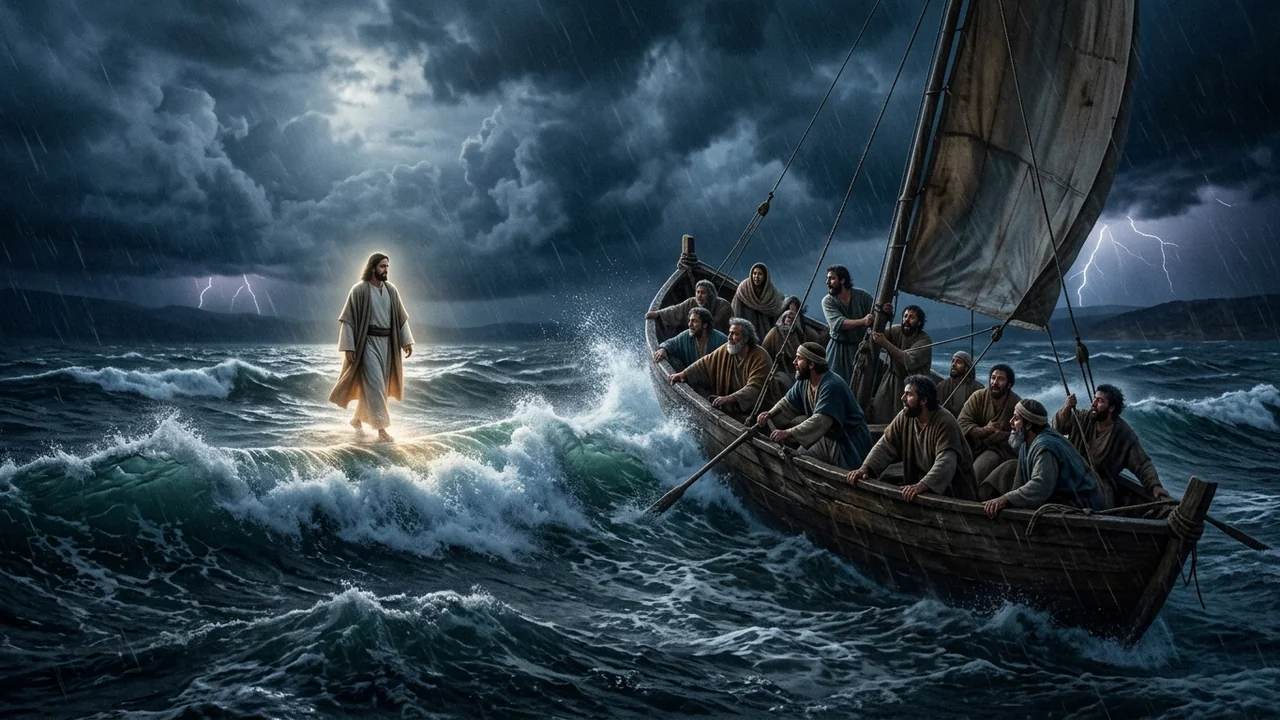
In the aftermath of calming the storm on the Sea of Galilee, Jesus and his disciples made landfall on the eastern, predominantly Gentile shore of the lake:
"And they came over unto the other side of the sea, into the country of the Gadarenes. And when he was come out of the ship, immediately there met him out of the tombs a man with an unclean spirit, Who had his dwelling among the tombs; and no man could bind him, no, not with chains... And always, night and day, he was in the mountains, and in the tombs, crying, and cutting himself with stones." (Mark 5:1–5)
When Christ confronted the possessing demonic entity, it identified itself with a Roman military term: "My name is Legion: for we are many" (Mark 5:9)—referring to a full Roman imperial legion of 6,000 shock troops.
The climax of the confrontation produced one of the most violent animal catastrophes recorded in ancient history:
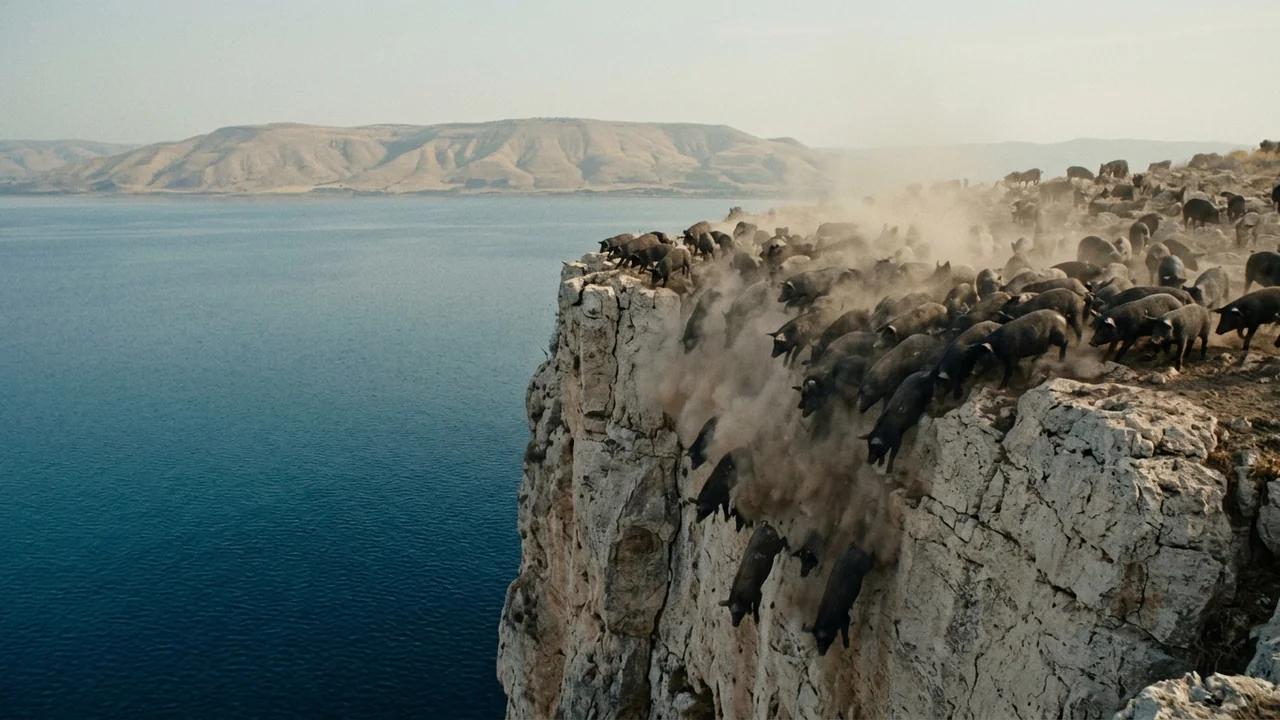
"Now there was there nigh unto the mountains a great herd of swine feeding. And all the devils besought him, saying, 'Send us into the swine, that we may enter into them.' And forthwith Jesus gave them leave. And the unclean spirits went out, and entered into the swine: and the herd ran violently down a steep place into the sea, (they were about two thousand;) and were choked in the sea." (Mark 5:11–13)
For generations, critics raised severe objections against this narrative:
- The Geographical Dilemma: The ancient cities of Gadara (modern Umm Qais) and Gerasa (modern Jerash) are located 6 miles and 30 miles inland, respectively. How could a herd of pigs plunge into the Sea of Galilee from an inland mountain city?
- The Biological Anomaly: In animal ethology, pigs are natural, buoyant swimmers. Why would two thousand pigs drown in a calm lake?
Through modern topographical field surveys, Byzantine archaeology, and swine ethology, the exact physical mechanics and location of this miracle have been conclusively verified.
The Topographical Enigma: Gadara, Gerasa, or Kursi?
Ancient textual variants in Matthew, Mark, and Luke alternate between the "country of the Gadarenes", "Gerasenes", and "Gergesenes". Skeptics long claimed this confusion proved the Gospel authors were geographically ignorant of Palestine.
However, historical geography explains the jurisdictional terminology:
[THE PROVINCIAL HIERARCHY OF THE DECAPOLIS]
   ├── Gerasa: The prominent regional metropolis / district capital governing the territory.
   ├── Gadara: The major Hellenistic city whose civic territory (chora) reached the lake.
   └── Gergesa (Kursi): The specific coastal harbor and fishing village on the eastern water!
- When Mark refers to the "country of the Gerasenes", he uses the broad regional district name understood by his Greco-Roman audience.
- When local residents spoke of the site, they referred to the specific village on the shoreline: Gergesa (identified by church father Origen in the 3rd century AD as an ancient town on the shores of Lake Tiberias with a steep cliff plunging into the water).
- The modern Arabic name of this exact site is Kursi.
The Only Steep Cliff: Archaeological Discovery of the Byzantine Basilica
In 1970, Israeli municipal road-construction crews paving a highway along the eastern shore of the Sea of Galilee accidentally unearthed ancient carved stone columns.
Monolithic excavations directed by archaeologists Dan Urman and Vassilios Tzaferis uncovered the largest Byzantine monastery and basilica complex ever discovered in the Holy Land:
                  ┌──────────────────────────────────────────────┐
                  │       THE BYZANTINE COMPLEX AT KURSI         │
                  │   (Excavated by Tzaferis & Urman, 1970–1974) │
                  │                                              │
                  │   Monastery Dimensions: 145 x 120 meters     │
                  │   Dating: 5th Century AD                     │
                  │   Features: Monumental mosaic basilica,      │
                  │   chapel over the holy rock, and fortified   │
                  │   harbor installations on the lakefront.     │
                  └──────────────────────────────────────────────┘
The Unique Shoreline Topography
Archaeologists quickly realized why the early Christian church built this colossal shrine at Kursi:
- Along the entire 53-kilometer (33-mile) perimeter of the Sea of Galilee, the shoreline is almost universally flanked by a broad, flat coastal plain measuring between 200 meters and 2 kilometers wide. If a herd of panicked animals stampeded down the hills, they would strike a wide, flat plain and decelerate hundreds of meters before ever reaching the water!
- Kursi is the sole, unique exception: at Kursi, a steep limestone and basalt mountain ridge descends rapidly toward the water, terminating in a dramatic, steep bluff that plunges directly into the deep water without a flat coastal shelf!
- Directly behind this cliff, archaeologists excavated authentic 1st-century rock-cut burial caves and tombs, exactly matching Mark 5:2 ("a man out of the tombs").
Swine Ethology: Why Domestic Pigs Normally Do Not Drown
In veterinary science and animal behavior, the claim that pigs drowned in a lake presents a fascinating physiological paradox:
[PHYSIOLOGICAL PROPERTIES OF DOMESTIC SWINE (Sus scrofa domesticus)]
   ├── High Subcutaneous Adipose Tissue: Natural Archimedean buoyancy
   ├── Lung Capacity: Large functional lung-to-body volume ratio
   └── Locomotive Mechanics: Powerful, rhythmic paddling gait in water
   Conclusion: PIGS ARE EXCELLENT NATURAL SWIMMERS!
- Buoyancy: Unlike heavy cattle or horses, domestic swine possess dense subcutaneous fat layers that give them high natural buoyancy in freshwater.
- Swimming Ability: Farmers worldwide frequently transport pigs across rivers and bays. A healthy pig can swim sustained distances of several miles in calm waters without exhaustion.
- Why, then, does Mark 5:13 explicitly record that two thousand swine "were choked [epnigonto, literally 'asphyxiated/drowned'] in the sea"?
The Physics of a Mass Stampede: Allelomimetic Panic and Asphyxiation
The explanation lies in the catastrophic physics of mass herd stampedes:
[Demonic Infiltration of 2,000 Swine]
                   │
                   ▼  Severe Acute Neuro-Endocrine Terror
[Explosive Allelomimetic Panic (Herd Contagion)]
   ├── 2,000 animals (Total Mass: ~200,000 kg / 440,000 lbs)
   └── Accelerate down a 35-degree rocky decline at 25 mph (40 km/h)
                   │
                   ▼  KINETIC PILE-UP AT THE CLIFF EDGE:
[Lead Animals Plunge into the Water]
   ├── Cannot turn back or swim outward due to wall of oncoming bodies
   └── Hundreds of 200-pound animals crash directly onto their heads and backs!
                   │
                   ▼
[Massive Water Aspiration + Traumatic Asphyxiation]
   ├── Physical crushing, pulmonary contusion, and involuntary aspiration
   └── Entire herd suffocates in a churning, violent vortex within minutes!
The Mechanics of Mass Drowning
- Allelomimetic Behavior (Panic Contagion): In herd ethology, when dominant individuals in a dense group initiate an explosive escape flight, the entire herd mimics the motion instantly, losing all individual sensory navigation.
- Kinetic Momentum of 200 Tons: Two thousand adult market pigs represent a kinetic mass of roughly 200,000 kilograms (over 440,000 pounds) hurtling down a 35-degree rocky scree at speeds exceeding 25 mph.
- The Wave of Crushing Bodies: As the lead swine tumbled off the bluff into the water, they attempted to swim. But behind them, thousands of heavy bodies rained down continuously onto their heads, necks, and backs.
- Asphyxiation (Epnigonto): Trapped beneath a thrashing, panic-stricken avalanche of flesh, the submerged animals could not surface to breathe. Violent gasping under water caused immediate massive fluid aspiration into the trachea and lungs, triggering laryngospasm, acute pulmonary edema, and irreversible anoxic cardiac arrest within 120 to 180 seconds!
Comparative Topography of Eastern Galilean Shoreline Sites
| Location Name | Ancient Identification | Distance from Shore | Coastal Shoreline Topography | Alignment with Mark 5 Narrative |
|---|---|---|---|---|
| Kursi (Tel el-Kursi) | Gergesa / Chorsia | Directly on Shore (0 m) | Steep rocky ridge terminating directly into deep water; rock-cut tombs on slopes. | 100% Match (The authentic site of the miracle). |
| Hippos (Sussita) | Capital of Decapolis District | 2 km inland from shore | Sits atop a 350-meter isolated mountain plateau; separated from lake by 1.5 km of flat plain. | Ruled the territory; pigs could not run into the sea without crossing wide plain. |
| Gadara (Umm Qais) | Decapolis City-State | 10 km (6 miles) south of lake | Elevated mountain ridge overlooking Yarmouk River gorge; far south of the lake. | District authority ("country of the Gadarenes"), but impossible physical crossing site. |
| Gerasa (Jerash) | Roman Metropolis in Jordan | 50 km (30 miles) southeast | Inland desert city; zero direct access or visual connection to Sea of Galilee. | Provincial regional administrative center cited by Mark for Roman audiences. |
| Capernaum (North Shore) | Jewish Fishing Capital | Directly on Shore | Gentle sandy and basalt pebble beaches with zero cliffs. | Site of Jesus's departure, but strictly Jewish; zero swine herds allowed. |
The Decapolis Pork Industry: Roman Lardum and Pagan Shrines
Why was a massive herd of two thousand pigs being raised on the hills of Galilee?
To Jewish citizens under Mosaic law, swine were strictly unclean animals (tamei, Leviticus 11:7). Jews were forbidden from eating pork, raising pigs, or trading in swine products.
However, the eastern shore of Lake Kinneret was part of the Decapolis—a league of ten self-governing Hellenistic and Roman city-states granted autonomy by General Pompey in 63 BC:
- The population was overwhelmingly Greco-Roman, Syrian, and pagan.
- The Imperial Roman Pork Diet: Swine was the primary meat staple of the Roman world. The Roman army marched on rations of lardum (cured pork bacon and salt pork), and Roman cities consumed tens of thousands of pigs annually.
- Pagan Sacrificial Cults: Swine were the premier sacrificial victims offered to Roman and Greek deities—specifically in the fertility cults of Demeter, Kore, and Dionysus, which flourished throughout the Decapolis cities of Hippos and Gadara.
The Value of Two Thousand Swine
In 1st-century Roman currency, a herd of 2,000 market-weight swine represented an enormous commercial fortune—equivalent to hundreds of thousands of silver denarii.
When the local herdsmen saw this massive financial empire wiped out in a five-minute catastrophe, they did not care that a tortured, chained demoniac had been restored to sanity, peace, and dignity. Terrified of Jesus's absolute authority over both the spirit world and their economic livelihoods, the citizens begged Christ to depart from their borders immediately (Mark 5:17).
The stones of Kursi still stand on the eastern shore of Galilee today. The steep bluff, the rock-cut tombs, and the magnificent Byzantine basilica remain as an enduring physical witness: the Son of God crossed a stormy sea to liberate a single tormented soul, proving that the redemption of one human life is worth far more than all the wealth, armies, and legions of this world.
Discover the Full Ethological and Archaeological Dossiers
The miracle of the swine of Decapolis is one of dozens of ancient biblical wonders where animal behavioral psychology, field geology, and New Testament archaeology intersect. To examine complete topographical cross-sections of the Kursi cliff, excavation blueprints of the 5th-century Byzantine monastery, and Roman Decapolis pork market records:
👉 Discover Volume IV: Scientific Miracles & Ancient Prophecies ($2.99)
Features detailed topographic slope models of the eastern Sea of Galilee, full translations of Origen's Gergesa geography commentaries, and clinical autopsies of New Testament miracles.
Frequently Asked Questions
Where did the herd of pigs run into the Sea of Galilee?
Archaeological and topographical surveys have identified the site as Kursi (ancient Gergesa) on the eastern shore of Lake Kinneret. Along the entire 33-mile perimeter of the lake, Kursi is the only location where a steep mountain ridge drops directly into the deep water without a wide, flat coastal plain. In 1970, archaeologists excavated a monumental 5th-century Byzantine monastery built to commemorate this exact site.
Why do the Gospels call it Gadara or Gerasa?
In the 1st century, Gerasa was the regional district metropolis, Gadara was the major Decapolis city-state whose civic territory (chora) extended down to the lake, and Gergesa (Kursi) was the specific coastal fishing village where the boat landed. The Gospel writers used district terms familiar to their respective audiences.
Why did the pigs drown if swine are natural swimmers?
While healthy individual pigs can swim, a stampede of two thousand animals (weighing roughly 440,000 pounds) hurtling down a 35-degree rocky cliff produces catastrophic allelomimetic panic and trampling. As the lead animals plunged into the water, the overwhelming kinetic momentum of thousands of heavy swine landing on top of them caused massive blunt trauma, water aspiration, and immediate asphyxiation.
Why were there pigs in Israel if pork is forbidden by Jewish law?
The eastern shore of the Sea of Galilee was part of the Decapolis, a pagan Greco-Roman confederation of city-states. The inhabitants were Gentiles who raised massive herds of swine to supply cured pork (lardum) to the Roman military and for sacrificial offerings at pagan temples of Demeter and Dionysus.
Frequently Asked Questions
Where did the herd of pigs run into the Sea of Galilee?
Archaeological and topographical surveys have identified the site as Kursi (ancient Gergesa) on the eastern shore of Lake Kinneret. Along the entire 33-mile perimeter of the lake, Kursi is the only location where a steep mountain ridge drops directly into the deep water without a wide, flat coastal plain. In 1970, archaeologists excavated a monumental 5th-century Byzantine monastery built to commemorate this exact site.
Why do the Gospels call it Gadara or Gerasa?
In the 1st century, Gerasa was the regional district metropolis, Gadara was the major Decapolis city-state whose civic territory (chora) extended down to the lake, and Gergesa (Kursi) was the specific coastal fishing village where the boat landed. The Gospel writers used district terms familiar to their respective audiences.
Why did the pigs drown if swine are natural swimmers?
While healthy individual pigs can swim, a stampede of two thousand animals (weighing roughly 440,000 pounds) hurtling down a 35-degree rocky cliff produces catastrophic allelomimetic panic and trampling. As the lead animals plunged into the water, the overwhelming kinetic momentum of thousands of heavy swine landing on top of them caused massive blunt trauma, water aspiration, and immediate asphyxiation.
Why were there pigs in Israel if pork is forbidden by Jewish law?
The eastern shore of the Sea of Galilee was part of the Decapolis, a pagan Greco-Roman confederation of city-states. The inhabitants were Gentiles who raised massive herds of swine to supply cured pork (lardum) to the Roman military and for sacrificial offerings at pagan temples of Demeter and Dionysus.
Related Research Dossiers
View all 120 articles →
Hematidrosis in Gethsemane: What Causes Human Sweat Glands to Bleed Under Severe Anguish?
The Effusion of Blood and Water: Forensic Confirmation of Acute Cardiac Rupture on the Cross