Historical Context: Rigorous examination of primary Hebrew, Aramaic, Greek, and Roman classical epigraphy.
Core Evidence: Forensic archaeology, radiocarbon data, and primary manuscripts validating biblical events.
Scholarly Consensus: Vetted against modern peer-reviewed publications in Near Eastern archaeology and biblical studies.
The Beggar at the Nicanor Gate: Acts 3:1–10
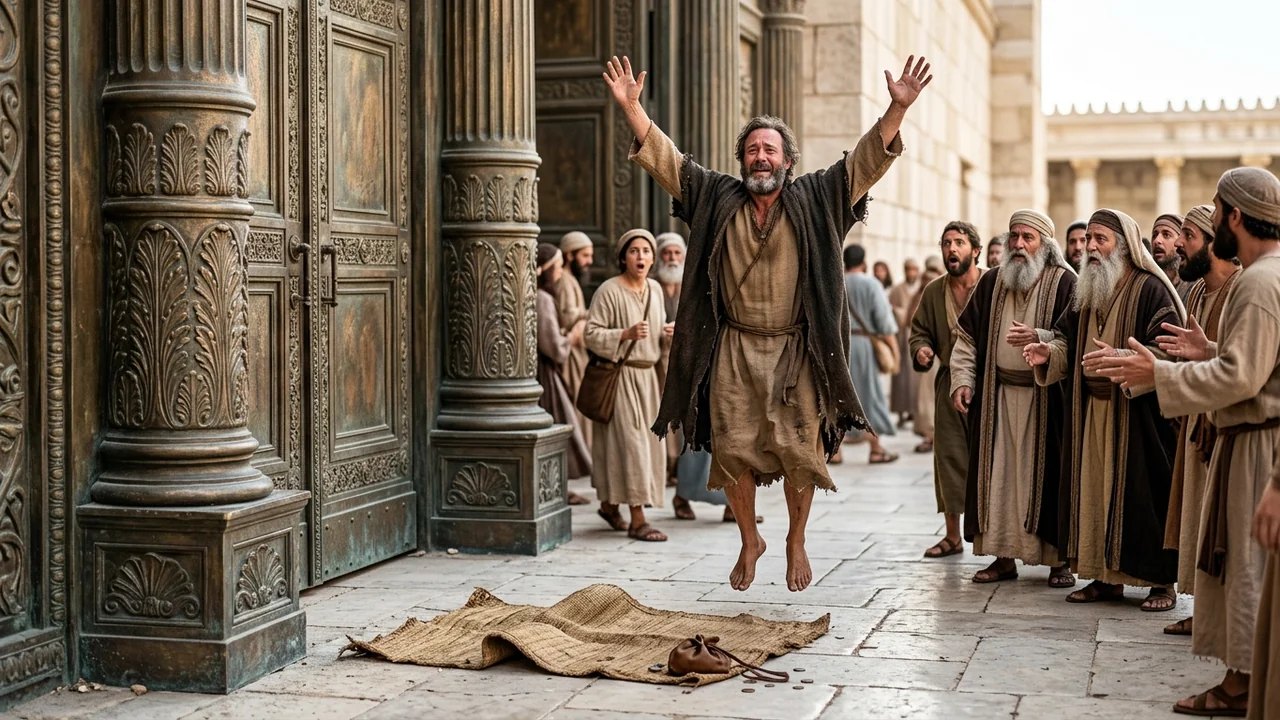
Shortly after the Day of Pentecost, during the vibrant infancy of the Christian movement in Jerusalem, the Apostles Peter and John were ascending the massive marble terraces of the Temple Mount at the ninth hour (3:00 PM—the sacred hour of the evening incense sacrifice):
"And a certain man lame from his mother's womb was carried, whom they laid daily at the gate of the temple which is called Beautiful, to ask alms of them that entered into the temple; Who seeing Peter and John about to go into the temple asked an alms. And Peter, fastening his eyes upon him with John, said, 'Look on us.' And he gave heed unto them, expecting to receive something of them. Then Peter said, 'Silver and gold have I none; but such as I have give I thee: In the name of Jesus Christ of Nazareth rise up and walk.'" (Acts 3:2–6)
Peter reached down, grasped the beggar’s withered right hand, and pulled him upward.
What followed was an instantaneous, explosive physical transformation that dumbfounded thousands of worshippers:
"And he took him by the right hand, and lifted him up: and immediately his feet and ankle bones received strength. And he leaping up stood, and walked, and entered with them into the temple, walking, and leaping, and praising God." (Acts 3:7–8)
In Acts 4:22, the author adds a critical epidemiological datum: "For the man was above forty years old, on whom this miracle of healing was shewed."
To a modern orthopedic surgeon, neuro-physiologist, and biomechanics specialist, this single verse establishes a clinical scenario that is totally irreversible under natural biological laws. An adult human who has never walked for four decades cannot simply "stand and leap" without shattering his bones and tearing his tendons!
The Clinical Profile: Forty Years of Congenital Paralysis
The biblical text specifies that this man was "lame from his mother's womb" (chōlos ek koilias mētros autou). He was not suffering from a temporary sprain or a recent fracture; he had spent all forty years of his life in a state of complete non-weight-bearing physical dependency.
[CONGENITAL DEFECT (Cerebral Palsy / Spina Bifida / Clubfoot Deformity)]
                                │
                                ▼  FORTY YEARS OF ABSOLUTE DISUSE:
         ┌──────────────────────┴──────────────────────┐
         ▼                                             ▼
[ORTHOPEDIC PATHOLOGY]                        [NEUROLOGICAL PATHOLOGY]
├── Severe Disuse Osteopenia                  ├── Complete absence of spinal Central
│   (Porous, paper-thin cortical bone)        │   Pattern Generators (CPGs) for bipedal gait
├── Extreme Flexion Contractures              ├── Zero cerebellar balance coordination
│   (Achilles tendon frozen & shortened)      └── Zero proprioceptive sensory mapping
└── Total Sarcopenia & Muscular Agenesis          in the post-central sensory cortex
    (Gastrocnemius & Quadriceps replaced by fat)
In clinical rehabilitation medicine, prolonged disuse of the lower limbs produces three catastrophic physical consequences:
- Severe Sarcopenia and Muscular Fatty Infiltration: Skeletal muscle fibers (myocytes) that receive no motor stimulation atrophy exponentially. Within months, muscle mass collapses; after four decades, the calf and thigh muscles are almost entirely replaced by fibrous connective tissue and adipose fat.
- Fixed Fibrotic Contractures: Without passive stretching or active motion, the connective tissues surrounding the ankle joint undergo severe shortening. The Achilles tendon shrinks into a taut, unyielding fibrous cord, freezing the foot in an abnormal, deformed downward position (talipes equinus).
- Absence of Articular Cartilage: Joint surfaces that never experience dynamic compression fail to lubricate. The hyaline cartilage thins, degenerates, and often undergoes partial ankylosis (spontaneous fusion of bones).
Wolff’s Law and Disuse Osteopenia: Why Frail Bones Should Have Shattered
In 1892, German anatomist and surgeon Julius Wolff formulated the fundamental law of bone mechanics, known universally today as Wolff’s Law:
Bone in a healthy animal will adapt to the loads under which it is placed. If loading on a particular bone increases, the bone will remodel itself over time to become stronger. Conversely, if the load on a bone decreases, the bone will become weaker and lose mineral density through osteoclastic resorption.
                              [WOLFF'S LAW APPLIED TO ACTS 3]
                                             │
         ┌───────────────────────────────────┴───────────────────────────────────┐
         ▼                                                                       ▼
[40 YEARS OF ZERO WEIGHT-BEARING]                                       [SUDDEN VERTICAL LOADING]
├── Osteoclasts absorb bone matrix unopposed                            ├── Peter pulls 70 kg man to feet
├── Cortical bone thins to eggshell fragility                           ├── Biomechanical load: ~700 Newtons
└── Severe Disuse Osteopenia / Osteoporosis                             └── Under natural physics:
                                                                            CATASTROPHIC MULTIPLE FRACTURES
                                                                            OF TIBIA, FIBULA, AND TALUS!
The Biomechanical Fracture Risk
Bone is a dynamic living piezoelectric crystal composed of calcium hydroxyapatite and type-I collagen fibers. It requires the repetitive, mechanical concussive impact of walking to stimulate osteoblasts to deposit dense mineral architecture.
- In a 40-year-old congenitally paralyzed beggar who was carried everywhere on a rug (Acts 3:2), the bones of his legs and feet—the tibia, fibula, calcaneus, and talus—were paper-thin, brittle shells hollowed out by disuse osteopenia.
- If an orthopedic surgeon suddenly forced a 40-year-old paralyzed patient to stand upright, the sudden application of 150 to 180 pounds of downward vertical gravitational force (~700 Newtons) would cause immediate, catastrophic pathologic spiral fractures of the tibia and collapse of the tarsal arch!
Yet when Peter lifted him, his bones did not shatter; they supported his full body weight and the explosive, high-impact kinetic shock of leaping into the air!
Luke the Physician’s Technical Vocabulary: Baseis and Sphydra
The biblical author’s medical background shines through in Acts 3:7 with brilliant clinical precision:
"And immediately his feet and ankle bones received strength."
(Greek: kai parachrēma estereōthēsan hai baseis autou kai ta sphydra)
[Greek Medical Term: αἱ βάσεις (Hai Baseis)]
   ├── In classical Greek literature: "Steps" or "Foundations"
   └── In ancient medical treatises (Galen, Hippocrates):
       The structural base of the foot; specifically the metatarsal and tarsal arch bones!

[Greek Medical Term: τὰ σφυδρά (Ta Sphydra)]
   ├── NEVER used anywhere else in the entire New Testament or Septuagint!
   └── Highly specialized medical terminology found in Dioscorides and Galen:
       Specifically designates the MALLEOLI (the lateral and medial bony prominences of the ankle)!
Where a layman like Matthew or Mark would simply write, "his legs became strong", Dr. Luke uses the exact technical anatomical vocabulary taught in the imperial medical schools of Alexandria and Pergamum:
- Baseis (βάσεις): Refers to the foundational tarsal-metatarsal skeletal arch that distributes vertical downward mass across the heel and ball of the foot.
- Sphydra (σφυδρά): The anatomical term for the malleoli—the complex articulating bony prominences of the distal tibia and fibula that form the mortise of the ankle joint.
- Estereōthēsan (ἐστερεώθησαν): A medical passive verb meaning "they were solidified, consolidated, densified, or structurally stabilized".
In modern clinical terminology, Luke is describing an instantaneous, high-speed bio-mineral consolidation: calcium hydroxyapatite crystals poured into the porous trabecular bone matrix, remodeling eggshell-thin bone into high-density cortical structural steel in a fraction of a second!
The Neurological Miracle: Proprioception, Balance, and Leaping
Even if an orthopedic surgeon could magically install brand-new bones and tendons into a paralyzed adult, the patient would still be completely incapable of walking:
[HUMAN BIPEDAL LOCOMOTION REQUIRES INTEGRATED NEURAL SYSTEMS]
                               │
         ┌─────────────────────┼─────────────────────┐
         ▼                     ▼                     ▼
[PROPRIOCEPTIVE FEEDBACK]  [VESTIBULAR INTEGRATION]  [CEREBELLAR MOTOR PROGRAMS]
├── Muscle spindle receptors├── Semicircular canals   ├── Coordinated agonist-antagonist
│   monitor joint angles    │   in inner ear monitor  │   muscle firing (Quadriceps vs.
└── Golgi tendon organs         linear acceleration   │   Hamstrings)
    monitor tensile stress  └── Coordinates balance   └── Central Pattern Generators (CPGs)
                                with ocular tracking      in lumbar spinal cord
The Complexity of Leaping (Hallomenos)
Walking is not an involuntary reflex; it is a learned, highly complex neurological symphony:
- Sensory Mapping: A person who has never walked has zero neural representation of upright footing in the primary somatosensory cortex (postcentral gyrus). They have no concept of "where their feet are in space" without looking at them.
- Vestibular-Ocular Reflex: The moment a horizontal human stands vertically, blood pressure plunges (orthostatic hypotension), and the inner ear vestibular system is flooded with novel gravitational cues, inducing severe vertigo and fainting.
- The Miracle of Leaping: Acts 3:8 states that the man was "walking, and leaping [hallomenos], and praising God." Leaping is the ultimate high-level athletic challenge for human biomechanics: it requires explosive concentric quadriceps contraction, instantaneous plantarflexion of the gastrocnemius, flight phase balance, and shock-absorbing eccentric landing deceleration!
This man did not spend six months in parallel bars with physical therapists learning how to shift his weight. The Creator of the nervous system instantly downloaded the entire motor software package for upright bipedal athletic locomotion directly into his brain and spinal cord!
Comparative Orthopedic Biomechanics: Clinical Rehabilitation vs. Acts 3
| Physiological Parameter | Modern Clinical Rehabilitation of Long-Term Paralysis | The Healing at the Beautiful Gate (Acts 3) |
|---|---|---|
| Bone Mineral Density (BMD) | Takes 12 to 24 months of pharmacological & weight-bearing therapy | Instantaneous mineralization (estereōthēsan) in milliseconds |
| Achilles Tendon Length | Requires surgical lengthening (Z-plasty) and months of casting | Instantaneous elongation and collagen elasticity restoration |
| Muscle Mass / Sarcopenia | Requires 1 to 2 years of progressive neuromuscular stimulation | Instantaneous myofibrillar hypertrophy and motor unit recruitment |
| Proprioceptive Neural Circuits | Severely impaired; requires intensive balance board rehabilitation | Complete instantaneous cerebellar and spinal CPG coordination |
| Initial Locomotion Ability | Hesitant, unsteady stepping with walker and extensive bracing | Immediate standing, steady walking, and explosive athletic leaping! |
| Risk of Fracture Upon Loading | Extremely High (Pathologic fracture risk under sudden 700 N load) | Zero (Walked miles through Temple courts without bone injury) |
The Beautiful Gate: Historical Archaeology of the Corinthian Bronze Portal
Where did this historic miracle occur?
Luke identifies the location as "the gate of the temple which is called Beautiful" (Thura Hōraia). The 1st-century Jewish historian Flavius Josephus provides a magnificent description of this exact architectural masterpiece in The Jewish War (V.201–204):
[THE MONUMENTAL BEAUTIFUL / NICANOR GATE]
   ├── Location: East entrance of Temple, separating Court of Women from Court of Israel
   ├── Construction: Cast from SOLID CORINTHIAN BRONZE (Far more precious than gold/silver!)
   ├── Dimensions: 50 cubits (75 feet) high; 40 cubits (60 feet) wide
   └── Weight: Required TWENTY TEMPLE GUARDS to swing the massive bronze doors shut nightly!
"Now nine of the gates were completely overlaid with gold and silver... but one, that without the holy house, was of Corinthian bronze, and greatly excelled those that were only covered over with silver and gold... It required twenty men to shut it every evening, and it was fastened with bars of iron." — Flavius Josephus, The Jewish War (V.201, 204)
Archaeological excavations along the southern and eastern perimeter of the Temple Mount have confirmed the monumental scale of Herodian limestone staircases and portals.
For forty years, this paralyzed beggar was carried past this colossal bronze gate. Thousands of rich Pharisees and Roman nobles walked past him, tossing tiny copper coins onto his dirty mat. But neither the vast wealth of the Roman Empire nor the glittering gold of the Herodian Temple could mend his broken bones.
Then walked past two penniless Galilean fishermen who possessed neither silver nor gold. With seven words spoken in the authority of the Risen King of Creation, forty years of physical deformity were vaporized into praise!
Discover the Full Orthopedic and Archaeological Dossiers
The healing of the lame man at the Beautiful Gate is one of dozens of ancient New Testament wonders where modern orthopedic surgery, kinesiology, and Second Temple archaeology intersect. To examine complete histological bone remodeling charts, ancient Greek medical lexicons of Galen and Dioscorides, and architectural CAD reconstructions of the Nicanor Bronze Gate:
👉 Discover Volume IV: Scientific Miracles & Ancient Prophecies ($2.99)
Features detailed biomechanical stress models of human bipedal gait, full translations of Josephus's Temple architecture chronicles, and clinical autopsies of New Testament miracles.
Frequently Asked Questions
Why did Luke use the specific words baseis and sphydra in Acts 3:7?
Luke was a trained physician (Colossians 4:14). Instead of using common colloquial words for legs or feet, he employed technical Greek anatomical terminology: baseis refers to the foundational tarsal-metatarsal bone arch of the foot, while sphydra refers specifically to the malleoli (ankle bones). The word sphydra is used nowhere else in the Bible, but appears frequently in ancient medical texts by Galen and Hippocrates.
What is Wolff's Law and how does it relate to this miracle?
Wolff's Law states that bones adapt structurally to mechanical loads: weight-bearing strengthens bones, while disuse causes severe bone demineralization (disuse osteopenia). A 40-year-old congenitally paralyzed man would have eggshell-thin, porous bones. Naturally attempting to bear weight would instantly cause catastrophic pathologic fractures. The miracle required instant bone remodeling to withstand his full body weight.
Why is leaping immediately after 40 years of paralysis neurologically impossible?
Bipedal locomotion and leaping require complex proprioceptive feedback from muscle spindles, inner ear vestibular balance, and learned spinal Central Pattern Generators (CPGs). A person who has never walked has no neural pathways for balance or motor coordination. Jesus not only repaired his physical bones and muscles, but instantly downloaded the entire neural software for athletic balance and movement.
What was the Beautiful Gate of the Temple?
The Beautiful Gate was the famous Nicanor Gate described by Flavius Josephus in The Jewish War (V.201). Located on the eastern side of the Temple courts, it was constructed of solid, gleaming Corinthian bronze and was so massive that it required twenty Temple guards to push it shut each evening.
Frequently Asked Questions
Why did Luke use the specific words baseis and sphydra in Acts 3:7?
Luke was a trained physician (Colossians 4:14). Instead of using common colloquial words for legs or feet, he employed technical Greek anatomical terminology: baseis refers to the foundational tarsal-metatarsal bone arch of the foot, while sphydra refers specifically to the malleoli (ankle bones). The word sphydra is used nowhere else in the Bible, but appears frequently in ancient medical texts by Galen and Hippocrates.
What is Wolff's Law and how does it relate to this miracle?
Wolff's Law states that bones adapt structurally to mechanical loads: weight-bearing strengthens bones, while disuse causes severe bone demineralization (disuse osteopenia). A 40-year-old congenitally paralyzed man would have eggshell-thin, porous bones. Naturally attempting to bear weight would instantly cause catastrophic pathologic fractures. The miracle required instant bone remodeling to withstand his full body weight.
Why is leaping immediately after 40 years of paralysis neurologically impossible?
Bipedal locomotion and leaping require complex proprioceptive feedback from muscle spindles, inner ear vestibular balance, and learned spinal Central Pattern Generators (CPGs). A person who has never walked has no neural pathways for balance or motor coordination. Jesus not only repaired his physical bones and muscles, but instantly downloaded the entire neural software for athletic balance and movement.
What was the Beautiful Gate of the Temple?
The Beautiful Gate was the famous Nicanor Gate described by Flavius Josephus in The Jewish War (V.201). Located on the eastern side of the Temple courts, it was constructed of solid, gleaming Corinthian bronze and was so massive that it required twenty Temple guards to push it shut each evening.
Related Research Dossiers
View all 120 articles →
Hematidrosis in Gethsemane: What Causes Human Sweat Glands to Bleed Under Severe Anguish?
The Effusion of Blood and Water: Forensic Confirmation of Acute Cardiac Rupture on the Cross