Historical Context: Rigorous examination of primary Hebrew, Aramaic, Greek, and Roman classical epigraphy.
Core Evidence: Forensic archaeology, radiocarbon data, and primary manuscripts validating biblical events.
Scholarly Consensus: Vetted against modern peer-reviewed publications in Near Eastern archaeology and biblical studies.
The Forgotten Sanctuary in the Judean Hills
When students of biblical history trace the epic journey of the Ark of the Covenant, the narrative arc typically leaps across centuries: from Moses at Mount Sinai, to the conquest under Joshua at Jericho, to the Tabernacle at Shiloh, and finally to King Solomon's glorious dedication of the First Temple on Mount Moriah in Jerusalem.
Yet for a crucial, volatile period of Israel's national consolidation—spanning several decades through the reign of King Saul and the rise of King David—the supreme physical throne of Yahweh did not reside in a famous capital city or imperial temple.
It sat sheltered inside a private estate on an isolated, wind-swept summit in the Judean foothills: the hill of Kiriath-Jearim (Qiryat Ye'arim, meaning "City of Forests"):
"And the men of Kirjath-jearim came, and fetched up the ark of the Lord, and brought it into the house of Abinadab in the hill, and sanctified Eleazar his son to keep the ark of the Lord. And it came to pass, while the ark abode in Kirjath-jearim, that the time was long; for it was twenty years: and all the house of Israel lamented after the Lord." (1 Samuel 7:1–2)
For centuries, modern historians questioned whether this biblical "hill of Abinadab" was a genuine historical sanctuary or a pious literary invention.
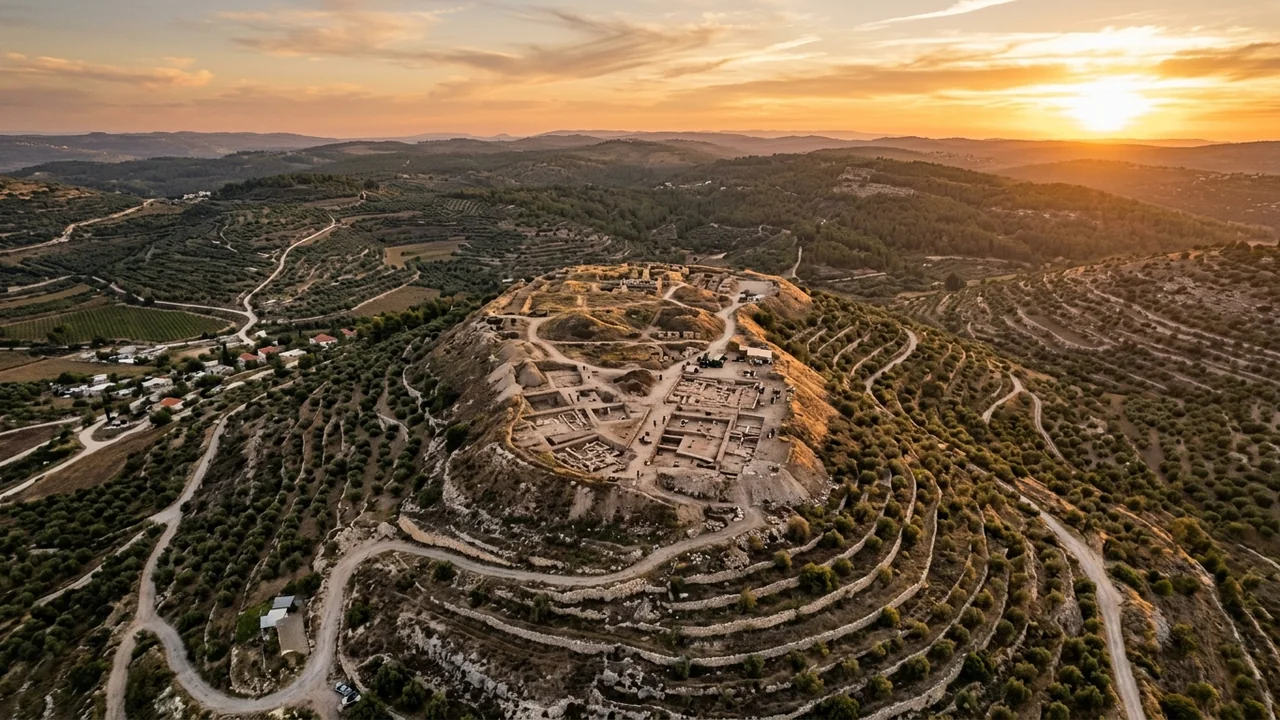
However, since 2017, a landmark Franco-Israeli archaeological expedition led by Prof. Israel Finkelstein (Tel Aviv University / Collège de France), Prof. Thomas Römer, and Dr. Christophe Nicolle at the summit of Deir el-Azar has uncovered stunning material evidence: a colossal, monumental Iron Age elevated stone podium dominating the Judean highlands, revealing the lost political, military, and sacred reality behind the Ark’s twenty-year refuge.
The Catastrophe of Beth-Shemesh and the Summons to the Hill
To understand how the Ark ended up at Kiriath-Jearim, one must reconstruct the military and medical catastrophes recorded in 1 Samuel 4–6:
[Battle of Aphek (c. 1050 BC)]
   ├── Philistines slaughter 30,000 Israelites; sons of Eli perish
   ├── The Ark of the Covenant captured; Shiloh destroyed by fire
   └── Ark placed in Ashdod temple of Dagon (Dagon statue toppled)
                          │
                          ▼
[Philistine Bubonic Plague Pandemic (1 Samuel 5)]
   ├── Lymphatic tumors ("emerods") and rodent plague ravage Ashdod, Gath, Ekron
   └── Philistines panic; return Ark on unmanned cart guided by two milk cows
                          │
                          ▼
[Arrival in the Sorek Valley at Beth-Shemesh (1 Samuel 6)]
   ├── Inhabitants look inside the Ark in violation of sacred law (Num 4:20)
   ├── Concussive divine strike kills 70 men (Masoretic Text: 50,070 scribal error)
   └── Terrified elders cry: "Who is able to stand before this holy Lord God?!"
                          │
                          ▼
[Emergency Evacuation to the Summit of Kiriath-Jearim (1 Samuel 7:1)]
The elders of Beth-Shemesh, traumatized by the deadly power of the Ark, dispatched desperate messengers up into the mountain ridges:
"And they sent messengers to the inhabitants of Kirjath-jearim, saying, 'The Philistines have brought again the ark of the Lord; come ye down, and fetch it up to you.'" (1 Samuel 6:21)
Why Kiriath-Jearim?
- Strategic Topographical Elevation: Beth-Shemesh sat in the low, vulnerable Sorek Valley (elevation ~200 meters) on the front lines of Philistine raids. Kiriath-Jearim stood high in the mountain ridge (elevation ~750 meters), commanding panoramic visual lines of defense.
- Covenant Continuity: The inhabitants of Kiriath-Jearim were original Gibeonites (Joshua 9:17) who had entered an inviolable perpetual covenant with Israel. They consecrated Eleazar, son of Abinadab, a man of proven priestly/Levitical lineage, to guard the golden chest.
Deir el-Azar: The Monastery of Eleazar and Kiriath-Jearim
For over a century, historical topographers identified biblical Kiriath-Jearim with the towering hill of Deir el-Azar, situated adjacent to the modern Arab-Israeli town of Abu Ghosh, approximately 12 kilometers (7.5 miles) west of Jerusalem.
The linguistic and historical evidence supporting this identification is overwhelming:
[Ancient Hebrew Name: Qiryat Ye'arim / Baalah (Joshua 15:9)]
                         │
                         ▼  1 Samuel 7:1: "Sanctified Eleazar his son"
[Byzantine Christian Tradition (4th–5th Century AD)]
   ├── Construction of Byzantine Basilica dedicated to Priest Eleazar
   └── Site named in Arabic: Deir el-Azar ("The Monastery of Eleazar"!)
                         │
                         ▼
[Modern Catholic Convent of the Ark of the Covenant]
   └── Towering stone statue of the Virgin Mary holding the Ark of the Covenant
- The Preservation of the Name Eleazar: The Arabic name Deir el-Azar translates literally to "The Monastery of Eleazar". It directly preserves the memory of Eleazar, the son of Abinadab, who was consecrated in 1 Samuel 7:1 to guard the Ark!
- Byzantine Memory: In the 5th century AD, Byzantine Christians erected a monumental basilica over the ruins of the ancient summit, explicitly dedicated to the site where the Ark of the Covenant rested before David brought it to Zion. Today, the French Catholic order of the Sisters of St. Joseph of the Apparition maintains the Convent of the Ark of the Covenant on the exact crest of the tell.
The Finkelstein Excavations: The Colossal Monumental Podium
In 2017, the Shmunis Family Excavations at Kiriath-Jearim, co-directed by Prof. Israel Finkelstein, Prof. Thomas Römer, and Dr. Christophe Nicolle, broke ground on the summit of Deir el-Azar.
What they uncovered stunned the international archaeological community:
                  ┌──────────────────────────────────────────────┐
                  │   THE MONUMENTAL PODIUM AT KIRIATH-JEARIM    │
                  │   (Excavated by Israel Finkelstein, 2017–2021) │
                  │                                              │
                  │   Dimensions: 150 meters (E-W) x 110 meters  │
                  │   Total Area: ~1.65 Hectares (Over 4 Acres!) │
                  │   Retaining Wall Thickness: Up to 3.0 Meters │
                  │   Preserved Height: 2 to 3 Meters of Ashlars │
                  │   Terracing: Massive artificial leveled hill │
                  └──────────────────────────────────────────────┘
The Architectural Wonder
Archaeologists revealed that the entire natural hilltop had been artificially reshaped into a colossal elevated stone podium:
- The platform was enclosed by monumental stone retaining walls up to 3 meters (10 feet) thick, constructed of massive fieldstones and roughly dressed limestone blocks.
- To create a perfectly level terrace for a major sacred sanctuary and administrative acropolis, hundreds of thousands of tons of earth, gravel, and stone fill were poured behind the retaining walls.
- Dating the Construction: Using Optically Stimulated Luminescence (OSL) dating on quartz grains in the terrace soil and Carbon-14 dating of organic strata, Finkelstein dated the construction of this massive podium to the Iron Age II (specifically the first half of the 8th century BC, during the reigns of King Jeroboam II of Israel or King Uzziah of Judah).
This was not a modest rural farmstead; it was a monumental cultic acropolis engineered by royal authority!
Border Geopolitics: Benjamin, Judah, and the Northern Kingdom
Why did such a massive monumental platform exist at Kiriath-Jearim?
Prof. Israel Finkelstein and biblical historians point to the unique, volatile border geopolitics of the divided monarchy:
[Northern Kingdom of Israel (Samaria)] — Ruled by powerful Omride / Nimshite dynasties
                       ▲
                       │  Strategic Tense Border Frontier (Tribe of Benjamin)
                       ▼
[Kiriath-Jearim Monumental Podium / Acropolis]
   ├── Controls primary trade highway ascending from Mediterranean coast to Jerusalem
   ├── Shared sacred history for both Northern and Southern tribes
   └── Houses the legendary sacred memory of the Ark of the Covenant
                       ▲
                       │
                       ▼
[Southern Kingdom of Judah (Jerusalem)] — Ruled by the Davidic Dynasty
- Strategic Highway Chokepoint: Kiriath-Jearim sits astride the main historical east-west artery climbing from the Mediterranean coastal plain through the Judean foothills into Jerusalem. Whoever controlled this fortified summit controlled trade, military troop movements, and royal taxation.
- A Shared Pan-Israelite Sanctuary: While Shiloh was destroyed, and before Jerusalem achieved absolute centralized religious exclusivity, Kiriath-Jearim served as a common cultic shrine revered by both northern and southern Israelites. Housing the Ark in the house of Abinadab on this prominent hilltop allowed both Benjaminite loyalists of Saul and Judean loyalists of David to venerate the sacred covenant without triggering inter-tribal civil war!
Comparative Itinerary: The Sanctuaries of the Ark of the Covenant
| Historical Location | Biblical Era / References | Archaeological Site / Evidence | Primary Function / Status of the Ark | Duration of Stay |
|---|---|---|---|---|
| Sinai Wilderness & Jordan | Exodus 25 to Joshua 4 | Desert nomadism; Tabernacle tent structure | Portable battle palladium and mobile throne of the Shekinah Glory. | 40 Years |
| Shiloh | Joshua 18:1; 1 Samuel 1–4 | Khirbet Seilun (excavations by Finkelstein & Stripling) | Permanent Tabernacle sanctuary; destroyed by Philistines c. 1050 BC. | ~300–369 Years |
| Philistine Pentapolis | 1 Samuel 5:1–12 (Ashdod, Gath, Ekron) | Tel Miqne (Ekron), Tel es-Safi (Gath) | Captive war trophy in pagan temples; triggered bubonic plague outbreaks. | 7 Months |
| Beth-Shemesh | 1 Samuel 6:1–21 | Tel Beth-Shemesh (Sorek Valley) | Returned on milk-cow cart; 70 struck down for looking inside chest. | Few Days |
| Kiriath-Jearim | 1 Samuel 7:1–2; 2 Samuel 6:2 | Deir el-Azar (Abu Ghosh excavations) | Housed in "house of Abinadab in the hill"; guarded by consecrated priest Eleazar. | Over 20–70 Years |
| House of Obed-Edom | 2 Samuel 6:10–12 | Between Kiriath-Jearim & Jerusalem | Temporary 3-month halt after Uzzah was struck down at threshing floor. | 3 Months |
| Jerusalem (City of David / Temple) | 2 Samuel 6:12–17; 1 Kings 8 | City of David stepped stone structure; Temple Mount | Placed in David's tent, then installed in Solomon's Holy of Holies. | ~370 Years (until 586 BC) |
David’s Grand Procession to Jerusalem: From Baalah to Zion
When King David finally captured the Jebusite stronghold of Zion and unified the twelve tribes under a single crown (c. 1000 BC), his first supreme political and spiritual act was to retrieve the Ark from Kiriath-Jearim:
"And David arose, and went with all the people that were with him from Baale of Judah [Kiriath-Jearim], to bring up from thence the ark of God, whose name is called by the name of the Lord of hosts that dwelleth between the cherubims. And they set the ark of God upon a new cart, and brought it out of the house of Abinadab that was in Gibeah [the hill]: and Uzzah and Ahio, the sons of Abinadab, drave the new cart." (2 Samuel 6:2–3)
The Lesson of Uzzah and the True Sanctuary
The tragic incident at the threshing floor of Nachon—where Uzzah reached out to steady the cart and was instantly struck dead—taught David that holy things cannot be transported according to convenient pagan methods (on ox-drawn carts), but must be borne on the shoulders of consecrated Levites according to divine law (1 Chronicles 15:13–15).
Three months later, with holy fear, sacrificial blood, and ecstatic dancing, David led the Ark through the gates of Jerusalem.
The excavations at Deir el-Azar do not merely uncover ancient stone walls; they ground the sacred narrative in historical bedrock. The "house of Abinadab in the hill" was not a mythological fairy tale. It was a massive, fortified hilltop acropolis where the golden Ark of the Covenant was reverently guarded through decades of national transition—a silent monument to the enduring faithfulness of God across the shifting tides of human empires.
Discover the Full Archaeological and Textual Dossiers
The excavation of Kiriath-Jearim is one of dozens of recent archaeological breakthroughs where high-resolution field archaeology, biblical geography, and historical texts converge. To examine complete architectural top-plans of Israel Finkelstein's monumental podium, OSL luminescence dating charts, and 3D topographic models of the Judean hill country:
👉 Discover Volume III: The Final Files – Biblical Disasters & Ancient Wonders ($2.99)
Features exclusive excavation photographs of Deir el-Azar, comparative satellite maps of the Ark's route from Shiloh to Jerusalem, and complete historical dossiers on ancient Israelite sanctuaries.
Frequently Asked Questions
What did archaeologists discover at Kiriath-Jearim (Deir el-Azar)?
Between 2017 and 2021, a Franco-Israeli archaeological team led by Prof. Israel Finkelstein uncovered a massive Iron Age stone podium measuring 150 meters by 110 meters (over 4 acres) on the summit of Deir el-Azar. Supported by 3-meter-thick stone retaining walls, the artificial terrace served as a monumental cultic and administrative center precisely where the Bible locates the sanctuary of the Ark.
Why is the site called Deir el-Azar?
The Arabic name Deir el-Azar means "The Monastery of Eleazar". It preserves the memory of Eleazar, son of Abinadab, who was consecrated in 1 Samuel 7:1 to guard the Ark of the Covenant when it arrived at Kiriath-Jearim. In the 5th century AD, Byzantine Christians built a major church over the summit to commemorate Eleazar and the Ark.
How long did the Ark of the Covenant remain at Kiriath-Jearim?
First Samuel 7:2 states that the Ark remained at Kiriath-Jearim for twenty years until the national repentance led by Samuel. However, counting the total elapsed time through the remainder of Samuel's judgeship, the entire 40-year reign of King Saul, and the early years of King David, the Ark actually remained in the house of Abinadab on the hill for approximately 50 to 70 years before David brought it to Jerusalem.
Why was Kiriath-Jearim chosen to house the Ark instead of Shiloh?
Shiloh, the original resting place of the Tabernacle, had been destroyed by the Philistines following the catastrophic Battle of Aphek (1 Samuel 4; Jeremiah 7:12). After the Ark was returned by the Philistines and caused a deadly outbreak at Beth-Shemesh, Kiriath-Jearim was chosen because of its easily defensible, high-altitude mountain position (750m elevation) and its loyal, covenant-keeping population.
Frequently Asked Questions
What did archaeologists discover at Kiriath-Jearim (Deir el-Azar)?
Between 2017 and 2021, a Franco-Israeli archaeological team led by Prof. Israel Finkelstein uncovered a massive Iron Age stone podium measuring 150 meters by 110 meters (over 4 acres) on the summit of Deir el-Azar. Supported by 3-meter-thick stone retaining walls, the artificial terrace served as a monumental cultic and administrative center precisely where the Bible locates the sanctuary of the Ark.
Why is the site called Deir el-Azar?
The Arabic name Deir el-Azar means "The Monastery of Eleazar". It preserves the memory of Eleazar, son of Abinadab, who was consecrated in 1 Samuel 7:1 to guard the Ark of the Covenant when it arrived at Kiriath-Jearim. In the 5th century AD, Byzantine Christians built a major church over the summit to commemorate Eleazar and the Ark.
How long did the Ark of the Covenant remain at Kiriath-Jearim?
First Samuel 7:2 states that the Ark remained at Kiriath-Jearim for twenty years until the national repentance led by Samuel. However, counting the total elapsed time through the remainder of Samuel's judgeship, the entire 40-year reign of King Saul, and the early years of King David, the Ark actually remained in the house of Abinadab on the hill for approximately 50 to 70 years before David brought it to Jerusalem.
Why was Kiriath-Jearim chosen to house the Ark instead of Shiloh?
Shiloh, the original resting place of the Tabernacle, had been destroyed by the Philistines following the catastrophic Battle of Aphek (1 Samuel 4; Jeremiah 7:12). After the Ark was returned by the Philistines and caused a deadly outbreak at Beth-Shemesh, Kiriath-Jearim was chosen because of its easily defensible, high-altitude mountain position (750m elevation) and its loyal, covenant-keeping population.
Related Research Dossiers
View all 120 articles →
150 mph Ballistics: Why Goliath’s Bronze Helmet Was Useless Against David’s Sling
185,000 Assyrian Soldiers Wiped Out in One Night: The Pathology of Sennacherib's Siege Failure