Historical Context: Rigorous examination of primary Hebrew, Aramaic, Greek, and Roman classical epigraphy.
Core Evidence: Forensic archaeology, radiocarbon data, and primary manuscripts validating biblical events.
Scholarly Consensus: Vetted against modern peer-reviewed publications in Near Eastern archaeology and biblical studies.
The Golden Age of King Uzziah: Military Genius and Prosperity
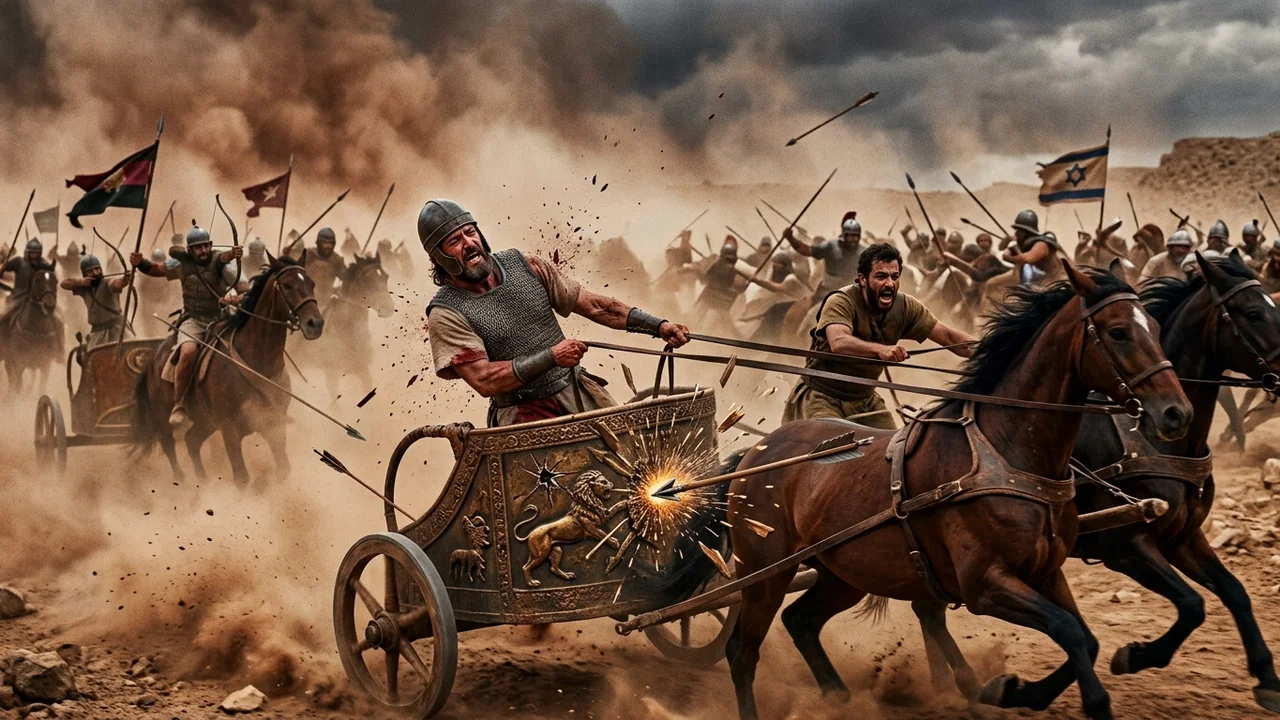
In the 8th century BC (c. 792–740 BC), the Kingdom of Judah experienced an extraordinary fifty-two-year golden age under the reign of King Uzziah (also called Azariah). Rising to power following the assassination of his father Amaziah, Uzziah transformed Judah from a vulnerable southern enclave into a fortified military superpower.
The chronicler in 2 Chronicles 26 documents his sweeping achievements:
- Military Conquests: Uzziah defeated the Philistines, dismantling the walls of Gath, Jabneh, and Ashdod, and subdued the Arabians and Ammonites, who paid him heavy annual tribute.
- Engineering Innovations: He fortified the towers of Jerusalem at the Corner Gate, Valley Gate, and the Angle, fitting the walls with early mechanical artillery engines—ballistas and catapults invented by cunning engineers to shoot arrows and great stones (2 Chronicles 26:15).
- Economic & Agricultural Flourishing: He dug numerous cisterns in the Judean wilderness, built watchtowers in the desert to protect trade routes to the Red Sea port of Elath, and maintained vast vineyards and herds in the fertile foothills (Shephelah).
His fame spread as far as the border of Egypt. Yet, as with many great monarchs of antiquity, unchecked military triumph became the seedbed of fatal hubris:
"But when he was strong, his heart was lifted up to his destruction: for he transgressed against the Lord his God, and went into the temple of the Lord to burn incense upon the altar of incense." (2 Chronicles 26:16)
The Sacrilege in the Holy Place: 2 Chronicles 26
In the biblical covenant of Moses, the separation of civil and religious authority was absolute. Kings governed from the palace; only the consecrated sons of Aaron from the tribe of Levi were permitted to enter the Holy Place of the Temple and offer the sacred incense (Ketoret) upon the Golden Altar (Numbers 18:1–7).
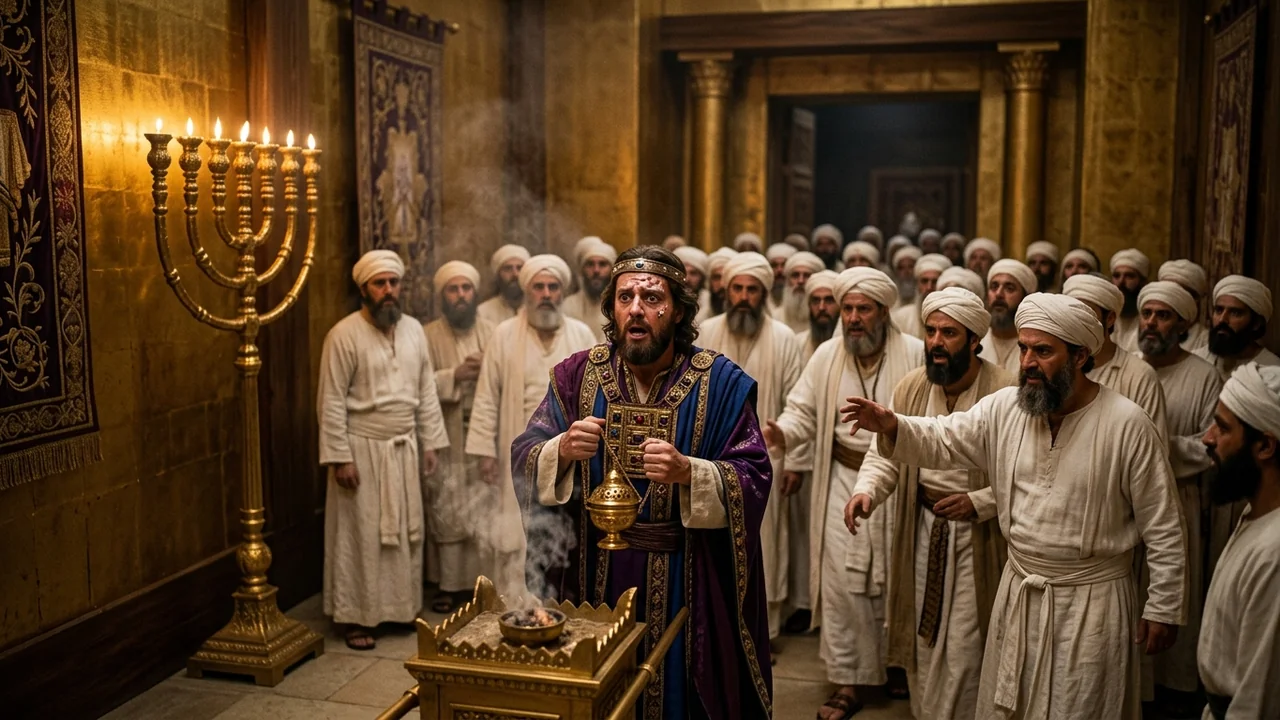
In ancient pagan kingdoms—such as Egypt, Assyria, and Babylon—monarchs routinely functioned as high priests, merging absolute political and sacerdotal power. Emulating pagan imperial grandeur, Uzziah took a golden censer in his hand and strode into the Holy Place before the veil of the Holy of Holies.
Eighty valiant priests, led by the intrepid High Priest Azariah, pursued the armed king into the sanctuary, putting their lives on the line:
"And they withstood Uzziah the king, and said unto him, 'It pertaineth not unto thee, Uzziah, to burn incense unto the Lord, but to the priests the sons of Aaron, that are consecrated to burn incense: go out of the sanctuary; for thou hast trespassed; neither shall it be for thine honor from the Lord God.' Then Uzziah was wroth, and had a censer in his hand to burn incense: and while he was wroth with the priests, the leprosy even rose up in his forehead before the priests in the house of the Lord, from beside the incense altar." (2 Chronicles 26:18–19)
As the king raged against the priests, a sudden, blinding physical transformation occurred. Right before the eyes of the eighty priests, a white, chalky lesion (tsara'at) erupted instantaneously upon his forehead.
Looking upon his face, Azariah and the priests saw the mark of divine judgment. Terrified, the priests thrust him out of the sanctuary; and Uzziah himself, realizing his doom, fled into the courtyard.
[1. Royal Hubris & Sanctuary Trespass]
             │  └── King enters Holy Place to usurp Aaronite priesthood
             │
[2. Sacerdotal Confrontation]
             │  └── High Priest Azariah & 80 priests bar the Golden Altar
             │
[3. Immediate Dermatological Outbreak]
             │  └── Sudden white lesion (tsara'at) erupts on the forehead
             │
[4. Perpetual Quarantine (Beit ha-Chophshit)]
             └── Stripped of royal executive power; excluded from the Temple for life
Clinical Pathology of Tsara’at: Hansen’s Disease vs. Acute Eruption
What was the medical condition that struck King Uzziah? In English Bibles, the Hebrew word tsara'at is traditionally translated as "leprosy." However, modern medical historians and clinical dermatologists distinguish between true Hansen's disease and biblical tsara'at:
- Hansen's Disease (Mycobacterium leprae): True modern leprosy is a slow-growing chronic bacterial infection. The incubation period averages 3 to 5 years, with physical symptoms—hypopigmented skin macules, peripheral neuropathy, and tissue absorption—developing gradually over decades. True Hansen's disease never erupts instantaneously in minutes.
- Biblical Tsara'at: Leviticus 13–14 outlines a wide spectrum of severe dermatological and spiritual manifestations, encompassing acute exfoliative psoriasis, vitiligo, severe seborrheic dermatitis, and secondary necrotic infections.
From a clinical and theological perspective, Uzziah’s sudden outbreak represents an acute divine dermatosis:
- The lesion appeared specifically on the forehead—the exact anatomical location where the High Priest wore the sacred gold plate (tzitz) engraved with "Holiness to the Lord" (Exodus 28:36–38). Where Uzziah sought to claim priestly glory, his forehead was branded with the mark of supreme ritual uncleanness!
- The rapid eruption produced profound psychosomatic shock, blanching of the microvasculature, and immediate desquamation of the epidermal layer.
The House of Isolation: Royal Leprosy Quarantine Protocols
Under Levitical law, an individual diagnosed with tsara'at was classified as ritually unclean and legally dead to society:
"And Uzziah the king was a leper unto the day of his death, and dwelt in a several house, being a leper; for he was cut off from the house of the Lord: and Jotham his son was over the king's house, judging the people of the land." (2 Chronicles 26:21)
The Hebrew term for "a several house" is beit ha-chophshit (literally, "the house of freedom" or "the house of isolation/release"). In ancient Near Eastern legal terminology, it designated an isolated quarantine compound located outside the city walls.
For the remainder of his life (roughly ten to eleven years), King Uzziah lived in total social, political, and religious quarantine:
- He was strictly barred from entering the Temple mount.
- He was stripped of executive administrative duties, while his son Jotham governed as coregent in Jerusalem.
- Even upon his death, Uzziah was denied burial inside the royal sepulchers of the Davidic dynasty: "So Uzziah slept with his fathers, and they buried him with his fathers in the field of the burial which belonged to the kings; for they said, 'He is a leper'" (2 Chronicles 26:23).
The Archaeological Artifact: The Uzziah Burial Inscription
In 1931, world-renowned biblical archaeologist and epigrapher Prof. Eleazar Sukenik (who later authenticated the first Dead Sea Scrolls) made one of the most stunning epigraphic discoveries in Jerusalem’s history.
Browsing the antiquities collection of the Russian Orthodox Convent on the Mount of Olives, Sukenik identified a finely carved, square limestone plaque measuring 35 by 35 centimeters. Dating to the late Second Temple period (c. 1st century AD), the tablet bears an exquisite four-line inscription in cursive Aramaic script:
[The Aramaic Inscription of King Uzziah (Israel Museum)]
               לכה התית טמי עוזיה
               מלך יהודה ולא למפתח
"L'khah hateit t'mei Uziyah Melekh Yehudah v'la l'miftach"
"Hither were brought the bones of Uzziah, King of Judah; do not open!"
Epigraphers determined that during the massive Roman-Herodian reconstruction of Jerusalem in the 1st century AD, municipal authorities expanded the city walls south and east. Finding ancient tombs within the newly enclosed urban zone, religious authorities re-interred the bones of ancient kings outside the city.
Because Uzziah had died as a leper, his secondary ossuary was re-buried with an explicit, solemn warning engraved in stone: "DO NOT OPEN!"—a permanent testament to the lingering ritual contamination of the king who defiled the altar. Today, this monumental artifact is proudly displayed in the Israel Museum in Jerusalem!
The Earthquake of Uzziah: Confirmed by Geology
Uzziah’s reign was also punctuated by a catastrophic natural disaster that left an indelible mark on prophetic literature: the Great Earthquake of Uzziah.
Amos opens his prophecy by dating his vision to "two years before the earthquake" (Amos 1:1), and Zechariah recalls it two centuries later: "ye shall flee, like as ye fled from before the earthquake in the days of Uzziah king of Judah" (Zechariah 14:5). Josephus records that when Uzziah held the censer in the Temple, a terrifying earthquake shattered the temple roof, split the nearby mountain of En-Rogel, and caused a massive landslide that buried the royal gardens.
In 2021, the Israel Antiquities Authority (IAA), led by Dr. Joe Uziel and Ortal Chalaf, announced that archaeological excavations in the City of David uncovered a destroyed 8th-century BC building stratum containing collapsed walls, smashed ceramic vessels, and collapsed stone ceilings without any signs of fire—the first physical archaeological confirmation of the massive earthquake of King Uzziah!
Uncover the Archaeological Relics of the Kings of Judah
The Uzziah Burial Inscription and the earthquake strata of the City of David are tangible proof that the biblical narratives rest on concrete historical foundations. If you want to explore the complete archaeological catalogs, royal bullae, and medical mysteries of ancient Judah:
👉 Discover Volume II: Kings & Prophets – Tragic Ends & Medical Mysteries ($2.99)
Includes high-resolution photos of the Uzziah Tablet, archaeological site plans of Solomon’s Temple, and clinical case files of ancient royal diseases.
Frequently Asked Questions
What was the sin of King Uzziah?
King Uzziah’s sin was proud presumption and sacrilege. Despite God making him exceptionally prosperous and militarily powerful, Uzziah entered the Holy Place of the Temple in Jerusalem to burn sacred incense on the Golden Altar, a sacred ritual strictly reserved by God’s covenant exclusively for the consecrated Aaronite priests (2 Chronicles 26:16–18).
Did archaeologists find the tomb or bones of King Uzziah?
In 1931, Prof. Eleazar Sukenik discovered a famous 1st-century AD limestone burial plaque from Jerusalem, now in the Israel Museum, inscribed in Aramaic: "Hither were brought the bones of Uzziah, King of Judah; do not open!" This confirms that Uzziah’s secondary burial site was preserved and honored in Jerusalem centuries after his death.
Where was King Uzziah quarantined?
King Uzziah lived in an isolated royal residence called the Beit ha-Chophshit (the "House of Isolation" or "Several House") outside the city of Jerusalem. Under Levitical law, lepers were considered ritually unclean and forbidden from dwelling among the general population or entering the Temple mount.
How did King Uzziah die?
King Uzziah died after living approximately ten to eleven years in isolation with his skin disease. Because of his condition, he was not buried in the royal rock-cut tombs of the kings of Judah, but in an adjacent burial field set apart for contaminated burials.
Frequently Asked Questions
What was the sin of King Uzziah?
King Uzziah’s sin was proud presumption and sacrilege. Despite God making him exceptionally prosperous and militarily powerful, Uzziah entered the Holy Place of the Temple in Jerusalem to burn sacred incense on the Golden Altar, a sacred ritual strictly reserved by God’s covenant exclusively for the consecrated Aaronite priests (2 Chronicles 26:16–18).
Did archaeologists find the tomb or bones of King Uzziah?
In 1931, Prof. Eleazar Sukenik discovered a famous 1st-century AD limestone burial plaque from Jerusalem, now in the Israel Museum, inscribed in Aramaic: "Hither were brought the bones of Uzziah, King of Judah; do not open!" This confirms that Uzziah’s secondary burial site was preserved and honored in Jerusalem centuries after his death.
Where was King Uzziah quarantined?
King Uzziah lived in an isolated royal residence called the Beit ha-Chophshit (the "House of Isolation" or "Several House") outside the city of Jerusalem. Under Levitical law, lepers were considered ritually unclean and forbidden from dwelling among the general population or entering the Temple mount.
How did King Uzziah die?
King Uzziah died after living approximately ten to eleven years in isolation with his skin disease. Because of his condition, he was not buried in the royal rock-cut tombs of the kings of Judah, but in an adjacent burial field set apart for contaminated burials.
Related Research Dossiers
View all 120 articles →
Eaten Alive by Worms: The Gruesome Clinical Pathology Behind Herod Agrippa’s Sudden Collapse
The Twin Pillars of Gaza: The Structural Physics Behind Samson's Catastrophic Final Vengeance