How old are the Ketef Hinnom silver scrolls?
The Ketef Hinnom scrolls date to approximately 650–600 BC (late Iron Age II), making them over 2,600 years old. They are more than 350 years older than the earliest biblical manuscripts found among the Dead Sea Scrolls at Qumran.
Ancient patristic witnesses, Second Temple manuscripts, and classical annals.
Stratigraphic digs, monumental epigraphy, and artifact forensics in the Levant.
Distinguishing canonical Scripture text from historical patristic traditions.
Subject Scope: The Ketef Hinnom Silver Scrolls: The Oldest Surviving Biblical Verses on Earth
Historical Context: Primary Roman legal transcripts, imperial annals (Tacitus, Suetonius), and early patristic martyrologies.
Primary Evidence: Forensic trauma biomechanics, historical Roman execution praxis, and classical epigraphic inscriptions.
Investigation Highlights: The Accidental Discovery in Burial Cave 24 • The Technology of Unrolling Ancient Silver Foils • The Paleo-Hebrew Inscription: Numbers 6:24–26
Scholarly Consensus: Cross-referenced against Roman imperial records and Mediterranean early Christian archaeological sites.
The Accidental Discovery in Burial Cave 24
In the summer of 1979, Israeli archaeologist Dr. Gabriel Barkay was directing an excavation of Iron Age burial caves at Ketef Hinnom (the 'Shoulder of Hinnom'), a rocky knoll overlooking the Hinnom Valley just southwest of Jerusalem's Old City walls, directly adjacent to St. Andrew's Scottish Church.
The tomb complex, designated Cave 24, dated to the late First Temple period (7th to 6th centuries BC). Like nearly all ancient Judean tombs, Cave 24 had been thoroughly looted over two millennia. However, Barkay enlisted a team of teenage volunteers from the Society for the Protection of Nature in Israel to help clean and document the empty bedrock benches.
One 13-year-old assistant, Nathan Hanel, grew bored and began banging a hammer against the stone floor beneath a burial bench. Suddenly, the bedrock cracked open, exposing a collapsed secret repository beneath the bench. Ancient Judeans used these subterranean repositories (repose-chambers) to sweep together the bones and grave goods of deceased family members once the flesh had decomposed, making room on the bench for the next generation (fulfilling the biblical idiom of being 'gathered to one's fathers').
Because the ceiling of this repository had collapsed in antiquity, grave robbers had missed it entirely. Inside lay over 1,000 intact artifacts: 263 intact ceramic vessels, 100 silver objects, iron arrowheads, gold earrings, glass beads, and two tiny, corroded rolls of 99% pure silver that resembled miniature cigarette butts.
Direct Historical Answer Box:
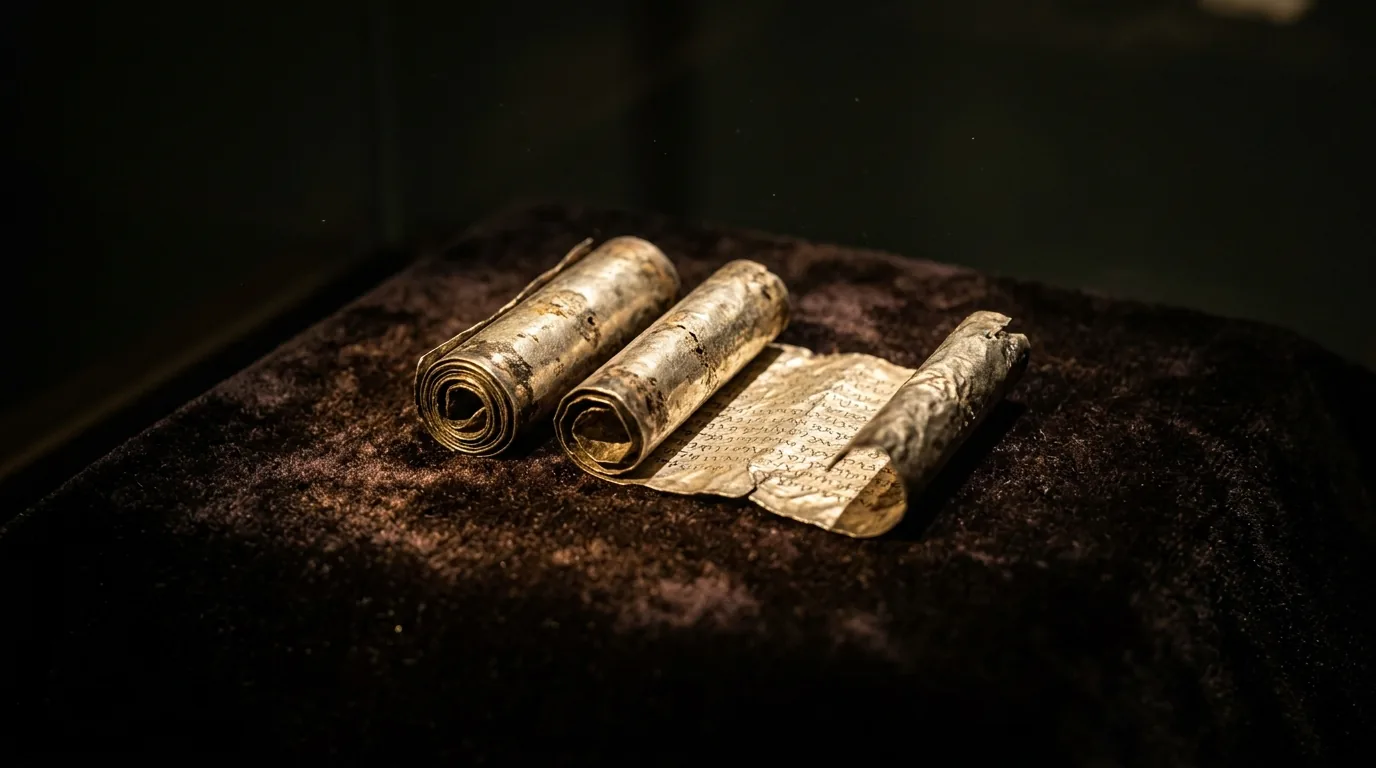
The Ketef Hinnom Silver Scrolls (cataloged as KH1 and KH2) are the oldest surviving physical fragments of the Hebrew Bible ever discovered, dating to approximately 650–600 BC—the reign of King Josiah or Jeremiah the prophet. Measuring less than an inch in length and unrolled after three years of delicate lab work at the Israel Museum, these silver amulets contain microscopic paleo-Hebrew inscriptions of the Priestly Blessing from Numbers 6:24–26 ('May Yahweh bless you and keep you; may Yahweh make His face shine upon you'). They predate the Dead Sea Scrolls by over 350 years.
The Technology of Unrolling Ancient Silver Foils
The discovery was monumental, but the physical artifacts presented an agonizing dilemma. The silver foils were brittle, oxidized, and rolled tightly like miniature scrolls. Any attempt to unroll them with standard tweezers risked crumbling the irreplaceable metal into fine dust.
For three years, the scrolls remained untouched in the laboratories of the Israel Museum. Conservator Joseph Shenhav developed a pioneering metallurgical procedure:
- Chemical Softening: The scrolls were soaked in specialized chemical solvents and dilute acrylic solutions to dissolve corrosion and soften brittle mineral crusts without dissolving the underlying silver.
- Thermal Expansion: Utilizing micro-heating tools and ultrasonic baths, conservators gently stimulated the elasticity of the ancient metal.
- Micro-Spatula Manipulation: Under high-powered binocular stereomicroscopes, conservators unrolled the silver foils fraction of a millimeter per day using ivory needles and flexible Teflon spatulas.
When the two scrolls finally yielded their secrets, the larger scroll (KH1) measured just 3.8 inches by 1.1 inches (97 x 27 mm), and the smaller scroll (KH2) measured 1.5 inches by 0.4 inches (39 x 11 mm). Etched into the silver surface with a fine iron stylus were lines of microscopic paleo-Hebrew script.
The Paleo-Hebrew Inscription: Numbers 6:24–26
When paleographers examined the scratched letters under raking light, they identified the divine Tetragrammaton (YHWH) appearing repeatedly, alongside the exact liturgical phrases preserved in the Book of Numbers:
Ketef Hinnom Scroll 1 (KH1):
- Lines 1–6: Mentions God as the one who keeps covenant and steadfast love (hesed) toward those who love Him, echoing Deuteronomy 7:9.
- Lines 14–18: Contains the solemn blessing: '...May Yahweh bless you and keep you; may Yahweh make His face shine upon you and give you peace...'
Ketef Hinnom Scroll 2 (KH2):
- Lines 5–12: 'May [he/she] be blessed by Yahweh, the warrior/helper and the rebuker of Evil: May Yahweh bless you, keep you. May Yahweh make His face shine upon you and give you peace.'
The tiny scrolls were worn during life as phylacteries or protective amulets around the neck and accompanied the owner into the tomb at death.
Demolishing Wellhausen and the Documentary Hypothesis
The discovery of the Ketef Hinnom scrolls dealt a decisive, empirical blow to 19th- and 20th-century higher biblical criticism, specifically the Documentary Hypothesis popularized by German scholar Julius Wellhausen.
Wellhausen’s theory claimed that the Torah (Pentateuch) was not composed in the time of Moses, but was a composite patchwork of four late sources (J, E, D, and P). Most crucially, critical scholars dogmatically asserted that the Priestly Code (P), which contains the ritual laws and the Priestly Blessing of Numbers 6, was an artificial, post-exilic fabrication invented by Jewish priests living during or after the Persian era (c. 500–400 BC) to consolidate ecclesiastical authority.
Ketef Hinnom demolished this theoretical construct:
- Physical Pre-Exilic Date: The archaeological context of Burial Cave 24, the associated pottery forms, and advanced epigraphic analysis (confirmed in 2004 by high-resolution digital imaging from the West Semitic Research Project) date the scrolls securely to the late 7th century BC—before the destruction of Solomon's Temple in 586 BC.
- Standardized Liturgical Text: The presence of the exact poetic structure of Numbers 6:24–26 demonstrates that the Priestly Blessing was not a late Persian invention, but an already established, widely revered sacred text embedded in Judean public worship during the First Temple period.
The 3-Step Protocol for Speaking the Priestly Blessing
The words inscribed on these ancient silver scrolls carry immense theological power. You can implement the Aaronic blessing over your home today using this 3-step protocol:
- Step 1: Pronounce the Divine Name and Ownership: In Numbers 6:27, God commanded: 'So they shall put My name upon the children of Israel, and I will bless them.' When you pray over your family, audibly dedicate them to the Lord, invoking His covenant protection over their minds, bodies, and spirits.
- Step 2: Proclaim Divine Favor Over Shame: The phrase 'make His face shine upon you' is ancient Semitic imagery for radiant favor, smiling acceptance, and royal warmth. Contrast this with condemnation and guilt; proclaim that God's countenance shines upon your household.
- Step 3: Establish True Biblical Shalom: Biblical Shalom is not merely the absence of conflict; it represents completeness, wholeness, physical health, emotional soundness, and divine prosperity. Pray for God’s comprehensive Shalom over your bedroom, finances, and relationships.
Spoken Declaration of the Aaronic Benediction
Proclaim this ancient blessing, preserved in silver from Jerusalem's hills:
"The Lord bless you and keep you;
The Lord make His face shine upon you, and be gracious to you;
The Lord lift up His countenance upon you, and give you peace.Heavenly Father, I receive the covenant blessing inscribed on ancient silver by Your servants in Jerusalem. You are the God who keeps steadfast love to a thousand generations. I place Your holy name over my mind, my children, and my home tonight. Let Your radiant countenance dispel every shadow of anxiety, sickness, and fear. Grant me Your supernatural Shalom that surpasses all human understanding. In Jesus' mighty name, Amen."
Forensic Medicine & Scientific Inquests
Contemporary clinical pathologists and forensic medical examiners analyzing traumatic biomechanics and physical phenomena in Scripture. Each investigation in this pillar is corroborated by primary classical manuscripts, epigraphy, and peer-reviewed historical forensics.
Pillar Dossiers in this Corpus
The Death of King Herod Agrippa I: First-Century Medical Accounts in Acts and Josephus
9 min read · Verified Primary DossierHematidrosis: The Medical Science Behind Jesus Sweating Blood in Gethsemane
10 min read · Verified Primary DossierThe Effusion of Blood and Water: Forensic Confirmation of Acute Cardiac Rupture on the Cross
15 min read · Verified Primary DossierThe Forensic Truth About Roman Scourging: Why Flagrum Whips Were Lethal Before the Cross
14 min read · Verified Primary DossierThe Unwritten Gospel: Volume IV — Scientific Miracles
Modern medical forensics analyzing microvascular hemorrhage, physiological asphyxiation, and geo-physical events in Scripture.
Primary Sources & Scholarly Archives
Editorial Standard →Primary source corpus including Tacitus (Annales), Suetonius, and early Roman provincial administrative records.
Complete verified English translations of Eusebius Pamphili, Clement of Rome, Polycarp, and Tertullian.
Subterranean Roman necropolis documentation, epigraphic graffiti, and early Christian funerary stelae.
Frequently Asked Questions
How old are the Ketef Hinnom silver scrolls?
The Ketef Hinnom scrolls date to approximately 650–600 BC (late Iron Age II), making them over 2,600 years old. They are more than 350 years older than the earliest biblical manuscripts found among the Dead Sea Scrolls at Qumran.
Where are the Ketef Hinnom scrolls displayed today?
The original scrolls (KH1 and KH2) and their high-magnification photographic documentation are permanently housed and displayed in the Archaeology Wing of the Israel Museum in Jerusalem.
What is the text of the Priestly Blessing in Hebrew?
The blessing from Numbers 6:24–26 reads: 'Yevarekhekha Adonai ve-yishmerekha; Ya'er Adonai panav elekha vi-ykhuneka; Yissa Adonai panav elekha ve-yasem lekha shalom' ('The Lord bless you and keep you; the Lord make His face shine upon you and be gracious to you; the Lord lift up His countenance upon you and give you peace').
Biblical Manuscripts & Master Study Resources {#manuscripts-study-resources}
Explore the living manuscript evidence for the reliability of Scripture:- Read the comprehensive manuscript dossier in The Unwritten Gospel: 4-Volume Master Bundle ($9.00).
- Examine critical manuscript and historical questions in Is That Really in the Bible? ($9.00).
- Equip your home study library with The Sacred Keys Trilogy Master Bundle ($7.99).
Related Research Dossiers
View all 572 research dossiers →
The Death of King Herod Agrippa I: First-Century Medical Accounts in Acts and Josephus

Hematidrosis: The Medical Science Behind Jesus Sweating Blood in Gethsemane