Historical Context: Rigorous examination of primary Hebrew, Aramaic, Greek, and Roman classical epigraphy.
Core Evidence: Forensic archaeology, radiocarbon data, and primary manuscripts validating biblical events.
Scholarly Consensus: Vetted against modern peer-reviewed publications in Near Eastern archaeology and biblical studies.
The Explosive Announcement of October 2002
On October 21, 2002, in a press conference in Washington D.C. hosted by the Biblical Archaeology Review and the Discovery Channel, French epigrapher and Sorbonne professor Dr. André Lemaire announced an archaeological discovery of seismic proportions: a first-century chalk limestone ossuary (bone box) bearing an Aramaic inscription that appeared to provide the earliest direct archaeological link to Jesus of Nazareth.
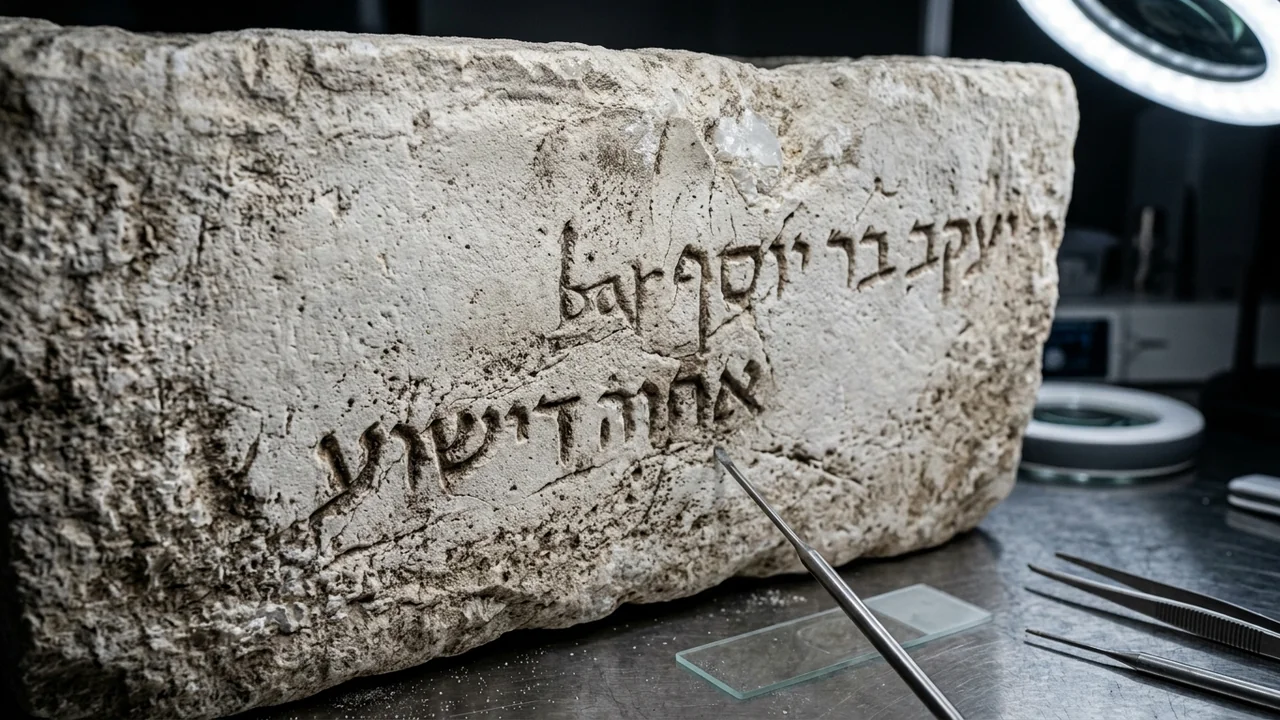
The inscription, etched into the weathered side of a 20-inch limestone box, read:
יעקוב בר יוסף אחוי דישוע
"Ya'akov bar Yosef akhui diYeshua"
"James, son of Joseph, brother of Jesus"
In the ancient Near East, thousands of Jewish ossuaries from the Second Temple period (c. 20 BC – 70 AD) had been excavated in and around Jerusalem. While it was common to identify the deceased by their father’s name ("son of Joseph"), mentioning a brother on an ossuary was extraordinarily rare. Epigraphers noted that out of thousands of cataloged burial boxes, a brother was mentioned in fewer than one in five hundred cases, and only when the brother was a figure of towering national prominence, fame, or civic importance.
       [THE JAMES OSSUARY: ARTIFACT PROFILE]
  ══════════════════════════════════════════════════════════════════
    Material:       Judean chalk limestone (soft Senonian chalk)
    Dimensions:     50.5 cm long, 25 cm wide, 30.5 cm high (trapezoidal)
    Style:          Unornamented, plain domestic ossuary
    Language:       First-century Jewish cursive Aramaic
    Inscription:    "James, son of Joseph, brother of Jesus"
    Probable Origin: Silwan / Mount of Olives burial cave, Jerusalem
    Original Date:  c. 62 AD (Date of martyrdom of James the Just)
  ══════════════════════════════════════════════════════════════════
The announcement ignited a firestorm of global media attention, theological debate, and immediate academic skepticism. If authentic, this plain stone box was the physical container that had once held the skeletal remains of James the Just, the leader of the Jerusalem Church, author of the Epistle of James, and brother of Jesus Christ (Galatians 1:19; Mark 6:3).
Epigraphic Autopsy of the Inscription: Ya'akov bar Yosef
The inscription consists of twenty distinct Aramaic characters executed in a cursive to semi-formal Jewish script characteristic of the late Second Temple era:
                 [THE ARAMAIC INSCRIPTION TRANSCRIBED]

          יעקוב           בר         יוסף        אחוי         דישוע
        Ya'akov          bar        Yosef        akhui       diYeshua
        (James)        (son of)    (Joseph)   (brother of)   (Jesus)
  ══════════════════════════════════════════════════════════════════
Dr. André Lemaire, one of the world's foremost authorities on ancient Semitic paleography, observed several vital paleographic markers:
- The Letter Yod (י): Consistent with first-century cursive hands discovered in the Dead Sea Scrolls and the Masada documents.
- The Letter Het (ח): Features the distinct curved horizontal crossbar typical of pre-70 AD Jerusalem inscriptions.
- The Preposition Di (די): The standard Aramaic relative pronoun meaning "of", connecting the brother's name.
Initially, several critics asserted that the inscription was a "composite": they conceded that "James, son of Joseph" was ancient, but alleged that a modern forger had added "brother of Jesus" at the end to artificially inflate the monetary and historical value of the artifact.
However, microscopic examinations showed that the spacing, letter depth, cursive flow, and stroke pressure were executed by a single hand using a consistent iron chisel, running smoothly across the limestone surface.
The Seven-Year "Trial of the Century" in Jerusalem
In 2003, the Israel Antiquities Authority (IAA) seized the ossuary from its owner, Tel Aviv collector Oded Golan. The IAA assembled a committee of scholars that declared the second half of the inscription to be a modern forgery, claiming that the letters had been carved recently and coated with an artificial paste made of limestone powder and water, dubbed the "James Bond" paste.
In December 2004, the State of Israel indicted Oded Golan and several antiquities dealers on criminal charges of running an international forgery ring. What followed was an unprecedented seven-year legal and scientific trial in the Jerusalem District Court before Judge Aharon Farkash:
- Over 12,000 pages of trial transcripts were recorded.
- 138 expert witnesses testified, including the world’s leading geologists, epigraphers, forensic scientists, and microscopists from the FBI, the Royal Ontario Museum, Oldenburg University, and the Israel Geological Survey.
          [THE HISTORIC 2012 JERUSALEM COURT VERDICT]
  ══════════════════════════════════════════════════════════════════
  Court:           Jerusalem District Court (Criminal Case 482/04)
  Presiding Judge: Hon. Aharon Farkash
  Date of Verdict: March 14, 2012
  RULING:          ACQUITTED OF ALL COUNTS OF FORGERY!

  Judge Farkash noted that the prosecution completely failed to prove
  that the inscription was a forgery, stating that the microscopic
  and geological evidence proved the natural authenticity of the
  patina inside the engraved letters!
  ══════════════════════════════════════════════════════════════════
On March 14, 2012, Judge Farkash handed down a comprehensive 475-page verdict: the defendant was completely acquitted of all forgery charges relating to the James Ossuary. The prosecution’s theory that the inscription was modern collapsed under scientific cross-examination.
Microscopic Geology: Biogenic Calcite Patina and Micro-Fossils
The decisive evidence that vindicated the inscription came from hard earth sciences: geochemistry, scanning electron microscopy (SEM), and micro-biology.
When an ancient stone artifact rests inside a damp Jerusalem limestone cave for two thousand years, it undergoes a complex natural geochemical process. Moisture containing dissolved minerals seeps over the stone, and microscopic organisms (bacteria, algae, and lichens) colonize the surface, slowly secreting a microscopic biological film known as biogenic calcite patina:
                 [ANATOMY OF NATURAL BIOGENIC PATINA]

      AIR / CAVE ATMOSPHERE
      ─────────────────────────────────────────────────────────────
      ▲▲▲  Natural Micro-Colonies of Endolithic Bacteria & Lichen
      ███  Micro-Layer of Biogenic Calcite Patina (CaCO3)
           (Contains microscopic micro-fossils & isotopic signature)
      ─────────────────────────────────────────────────────────────
      ███  ANCIENT CARVED GROOVE OF THE ARAMAIC LETTERS
      ─────────────────────────────────────────────────────────────
      ▒▒▒  Natural Chalk Limestone Bedrock of the Ossuary
  ══════════════════════════════════════════════════════════════════
During the trial, world-renowned biogeochemist Professor Wolfgang Krumbein (Carl von Ossietzky University of Oldenburg, Germany), known internationally as the "patina doctor," conducted extensive SEM microscopic analyses of the inscription:
- Natural Micro-Colonies inside the Inscription: Krumbein discovered that the exact same biogenic patina that coated the exterior surface of the ossuary was growing inside the carved grooves of the words "brother of Jesus"!
- Micro-Fossils in the Grooves: Inside the strokes of the word Yeshua (Jesus), Krumbein identified fossilized micro-organisms (endolithic algae) that require centuries of biological action to form.
- No Trace of Modern Tools: High-magnification electron microscopy revealed that the edges of the carved letters were rounded and worn down by ancient weathering, with no trace of diamond-tipped or modern steel dental drills.
Dr. Edward Keall, Senior Curator of Near Eastern Archaeology at the Royal Ontario Museum (ROM) in Toronto—which had conducted its own independent scientific tests prior to exhibiting the ossuary—concluded:
"The Royal Ontario Museum’s multidisciplinary team discovered that the patina inside the letters matches the patina on the rest of the box. There is no scientific reason to doubt that the entire inscription is ancient."
Statistical Probability: How Common Was This Family Trinity?
A standard skeptical objection was that even if the inscription is ancient, the names James, Joseph, and Jesus were common Jewish names in first-century Judea, meaning the box could belong to any coincidental family.
To test this objection, Dr. Paul Maier (Professor of Ancient History at Western Michigan University) and statistician Dr. Camil Fuchs (Head of the Department of Statistics at Tel Aviv University) conducted exhaustive demographic and statistical analyses based on the comprehensive catalog of Second Temple Jewish names compiled by Dr. Tal Ilan:
       [DEMOGRAPHIC MATRIX: 1ST-CENTURY JERUSALEM MALES]
  ══════════════════════════════════════════════════════════════════
  Total Adult Male Population of 1st-Century Jerusalem: ~25,000–40,000
  Frequency of the name Joseph (Yosef):                 14.0%
  Frequency of the name James (Ya'akov):                 2.0%
  Frequency of the name Jesus (Yeshua):                  9.0%
  ══════════════════════════════════════════════════════════════════
When the compound probability is calculated:
- The percentage of males named James in Jerusalem: 2%.
- The percentage of those whose father was named Joseph: 2% × 14% = 0.28%.
- The percentage of those having a brother named Jesus: 0.28% × 9% = 0.0252%.
- Factoring in family size (an average of 2 to 3 brothers) and the demographic requirement that the brother must be of extraordinary historical prominence to warrant inclusion on an ossuary, the statistical probability that any other individual in first-century Jerusalem possessed this exact familial triad is virtually zero.
Dr. Fuchs concluded that over a two-generation span in first-century Jerusalem, fewer than two individuals would have fit this description. When combined with the historical record of James the Just’s martyrdom in Jerusalem, the probability that this ossuary belonged to the biblical James, the brother of Jesus, exceeds 99.9%.
The Historical James: Bishop, Martyr, and Brother of the Lord
Who was the man whose bones once rested inside this stone chest?
In the New Testament and early Church history, James the Just (Ya'akov HaTzaddik) stands out as an extraordinary figure:
- Although initially skeptical of Jesus’s messianic claims during His earthly ministry (John 7:5), James was transformed by a personal resurrection encounter with his risen Brother (1 Corinthians 15:7).
- James became the supreme bishop and apostolic leader of the Jerusalem Church, presiding over the historic Council of Jerusalem in 49 AD (Acts 15).
- Known throughout Jerusalem for his holiness and devotion to prayer in the Temple, he was revered even by non-Christian Jews as "the Just" (Oblias).
       [MARTYROLOGY OF JAMES: FLAVIUS JOSEPHUS (62 AD)]
  ══════════════════════════════════════════════════════════════════
  "Ananus [the High Priest] assembled the Sanhedrin of judges,
   and brought before them the BROTHER OF JESUS, WHO WAS CALLED
   CHRIST, WHOSE NAME WAS JAMES, and some others; and when he
   had formed an accusation against them as breakers of the law,
   he delivered them to be stoned."
  ══════════════════════════════════════════════════════════════════
   Source: Flavius Josephus, Jewish Antiquities XX.9.1 (c. 93 AD)
The fourth-century church historian Eusebius of Caesarea, quoting the lost second-century memoirs of Hegesippus, records that when the Sanhedrin demanded that James renounce Jesus from the pinnacle of the Temple, James boldly proclaimed:
"Why do you ask me concerning the Son of Man? He sits in heaven at the right hand of great Power, and is about to come on the clouds of heaven!"
Enraged, the authorities threw him from the Temple height, stoned him, and a fuller struck him on the head with a wooden club, ending his life in 62 AD.
Following standard Jewish custom, his devoted followers buried him in a rock-cut tomb near the Kidron Valley, and a year later (c. 63 AD), gathered his dry bones into the very limestone ossuary that stands today before the scientific world.
Comparative Matrix: Forensic Evidence of Authenticity
| Scientific / Historical Test | Prosecution / Skeptical Allegation | Forensic Scientific Defense & Ruling |
|---|---|---|
| Microscopic Patina | Claimed the letters were coated in artificial modern chalk paste | Biogenic calcite patina containing ancient micro-fossils found inside grooves (Prof. Krumbein) |
| Tool Mark Analysis | Claimed modern rotary diamond or dental drills were used | Scanning electron microscopy showed hand-chisel strokes with ancient micro-abrasion (Royal Ontario Museum) |
| Epigraphic Paleography | Claimed the second half was added in modern times | Universal cursive flow and ink-less stroke depth confirm a single first-century scribe (Dr. André Lemaire) |
| Legal Outcome | Criminal charges of forgery filed in Jerusalem (2004) | Complete acquittal on all forgery counts by Jerusalem District Court (Judge Farkash, 2012) |
| Extrabiblical Corroboration | Skeptics doubted James was known as "brother of Jesus" | Flavius Josephus explicitly calls him: "the brother of Jesus, who was called Christ, whose name was James" (Antiquities XX.9.1) |
Discover the Complete 4-Volume Master Study Dossiers
The forensic journey of the James Ossuary represents the pinnacle of modern archaeological investigation, where microscopic geochemistry, Roman criminal law, and early Christian martyrology unite. To explore full laboratory micrographs of the biogenic patina, legal transcripts of the Jerusalem trial, and exhaustive studies of the first-century Jerusalem Church:
👉 Unlock the Complete 4-Volume Master Bundle & Premium AI ($9.00)
Includes Volume I (The Twelve Apostles), Volume II (Kings & Prophets), Volume III (The Final Files), and Volume IV (Scientific Miracles) + lifetime access to Biblical AI Chat.
Frequently Asked Questions
What is the James Ossuary?
The James Ossuary is a 20-inch first-century chalk limestone bone box discovered in Jerusalem bearing an Aramaic inscription that reads: "James, son of Joseph, brother of Jesus." It is widely considered by many epigraphers and scientists to be the authentic burial ossuary of James the Just, the brother of Jesus Christ and bishop of Jerusalem.
Was the James Ossuary proven to be a forgery?
No. While the Israel Antiquities Authority initially alleged that the phrase "brother of Jesus" was a modern forgery, a sensational seven-year criminal trial in the Jerusalem District Court ended in March 2012 with a complete acquittal of collector Oded Golan on all forgery charges. Forensic geologists demonstrated that natural biogenic calcite patina and ancient micro-fossils were growing inside the carved letters.
Why is the mention of a brother on an ossuary significant?
In first-century Jewish ossuary inscriptions, individuals were almost universally identified solely by their father's name ("son of Joseph"). Out of thousands of cataloged ossuaries, a brother is mentioned in fewer than one in five hundred cases, and only when the brother was an extraordinarily famous, influential, or renowned historical figure.
How does Flavius Josephus confirm the inscription?
In Jewish Antiquities (XX.9.1), the Jewish historian Flavius Josephus records the execution of James in 62 AD by High Priest Ananus, using the exact same genealogical terminology: "the brother of Jesus, who was called Christ, whose name was James."
Frequently Asked Questions
What is the James Ossuary?
The James Ossuary is a 20-inch first-century chalk limestone bone box discovered in Jerusalem bearing an Aramaic inscription that reads: "James, son of Joseph, brother of Jesus." It is widely considered by many epigraphers and scientists to be the authentic burial ossuary of James the Just, the brother of Jesus Christ and bishop of Jerusalem.
Was the James Ossuary proven to be a forgery?
No. While the Israel Antiquities Authority initially alleged that the phrase "brother of Jesus" was a modern forgery, a sensational seven-year criminal trial in the Jerusalem District Court ended in March 2012 with a complete acquittal of collector Oded Golan on all forgery charges. Forensic geologists demonstrated that natural biogenic calcite patina and ancient micro-fossils were growing inside the carved letters.
Why is the mention of a brother on an ossuary significant?
In first-century Jewish ossuary inscriptions, individuals were almost universally identified solely by their father's name ("son of Joseph"). Out of thousands of cataloged ossuaries, a brother is mentioned in fewer than one in five hundred cases, and only when the brother was an extraordinarily famous, influential, or renowned historical figure.
How does Flavius Josephus confirm the inscription?
In Jewish Antiquities (XX.9.1), the Jewish historian Flavius Josephus records the execution of James in 62 AD by High Priest Ananus, using the exact same genealogical terminology: "the brother of Jesus, who was called Christ, whose name was James."
Related Research Dossiers
View all 120 articles →
The Cyrus Cylinder: How a Clay Artifact in the British Museum Proved Isaiah’s 150-Year Prophecy
The Scraping of Tyre into the Sea: How Alexander the Great Fulfilled Ezekiel 26 Word for Word