Historical Context: Rigorous examination of primary Hebrew, Aramaic, Greek, and Roman classical epigraphy.
Core Evidence: Forensic archaeology, radiocarbon data, and primary manuscripts validating biblical events.
Scholarly Consensus: Vetted against modern peer-reviewed publications in Near Eastern archaeology and biblical studies.
The Prophecy of the Hidden Stones in the Brick Pavement
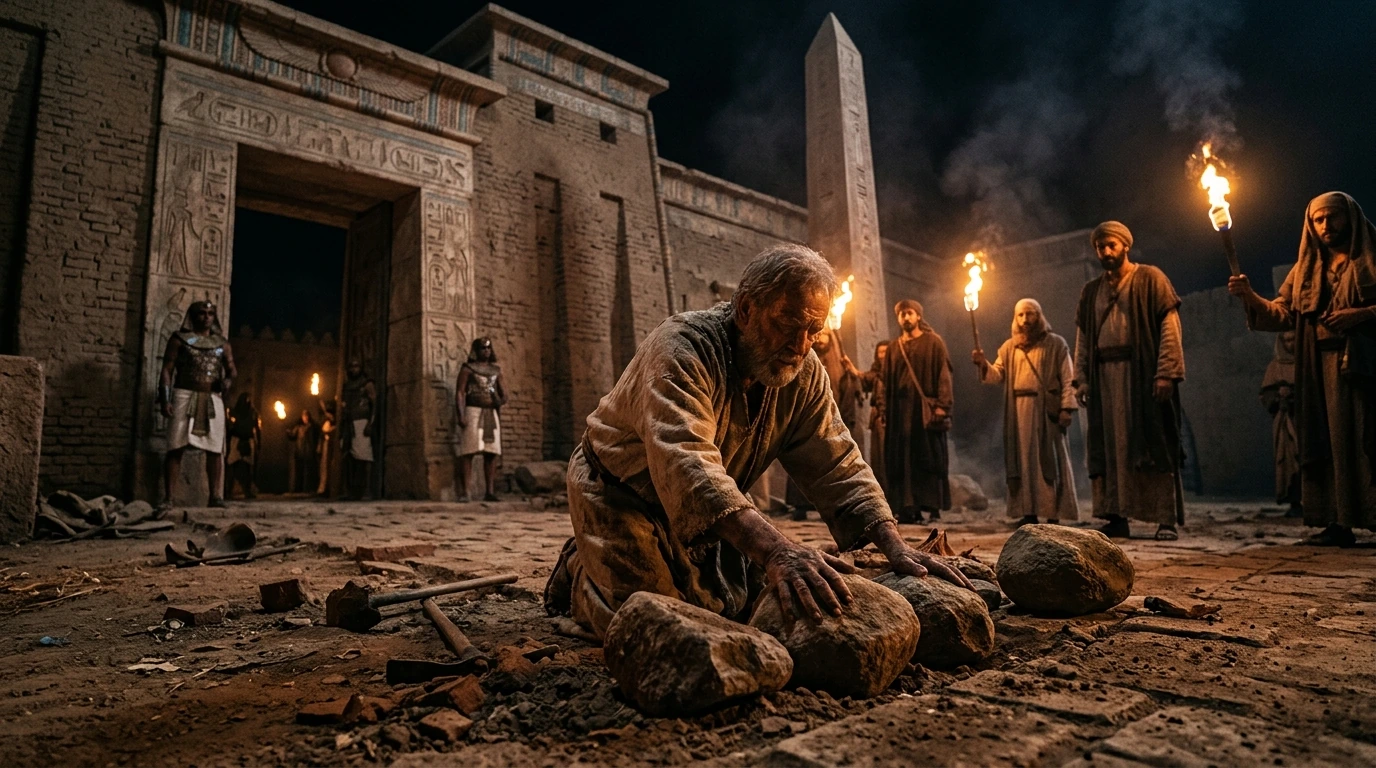
Upon arriving in Egypt around 586/585 BC, the Prophet Jeremiah performed a striking prophetic sign-act at the royal gate of Tahpanhes:
*"Take large stones in your hand, and hide them in the sight of the men of Judah, in the clay in the brick courtyard which is at the entrance to Pharaoh’s house in Tahpanhes; and say to them:
'Thus says the Lord of hosts, the God of Israel: Behold, I will send and bring Nebuchadnezzar the king of Babylon, My servant, and will set his throne above these stones that I have hidden. And he will spread his royal pavilion over them. When he comes, he shall strike the land of Egypt!'"* (Jeremiah 43:9–11)
To the Jewish refugees sheltering under the military protection of Pharaoh Hophra (Apries), Jeremiah’s prediction that the King of Babylon would erect his royal golden throne right outside Pharaoh’s front door seemed impossible.
Sir Flinders Petrie’s Discovery at Tell Defenneh (1886)
In the spring of 1886, legendary British pioneer archaeologist Sir William Matthew Flinders Petrie conducted excavations in the eastern Nile Delta at Tell Defenneh—the biblical Tahpanhes (classical Daphnae).
Petrie uncovered the massive fortified military citadel of the Twenty-Sixth Dynasty (Saite Period):
- A massive mud-brick fortress tower surrounded by an eight-meter-thick defensive wall.
- The local Bedouin called the ruin Qasr Bint el-Yahudi—"The Palace of the Jew’s Daughter"—preserving an oral memory of King Zedekiah’s daughters who were brought to Tahpanhes by Johanan (Jeremiah 43:6).
Most astonishingly, Petrie cleared the main gateway of the fortress and uncovered a large, elevated platform of compacted lime mortar and brickwork:
"Here was the very brickwork, or pavement, at the entry of Pharaoh’s house in Tahpanhes, of which Jeremiah spoke! It was a large, open-air terrace or mastaba, exactly suited for royal receptions, inspections, and pitched pavilions." (Petrie, Tanis II / Nebesheh and Defenneh, 1888)
Babylonian Cuneiform Confirmation: Nebuchadnezzar’s Egyptian Campaign (568 BC)
Skeptics long asserted that Nebuchadnezzar II never invaded Egypt and that Jeremiah's prophecy had failed.
In 1878, the British Museum acquired a fragmented cuneiform tablet (BM 33041, now known as the Nebuchadnezzar Egyptian Campaign Tablet), dated to the 37th year of Nebuchadnezzar’s reign (568/567 BC):
Line 1:  [In the 37th year, Nebuchadnezzar, king of Babylon, ma]rched against
Line 2:  [Misir (Egypt) to deliver] a battle.
Line 3:  [...Am]asis, king of Egypt, assembled his [army...]
Line 4:  [...horses and chariots] he summoned to his aid...
The tablet proves that in 568 BC—barely eighteen years after Jeremiah hid the stones in the brickwork—Nebuchadnezzar launched a massive military invasion of the Nile Delta, defeated the Egyptian garrison forces, and set up his imperial pavilion exactly as foretold in Jeremiah 43.
The Tragic Fate of Pharaoh Hophra (Apries)
Jeremiah had also issued a terrifying, specific personal prophecy against Egypt's reigning monarch:
"Behold, I will give Pharaoh Hophra king of Egypt into the hand of his enemies and into the hand of those who seek his life, as I gave Zedekiah king of Judah into the hand of Nebuchadnezzar." (Jeremiah 44:30)
Greek historian Herodotus (Histories II.161–169) confirms the tragic fulfillment:
- Pharaoh Hophra faced a catastrophic military revolt after sending Egyptian troops into a disastrous campaign against Cyrene.
- His rebel general, Amasis II, seized power and took Hophra prisoner.
- Though initially keeping him under house arrest at Sais, the enraged Egyptian populace demanded his life; Hophra was strangled to death, fulfilling Jeremiah's prophecy that he would be given into the hand of those seeking his life.
Archaeological Artifacts Recovered from Tahpanhes
Petrie’s excavations at Tell Defenneh yielded artifacts that illuminate the multi-cultural melting pot where Jeremiah lived his final days:
- Thousands of Greek iron weapons, armor scales, and Greek archaic painted pottery, confirming Herodotus’ account that Tahpanhes was garrisoned by Ionian and Carian mercenary troops.
- Royal Egyptian seals bearing the cartouche of Pharaoh Psamtik I and Pharaoh Hophra.
- Semitic scale weights and bronze worktools used by the foreign refugee communities.
The stones of Tahpanhes stand as an immutable archaeological witness to Jeremiah’s faithfulness, proving that neither distance, exile, nor martyrdom can hinder the unerring fulfillment of the Word of God.
Frequently Asked Questions
Where was biblical Tahpanhes located?
Tahpanhes is modern Tell Defenneh (classical Daphnae), situated in the northeastern Nile Delta in Egypt near the modern Suez Canal.
What did Sir Flinders Petrie discover at Tahpanhes in 1886?
Petrie discovered Pharaoh’s Saite fortress, known locally as "The Palace of the Jew’s Daughter", complete with the outdoor brick pavement mentioned in Jeremiah 43.
Is there secular historical proof that Babylon invaded Egypt?
Yes. A Babylonian cuneiform chronicle in the British Museum (BM 33041) records Nebuchadnezzar II’s military campaign against Egypt in his 37th regnal year (568 BC).
Related Research Dossiers
View all 120 articles →
Nathan Confronting David: 'You Are the Man!' (2 Samuel 12), The Royal Court, and Prophetic Courage

The Fall of Nineveh in Secular History: The Babylonian Chronicle, Cyaxares, and Diodorus Siculus
