Subject Scope: Apparent Contradiction Resolved: Harmonizing Christ’s Descent, 1 Peter 3:19, and the Creedal "Descensus ad Inferos" with Historical Rigor
Historical Context: Rigorous historical and theological examination within the field of Apologetics & Biblical Difficulties.
Primary Evidence: Forensic archaeology, textual preservation, and primary ancient manuscripts corroborating scriptural events.
Investigation Highlights: The Textual Paradox: Paradise or the Underworld? • Harmonizing the Four Key Biblical Texts • Historical Development of the Apostles’ Creed: Rufinus and Sirmium
Scholarly Consensus: Vetted against peer-reviewed academic literature in biblical history, linguistics, and archaeology.
The Textual Paradox: Paradise or the Underworld?
For centuries, Bible students and theologians have wrestled with what appears to be a direct geographical and theological contradiction in the New Testament:
[THE APPARENT CONTRADICTION]
1. LUKE 23:43:
   Jesus tells the dying penitent thief on the cross:
   "Truly, I say to you, today you will be with me in Paradise (sēmeron met' emou esē en tō paradeisō)."
   -> Destination: Paradise (a place of heavenly rest and communion with God).

2. 1 PETER 3:18–20:
   Peter states that Christ "went and proclaimed to the spirits in prison (tois en phylakē pneumasin),
   who formerly did not obey... in the days of Noah."
   -> Destination: A dark cosmic prison of condemned spirits.

3. EPHESIANS 4:9:
   Paul writes that before Christ ascended, "he also descended into the lower regions, the earth
   (katebē eis ta katōtera merē tēs gēs)."
   -> Destination: The subterranean underworld (Sheol/Hades).

4. ACTS 2:27, 31 (CITING PSALM 16:10):
   Peter proclaims at Pentecost that Christ’s soul was "not abandoned to Hades (eis hadēn),
   nor did his flesh see corruption."
   -> Destination: Hades (the realm of the dead).
Did Jesus ascend immediately to Paradise with the thief, or did He descend into the subterranean bowels of Hades to battle spirits? How can these distinct biblical witnesses be harmonized without twisting the plain meaning of the Greek text?
Harmonizing the Four Key Biblical Texts
The solution emerges when we abandon 21st-century Western colloquialisms and read these passages through Second Temple Jewish eschatological geography:
[SECOND TEMPLE COSMOGRAPHY OF THE DEAD]
========================================================================
                          SHEOL / HADES
------------------------------------------------------------------------
   UPPER COMPARTMENT / PARADISE    |     LOWER COMPARTMENT / ABYSS
   "Abraham's Bosom" (Luke 16:22)  |     "Place of Torment" (Luke 16:23)
   - Righteous souls resting       |     - Wicked souls awaiting final
     under covenant promise        |       judgment
   - Peace, light, comfort         |     - Thirst, agony, anguish
------------------------------------------------------------------------
                GREAT UNBRIDGEABLE CHASM (Luke 16:26)
------------------------------------------------------------------------
   DEEPEST ABYSS: TARTARUS (2 Peter 2:4; Jude 6; 1 Peter 3:19)
   - "Chains of gloomy darkness"
   - Incarceration specifically for the rebel "sons of God" (Watchers)
========================================================================
- Paradise was inside Sheol: In Jewish thought prior to Christ’s resurrection, the abode of all departed spirits was Sheol (translated Hades in the Septuagint and Greek New Testament). Within Sheol existed two distinct zones: the place of torment for the wicked and Abraham’s Bosom (Paradise) for the righteous.
- Jesus entered Paradise on Friday afternoon: When Jesus gave up His spirit, His soul descended to the righteous compartment of Hades (Paradise), fulfilling Luke 23:43. The thief was with Him in that very place of blessed rest.
- Jesus was not abandoned to Hades (Acts 2:31): His soul did not remain indefinitely in the realm of the dead; on the third day, His soul was reunited with His physical body in the tomb.
- The Proclamation in Tartarus (1 Peter 3:19): In His disembodied, resurrected-spirit power, Christ made an official heraldic proclamation (ekēryxen) over the cosmic abyss (Tartarus), declaring His victory over the fallen angels of Genesis 6.
- The Ascension with Captives (Ephesians 4:8–9): Upon His bodily resurrection and subsequent ascension, Christ emptied the Paradise compartment of Sheol, transferring the righteous saints of the Old Covenant into the direct presence of God in heaven.
Historical Development of the Apostles’ Creed: Rufinus and Sirmium
Where did the phrase "He descended into hell" (descendit ad inferos) come from, and how did it enter the historic creed?
[CREEDAL TRANSMISSION TIMELINE]
1. c. 150–200 AD: THE OLD ROMAN CREED (R):
   The earliest ancestral form of the Apostles' Creed used in Rome for baptismal confessions:
   "Crucified under Pontius Pilate and buried; on the third day he rose again from the dead..."
   NOTICE: IT DID NOT CONTAIN THE CLAUSE "DESCENDED INTO HELL".

2. 359 AD: THE FOURTH SYNOD OF SIRMIUM (THE "DATED CREED"):
   Composed in Greek by Mark of Arethusa; first official conciliar document to include:
   "He was crucified and died, and descended to the underworld (katelthonta eis ta katachthonia),
   and regulated things there, whom the gatekeepers of Hades trembled when they saw."

3. c. 400 AD: RUFINUS OF AQUILEIA (Commentary on the Apostles' Creed):
   Rufinus notes that the church in Aquileia (northern Italy) included the clause:
   "Descendit ad inferna."
   CRITICAL HISTORICAL NOTE BY RUFINUS:
   Rufinus explicitly states that the Roman Creed and Eastern churches did not have the words,
   and he explains that the clause was merely intended as a synonym for burial:
   "The meaning seems to be the very same as that which is conveyed in the word 'buried'."

4. c. 750 AD: THE TEXTUS RECEPTUS OF THE APOSTLES' CREED:
   Under the influence of the Gallican Psalter and Charlemagne's liturgical reforms, the Aquileian
   clause "descendit ad inferos" became universally fixed in the standard Western text.
In ancient Latin, inferos does not mean the lake of fire (Gehenna); it is the plural accusative of inferus, meaning "the lower world," "the dead below," or "the underworld (Hades)".
The Reformation Clash: Calvin’s Metaphor vs. Luther’s Triumphalism
During the 16th-century Protestant Reformation, the meaning of Christ's descent became a theological battlefield:
Martin Luther and the Torgau Sermon (1533)
Luther insisted on a literal, physical, and victorious descent:
- Christ in His whole person (body and soul) descended to hell after His burial to confront Satan.
- He broke down the iron gates, smashed the chains of darkness, and took the devil captive.
- The Formula of Concord (1577, Article IX) solidified this Lutheran dogma: "We simply believe that the entire person, God and man, after the burial descended to hell, conquered the devil, destroyed the power of hell, and took from the devil all his power."
John Calvin’s Psychological / Metaphorical Model (Institutes 2.16.10)
Calvin rejected any physical descent to the underworld as mythological:
- Calvin argued that "He descended into hell" describes the spiritual agony Christ endured on the cross.
- On Calvary, Jesus bore the terrifying weight of divine wrath against human sin: "He suffered in His soul the dreadful torments of a condemned and lost man."
- For Calvin, the clause was not a chronological event occurring between Friday and Sunday, but an explanation of the invisible, spiritual depth of the cross itself.
The Westminster Confession of Faith (1647)
The Westminster Shorter Catechism (Q. 50) adopted a third, classically Reformed exegetical position:
"Christ’s humiliation after his death consisted in his being buried, and continuing in the state of the dead, and under the power of death, till the third day."
The Wayne Grudem Controversy: Should the Clause Be Removed?
In 1991, prominent evangelical theologian Dr. Wayne Grudem published a provocative article in the Journal of the Evangelical Theological Society (JETS) titled: "He Did Not Descend into Hell: A Plea for Following Scripture Instead of the Apostles’ Creed."
Grudem argued:
- Lack of Early Attestation: The clause was absent from the earliest forms of the creed for the first four centuries.
- Misinterpretation of Rufinus: Rufinus introduced it believing it meant burial; later scribes mistakenly kept both "was buried" and "descended into hell".
- Exegetical Re-evaluation of 1 Peter 3:19: Grudem followed Augustine’s view that Christ preached through Noah in antiquity by the Holy Spirit to the pre-flood generation, rather than during the intermediate state.
- Pastoral Confusion: Modern believers assume the creed teaches that Jesus went to the lake of fire to be tortured by demons.
Conversely, scholars like D.A. Carson, Daniel Hyde, and Michael Horton defended retention of the clause, arguing that properly understood through patristic and biblical categories (Sheol/Hades), the clause affirms the complete reality of Christ’s human death and His absolute cosmic victory over the realm of the grave.
Harmonized Synthesis: What Really Occurred Between Friday and Sunday
[CHRONOLOGICAL HARMONIZATION OF THE THREE DAYS]

1. FRIDAY AFTERNOON (c. 3:00 PM):
   - Jesus cries out: "It is finished!" (John 19:30). Atonement is fully accomplished.
   - Jesus commits His spirit to the Father: "Father, into your hands I commit my spirit!" (Luke 23:46).
   - His physical body is wrapped in linen and sealed in Joseph of Arimathea's tomb.

2. FRIDAY EVENING TO SATURDAY (THE INTERMEDIATE REST):
   - Christ's human soul immediately enters Abraham's Bosom (Paradise) in Sheol/Hades,
     welcoming the repentant thief (Luke 23:43).
   - In His spiritual power, Christ manifests His cosmic victory over the demonic powers bound
     in Tartarus (1 Peter 3:19; 2 Peter 2:4).
   - He delivers the Old Covenant righteous souls awaiting the consummation of redemption (Eph 4:8–9).

3. SUNDAY DAWN (EASTER RESURRECTION):
   - Christ's soul re-enters His physical body; He rises bodily immortal and incorruptible.
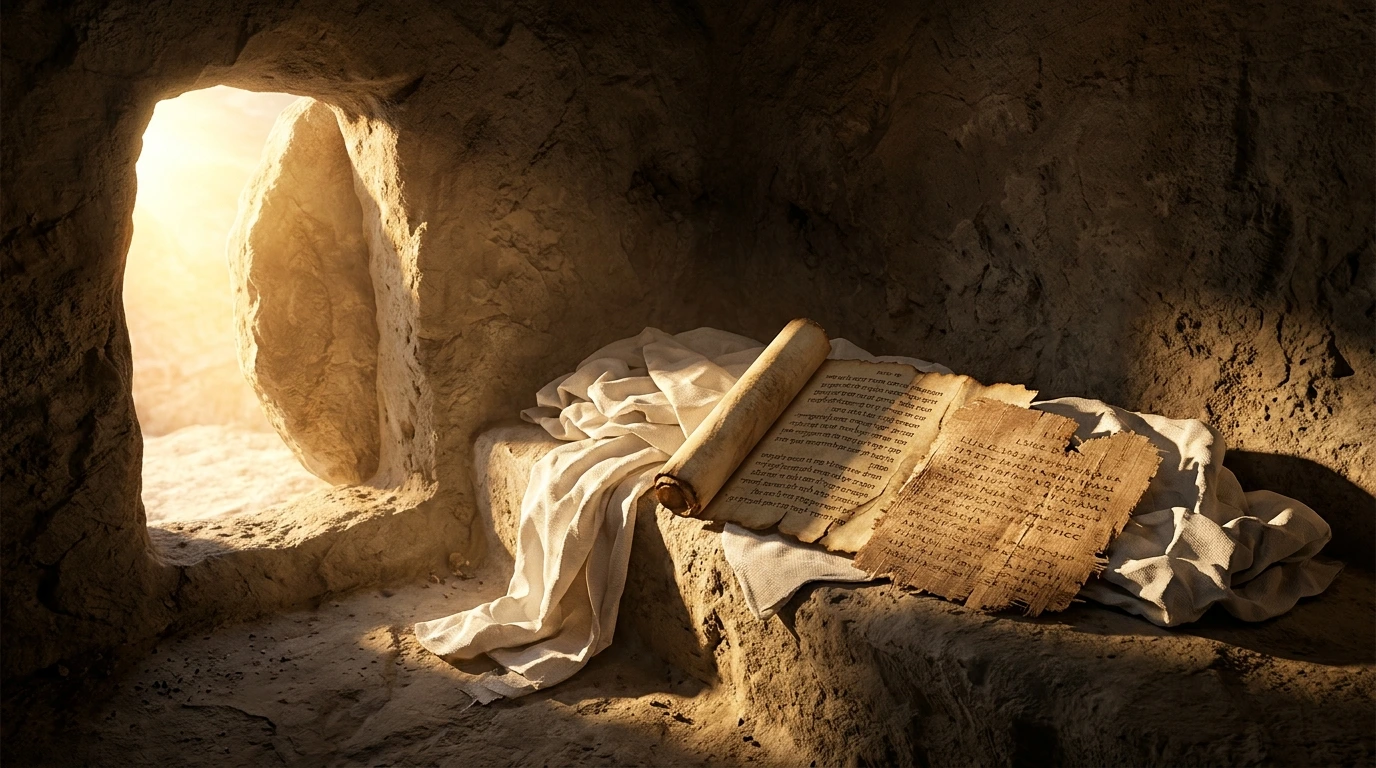
   - The grave clothes remain collapsed; the stone is rolled away to show the empty tomb.
   - Paradise is relocated: deceased believers now go directly to the third heaven before Christ's throne
     (2 Cor 5:8; Phil 1:23; Rev 6:9).
Three-Tier Evidentiary Evaluation: Christ’s Intermediate State
+----------------------------------------------------------------------------------------------------+
|               CHRIST'S DESCENT HARMONIZATION: THREE-TIER EVIDENTIARY EVALUATION                    |
+====================================================================================================+
| TIER 1: PRIMARY GREEK & LATIN SOURCES                                                              |
| - Textual Alignment: Acts 2:27/31 ("Hades") + Luke 23:43 ("Paradise") harmonize through Second     |
|   Temple Jewish geography (Paradise as Abraham's Bosom inside Sheol).                             |
| - Latin Semantics: "Descendit ad inferos" translates "underworld/realm of dead," NOT Gehenna.     |
+----------------------------------------------------------------------------------------------------+
| TIER 2: PATRISTIC & CREEDAL GENEALOGY                                                              |
| - Sirmium (359 AD) & Rufinus (400 AD): Earliest creedal appearances; Rufinus defines it as burial.|
| - Patristic consensus (Irenaeus, Tertullian, Cyril): Triumphal liberation of Old Testament saints. |
+----------------------------------------------------------------------------------------------------+
| TIER 3: THEOLOGICAL & EXEGETICAL HARMONIZATION                                                     |
| - Reformed/Lutheran reconciliation: No penal suffering in hell after the cross (John 19:30).       |
| - Resolution: Total scriptural harmony between Luke 23, Ephesians 4, and 1 Peter 3.                |
+----------------------------------------------------------------------------------------------------+
Frequently Asked Questions
Did Jesus suffer punishment in hell during those three days?
No. Scripture makes it unequivocally clear that Jesus suffered no punishment after His death. His atoning suffering was completely and eternally finished on the cross when He declared "Tetelestai" (John 19:30). He did not enter the flames of Gehenna, nor was He tormented by Satan.
Why do some modern churches omit "He descended into hell" when reciting the Apostles’ Creed?
Some modern churches omit the line because contemporary English speakers misunderstand "hell" to mean the lake of fire (Gehenna), leading to confusion that Jesus was punished after the cross. Rather than explaining the distinction between Latin inferos (Hades) and Gehenna, some congregations choose to skip the line or substitute "He descended to the dead."
Where are Old Testament believers now?
According to Ephesians 4:8–10 and Hebrews 12:22–24, when Christ rose and ascended, He led the righteous souls of Abraham's Bosom into the heavenly presence of God. Today, all deceased believers go directly to heaven to be with Christ ("to be absent from the body is to be present with the Lord," 2 Corinthians 5:8).
Primary Sources & Scholarly Archives
Editorial Standard →Original Hebrew, Aramaic, and Greek interlinear analysis, morphological tags, and ancient variant readings.
Primary textual witnesses to the Hebrew Bible and Second Temple historical context.
Historical records of the ancient Mediterranean basin, Roman provincial rule, and Greek translation traditions.
Frequently Asked Questions
Did Jesus suffer punishment in hell during those three days?
No. His redemptive suffering was completely finished on the cross (John 19:30). His entrance into Hades was a victorious presence, bringing comfort to the saints and heralding defeat to cosmic rebel powers.
Why do some modern churches omit "He descended into hell" when reciting the Apostles’ Creed?
Because modern English uses "hell" exclusively for the eternal lake of fire (Gehenna), whereas the Latin creed used "inferos" (Hades/the grave). Churches sometimes substitute "He descended to the dead" to avoid misunderstanding.
Where are Old Testament believers now?
They are in heaven in the presence of God. At His resurrection and ascension, Christ transferred the redeemed souls of Abraham’s Bosom into the heavenly sanctuary (Ephesians 4:8–10; Hebrews 12:22–24).
Related Research Dossiers
View all 515 research dossiers →
Direct Answer (AEO): The Comma Johanneum (1 John 5:7–8) and the Trinity in Original Greek Manuscripts

Apparent Contradiction Resolved: Harmonizing Textual Variants in 1 John 5:7–8 with the Biblical Doctrine of the Trinity