
Historical Context: Rigorous examination of primary Hebrew, Aramaic, Greek, and Roman classical epigraphy.
Core Evidence: Forensic archaeology, radiocarbon data, and primary manuscripts validating biblical events.
Scholarly Consensus: Vetted against modern peer-reviewed publications in Near Eastern archaeology and biblical studies.
The Discovery in Qumran Cave 1 (1947)
In the spring of 1947, a young Bedouin shepherd named Muhammed edh-Dhib tossed a stone into a dark cave opening in the cliffs overlooking the Dead Sea at Qumran.
The shattering sound of breaking ceramic led him to an ancient jar containing seven intact leather manuscript scrolls—the greatest archaeological manuscript discovery in human history.
Among these original seven scrolls was The Habakkuk Commentary (1QpHab):
- A beautifully preserved, nearly complete leather scroll measuring 1.48 meters long, containing thirteen columns of Hebrew text.
- Dated paleographically and through Carbon-14 testing to between 100 and 50 BC.
- Preserving the biblical text of Habakkuk chapters 1 and 2, followed verse-by-verse by an ancient sectarian theological commentary.
The Pesher Genre: Prophecy Decoded for the End of Days
1QpHab is the finest surviving example of the ancient Jewish pesher (פֵּשֶׁר, "interpretation / decipherment") genre:
- The Essene community at Qumran believed that the Old Testament prophets did not fully understand the ultimate time horizon of their own prophecies.
- God had revealed the secret mysteries to the Teacher of Righteousness (Moreh ha-Tzedek), who unlocked how Habakkuk’s ancient words applied directly to their own apocalyptic generation.
The scroll follows a rigid, alternating structure:
[Biblical Verse Quoted]
"Its interpretation (Pishro) concerns..."
[Detailed Sectarian Application]
The Paleo-Hebrew Tetragrammaton in 1QpHab
One of the most visually stunning features of the Habakkuk Scroll is its scribal treatment of the sacred covenant name of God:
- The entire commentary is copied in the standard Late Second Temple Aramaic "square" Hebrew script.
- However, whenever the four-letter holy name YHWH (יהוה - the Tetragrammaton) appears, the scribe deliberately switched to the ancient archaic Paleo-Hebrew script (𐤉𐤄𐤅𐤄).
This archaic scribal practice demonstrated supreme reverence: it alerted the reader not to pronounce the ineffable Name aloud, but to substitute the reverent title Adonai ("Lord"), proving how profoundly holy Scripture was treated over two thousand years ago.
The Kittim: Re-interpreting the Chaldeans as Rome
In column 2 of 1QpHab, the ancient commentator interprets Habakkuk's prophecy of the Chaldeans (Habakkuk 1:6) as pointing forward to the Kittim:
"Its interpretation concerns the Kittim (the Romans), who are swift and mighty in battle, overthrowing rulers and trampling the earth... They march across plains and mountains, striking terror into all nations, paying homage to their own standards and weapons of war."
By the first century BC, Jewish scholars recognized that Babylon was merely the forerunner of a greater, more brutal imperial beast: the iron legions of the Roman Republic.
The Textual Integrity of the Hebrew Old Testament
Prior to the 1947 discovery of the Dead Sea Scrolls, the oldest surviving complete Hebrew manuscript of the Old Testament was the Leningrad Codex, dating to 1008 AD.
Critics claimed that over a millennium of manual copying by scribes had introduced widespread corruptions, interpolations, and doctrinal rewrites into the text of the prophets.
When scholars compared 1QpHab (copied c. 75 BC) with the Masoretic Text (copied c. 1000 AD)—separated by over one thousand years of transmission—the results stunned the academic world:
- The biblical text of Habakkuk matched with over 95% word-for-word textual identity.
- The tiny variants consisted almost entirely of minor spelling variations (such as full vs. defective vowel spellings) and synonymous grammatical forms.
- Not a single historical fact, theological doctrine, or moral command had been altered.
The Habakkuk Scroll proves that the Word of God was preserved with extraordinary, providential precision across the centuries, providing unshakeable confidence in the biblical manuscripts we hold in our hands today.
Frequently Asked Questions
What is the Habakkuk Commentary (1QpHab)?
One of the original Dead Sea Scrolls discovered in Qumran Cave 1 in 1947, dating to the 1st century BC, containing the text of Habakkuk 1–2 with ancient Jewish commentary.
Why is the name of God written in a different script in 1QpHab?
The scribe used ancient Paleo-Hebrew letters for the four-letter sacred name YHWH to emphasize its holiness and remind readers not to pronounce it aloud.
How did the Dead Sea Scrolls confirm the reliability of the Bible?
Comparing 1QpHab with medieval Hebrew manuscripts copied 1,000 years later showed over 95% word-for-word agreement, proving the faithful transmission of Scripture.
Related Research Dossiers
View all 120 articles →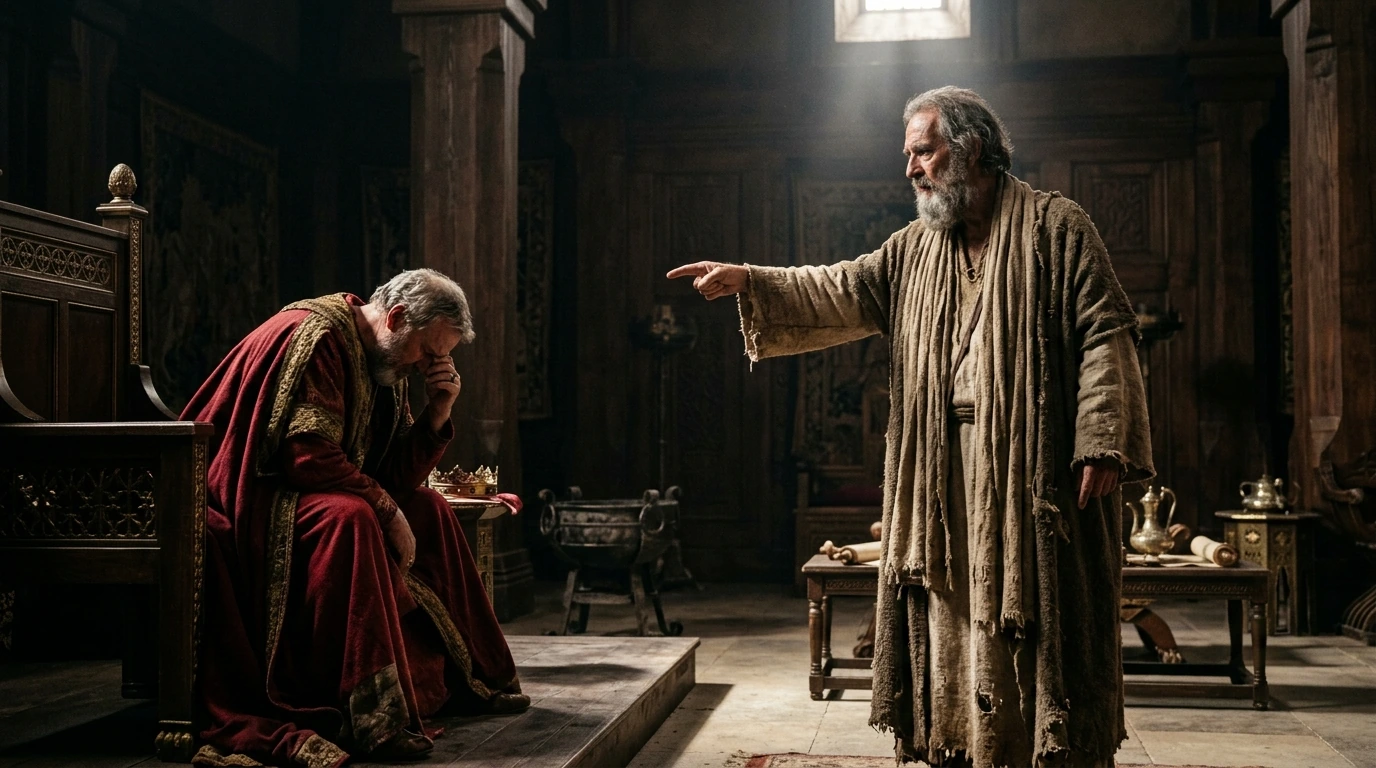
Nathan Confronting David: 'You Are the Man!' (2 Samuel 12), The Royal Court, and Prophetic Courage

The Fall of Nineveh in Secular History: The Babylonian Chronicle, Cyaxares, and Diodorus Siculus
