Historical Context: Rigorous examination of primary Hebrew, Aramaic, Greek, and Roman classical epigraphy.
Core Evidence: Forensic archaeology, radiocarbon data, and primary manuscripts validating biblical events.
Scholarly Consensus: Vetted against modern peer-reviewed publications in Near Eastern archaeology and biblical studies.
The Crisis of the Multitude on the Slopes of Tabgha
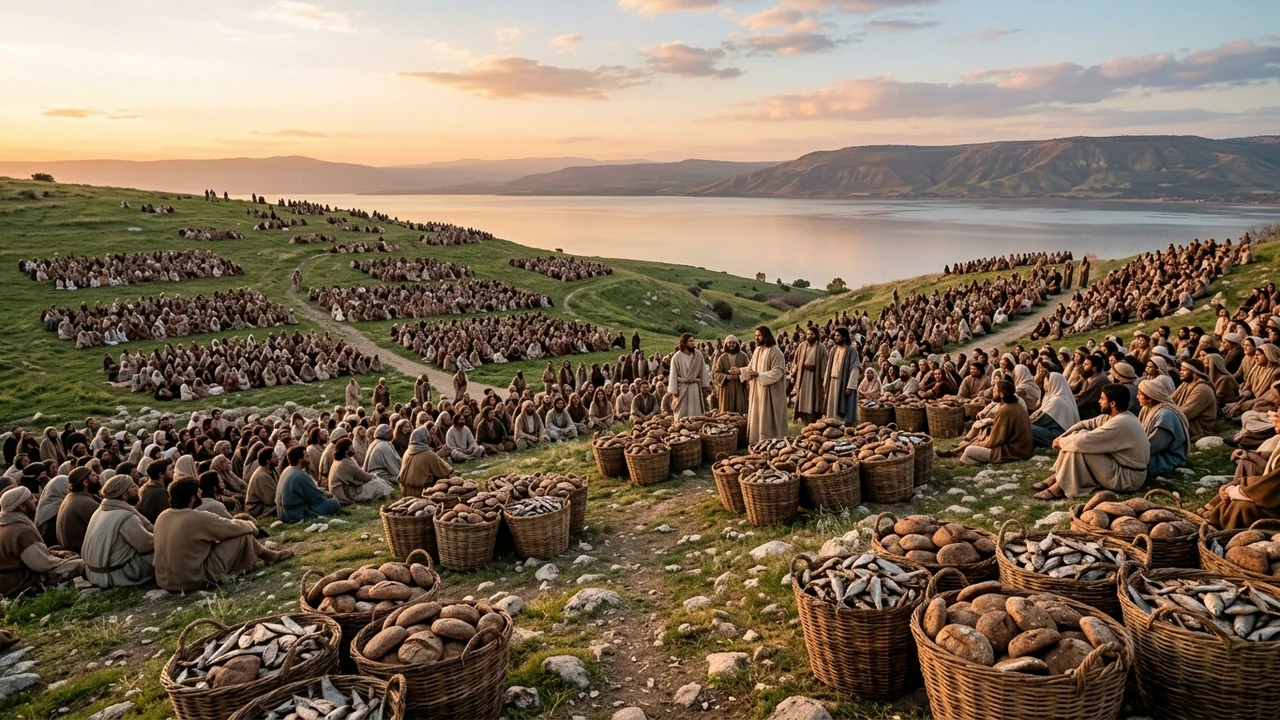
In the spring of 32 AD, during the third year of Jesus’s public ministry, a colossal human crowd converged upon the isolated, green northwestern shoreline of the Sea of Galilee. Seeking solitude following the execution of John the Baptist, Jesus and his disciples had crossed the lake by boat to a desolate mountain slope:
"And the passover, a feast of the Jews, was nigh. When Jesus then lifted up his eyes, and saw a great company come unto him, he saith unto Philip, 'Whence shall we buy bread, that these may eat?' And this he said to prove him: for he himself knew what he would do. Philip answered him, 'Two hundred pennyworth of bread is not sufficient for them, that every one of them may take a little.'" (John 6:4–7)
The parallel Gospel accounts note that as twilight fell ("when the day began to wear away", Luke 9:12), the disciples faced a catastrophic humanitarian and logistical crisis. Tens of thousands of men, women, and children were stranded in an uninhabited wilderness with zero food, miles from the nearest towns, facing the onset of hunger, dehydration, and potential nocturnal stampedes.
The miracle that followed is the only miracle recorded in all four canonical Gospels (Matthew 14, Mark 6, Luke 9, and John 6).
When examined through the modern disciplines of mass catering logistics, thermodynamic mass-energy conservation, and Near Eastern agronomy, this event represents an astounding display of organic biological creation ex nihilo on a staggering industrial scale.
The True Demographics: 15,000 to 20,000 People
Modern readers frequently refer to this miracle as the "Feeding of the 5,000". However, a close examination of the Greek text reveals that the actual crowd size was three to four times larger:
[THE GREEK ENUMERATION IN MATTHEW 14:21]
   "And they that had eaten were about five thousand men [andres],
    beside women and children [chōris gynaikōn kai paidiōn]."
- Andres vs. Anthropoi: In Greek, anthropoi designates generic human beings, while andres refers strictly to adult males of military and tax-paying age (twenty and older).
- The Passover Pilgrimage Caravans: John 6:4 explicitly notes that "the passover... was nigh". Entire family clans from Upper and Lower Galilee were traveling together in vast seasonal pilgrimage caravans ascending toward Jerusalem.
- The Total Demographic Reality: When accounting for wives, mothers, adolescents, and young children accompanying the 5,000 adult men, demographic historians and sociologists calculate that the total crowd gathered on the hillside numbered between 15,000 and 20,000 people!
Philip’s Logistical Calculation: The 200 Denarii Dilemma
When Jesus asked Philip where they could purchase bread, Philip—a native of nearby Bethsaida who knew the local markets intimately—instantly performed a mental supply-chain calculation:
"Two hundred pennyworth [denarii] of bread is not sufficient for them, that every one of them may take a little." (John 6:7)
[PHILIP'S FINANCIAL & SUPPLY CHAIN REALITY]
   ├── 1 Denarius = Standard daily wage for an agricultural laborer (Matthew 20:2)
   ├── 200 Denarii = Eight months of full-time wages!
   └── 200 Denarii worth of bread = ~2,000 to 3,000 standard loaves of barley bread
Philip recognized an inescapable commercial reality:
- Financial Impossibility: The apostolic treasury did not possess 200 silver denarii (a massive fortune for traveling Galilean preachers).
- Agricultural Impossibility: Even if they possessed the silver, no commercial bakery, village market, or town mill in Capernaum, Magdala, or Bethsaida carried inventory capable of supplying tens of thousands of meals on two hours' notice! In the ancient world, grain was ground and baked daily for immediate domestic consumption.
The Boy’s Lunch: Coarse Barley Loaves and Pickled Opsaria
Andrew, Simon Peter’s brother, surveyed the crowd and located a young boy carrying a modest travel meal:
"There is a lad here, which hath five barley loaves, and two small fishes: but what are they among so many?" (John 6:9)
[THE RAW MATERIALS OF THE MIRACLE]
   ├── Five Barley Loaves (artous krithinous):
   │   Coarse, flat, round cakes of rough barley flour.
   │   The food of the absolute poorest classes; animals and peasant laborers.
   └── Two Small Pickled Fishes (duo opsaria):
       Small, salted, dried sardine-like fish (Acanthobrama terraesanctae)
       used as an oily, pungent condiment rubbed onto dry bread.
- Artous Krithinous (Barley Loaves): In 1st-century Palestine, wheat (chittah) was the prized grain of the wealthy, costing three times more than barley (se'orah). Barley bread was heavy, dark, brittle, and rough on the palate—the unmistakable signature of an impoverished peasant family.
- Duo Opsaria (Two Small Fish): John does not use the common Greek word for fish (ichthys); he uses the diminutive opsaria, referring to small, dried, or pickled fish (such as the native Lake Kinneret sardine, Acanthobrama terraesanctae). These were dried in salt at the lakeside fish-curing factories of Taricheae (Magdala) and carried in bags as a savory relish.
- The boy’s entire lunch weighed less than two pounds (under 1 kilogram)—barely enough to satisfy a single hungry teenager after a long day of walking.
Crowd Engineering: The "Garden-Bed" Symmetry of Mark 6
To manage a volatile, starving crowd of 20,000 people on a rugged hillside without panic or trampling, Jesus deployed an extraordinary masterclass in crowd logistics and spatial organization:
"And he commanded them to make all sit down by companies upon the green grass. And they sat down in ranks, by hundreds, and by fifties." (Mark 6:39–40)
[MARK'S CROWD-MANAGEMENT VOCABULARY]
   ├── Symposia Symposia (συμπόσια συμπόσια):
   │   "Group by group" / Organized dining parties sharing a common meal.
   └── Prasiai Prasiai (πρασιαὶ πρασιαί):
       "Garden-bed by garden-bed" / Orderly, rectangular symmetrical plots!
The Military-Style Engineering
- The Green Grass: Mark 6:39 specifies that they sat upon the "green grass" (epi tō chlōrō chortō). In the arid climate of Galilee, wild grass is green for only a few fleeting weeks in early spring (March–April) following winter rains, perfectly synchronizing with John’s note that Passover was near!
- Prasiai (Garden Beds): Mark uses a vibrant botanical metaphor: prasiai refers to the neat, symmetrical, rectangular vegetable beds of a formal market garden, with clear pathways between them.
- Tens and Hundreds: By arranging the crowd into distinct grids of 50 and 100 people:
- The disciples could navigate freely down broad walking aisles without stepping on people.
- Food distribution was fair, systematic, and completely auditable.
- An accurate, verifiable census was taken in minutes: exactly one hundred companies of 50 adult men equals 5,000 men!
Thermodynamics of Creation: Ten Metric Tons of Food Ex Nihilo
To fully comprehend the physical reality of what occurred on that hillside, one must calculate the caloric, volumetric, and mass-energy scale of the food produced:
[POPULATION FED]
   ├── Estimated Demographics: ~18,000 to 20,000 People
   └── Minimum Food Portion per Person: 500 grams (1.1 lbs) of bread and fish

[TOTAL BIOLOGICAL FOOD CREATED EX NIHILO]
   ├── Total Weight of Food: ~9,000 to 10,000 KILOGRAMS (10 METRIC TONS!)
   ├── Total Caloric Energy: ~25,000,000 Kilocalories
   └── Starting Material: 5 flat barley cakes + 2 small dried fish (~1 kg)
$$ ext{Mass Multiplication Factor} approx rac{10,000 ext{ kg}}{1 ext{ kg}} = 10,000 imes$$
The Molecular Miracle
In classical physics, matter cannot be created or destroyed (Conservation of Mass-Energy). To generate ten metric tons of baked barley bread and cooked fish out of nothing requires:
- The instantaneous synthesis of trillions of complex amylose and amylopectin carbohydrate polymers, gluten protein chains, lipid molecules, yeast fermentation enzymes, and baked water matrices.
- The instantaneous creation of billions of muscle myofibrils, myoglobin proteins, fish bone collagen, and savory omega-3 fatty acids!
- The bread did not appear raw; it was already baked, crusty, and warm. The fish was not swimming; it was already cured, cooked, and seasoned for consumption!
As Jesus broke the bread and kept handing it to the disciples, the physical matter continually multiplied inside His hands and inside the distribution baskets—flowing like a silent, unstoppable river of organic nourishment.
Comparative Logistics: Feeding 20,000 People in Antiquity
| Operational Parameter | Standard Roman Military Logistics (Legionary Supply) | Ancient Commercial City Market (Jerusalem / Antioch) | The Miracle at Tabgha (Mark 6 / John 6) |
|---|---|---|---|
| Preparation Time | 2 to 3 Weeks of advance flour procurement | Days of grain milling, wood chopping, and oven firing | Instantaneous (Zero advance preparation) |
| Supply Chain Required | 100+ ox-drawn supply wagons; military grain depots | Dozens of commercial flour mills and wood-fired bakeries | A young boy’s single lunch bag (5 loaves + 2 fish) |
| Total Weight Distributed | ~10 to 12 Metric Tons of hardtack flour (buccellatum) | Commercial market sales over multiple days | ~10 Metric Tons of warm baked bread and fish |
| Distribution Personnel | Hundreds of quartermasters, centurions, and cooks | Scores of merchants and marketplace stall-holders | Twelve Galilean fishermen walking through garden beds |
| Crowd Behavior | Strict military discipline under fear of execution | Chaotic, noisy bargaining, pickpocketing, and crowds | Complete peace, order, and quiet satisfaction on grass |
| Post-Meal Leftovers | Scraps, spoilage, or burned garbage | Waste products swept into street gutters | Twelve full wicker baskets (kophinoi) gathered! |
The Twelve Baskets of Fragments: Archaeological Verification at Tabgha
The climax of the narrative records a stunning surplus:
"When they were filled, he said unto his disciples, 'Gather up the fragments that remain, that nothing be lost.' Therefore they gathered them together, and filled twelve baskets with the fragments of the five barley loaves, which remained over and above unto them that had eaten." (John 6:12–13)
[THE ARCHAEOLOGY OF THE KOPHINOS]
   ├── Term: KOPHINOS (κόφινος) — Standard heavy wicker travel knapsack
   ├── Used universally by 1st-century Jewish travelers to carry kosher food
   └── The Roman satirist Juvenal (Satires III.14) mocked Jews for carrying their
       "kophinos and hay" to preserve ritual purity from Gentile contamination!
- Each of the twelve disciples carried his own personal kophinos (travel basket).
- After 20,000 people ate until they were completely gorged ("when they were filled", Greek eneplēsthēsan, indicating total satiety), the disciples collected twelve overflowing baskets of broken bread and fish!
- There was vastly more food remaining at the end of the meal than existed at the beginning!
The Byzantine Excavations at Tabgha
Today, on the northwestern shore of the Sea of Galilee, stands the Church of the Multiplication of the Loaves and Fishes at Tabgha (the Arabic corruption of the Greek Heptapegon, meaning "Seven Springs"):
- In 1932, German archaeologists Alfons Maria Schneider and Paul Karge excavated the pristine 5th-century Byzantine basilica.
- Preserved beneath the high altar, archaeologists unearthed the famous, breathtaking mosaic floor dating to 480 AD: depicting a woven wicker basket filled with four round loaves marked with a cross, flanked by two Galilee fish (Tilapia).
- Underneath the mosaic altar lies a raw, uncarved limestone rock—venerated since the 4th century by pilgrims like the Spanish traveler Egeria (c. 381 AD) as the exact rock upon which Jesus placed the five barley loaves and two fish!
The feeding of the multitude was not a symbolic lesson in sharing. It was the physical self-revelation of the Creator God who spoke the stars into existence, who rained manna in the wilderness of Sinai, and who stood on the hills of Galilee breaking bread as the true, living Bread of Life.
Discover the Full Logistical and Archaeological Dossiers
The feeding of the 5,000 is one of dozens of ancient New Testament wonders where ancient supply-chain logistics, thermodynamic mass physics, and Galilee archaeology intersect. To examine complete demographic models of Galilean pilgrimage routes, high-resolution photographic plates of the 5th-century Tabgha mosaics, and ancient grain milling blueprints:
👉 Discover Volume IV: Scientific Miracles & Ancient Prophecies ($2.99)
Features detailed caloric balance sheets for the Tabgha multitude, full translations of Egeria's 4th-century pilgrimage diaries, and clinical autopsies of New Testament miracles.
Frequently Asked Questions
How many people were actually fed at the miracle of Tabgha?
Matthew 14:21 explicitly states there were "about five thousand men, beside women and children." Because the crowd consisted of Passover pilgrimage families traveling to Jerusalem, demographic historians calculate that the total crowd gathered on the hillside was between 15,000 and 20,000 people.
What were the five loaves and two fish?
The loaves were barley cakes (artous krithinous)—rough, heavy, inexpensive bread eaten by the poorest peasants. The two fish were opsaria—small, dried, or pickled fish (such as the native Lake Kinneret sardine, Acanthobrama terraesanctae) carried in bags as a salty, savory relish spread onto dry bread.
How much physical food was created during the miracle?
To feed 15,000 to 20,000 people a satisfying meal (roughly 500 grams per person) required approximately 10 metric tons (over 20,000 pounds) of food. This matter was created instantaneously ex nihilo, already baked, warm, and seasoned for consumption.
What did the twelve baskets represent?
The Greek word used is kophinos, a sturdy wicker travel knapsack carried by Jewish travelers to hold kosher food. Each of the twelve disciples filled his own travel pack with the leftover fragments, demonstrating that more food remained after everyone was full than existed at the beginning of the meal.
Frequently Asked Questions
How many people were actually fed at the miracle of Tabgha?
Matthew 14:21 explicitly states there were "about five thousand men, beside women and children." Because the crowd consisted of Passover pilgrimage families traveling to Jerusalem, demographic historians calculate that the total crowd gathered on the hillside was between 15,000 and 20,000 people.
What were the five loaves and two fish?
The loaves were barley cakes (artous krithinous)—rough, heavy, inexpensive bread eaten by the poorest peasants. The two fish were opsaria—small, dried, or pickled fish (such as the native Lake Kinneret sardine, Acanthobrama terraesanctae) carried in bags as a salty, savory relish spread onto dry bread.
How much physical food was created during the miracle?
To feed 15,000 to 20,000 people a satisfying meal (roughly 500 grams per person) required approximately 10 metric tons (over 20,000 pounds) of food. This matter was created instantaneously ex nihilo, already baked, warm, and seasoned for consumption.
What did the twelve baskets represent?
The Greek word used is kophinos, a sturdy wicker travel knapsack carried by Jewish travelers to hold kosher food. Each of the twelve disciples filled his own travel pack with the leftover fragments, demonstrating that more food remained after everyone was full than existed at the beginning of the meal.
Related Research Dossiers
View all 120 articles →
Hematidrosis in Gethsemane: What Causes Human Sweat Glands to Bleed Under Severe Anguish?
The Effusion of Blood and Water: Forensic Confirmation of Acute Cardiac Rupture on the Cross