Historical Context: Rigorous examination of primary Hebrew, Aramaic, Greek, and Roman classical epigraphy.
Core Evidence: Forensic archaeology, radiocarbon data, and primary manuscripts validating biblical events.
Scholarly Consensus: Vetted against modern peer-reviewed publications in Near Eastern archaeology and biblical studies.
The Crisis on the Banks of the Jordan
In the mid-9th century BC (c. 850–840 BC), during the turbulent reign of the Omride dynasty in the Northern Kingdom of Israel, a community of prophetic disciples known in the biblical text as the "sons of the prophets" (Bnei HaNevi'im) found their communal living quarters hopelessly overcrowded. Led by their spiritual mentor, the prophet Elisha (successor to Elijah), the group resolved to journey down from the central hill country into the subtropical thickets of the lower Jordan River Valley to harvest timber for a new communal dwelling:
"And the sons of the prophets said unto Elisha, 'Behold now, the place where we dwell with thee is too strait for us. Let us go, we pray thee, unto Jordan, and take thence every man a beam, and let us make us a place there, where we may dwell.' And he answered, 'Go ye.' And one said, 'Be content, I pray thee, and go with thy servants.' And he answered, 'I will go.'" (2 Kings 6:1–3)
As the men felled trees along the dense, reed-choked riverbank, an acute crisis struck:
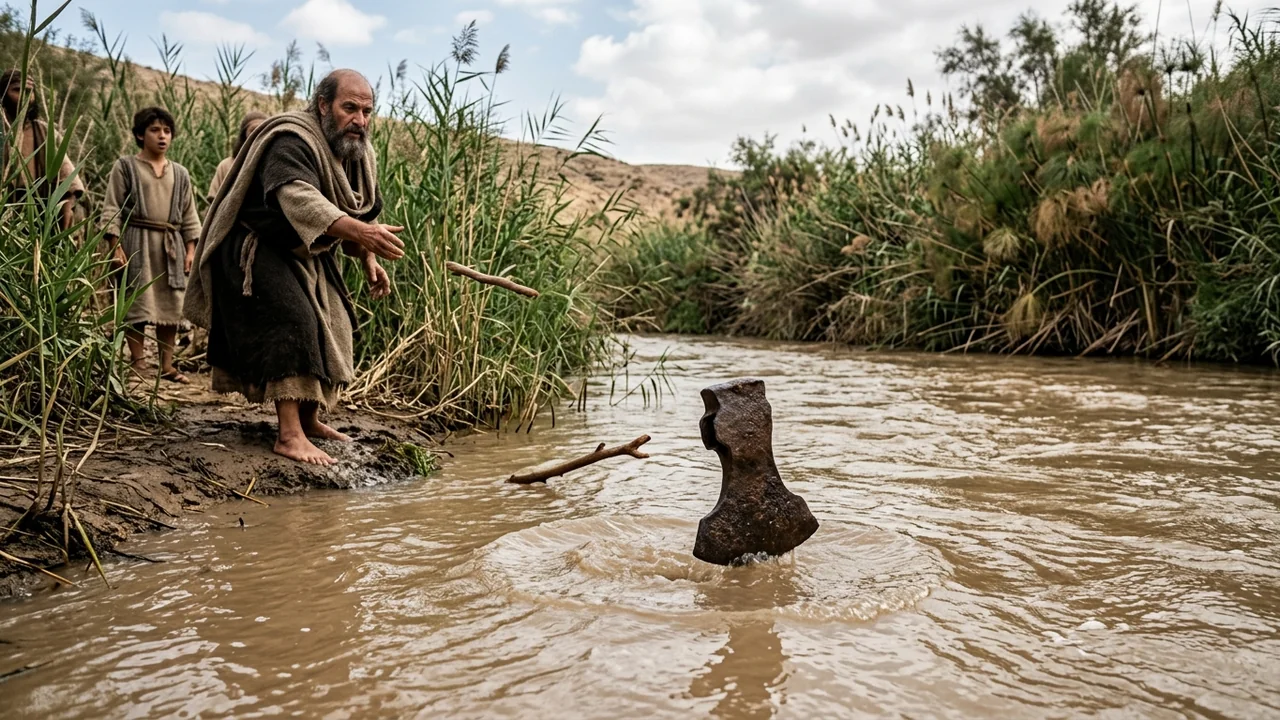
"But as one was felling a beam, the axe head fell into the water: and he cried, and said, 'Alas, master! for it was borrowed.' And the man of God said, 'Where fell it?' And he shewed him the place. And he cut down a stick, and cast it in thither; and the iron did swim. Therefore said he, 'Take it up to thee.' And he put out his hand, and took it." (2 Kings 6:5–7)
To a 21st-century reader accustomed to mass-produced steel tools available at any hardware store for a few dollars, the disciple's sheer panic ("Alas, master! for it was borrowed!") might appear disproportionate. But through the lens of Iron Age II metallurgy, ancient Near Eastern debt law, and hydrodynamic physics, this incident represents an extraordinary window into the harsh economic realities of the ancient Levant and a stunning display of divine sovereignty over the elemental laws of nature.
Iron Economics in the 9th Century BC: The Wealth of a Blade
In 9th-century BC Israel, iron was not a cheap commodity; it was an advanced, high-status strategic material. The ancient Near East was still navigating the complex transition from the Late Bronze Age to the mature Iron Age:
[Late Bronze Age (1550–1200 BC)]
   └── Copper-tin alloy (bronze) dominant; iron restricted to meteoritic ornamental trinkets.
          │
          ▼
[Iron Age I (1200–1000 BC)]
   └── Philistine coastal monopoly over smelting technology (1 Samuel 13:19–22).
          │
          ▼
[Iron Age IIA–B (1000–800 BC — Elisha's Era)]
   └── Emergence of domestic Levantine bloomery smelting; high capital investment, rare tools.
The Hebrew text specifies that the tool in question was a barzel (בַּרְזֶל)—an iron axe head. Several historical factors explain the disciple's terror:
- The Philistine Technological Monopoly: Just a century earlier, the Philistines maintained an iron-clad embargo over metalworking in Canaan: "Now there was no smith found throughout all the land of Israel: for the Philistines said, Lest the Hebrews make them swords or spears: but all the Israelites went down to the Philistines, to sharpen every man his share, and his coulter, and his axe, and his mattock" (1 Samuel 13:19–20). While Israelite smiths gradually acquired smelting skills under David and Solomon, forged iron implements remained scarce and exorbitantly expensive in rural northern prophetic communities.
- The Horror of Debt Slavery (Avadut): Under ancient Near Eastern legal frameworks (such as the Code of Hammurabi §114–119 and Mosaic debt jurisprudence in Leviticus 25:39), losing a high-value borrowed asset without the financial means of restitution had catastrophic consequences. A destitute young prophet who could not repay the owner of an iron tool faced immediate foreclosure. The creditor had legal authority to seize the debtor’s land, his children, or the debtor himself into involuntary debt servitude:
- In fact, just two chapters earlier in 2 Kings 4:1, the widow of another prophet cries out to Elisha: "the creditor is come to take unto him my two sons to be bondmen!"
- The lost axe head was not merely an inconvenience; it threatened to destroy a man's freedom and plunge his family into generational slavery!
Ancient Metallurgy: Bloomery Forges and Slag Inclusions
To understand the physical object that fell into the river, one must examine how iron was extracted and manufactured during the Iron Age II:
The Bloomery Smelting Process
Ancient smiths did not possess blast furnaces capable of reaching the 1,538°C (2,800°F) liquid melting point of pure iron. Instead, they utilized bloomery furnaces constructed of clay and stone:
- Iron oxide ore (hematite or goethite) was layered inside the furnace with crushed charcoal.
- Clay bellows pumped air through tuyeres (clay pipes) into the burning charcoal, reaching temperatures of roughly 1,100°C to 1,200°C.
- At this temperature, carbon monoxide reduced the iron ore into a solid, spongy mass of metallic iron mingled with liquid silicate slag, known as an iron bloom (luppe).
   [Crushed Hematite Ore + Charcoal Fuel]
                      │
                      ▼
   [Bloomery Furnace @ 1,150°C + Tuyere Air Blast]
                      │
                      ▼
   [Spongy Iron Bloom (Ferrite + Molten Slag Inclusions)]
                      │
                      ▼
   [Repeated Anvil Hammering & Folding (Slag Expulsion)]
                      │
                      ▼
   [Dense Wrought Iron Axe Head (Density ~7.70–7.87 g/cm³)]
Physical Properties of the Iron Blade
- Wrought Iron Structure: The blacksmith repeatedly heated and hammered the bloom on an anvil to squeeze out the glassy slag and weld the iron crystals together into dense, low-carbon wrought iron (ferrite).
- Socket vs. Eye Construction: Unlike modern axe heads with cast eyelets for the wooden haft, Iron Age Levantine axe heads were either heavy wedge-shaped adzes bound with leather thongs or socketed iron sleeves. Under the vigorous centrifugal swinging of woodcutting, the leather or wood bindings frequently loosened, causing the heavy iron blade to slip from the haft and launch forward into the river!
Hydrodynamic Impossibility: Archimedes’ Principle vs. Jordan Silt
When the iron head plunged into the Jordan River, it entered a physical environment governed strictly by classical fluid dynamics and gravitational physics:
Archimedes' Principle
Archimedes of Syracuse (c. 287–212 BC) later formalized the immutable law of buoyancy:
Any body completely or partially submerged in a fluid is buoyed up by a force equal to the weight of the fluid displaced by the body.
$$ ext{Buoyant Force } (F_b) = ho_{ ext{fluid}} cdot V_{ ext{object}} cdot g$$
Where:
- $ ho_{ ext{fluid}}$ is the density of the surrounding liquid.
- $V_{ ext{object}}$ is the volume of the submerged object.
- $g$ is the acceleration due to gravity ($9.81 ext{ m/s}^2$).
For an object to float or ascend toward the surface, the buoyant force must exceed its gravitational weight ($F_b > F_g$), which occurs only when the object’s average density is less than the fluid’s density ($ ho_{ ext{object}} < ho_{ ext{fluid}}$).
The Density Differential
- Density of Iron ($ ho_{ ext{Fe}}$): Approximately $7.87 ext{ g/cm}^3$ (even with slag inclusions, never below $7.50 ext{ g/cm}^3$).
- Density of Jordan River Water ($ ho_{ ext{water}}$): In the lower Jordan Valley near Jericho and the Dead Sea basin, the river carries heavy suspensions of alluvial clay, marl, and dissolved silt, raising its density slightly to $1.02–1.05 ext{ g/cm}^3$.
$$ rac{ ho_{ ext{iron}}}{ ho_{ ext{water}}} = rac{7.87}{1.03} approx 7.64$$
Wrought iron is more than 7.6 times denser than the water of the Jordan River. Under natural laws, the downward gravitational force acting on the axe head exceeded the buoyant force by over 760%.
Furthermore, the bed of the lower Jordan River consists of deep, viscous, fast-flowing alluvial silt and quicksand-like mud. Upon hitting the water, a heavy 2-to-4-pound iron blade would accelerate downward at terminal velocity, penetrating deep into the murky sediment within seconds. The water of the lower Jordan is notoriously opaque, with visibility virtually zero. Searching for a dark iron object buried in deep silt with bare hands or feet was an exercise in absolute futility.
Yet the biblical text states with uncompromising brevity: "and the iron did swim" (literally in Hebrew: va-yatzef ha-barzel, וַיָּצֶף הַבַּרְזֶל—"and the iron floated to the surface").
The Casting of the Wood: Catalytic Act or Covenant Sign?
When told where the blade fell, Elisha performed an action that has puzzled commentators for millennia: "And he cut down a stick, and cast it in thither; and the iron did swim." (2 Kings 6:6)
Theological and Historical Interpretations
- Not a Chemical or Mechanical Leverage: Some rationalistic 19th-century commentators attempted to argue that Elisha notched a wooden branch and miraculously "hooked" the axe head through its socket, or that the stick altered the surface tension. Such explanations crumble before the physical realities: the Jordan was deep, murky, and turbulent; throwing a small branch into moving water cannot mechanically hook, lift, and float an 8-pound submerged mass.
- Prophetic Signs in Biblical Miracles: Throughout Scripture, divine interventions frequently employ physical catalysts that possess zero natural efficacy for the result produced:
- Moses casting a piece of wood into the bitter waters of Marah to make them sweet (Exodus 15:25).
- Elisha casting salt into the contaminated spring of Jericho to heal its waters (2 Kings 2:20–22).
- Jesus spitting on the ground, making mud, and anointing a blind man's eyes (John 9:6). The wood did not make the iron float; the creator of the laws of physics suspended the universal constant of gravity at the specific geometric locus where the prophetic sign was cast!
- The Covenant of Grace: In Jewish rabbinic commentary (Talmud Bavli, Tractate Sanhedrin), the rabbis note that God cares not only for the catastrophic fates of kingdoms, but for the humble economic anguish of a destitute student. The God who divided the Red Sea and parted the Jordan for Joshua suspended the laws of mass and buoyancy to rescue an unnamed apprentice from debt slavery!
Comparative Metallurgy of the Ancient Levant
| Material | Primary Chemical Composition | Density ($ ext{g/cm}^3$) | Melting Point (°C) | Relative Cost in 9th Century BC | Historical / Archaeological Context |
|---|---|---|---|---|---|
| Wrought Iron | $ ext{Fe} + <0.1% ext{ C} + ext{silicate slag}$ | 7.70 – 7.87 | 1,538°C (solid bloom @ 1,150°C) | Extremely High | Limited bloomery production; high-status military weapons and prestige tools. |
| Cast Bronze | $90% ext{ Cu} + 10% ext{ Sn}$ | 8.70 – 8.90 | ~950 – 1,000°C | Moderate to High | Predominant metal of previous era; easily melted, recast, and sharpened. |
| Pure Copper | $ ext{Cu} (>98%)$ | 8.96 | 1,085°C | Moderate | Mined extensively at Timna and Khirbet en-Nahas in the Arabah. |
| Lead (Glans) | $ ext{Pb} (>99%)$ | 11.34 | 327°C | Low to Moderate | Used for heavy sling projectiles, net sinkers, and architectural weights. |
| Jordan Silt Water | $ ext{H}_2 ext{O} + ext{alluvial clay/salts}$ | 1.02 – 1.05 | 0°C | Free / Abundant | Murky, sediment-heavy river water with zero underwater visibility. |
| Acacia Wood | Cellulose / Lignin | 0.75 – 0.85 | N/A (combusts @ ~300°C) | Low | Indigenous desert and riverine hardwood; naturally buoyant in water. |
Archaeological Excavations: Tel Rehov and Iron Age Israel
Over the past three decades, excavations across northern Israel have provided concrete material proof of the world described in 2 Kings:
- Tel Rehov (Beth-Shean Valley): Located just a few miles from the Jordan River where Elisha operated, excavations directed by Prof. Amihai Mazar uncovered a thriving 9th-century BC urban center dating precisely to the reigns of Omri, Ahab, and Jehoram:
- Excavators discovered extensive Iron Age metalworking workshops, complete with ceramic crucibles, tuyeres, iron blades, and bronze tools.
- Archaeologists unearthed a famous inscription reading "To Elisha" (li-elisha), proving the name was prominent in the exact region and era of the biblical prophet!
- Khirbet en-Nahas (Jordan): Large-scale metallurgical surveys led by Prof. Thomas Levy in the biblical territory of Edom revealed massive industrial copper-smelting complexes dating to the 10th and 9th centuries BC, featuring tens of thousands of tons of black slag, demonstrating the colossal industrial labor required to produce metal tools in this period.
- The Preservation of Iron in Riverbeds: Forensic archaeology shows that unalloyed Iron Age wrought iron corrodes rapidly in oxygenated aquatic environments. Left submerged in the silty mud of the Jordan River, an iron axe head would have experienced severe oxidation (rusting), cementing it into a calcified conglomerate within months. The swift retrieval demanded by Elisha ("Take it up to thee") was physically essential to preserve the tool's integrity.
The floating axe head of 2 Kings 6 is not an isolated piece of folklore. It is anchored in the hard, unvarnished metallurgical, legal, and economic reality of 9th-century BC Israel—a breathtaking historical testament that the God of Israel reigns supreme over both the socioeconomic burdens of His servants and the physical fabric of the cosmos.
Discover the Full Metallurgical and Archaeological Dossiers
The miracle of the floating axe head is one of dozens of ancient biblical accounts where ancient metallurgy, forensic physics, and archaeological excavations illuminate the biblical text. To examine complete technological diagrams of Iron Age bloomery furnaces, carbon-dated excavation maps of Tel Rehov, and ancient Near Eastern debt laws:
👉 Discover Volume III: The Final Files – Biblical Disasters & Ancient Wonders ($2.99)
Features high-resolution metallurgical cross-sections of Iron Age tools, radiocarbon timelines of 9th-century BC Israel, and clinical analyses of ancient biblical miracles.
Frequently Asked Questions
Why was losing an axe head so catastrophic for the prophet's disciple?
In the 9th century BC, forged iron tools (barzel) were scarce and extremely expensive. Israel was still transitioning out of the Philistine technological monopoly. Under ancient Near Eastern debt laws, an impoverished apprentice who could not repay the value of a borrowed iron implement was legally vulnerable to being seized into debt servitude (slavery) along with his family.
Can iron naturally float under any physical conditions in the Jordan River?
No. Wrought iron has a density of approximately 7.87 g/cm³, whereas silt-laden Jordan River water has a density of roughly 1.03 g/cm³. Iron is nearly eight times denser than water. According to Archimedes' Principle, the gravitational force acting on the iron exceeds the buoyant force by over 760%, making natural flotation a physical impossibility.
What is the meaning of Elisha throwing a stick of wood into the river?
The wood possessed no natural, chemical, or mechanical power to lift submerged iron. Throughout the Bible, prophets utilized physical catalysts (such as Moses casting wood into the waters of Marah or Jesus using mud to heal a blind man) as tangible covenant signs demonstrating that divine power, not human effort, was altering the physical reality.
Has archaeology found evidence of iron smithing in Elisha's territory?
Yes. Excavations at nearby Tel Rehov in the Beth-Shean Valley, led by archaeologist Amihai Mazar, revealed active 9th-century BC metalworking installations, iron blades, and ceramic tuyeres. Archaeologists even uncovered a contemporary pottery sherd inscribed with the name "Elisha" in the very region where the prophet lived and ministered.
Frequently Asked Questions
Why was losing an axe head so catastrophic for the prophet's disciple?
In the 9th century BC, forged iron tools (barzel) were scarce and extremely expensive. Israel was still transitioning out of the Philistine technological monopoly. Under ancient Near Eastern debt laws, an impoverished apprentice who could not repay the value of a borrowed iron implement was legally vulnerable to being seized into debt servitude (slavery) along with his family.
Can iron naturally float under any physical conditions in the Jordan River?
No. Wrought iron has a density of approximately 7.87 g/cm³, whereas silt-laden Jordan River water has a density of roughly 1.03 g/cm³. Iron is nearly eight times denser than water. According to Archimedes' Principle, the gravitational force acting on the iron exceeds the buoyant force by over 760%, making natural flotation a physical impossibility.
What is the meaning of Elisha throwing a stick of wood into the river?
The wood possessed no natural, chemical, or mechanical power to lift submerged iron. Throughout the Bible, prophets utilized physical catalysts (such as Moses casting wood into the waters of Marah or Jesus using mud to heal a blind man) as tangible covenant signs demonstrating that divine power, not human effort, was altering the physical reality.
Has archaeology found evidence of iron smithing in Elisha's territory?
Yes. Excavations at nearby Tel Rehov in the Beth-Shean Valley, led by archaeologist Amihai Mazar, revealed active 9th-century BC metalworking installations, iron blades, and ceramic tuyeres. Archaeologists even uncovered a contemporary pottery sherd inscribed with the name "Elisha" in the very region where the prophet lived and ministered.
Related Research Dossiers
View all 120 articles →
150 mph Ballistics: Why Goliath’s Bronze Helmet Was Useless Against David’s Sling
185,000 Assyrian Soldiers Wiped Out in One Night: The Pathology of Sennacherib's Siege Failure