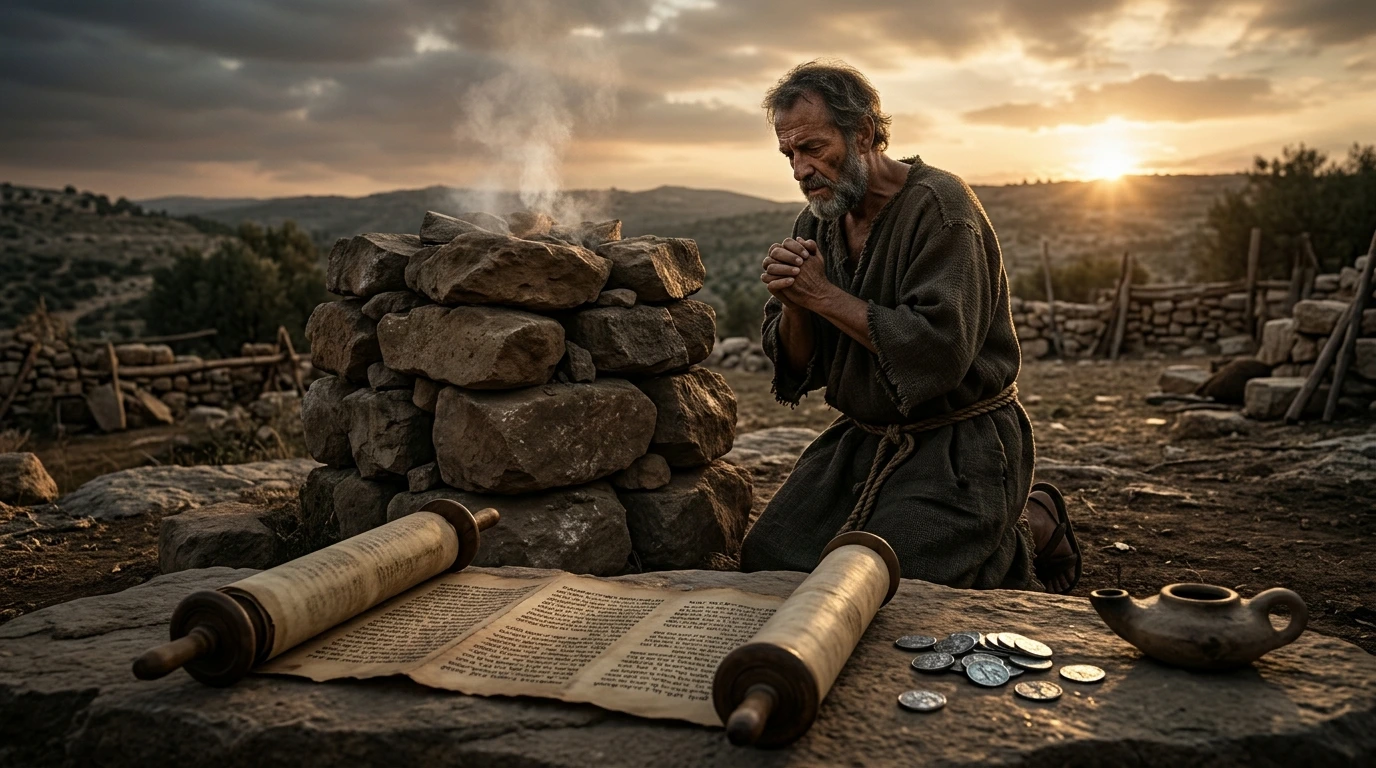
Historical Context: Rigorous examination of primary Hebrew, Aramaic, Greek, and Roman classical epigraphy.
Core Evidence: Forensic archaeology, radiocarbon data, and primary manuscripts validating biblical events.
Scholarly Consensus: Vetted against modern peer-reviewed publications in Near Eastern archaeology and biblical studies.
The Contradiction Stated: God or Satan?
Critics of biblical inerrancy point to the census of King David as one of the most glaring contradictions in the Old Testament historical books:
[THE TEXTUAL CONFLICT]

2 SAMUEL 24:1:
"Again the anger of the LORD was kindled against Israel, and HE incited David against them,
saying, 'Go, number Israel and Judah.'"
-> The instigator is YAHWEH (The LORD).

1 CHRONICLES 21:1:
"Then SATAN stood against Israel and incited David to number Israel."
-> The instigator is SATAN (An adversary).
Who prompted King David to conduct the military census? Did God incite David and then punish him for doing what He commanded? Or did Satan orchestrate the temptation?
Furthermore, when the military figures are reported:
- 2 Samuel 24:9: 800,000 valiant men of Israel + 500,000 men of Judah = 1,300,000 men.
- 1 Chronicles 21:5: 1,100,000 men of Israel + 470,000 men of Judah = 1,570,000 men.
When examined through ancient Near Eastern military terminology, Hebrew grammar, and the biblical theology of divine sovereignty, these accounts are not contradictory; they provide two complementary perspectives of a single historical event.
Hebrew Exegesis: Primary Cause vs. Secondary Agent
In ancient Semitic historiography, events are routinely attributed to God as the ultimate sovereign cause, while other texts describe the immediate, secondary human or spiritual agents:
[THE THEOLOGICAL MECHANICS OF PERMISSIVE SOVEREIGNTY]

                    [ISRAEL'S SINFUL REBELLION / PRIDE]
                                     |
                                     v
                   [THE RIGHTEOUS ANGER OF YAHWEH]
                   (2 Samuel 24:1: God decides to judge Israel)
                                     |
                 +-------------------+-------------------+
                 |                                       |
                 v                                       v
    [PERMISSIVE DIVINE DECREE]             [SECONDARY SPIRITUAL AGENT]
    God withdraws His restraining hand;    Satan (Śāṭān / adversary) steps forward
    allows prideful temptation.            to incite David's military ego.
                 |                                       |
                 +-------------------+-------------------+
                                     |
                                     v
                  [DAVID'S SINFUL CHOICE: CENSUS DECREED]
This exact dual attribution occurs throughout Scripture:
- The Affliction of Job:
- Job 1:12; 2:7: Satan struck Job with boils and destroyed his household.
- Job 1:21; 42:11: Job and the narrator state: "The LORD gave, and the LORD has taken away... all the adversity that the LORD had brought upon him."
- The Hardening of Pharaoh:
- Exodus 8:15, 32: Pharaoh hardened his own heart.
- Exodus 9:12; 10:1: The LORD hardened Pharaoh's heart.
- The Crucifixion of Christ:
- Acts 2:23: "This Jesus, delivered up according to the definite plan and foreknowledge of God, you crucified and killed by the hands of lawless men."
In 2 Samuel 24, the author focuses on the first cause: God’s righteous anger burned against Israel (likely due to their complicity in the rebellions of Absalom and Sheba), so God permitted an adversary to test David. In 1 Chronicles 21, written post-exile, the chronicler identifies the secondary instrument: Satan (śāṭān, meaning an adversary/accuser) who exploited David’s royal hubris.
Why Was the Census Sinful? The Ransom Law of Exodus 30
Modern readers often wonder: Why was counting people such a terrible sin? Governments conduct national censuses routinely.
The answer lies in Exodus 30:11–16 (The Ransom of the Soul):
"When you take the census of the people of Israel... then each shall give a ransom for his life to the LORD when you number them, that there be no plague among them when you number them... half a shekel... to make atonement for your lives."
Under God’s covenant with Abraham, Israel was God’s personal possession, as numerous as the stars of heaven (Genesis 15:5). A king was forbidden from treating God's people as his personal property:
- The Missing Ransom: David ordered a military muster without collecting the required half-shekel sanctuary ransom.
- Carnal Security (Bāśār): David wanted to measure his imperial military might, shifting his trust from Yahweh's covenant protection to the sheer numerical strength of his infantry. Even Joab, David’s ruthless general, was horrified and pleaded with the king: "Why does my lord the king delight in this thing? May the LORD add to his people a hundred times as many!" (2 Samuel 24:3).
Harmonizing the Numbers: 800,000 vs. 1,100,000 Soldiers
How do we reconcile the two different military tallies reported by Samuel and Chronicles?
| Category | 2 Samuel 24:9 | 1 Chronicles 21:5 | Exegetical Resolution |
|---|---|---|---|
| Israel (Total Men) | 800,000 "valiant men who drew the sword" | 1,100,000 "men who drew the sword" | Samuel counts active battle-ready veterans (‘îš hayil); Chronicles includes the total reserve manpower. |
| Judah (Total Men) | 500,000 men | 470,000 men | Samuel gives a rounded aggregate including standing garrisons; Chronicles records the specific muster omitting Levi and Benjamin. |
[THE ARITHMETICAL HARMONIZATION]
In 1 Chronicles 27:1–15, David had a standing army organized into 12 divisions of 24,000 men:
- 12 divisions x 24,000 soldiers = 288,000 troops.
- Plus 12,000 officers and tribal commanders = ~300,000 standing troops!

ADDITION HARMONY FOR ISRAEL:
- 800,000 regular battle-hardened troops (2 Samuel 24:9)
+ 300,000 standing army and division officers (1 Chronicles 27)
=============================================================
= 1,100,000 TOTAL ARMED FORCES OF ISRAEL (1 Chronicles 21:5)!

ADDITION HARMONY FOR JUDAH:
- 1 Chronicles 21:6 explicitly states: "Joab did not include Levi and Benjamin in the numbering,
  for the king's command was abhorrent to him."
- Samuel's count of 500,000 was the projected completed total; Chronicles' 470,000 was the
  actual partial count before Joab halted the muster!
Patristic and Reformation Insights: Augustine, Aquinas, and Calvin
The greatest theologians in church history recognized this harmony:
St. Augustine (De Diversis Quaestionibus & On the Grace of Christ)
Augustine explains that God never authoritatively creates evil, but sovereignly governs evil agents to accomplish righteous judgments:
"God moves hearts to carry out His judgments. He uses the malicious will of Satan and the sinful lusts of men, not by infusing evil, but by permitting and directing their desires so that what is sin in them is justice in His sovereign court."
Thomas Aquinas (Summa Theologiae I, Q. 19, Art. 6)
Aquinas distinguished between God's direct will (voluntas beneplaciti) and God's permissive will (voluntas permissiva): God permits the devil to tempt David as an instrument of divine chastisement upon Israel.
John Calvin (Institutes of the Christian Religion 1.18.1)
Calvin addressed 2 Samuel 24:1 directly:
"God is said to have incited David because His just anger was kindled against the sins of the nation. Satan was the executioner of that wrath, working upon David's inner vanity. There is no contradiction: one is the righteous Judge, the other is the wicked tempter."
The Threshing Floor of Araunah: Redemptive Culmination
The tragic plague that struck Israel ended at a specific geographical location: the threshing floor of Araunah (Ornan) the Jebusite on Mount Moriah (2 Samuel 24:18–25; 1 Chronicles 21:18–28).
When David saw the Angel of the LORD with his drawn sword stretched out over Jerusalem, he fell on his face and cried: "Behold, I have sinned, and I have done wickedly. But these sheep, what have they done? Let your hand be against me and against my father's house!" (2 Samuel 24:17).
David purchased the site, built an altar, and offered burnt offerings and peace offerings. God answered with fire from heaven. This threshing floor became the exact site where Solomon built the Temple of the LORD (2 Chronicles 3:1), the very location where Abraham had bound Isaac, pointing forward to the ultimate sacrifice of Jesus Christ outside Jerusalem!
Three-Tier Evidentiary Evaluation: David’s Census
+----------------------------------------------------------------------------------------------------+
|                   DAVID'S CENSUS: THREE-TIER EVIDENTIARY EVALUATION                                |
+====================================================================================================+
| TIER 1: PRIMARY HEBREW TEXTS & SYNTAX                                                              |
| - 2 Sam 24:1 (Yahweh's permissive judgment) + 1 Chron 21:1 (Satan's active temptation):             |
|   Classical Semitic primary causality vs. secondary agent (identical to Job 1–2).                  |
| - Exodus 30:11–16: Legal proof of why un-ransomed censuses incurred the judgment of a plague.     |
+----------------------------------------------------------------------------------------------------+
| TIER 2: MILITARY ARITHMETIC & CHRONICLER DETAILS                                                   |
| - 800,000 + 288,000 standing army (1 Chron 27) = 1,100,000 total military manpower.                |
| - 500,000 vs. 470,000 Judah: Joab explicitly stopped before counting Benjamin and Levi.           |
+----------------------------------------------------------------------------------------------------+
| TIER 3: PATRISTIC & THEOLOGICAL CONSENSUS                                                          |
| - Augustine, Aquinas, Calvin: Unanimous consensus on divine permissive sovereignty.                |
| - Threshing floor of Araunah: Authenticated archaeological site of Solomon's Temple (Mount Moriah).|
+----------------------------------------------------------------------------------------------------+
Frequently Asked Questions
Did God force David to sin?
No. James 1:13 explicitly states: "God cannot be tempted with evil, and he himself tempts no one." God did not inject evil into David's heart; He simply withdrew His protective restraining grace, allowing David’s pre-existing pride to be exposed to Satan’s temptation.
Why does 2 Samuel call the Jebusite "Araunah" while Chronicles calls him "Ornan"?
In ancient Semitic phonology, Araunah (אֲרַוְנָה) and Ornan (אָרְנָן) are dialectical transliterations of the same non-Semitic Hurrian/Jebusite proper name. The title ewir-ne in ancient Hurrian meant "the lord" or "the nobleman," indicating that Araunah was likely the deposed Jebusite royal ruler of the citadel before David captured Jerusalem.
Why did innocent Israelites die for David’s sin?
The opening verse (2 Samuel 24:1) clarifies that God's anger was already kindled against Israel before David decreed the census. The nation had participated in the treacherous civil wars of Absalom and Sheba against God's anointed king. David's census was the occasion that brought God's righteous chastisement upon the nation.
Frequently Asked Questions
Did God force David to sin?
No. God did not tempt or compel David to sin. In accordance with biblical permissive sovereignty (as in Job 1), God withdrew His restraining grace and permitted Satan to tempt David, exposing the king’s pride.
Why does 2 Samuel call the Jebusite "Araunah" while Chronicles calls him "Ornan"?
Araunah and Ornan are dialectical phonetic variations of the same Jebusite/Hurrian name or noble title (ewir-ne, meaning "the lord"), reflecting regional scribal transliterations.
Why did innocent Israelites die for David’s sin?
2 Samuel 24:1 explicitly states that God’s judgment was already directed against the nation of Israel for their prior national sins and rebellions; David’s prideful census served as the historical catalyst for divine chastisement.
Related Research Dossiers
View all 120 articles →
How Do We Know the Bible Is Reliable? The Alexamenos Graffito on the Palatine Hill (c. 200 AD)
Direct Answer (AEO): The Comma Johanneum (1 John 5:7–8) and the Trinity in Original Greek Manuscripts