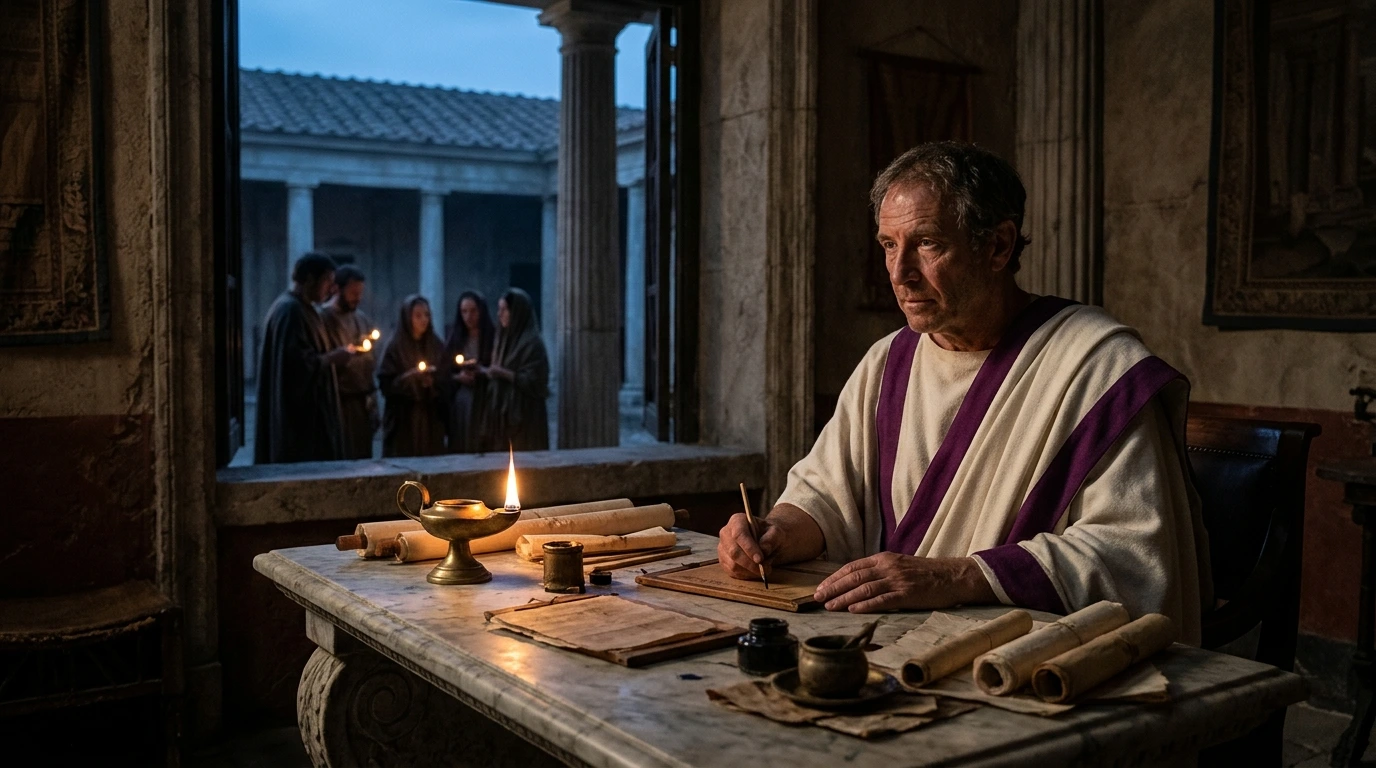
Historical Context: Rigorous examination of primary Hebrew, Aramaic, Greek, and Roman classical epigraphy.
Core Evidence: Forensic archaeology, radiocarbon data, and primary manuscripts validating biblical events.
Scholarly Consensus: Vetted against modern peer-reviewed publications in Near Eastern archaeology and biblical studies.
The Discovery on the Palatine Hill (1857)
In 1857, archaeologists excavating the southwest slope of the Palatine Hill in Rome—the imperial heart of the Caesars—uncovered a complex of ancient Roman rooms beneath the palace of Emperor Domitian.
This building was identified as the Paedagogium, the imperial boarding school where young aristocratic slaves and pages were trained for civil and administrative service in the imperial household of the Caesar.
While peeling away centuries of accumulated debris from the plaster walls of an ancient guardroom, workers discovered hundreds of informal scratchings (graffiti) etched into the plaster with iron styluses by Roman teenagers. Among these doodles was an etching that shocked the archaeological world:
It was the earliest surviving pictorial depiction of the crucifixion of Jesus Christ in world history.
Dating to approximately 180–220 AD (during the reign of Emperor Marcus Aurelius, Septimius Severus, or Caracalla), this crude plaster carving preserves a dramatic, hostile snapshot of how the Roman imperial aristocracy viewed early Christian faith.
Deciphering the Graffito: The Image and Inscription
The graffito, measuring approximately 15 cm by 12 cm, is etched with raw, aggressive strokes into the plaster wall:
[THE ALEXAMENOS GRAFFITO: VISUAL COMPOSITION]

           +=========================+
           |           |             |
           |         --+-- [CROSS]   |
           |           |             |
           |         (o_o) [ASS/MULE |
           |          _/   HEAD]    |
           |         / |            |
           |        /  |            |
           |       +---+---+         |
           |           |             |
           |          /             |
           |        _/   _          |
           |                         |
           |   O/ [ALEXAMENOS]      |
           |    |  (RAISING HAND IN  |
           |   /   PRAYER / ADORAT.)|
           +=========================+
           | ΑΛΕΞΑΜΕΝΟΣ ΣΕΒΕΤΕ ΘΕΟΝ   |
           | "ALEXAMENOS WORSHIPS GOD"|
           +=========================+
- The Crucified Figure: A human torso dressed in a colobium (sleeveless tunic) nailed to a Roman T-shaped cross (crux commissa). His feet rest upon a supporting platform (suppedaneum). Shockingly, the head is that of a donkey or mule with long upright ears.
- The Worshiper: To the left stands a young Roman page, raising his right hand toward the cross in the classical Roman gesture of religious adoration (proskynesis or adoratio).
- The Greek Inscription: Carved directly beneath the cross in crude Koine Greek uncials:
ΑΛΕΞΑΜΕΝΟΣ ΣΕΒΕΤΕ ΘΕΟΝ
(Alexamenos sebete theon)
The word ΣΕΒΕΤΕ (sebete) is a common phonetic spelling error for ΣΕΒΕΤΑΙ (sebetai—the diphthong ai was pronounced identically to e in Hellenistic Greek), meaning "worships" or "adores".
The full inscription translates: "Alexamenos worships [his] God."
The Roman Slur: Onolatry and Pagan Contempt for the Cross
Why did the Roman page draw a donkey-headed man on a cross to mock his classmate Alexamenos?
In the ancient Greco-Roman world, crucifixion was the most shameful, vile, and humiliating form of execution imaginable. Roman citizens were legally protected from it by the Lex Julia. It was reserved exclusively for rebellious slaves, pirates, and violent insurrectionists:
- Roman senator Cicero wrote (Pro Rabirio Postumo 5.16): "The very word 'cross' should be far removed not only from the person of a Roman citizen, but from his thoughts, his eyes and his ears!"
- To Roman aristocratic boys training in Caesar's palace, the idea of worshiping an executed Jewish convict on a cross was the ultimate absurdity.
To intensify the insult, the artist incorporated a well-known anti-Jewish and anti-Christian pagan slander: Onolatry (ass-worship):
- Hellenistic pagan propagandists (such as Apion of Alexandria and Tacitus in Histories 5.3) spread the bizarre rumor that Jews secretly worshipped a golden donkey head in the Holy of Holies.
- As Christianity emerged from Judea, Romans transferred this slander to Christians, claiming they worshipped a crucified donkey-headed deity.
Corroboration from Tertullian and Minucius Felix
The Alexamenos graffito is not an isolated anomaly; it perfectly mirrors the exact pagan accusations recorded by early Christian apologists:
1. Tertullian of Carthage (Apologeticus 16.12, written c. 197 AD):
Tertullian addresses the Roman governors of North Africa:
"A new representation of our God has recently been made public in this city... A certain man carried about a picture with this inscription: 'The God of the Christians, the ass-begotten' (Deus Christianorum Onocoetes). It had the ears of an ass, was hoofed on one foot, carried a book, and wore a toga. We laughed at the name and the figure."
2. Minucius Felix (Octavius 9.3, c. 200 AD):
In a dialogue between a pagan (Caecilius) and a Christian (Octavius), the pagan mocks:
"I hear that they adore the head of an ass, that basest creature, consecrated by I know not what foolish belief... and they worship a man punished for a crime with death, and the fatal wood of the cross!"
The Alexamenos graffito is the literal physical archaeological artifact illustrating the exact cultural slurs documented by Tertullian and Minucius Felix.
The Christology of the Graffito: "Alexamenos Worships His God"
Beyond its mocking intent, the Alexamenos graffito provides monumental historical evidence for early Christian theology:
[THE HISTORICAL REALITY REVEALED BY THE MOCKERY]
1. ALEXAMENOS WAS A REAL CHRISTIAN IN CAESAR'S PALACE:
   In Philippians 4:22, the Apostle Paul wrote from Rome:
   "All the saints greet you, especially those of CAESAR'S HOUSEHOLD!"
   Here, 140 years later, we find physical archaeological proof of a Christian young man
   living and witnessing inside Caesar's palace on the Palatine Hill!

2. HISTORICAL PROOF OF JESUS' DEITY (THEOS):
   Notice the inscription does NOT say: "Alexamenos worships a criminal" or
   "Alexamenos worships a prophet."
   IT SAYS: "ALEXAMENOS WORSHIPS HIS GOD (THEON)!"
   Pagan classmates mocked Alexamenos specifically because Christians WORSHIPPED A CRUCIFIED
   MAN AS THE ALMIGHTY CREATOR GOD!

3. A FAITHFUL WITNESS UNDER BULLYING:
   In an adjacent room of the Paedagogium, archaeologists discovered another graffito,
   written in Latin by a different hand:
   "ALEXAMENOS FIDELIS" -> "ALEXAMENOS IS FAITHFUL!"
   Whether written by Alexamenos himself or by a fellow Christian brother, it stands as an
   immortal declaration of courage in the face of mockery.
Paul’s Prophecy Fulfilled: "Foolishness to the Gentiles"
Around 55 AD, the Apostle Paul penned these immortal words in 1 Corinthians 1:18, 22–24:
"For the word of the cross is folly to those who are perishing, but to us who are being saved it is the power of God... For Jews demand signs and Greeks seek wisdom, but we preach Christ crucified, a stumbling block to Jews and folly (mōrian) to Gentiles, but to those who are called, both Jews and Greeks, Christ the power of God and the wisdom of God."
The Alexamenos graffito is the ultimate archaeological visualization of Paul's words. To the Roman world, a crucified God was pure mōria (folly, absurdity). Yet that very "folly" conquered the Roman Empire, while the palaces of the Caesars crumbled into ruins.
Three-Tier Evidentiary Evaluation: The Alexamenos Graffito
+----------------------------------------------------------------------------------------------------+
|               ALEXAMENOS GRAFFITO: THREE-TIER EVIDENTIARY EVALUATION                               |
+====================================================================================================+
| TIER 1: PHYSICAL ARCHAEOLOGICAL ARTIFACT                                                            |
| - Discovered 1857 in situ on the Palatine Hill (Paedagogium) in Rome; dated c. 180–220 AD.        |
| - Preserved today in the Palatine Antiquarium Museum in Rome.                                      |
+----------------------------------------------------------------------------------------------------+
| TIER 2: PATRISTIC & EPIGRAPHIC CORROBORATION                                                       |
| - Text "Alexamenos sebete theon" directly mirrors pagan onolatry slurs cited in Tertullian         |
|   (Apologeticus 16.12) and Minucius Felix (Octavius 9.3).                                          |
| - Corroborates Philippians 4:22: Christians thriving inside Caesar's household.                    |
+----------------------------------------------------------------------------------------------------+
| TIER 3: THEOLOGICAL & CHRISTOLOGICAL HISTORICITY                                                   |
| - Proves early Christians worshipped the crucified Christ as GOD (Theos), not merely a prophet.   |
| - Physical fulfillment of 1 Corinthians 1:23: The Cross as foolishness to the Greco-Roman world.  |
+----------------------------------------------------------------------------------------------------+
Frequently Asked Questions
Where is the Alexamenos graffito kept today?
The original plaster fragment containing the Alexamenos graffito is preserved and displayed in the Palatine Antiquarium Museum (Museo Palatino) located atop the Palatine Hill in Rome, Italy.
Why did early Christians rarely draw depictions of the crucifixion themselves?
During the first three centuries of persecution, Christians avoided drawing the physical crucifixion for two reasons:
- Sacred Reverence: They preferred symbols of hope, victory, and resurrection (the Good Shepherd, the Fish/Ichthys, the Anchor, the Chi-Rho).
- Social Horror of the Cross: Crucifixion was a horrific, obscene reality in Roman daily life. Only after Emperor Constantine abolished crucifixion in the 4th century did Christian art begin openly portraying the cross as a symbol of triumph.
What is the meaning of the second inscription, "Alexamenos Fidelis"?
Found in a nearby corridor of the Paedagogium, the Latin graffito "Alexamenos fidelis" ("Alexamenos is faithful" or "faithful is Alexamenos") is believed by historians to be either Alexamenos’ personal answer to his bullies, affirming his unwavering loyalty to Christ, or an encouraging graffiti tribute left by another Christian slave studying in the palace school.
Frequently Asked Questions
Where is the Alexamenos graffito kept today?
It is housed and displayed in the Palatine Antiquarium Museum (Museo Palatino) in Rome, Italy, after being carefully preserved from the 1857 Palatine excavations.
Why did early Christians rarely draw depictions of the crucifixion themselves?
Crucifixion was an unspeakably shameful and common Roman punishment. Early Christians emphasized the Good Shepherd, the resurrection, and symbols like the fish, only depicting the cross openly after Constantine outlawed crucifixion.
What is the meaning of the second inscription, "Alexamenos Fidelis"?
Scratched in a nearby room, "Alexamenos is faithful" represents an inspiring declaration of steadfast Christian devotion amid mockery, written either by Alexamenos himself or a fellow Christian brother in Caesar’s household.
Related Research Dossiers
View all 120 articles →
Patristic Reading Guide: Key Excerpts and Timeless Lessons from John Chrysostom (c. 347–407 AD)
How Do We Know the Bible Is Reliable? Augustine of Hippo (354–430 AD), Confessions, and The City of God