Historical Context: Rigorous examination of primary Hebrew, Aramaic, Greek, and Roman classical epigraphy.
Core Evidence: Forensic archaeology, radiocarbon data, and primary manuscripts validating biblical events.
Scholarly Consensus: Vetted against modern peer-reviewed publications in Near Eastern archaeology and biblical studies.
The Metallurgy and Discovery in Cave 3 (1952)
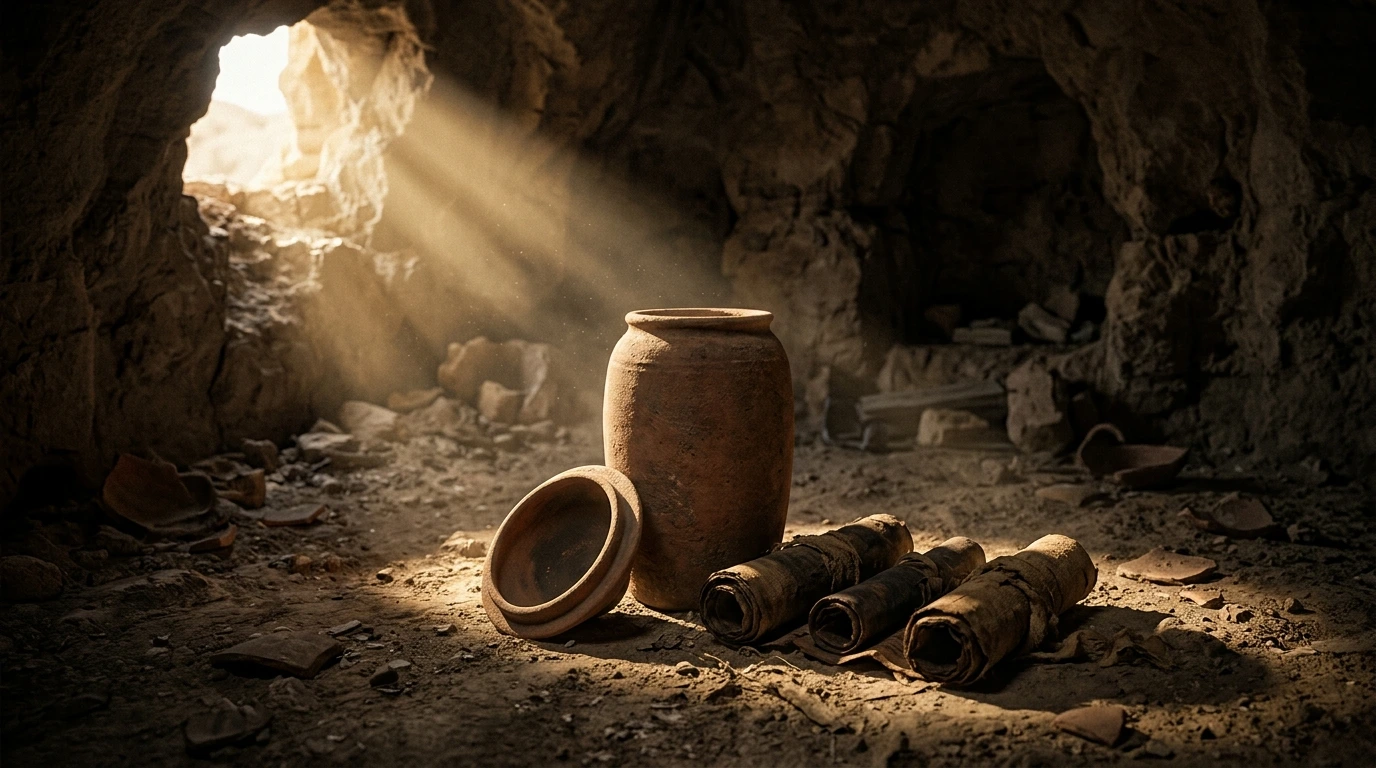
On March 20, 1952, during a systematic expedition conducted by the American Schools of Oriental Research (ASOR) and the École Biblique et Archéologique Française, archaeologists discovered Cave 3 at Qumran.
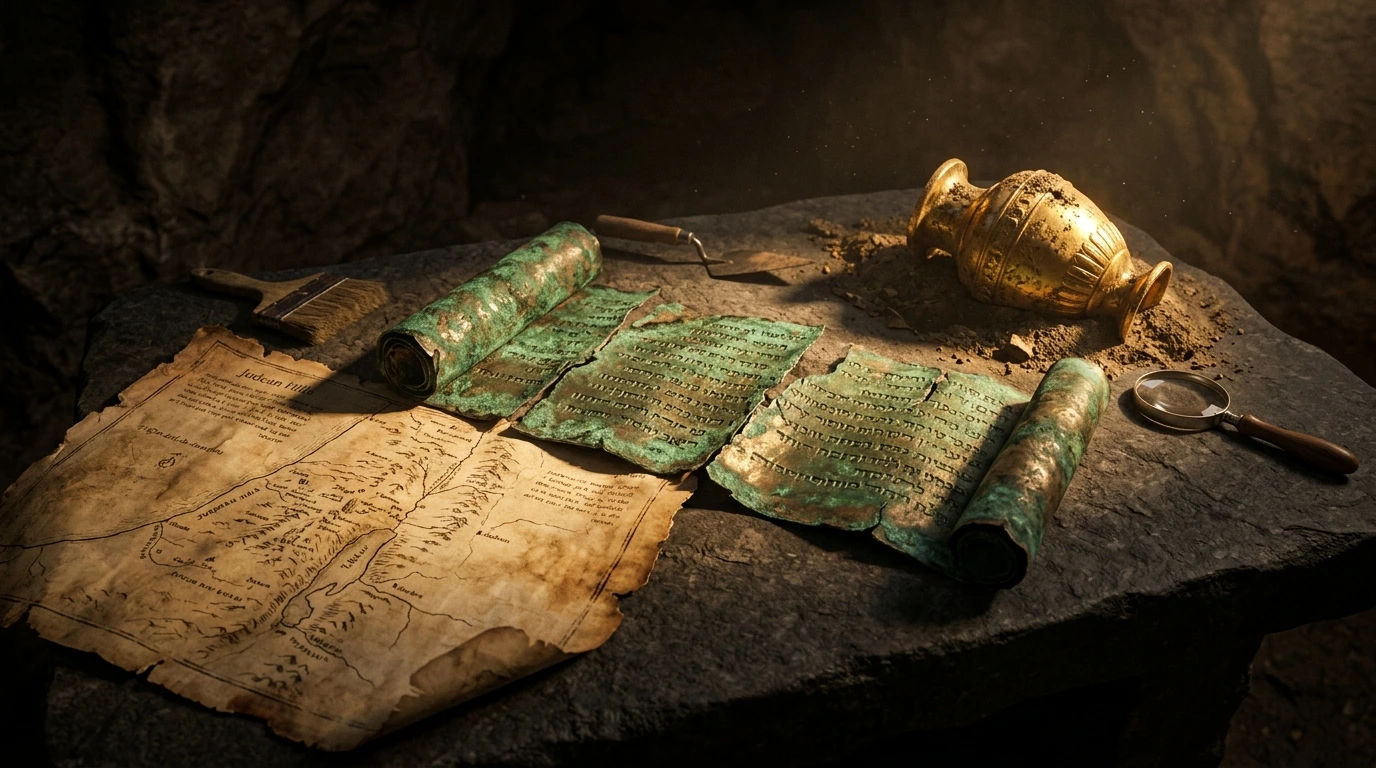
Resting on a natural rock shelf deep within the cave lay two heavily oxidized, greenish cylinders of rolled sheet metal: The Copper Scroll (designated 3Q15).
Physical Metallurgy
Unlike the parchment and papyrus manuscripts that constitute 99% of the Dead Sea library, 3Q15 was hammered from 99% pure refined copper, with approximately 1% tin alloy:
- Dimensions: When unrolled, the original sheet measured approximately 2.4 meters long by 30 cm wide, riveted together in three continuous plates.
- Scribal Inscription: The text was not painted with ink; it was chiseled directly into the cold metal using a hard steel or bronze punch, creating embossed characters readable from the reverse.
- Corrosion Challenge: Over twenty centuries in the humid desert air near the Dead Sea, the copper completely converted into brittle copper carbonate (malachite). Unrolling it physically was impossible without turning the metal into powder.
In 1955–1956, Professor H. Wright Baker at the Manchester College of Technology designed a microscopic circular saw spindle that delicately sliced the two cylinders into 23 curved convex strips, preserving every single line of engraved script.
Linguistic Analysis: The Dawn of Mishnaic Hebrew
The language of 3Q15 is a sensational anomaly in the Qumran corpus.
While biblical scrolls use Classical Biblical Hebrew and sectarian rules use Late Biblical Hebrew, 3Q15 is written in colloquial Proto-Mishnaic Hebrew—the spoken vernacular of 1st-century AD Judea:
[SAMPLE COMPARATIVE LINGUISTIC ANALYSIS: ITEM 1 (COLUMN 1:1–4)]
Transliterated Hebrew:
"Ba-charobah she-be-Emek Achor tachat ha-ma'alot ha-ba'ot lemizrach:
kikarin arba'im we-achat shel kesef."

English Translation:
"In the ruined fortress in the Valley of Achor, beneath the steps leading
eastward: forty-one talents of silver."
Key linguistic features include:
- Frequent use of the relative particle she- (-שֶׁ) instead of the classical asher (אֲשֶׁר).
- Orthographic variations and spelling anomalies reflecting colloquial phonetic pronunciation.
- Specific architectural loanwords describing cisterns (bor), aqueducts (mazmerah), subterranean vaults (sitra), and colonnades (peristylion).
The 64 Inventory Locations: Temple Treasury vs. Sectarian Wealth
The scroll contains a cold, unembellished ledger of 64 separate hiding places scattered across Jerusalem, the Judean wilderness, Jericho, and the Jordan Valley.
Total Recorded Wealth
The cumulative quantities of consecrated wealth specified in the text are staggering:
- Gold and Silver Talents: Approximately 4,630 talents of silver and gold bullion.
- Vessels and Vestments: Hundreds of consecrated jugs (amphoras), priestly vestments, and silver libation bowls filled with tithes (ma'aser sheni).
- Modern Weight Equivalent: Scholars calculate that 4,630 ancient talents equal between 50 and 65 metric tons of precious metal, worth billions of dollars today.
+-----------------------------------------------------------------+
| SELECTED TREASURE LOCATIONS IN 3Q15                             |
+-----------------------------------------------------------------+
| Item 1: Valley of Achor (Hyrcania fortress) - 41 talents silver  |
| Item 11: Under the steps of the Solomon's Pool - 70 talents      |
| Item 25: In the tomb of Zadok under the peristyle - vessels     |
| Item 32: In the subterranean aqueduct of Mount Gerizim - 70 tal |
| Item 64: In the Pit of the Dry Well at Kohlit - a duplicate copy|
|          of this inscription with explanations and keys!        |
+-----------------------------------------------------------------+
Historical Consensus: The Jerusalem Temple Treasury
Early scholar Father Józef Milik claimed the scroll was a piece of ancient folklore or Essene fantasy. However, modern historical consensus (championed by P. Kyle McCarter, Al Wolters, and David Wilmot) affirms that 3Q15 represents the authentic emergency inventory of the Second Temple Treasury, evacuated and concealed by Temple authorities between 66 and 68 AD as the Roman Tenth Legion marched toward Jerusalem.
The Cryptic Greek Letter Diglyphs: Secret Scribal Codes
At the end of several inventory entries, the scribe mysteriously stamped two or three isolated Greek capital letters:
- Column 1, Line 4: ΚΕΝ (KEN)
- Column 1, Line 8: ΧΑΓ (CHAG)
- Column 1, Line 12: ΗΝ (HN)
- Column 2, Line 2: ΘΕ (THE)
- Column 2, Line 9: ΔΙ (DI)
- Column 3, Line 2: ΤΡ (TR)
- Column 3, Line 9: ΣΚ (SK)
Scholars have proposed multiple forensic decryptions:
- Initials of Priestly Custodians: Greek acronyms indicating which Levitical family or Temple official deposited that specific cache.
- Topographical Triangulation Markers: Cryptic directional bearings cross-referenced with a master map or key.
- Canceled / Retrieved Deposits: Cryptic accounting checkmarks indicating that certain caches were retrieved or verified before the final collapse of Jerusalem in 70 AD.
Three-Tier Evidentiary Evaluation: Archaeological Reality
| Evidentiary Tier | Artifactual & Material Data | Historical & Textual Reality |
|---|---|---|
| Tier 1: Physical Material | 3Q15 pure hammered copper sheets, cut into 23 segments; on display at Amman Museum. | Proves that monumental, permanent records were deliberately inscribed on metal to survive fire and war. |
| Tier 2: Linguistic Milieu | Colloquial Mishnaic Hebrew dialect contemporary with the Bar Kokhba letters (132 AD). | Anchors the scroll directly to the 1st century AD, refuting theories of medieval or mythical fabrication. |
| Tier 3: Historical Match | Concealment in Cave 3 coincides with the Roman siege of Judea during the First Jewish Revolt (66–70 AD). | Confirms that Jerusalem Temple authorities utilized Qumran's desert topography to bury national treasures. |
Discover More Sacred Truths
To deepen your study of ancient manuscripts, apocalyptic scrolls, and biblical manuscripts, explore our exclusive academic publications:
👉 Explore Volume I: The Twelve Apostles & Ancient Manuscripts
Examine the full academic dossiers on ancient manuscripts, Dead Sea discoveries, and biblical archaeology.
🎁 Or Unlock The Sacred Keys Trilogy Master Collection ($7.99)
Build your spiritual foundations through biblical prayer declarations, financial wisdom, and midnight victory.
Frequently Asked Questions
Has any of the treasure described in the Copper Scroll ever been found?
No documented hoard has been authenticated. Over the centuries, ancient looters, Roman legionaries under Titus, Bedouin, and treasure hunters searched the Judean wilderness. Many scholars believe the Roman army tortured captured Jewish priests (as recorded by Josephus) to extract the locations of the hidden Temple funds, which were subsequently used to finance the construction of the Colosseum in Rome.
Where is the physical Copper Scroll located today?
The original 23 sliced copper segments of 3Q15 are permanently housed and displayed in the Jordan Museum in Amman, Jordan, having remained in Jordanian custody following the partition of antiquities after the 1948–1967 period.
What is the final item (Item 64) in the scroll?
Item 64 is the most tantalizing passage in ancient epigraphy: "In the pit adjoining on the north, in a hole opening northward, and buried at its entrance: a copy of this very document, with explanations and their measurements, and an inventory of each and every thing." This master key has never been discovered.
Frequently Asked Questions
Has any of the treasure described in the Copper Scroll ever been found?
No official cache has been recovered. Historians believe Roman forces under Titus or ancient plunderers located many of the caches shortly after the fall of Jerusalem in 70 AD.
Where is the physical Copper Scroll located today?
All 23 conserved copper strips of 3Q15 are preserved and exhibited at The Jordan Museum in Amman, Jordan.
What is the final item (Item 64) in the scroll?
Item 64 describes a duplicate bronze or copper manuscript hidden in a dry pit at Kohlit containing the complete explanatory key and exact measurements, which remains lost.
Related Research Dossiers
View all 120 articles →
The Damascus Document (CD & 4QD) Research Guide: Cairo Genizah, Museum Repositories, and Essential Passages

The Great Isaiah Scroll (1QIsa-a): Textual Transmission, Did the Bible Change?, and Isaiah 53