Historical Context: Rigorous examination of primary Hebrew, Aramaic, Greek, and Roman classical epigraphy.
Core Evidence: Forensic archaeology, radiocarbon data, and primary manuscripts validating biblical events.
Scholarly Consensus: Vetted against modern peer-reviewed publications in Near Eastern archaeology and biblical studies.
The Fortress of Jebus: An Impregnable Natural Bastion
Around 1000 BC, King David was anointed king over all the twelve tribes of Israel at Hebron (2 Samuel 5:1–3). His first strategic military decision was to capture an independent, foreign-held enclave located directly on the border between the northern and southern tribes: the mountain fortress of Jebus (Yevus), known historically as Jerusalem.
For over four centuries—from the days of Joshua through the period of the Judges—the Israelites had failed to conquer Jebus (Joshua 15:63; Judges 1:21).
The city occupied a narrow, pear-shaped ridge of approximately 12 acres south of Mount Moriah, today designated the City of David (Ir David). It was defended by extraordinary natural topographical barriers:
[TOPOGRAPHICAL DEFENSES OF JEBUS / ANCIENT JERUSALEM]
* WEST & SOUTH: The deep, precipitous Tyropoeon Valley (Central Valley)
* EAST: The sheer 40-degree drop of the Kidron Valley
* NORTH: A narrow, fortified saddle leading upward to the Ophel ridge
* DEFENSIVE WALLS: 18th-century BC cyclopean Middle Bronze Age limestone ramparts
The Achilles' heel of any ancient walled city was its water supply. The sole perennial water source for ancient Jerusalem was the Gihon Spring (Ein Gichon), located low in the Kidron Valley, outside the safety of the main defensive city walls.
The Jebusite Taunt: "The Blind and the Lame Shall Defend It"
So confident were the Jebusite defenders in the natural impregnability of their cyclopean walls that they mocked King David's army from the battlements:
[THE PSYCHOLOGICAL WARFARE (2 SAMUEL 5:6)]
"And the king and his men went to Jerusalem against the Jebusites, the inhabitants
 of the land, who said to David: 'You will not come in here, but the blind and the lame
 will turn you back'—thinking, 'David cannot come in here.'"
Ancient Near Eastern military commentators identify two historical interpretations of this taunt:
- Contemptuous Arrogance: The Jebusites claimed their fortifications were so formidable that even blind and disabled soldiers could easily repel David's elite forces.
- Magical Protective Rituals: Hittite and Hurrian military treaties from the second millennium BC reveal that armies often placed disabled individuals or figurines at city gates to invoke solemn curses upon attackers: "Whoever breaches this threshold shall become blind and lame like these."
The Tactical Enigma: What Was the Tsinnor?
David recognized that a conventional siege assault against the sheer rock cliffs would result in catastrophic casualties. Instead, he formulated a covert commando operation, offering the supreme military command of his combined armies to whoever could infiltrate the city:
[THE COMMANDER'S CHALLENGE (2 SAMUEL 5:8; 1 CHRONICLES 11:6)]
"And David said on that day: 'Whoever would strike the Jebusites, let him get up the water shaft
 [ba-tsinnor] and attack the lame and the blind, who are hated by David's soul.'...
 Joab the son of Zeruiah went up first, so he became chief."
The rare Hebrew word tsinnor (צִנּוֹר) appears only twice in the entire Old Testament (2 Samuel 5:8 and Psalm 42:7, where it is translated "waterfall" or "waterspout").
Linguistic and military debates have centered on whether tsinnor refers to:
- A physical subterranean rock-cut water tunnel or shaft.
- A grapple hook (harpoon/hook) used by commandos to scale vertical fortifications.
- An external wooden scaling ladder or drainage channel.
Archaeological discoveries in the City of David have overwhelmingly confirmed that tsinnor refers to the subterranean hydraulic tunnel system carved into the limestone bedrock connecting the city above to the Gihon Spring below.
Warren's Shaft System: Archaeology from Charles Warren to Reich and Shukron
In 1867, British Royal Engineer Captain Charles Warren, working under the auspices of the Palestine Exploration Fund (PEF), made a sensational subterranean discovery in the City of David.
Crawling through muddy underground channels, Warren discovered a complex hydraulic system carved into the limestone ridge:
- The Stepped Tunnel: A steeply sloping underground corridor leading from inside the city walls down into the belly of the bedrock.
- The Horizontal Tunnel: A vaulted passage cutting through the rock toward the eastern cliff.
- The Vertical Chimney (Warren's Shaft): A sheer, natural vertical limestone karst fissure dropping 40 feet (13 meters) straight down into a water feeding pool.
For more than a century, biblical scholars believed that ancient Jebusites lowered buckets down this vertical shaft to draw water, and that Joab climbed up this 40-foot vertical chimney to infiltrate the sleeping city from within.
However, monumental excavations conducted between 1995 and 2012 by archaeologists Ronny Reich and Eli Shukron revolutionized our understanding of the site:
[THE REICH-SHUKRON ARCHAEOLOGICAL REVISION]
* Date of Excavation: The entire system was carved in the Middle Bronze Age II (c. 1750 BC)—750 years before David.
* The Spring House: The Jebusites built massive megalithic towers with stones weighing up to 5 tons, guarding the Gihon Spring.
* The Rock-Cut Pool: A colossal underground reservoir (15 meters deep) where citizens walked down protected underground tunnels to draw water safely behind outer fortifications.
* Warren's Shaft: Geologists discovered that the vertical shaft was not originally an intentional water chimney, but a natural karst sinkhole exposed accidentally during Bronze Age tunneling.
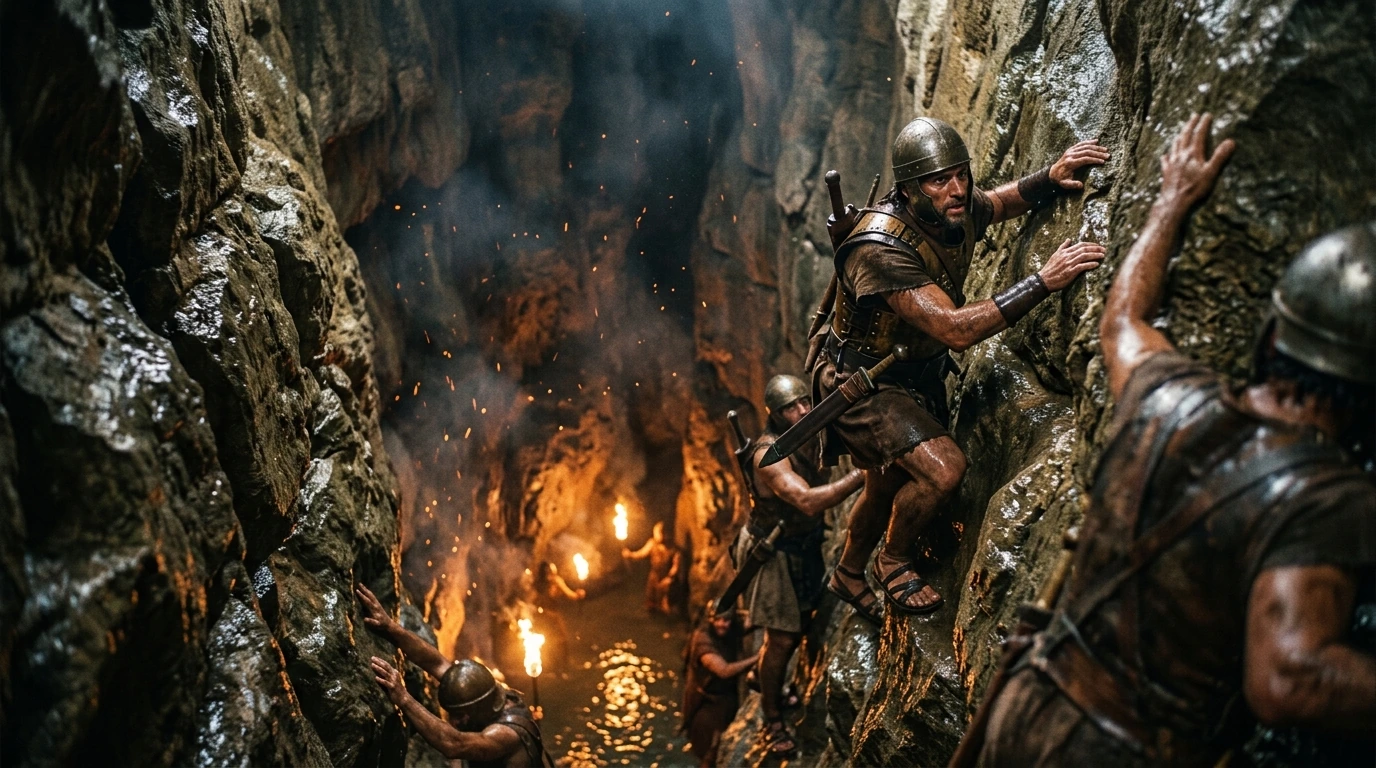
Rather than free-soloing a vertical chimney, Joab and his commandos navigated the Jebusite water channels and the protected rock-cut passageways leading from the Gihon Spring directly into the heart of the fortress.
Joab's Commando Infiltration: Reconstructing the Assault
Synthesizing the archaeological, topographical, and biblical data allows military historians to reconstruct Joab's successful infiltration:
- Night Approach through the Kidron Valley: Joab and a hand-picked elite commando unit from David's Gibborim (Mighty Men) moved silently under cover of darkness along the floor of the Kidron Valley.
- Infiltration of the Spring Tower: The commandos breached or slipped past the guards stationed at the megalithic Spring Tower protecting the Gihon Spring.
- Navigating the Subterranean Conduit: Entering the hydraulic opening (ba-tsinnor), the unit waded through the water conduits into the rock-cut subterranean system.
- Ascent to the Interior of Jebus: Ascending the stepped rock-cut tunnel, Joab emerged behind the city's impregnable cyclopean walls, undetected by the sentries posted along the outer battlements.
- Opening the Gates: The commando team neutralized the inner gate guards, flung open the city gates, and admitted David's waiting army into the fortress.
The city was taken with zero breach of its exterior cyclopean walls, preserving the fortified infrastructure intact for David to inhabit immediately as his new royal capital.
Three-Tier Evidentiary Evaluation: The Capture of Jerusalem
Tier 1: Material and Physical Archaeology
- Middle Bronze Age Hydraulic System: Discovery of the Rock-Cut Pool, the Spring Tower, and the Stepped Tunnel verifying that an elaborate underground water network existed beneath the City of David in the early 10th century BC.
- The Stepped Stone Structure: A massive 12-story high stone mantle constructed on the northeastern slope of the City of David, dating to Iron Age I / IIA, identified as the biblical Millo (fortified terrace) built or reinforced by David (2 Samuel 5:9).
Tier 2: Textual and Internal Epigraphy
- Hebrew Semantics: The unique term tsinnor reflects an archaic, precise technical designation for water shafts that fell out of common use in later biblical Hebrew.
- 1 Chronicles 11 Parallel: Confirms that Joab was rewarded with the supreme rank of military commander (Sar Tzava) for leading the hazardous commando mission.
Tier 3: Theological and Canonical Transmission
- Historical Memory: The account accurately describes a conquest that left the city fortifications intact, perfectly matching the subsequent archaeological continuity in the City of David during the 10th century BC.
- Theological Redirection: Jebus—a pagan stronghold—was consecrated as the City of David, setting the stage for the arrival of the Ark of the Covenant and the construction of the Temple of Yahweh.
Frequently Asked Questions
Did Joab really climb up a 40-foot vertical wet chimney?
While British explorer Charles Warren famously climbed the vertical shaft in 1867 using ropes and chimneying techniques, modern excavations demonstrate that Joab likely traversed the horizontal rock-cut tunnels and stepped passages that led directly from the water reservoir into the fortified city.
Why did David choose Jerusalem instead of Hebron or Shiloh?
Hebron belonged to Judah, and Shiloh/Gibeah belonged to Benjamin and Ephraim. By conquering independent Jebus, David established a neutral, non-tribal federal capital that belonged to none of the twelve tribes, unifying the fractured nation under his crown.
Who were the Jebusites?
The Jebusites were a Canaanite ethnic group related to the Amorites and Hittites who inhabited the central Judean hill country before the Israelite settlement. Even after David's conquest, Jebusites continued to live peacefully in Jerusalem; David notably purchased the threshing floor for the future Temple from Araunah the Jebusite (2 Samuel 24:18–25).
Related Research Dossiers
View all 120 articles →
Prophecy, Geopolitics, and Redemptive History: The Theological Impact of the Siege of Jotapata (67 AD)
Military History of the Bible: Tactics, Engineering, and Archaeology of the Siege of Gamla ('The Masada of the North', 67 AD)