Historical Context: Rigorous examination of primary Hebrew, Aramaic, Greek, and Roman classical epigraphy.
Core Evidence: Forensic archaeology, radiocarbon data, and primary manuscripts validating biblical events.
Scholarly Consensus: Vetted against modern peer-reviewed publications in Near Eastern archaeology and biblical studies.
The Trek Through the Valley of Death: The Arabah Depression
In the final year of the forty-year wilderness wanderings, the congregation of Israel made a grueling detour. Barred by the King of Edom from traversing the well-watered, fortified King’s Highway on the Transjordanian plateau (Numbers 20:14–21), the Israelites were forced to turn southward toward the Gulf of Aqaba and descend into the brutal, suffocating canyon of the Wadi Arabah:
"And they journeyed from mount Hor by the way of the Red sea, to compass the land of Edom: and the soul of the people was much discouraged because of the way. And the people spake against God, and against Moses, 'Wherefore have ye brought us up out of Egypt to die in the wilderness? for there is no bread, neither is there any water; and our soul loatheth this light bread.' And the Lord sent fiery serpents among the people, and they bit the people; and much people of Israel died." (Numbers 21:4–6)
The Wadi Arabah is a deep tectonic rift valley extending 166 kilometers from the southern shore of the Dead Sea down to the Gulf of Aqaba. It is a hyper-arid furnace of jagged red granite canyons, shifting sand dunes, and scorched gravel plains where temperatures routinely surpass 48°C (118°F).
Desperate for survival, the dying Hebrews pled with Moses to intercede. The divine prescription that followed is one of the most enigmatic medical and religious symbols in human history:
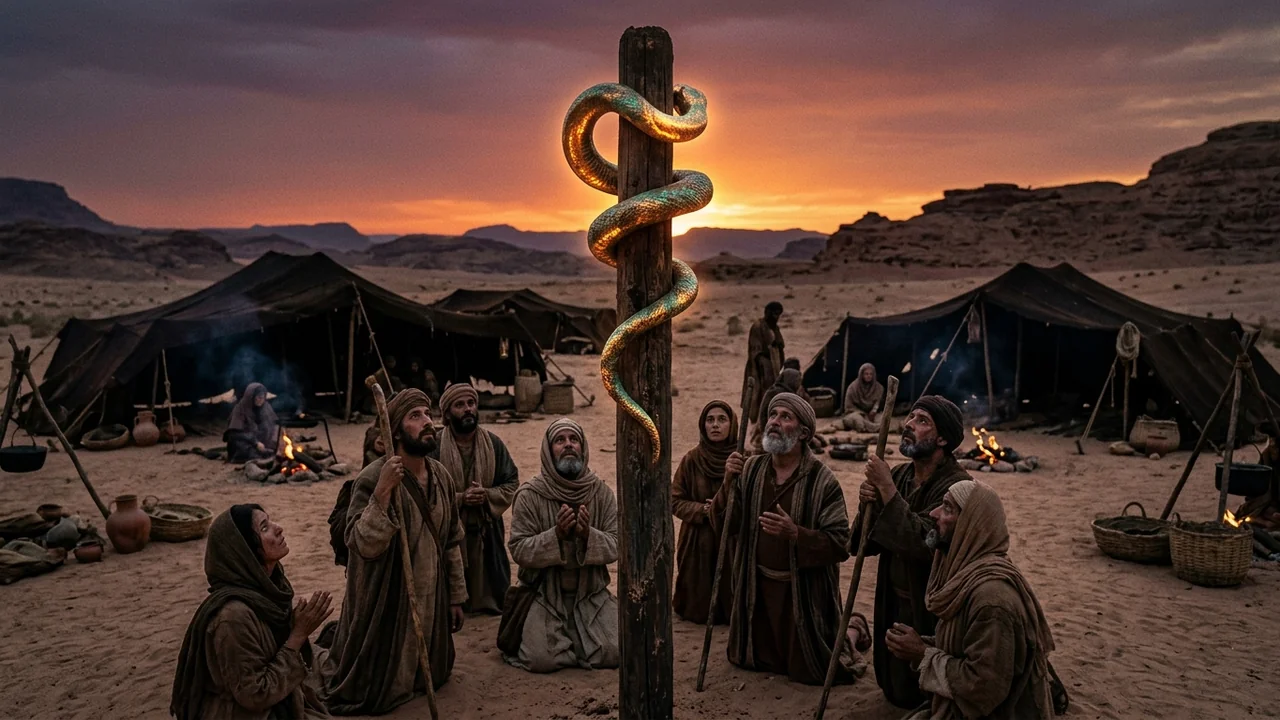
"And the Lord said unto Moses, 'Make thee a fiery serpent, and set it upon a pole: and it shall come to pass, that every one that is bitten, when he looketh upon it, shall live.' And Moses made a serpent of brass, and put it upon a pole, and it came to pass, that if a serpent had bitten any man, when he beheld the serpent of brass, he lived." (Numbers 21:8–9)
Through modern clinical toxicology, herpetology, and Near Eastern archaeology, we can reconstruct the exact species, the horrific biological pathology of the venom, and the extraordinary archaeological context of the bronze serpent.
Zoological Profile: The Saw-Scaled Viper (Echis coloratus)
The biblical Hebrew phrase used in Numbers 21:6 is ha-nehashim ha-seraphim (הַנְּחָשִׁים הַשְּׂרָפִים), literally "the burning/fiery serpents".
Herpetologists and field biologists working in the Sinai Peninsula and the Arabah Valley have identified the lethal predator responsible for this epidemic: the Burton’s carpet viper or saw-scaled viper (Echis coloratus), alongside its close relative Cerastes cerastes (the horned desert viper).
   Kingdom: Animalia
     └── Phylum: Chordata
           └── Suborder: Serpentes
                 └── Family: Viperidae
                       └── Genus: Echis
                             └── Species: Echis coloratus (Burton's Carpet Viper)
Behavioral Ecology in the Arabah Desert
- Camouflage and Concealment: Echis coloratus is masterfully camouflaged in shades of reddish-brown, grey, and pinkish-yellow with pale dorsal blotches that blend seamlessly with the granite, basalt, and Nubian sandstone rubble of the Arabah.
- Sidewinding Ambush Predator: Unlike heavy cobras that retreat, the saw-scaled viper is notoriously aggressive and easily agitated. When disturbed, it rubs its specialized, serrated lateral scales together, producing a terrifying, loud, rasping hiss like water boiling on hot stones.
- Nocturnal Desert Migration: In the searing heat of the Arabah, these vipers bury themselves beneath thin layers of sand or shelter under low acacia bushes and flat desert rocks. When hundreds of thousands of people marched, pitched tents, gathered scrub timber, and laid down their bedrolls in the twilight, they inadvertently disturbed thousands of resting, highly territorial vipers!
Clinical Toxicology: Why the Serpents Were Called "Fiery"
Why does the biblical text designate these creatures as seraphim ("fiery" or "burning")?
In the ancient world, names were derived from observable physical phenomena. While some commentators point to the reddish, fiery coloration of Echis coloratus, modern clinical venom pharmacology reveals that the term describes the excruciating, catastrophic physiological pathology inflicted by the venom inside the human body:
[Echis coloratus Bite & Subcutaneous Envenomation]
                      │
                      ▼
[Injection of Ecarin & Prothrombin Activators + Metalloproteinases]
                      │
                      ▼
[Acute Disseminated Intravascular Coagulation (DIC)]
   ├── Widespread, chaotic micro-thrombi formation throughout vascular beds
   └── Total consumption of fibrinogen, platelets, and clotting factors
                      │
                      ▼
[Catastrophic Systemic Coagulopathy & Capillary Permeability]
   ├── Agonizing, burning neuropathic pain radiating through bitten limb
   ├── Massive, black inflammatory tissue necrosis and blistering edema
   └── Spontaneous bleeding from mucous membranes, mouth, eyes, gastrointestinal tract
                      │
                      ▼
[Hypovolemic Shock, Renal Failure & Death Within 12 to 72 Hours]
The Three Lethal Toxins of Echis coloratus
- Ecarin (Prothrombin Activator): Unlike simple neurotoxins that paralyze the diaphragm, Echis venom contains ecarin, a potent zinc metalloproteinase that catalytically converts prothrombin into thrombin, triggering chaotic, body-wide clotting (Disseminated Intravascular Coagulation - DIC). Within minutes, the victim's clotting proteins are completely exhausted. The blood loses all capacity to coagulate, turning into a thin, uncoagulable fluid.
- Hemorrhagins (Vascular Endothelial Destruction): The venom dissolves the basement membranes of capillary walls throughout the entire circulatory system. Victims experience spontaneous bleeding from the gums, nose, eyes, stomach, and kidneys (hematuria), bleeding uncontrollably into their own internal cavities.
- Cytotoxins and Phospholipase $A_2$ (Fiery Local Necrosis): At the bite site, powerful digestive enzymes destroy cellular membranes, causing acute swelling, massive hemorrhagic blisters, and severe black tissue necrosis. The intense inflammatory cascade triggers agonizing, scalding neuropathic pain—a literal sensation of liquid fire coursing through the veins!
Without modern antivenom therapy, victims suffer an agonizing death characterized by unquenchable thirst, fever, systemic hemorrhaging, acute renal failure, and vascular collapse over 24 to 72 hours.
Timna and the Metallurgy of the Bronze Serpent (Nehash Nehoshet)
When Moses was commanded to fashion a serpent of bronze/copper (nehash nehoshet, נְחַשׁ נְחֹשֶׁת) and elevate it on a wooden staff in the center of the camp (Numbers 21:9), where did the metallurgical technology and raw material originate?
The geographic location provides the stunning answer: The Valley of Timna and Faynan.
[Gulf of Aqaba / Red Sea]
          ▲
          │  Wadi Arabah Rift Corridor
          ▼
[Timna Valley Copper Smelting Complex]
   ├── World's oldest industrial copper mines (Late Bronze / Early Iron Age)
   ├── Active Midianite, Kenite, and Egyptian mining expeditions
   └── Discovery of the authentic Midianite "Gilded Copper Snake" in 1969
The Timna Copper Mines
The Wadi Arabah contains the richest and oldest copper ore deposits in the entire Levant:
- Timna (Israel) and Faynan / Punon (Jordan) were operating as colossal industrial copper-mining and smelting centers during the Late Bronze and Early Iron Ages.
- In fact, Numbers 33:42–43 lists Punon (modern Faynan) as the very next campsite of Israel during this exact desert journey!
- Moses had spent forty years in Midian married to Zipporah, the daughter of a Midianite/Kenite priest-metallurgist (Jethro). The Kenites (Qenim, meaning "coppersmiths") were the master metallurgical guild of the ancient desert!
The Beno Rothenberg Discovery: The Timna Copper Serpent
In 1969, world-renowned Israeli archaeologist Prof. Beno Rothenberg was excavating the Hathor mining sanctuary in the Timna Valley. His team made an extraordinary discovery:
- In the Late Bronze II stratum (13th–12th century BC), when Egyptian mining control collapsed, local Midianite nomads took over the shrine, erecting a tent sanctuary (a precursor to the Tabernacle!).
- Inside the most sacred precinct (Holy of Holies), lying beside the stone altar, Rothenberg unearthed a 5-inch (12.7 cm) cast copper serpent, partially gilded with gold leaf around its neck and head!
- Rothenberg published the artifact as definitive archaeological evidence that ancient desert populations living in the Arabah during the biblical Exodus era manufactured copper votive serpents as instruments of apotropaic ritual healing and divine mediation!
Moses was casting an object using the indigenous metal of the very valley through which they were marching—copper extracted from the sandstone reefs of the Arabah!
Comparative Toxicology of Desert Vipers in the Sinai & Arabah
| Scientific Name | Common Name | Primary Habitat in Levant | Venom Classification | Lethality Mechanisms | Clinical Symptoms in Envenomated Victims |
|---|---|---|---|---|---|
| Echis coloratus | Burton's Carpet Viper / Saw-Scaled Viper | Rocky hills, granite canyons, dry wadis of Arabah & Sinai | Potent Hemotoxic & Procoagulant | Ingestion of Ecarin; systemic DIC; massive internal hemorrhaging | Scalding "fiery" pain; rapid tissue necrosis; bleeding from gums/eyes; vascular collapse. |
| Cerastes cerastes | Saharan Horned Desert Viper | Fine sand dunes, loose sandy wadis across northern Sinai | Hemotoxic & Cytotoxic | Phospholipase $A_2$; disruption of cellular integrity and platelets | Severe local edema; blistering; extensive ecchymosis (bruising); secondary infection. |
| Pseudocerastes fieldi | Field's Horned Viper | Shrubby desert steppes, limestone plateaus of Negev/Jordan | Mixed Neurotoxic & Myotoxic | Presynaptic neurotoxins blocking acetylcholine release | Flaccid muscular paralysis; respiratory compromise; localized pain without severe necrosis. |
| Walterinnesia aegyptia | Desert Black Cobra | Arid scrublands, rocky ravines, cultivated desert fringes | Potent Post-Synaptic Neurotoxic | Postsynaptic block of nicotinic receptors at neuromuscular junction | Ptosis (drooping eyelids); paralysis of pharyngeal muscles; asphyxiation by diaphragm arrest. |
| Atractaspis engaddensis | Ein Gedi Burrowing Asp / Stiletto Snake | Subterranean fissures, desert oases near Dead Sea & Arabah | Cardiotoxic (Sarafotoxins) | Endothelin-like peptides causing severe coronary vasospasm | Sudden crushing cardiac ischemia; severe bradycardia; atrioventricular block; rapid death. |
From Healing Sign to Idolatrous Relic: The Fate of Nehushtan
The bronze serpent crafted by Moses in Numbers 21 did not disappear after the plague subsided. According to biblical and archaeological records, it was preserved as a sacred heirloom for over five hundred years, journeying with the Tabernacle into Canaan and eventually finding a home inside the Temple of Solomon in Jerusalem.
However, over centuries of spiritual decay, the healing sign devolved into an object of pagan worship:
"He [King Hezekiah] removed the high places, and brake the images, and cut down the groves, and brake in pieces the brasen serpent that Moses had made: for unto those days the children of Israel did burn incense to it: and he called it Nehushtan." (2 Kings 18:4)
By the late 8th century BC (c. 715 BC), the people of Judah had transformed the artifact into a magical serpent deity, offering incense (qittur) to it in direct violation of the Second Commandment. King Hezekiah demonstrated ruthless spiritual clarity: he pulverized the ancient sacred relic into powder, naming it Nehushtan (נְחֻשְׁתָּן)—a derisive wordplay meaning "a mere piece of copper/brass!"
This historic transition provides profound insight: God uses material objects as temporary vehicles of His saving power, but when fallen humanity begins to venerate the instrument rather than the Living Creator, the holy instrument becomes an abomination that must be crushed into dust.
Medical Symbolism and the Johannine Typology (John 3:14)
The bronze serpent on the pole reverberates across two fundamental pillars of world history: modern medicine and Christian soteriology.
The Rod of Asclepius vs. The Caduceus
For centuries, medical historians have debated the origin of the universal symbol of the medical profession: a single snake entwined around a rough wooden staff—the Rod of Asclepius:
- While classical history attributes the symbol to the Greek god of medicine (Asclepius), Near Eastern scholars trace its iconographic genesis back to the ancient Levantine wilderness, where Moses elevated the copper serpent as an instrument of bodily restoration.
- Even the ancient extraction method for parasitic guinea worms (Dracunculus medinensis, the fiery serpent of the tropics)—which required winding the emerging worm slowly around a small wooden stick over weeks—shares profound visual and practical resonance with this motif.
The Typology of Christ in John 3:14
In the Gospel of John, Jesus Christ identifies the bronze serpent on the pole as the supreme Old Testament prophetic archetype of His own impending crucifixion:
"And as Moses lifted up the serpent in the wilderness, even so must the Son of man be lifted up: That whosoever believeth in him should not perish, but have eternal life." (John 3:14–15)
The theological paradox is breathtaking:
- The Serpent as the Source of Curse: Throughout Genesis and ancient symbolism, the serpent represents the curse, deception, sin, and death.
- Bearing the Form of the Curse: Moses did not erect a lamb or a dove; he erected the likeness of the very serpent that was killing them, yet made of inert, non-venomous bronze. In the exact same way, the Apostle Paul declares that God sent "his own Son in the likeness of sinful flesh" (Romans 8:3) and "made him to be sin for us, who knew no sin; that we might be made the righteousness of God in him" (2 Corinthians 5:21).
- The Look of Faith: The dying Hebrew lying in the sand with failing kidneys and coagulating blood did not need to run a marathon or purchase costly antidotes. He had only to lift his dying eyes and gaze upon the serpent raised upon the pole in absolute faith in the promise of God—and instantly, the lethal poison was neutralized!
The bronze serpent stands at the crossroads of clinical pathology, ancient copper smelting, and divine redemption: the very thing that brought death became, when judged and lifted high, the source of everlasting life.
Discover the Full Toxicology and Archaeological Dossiers
The plague of fiery serpents is one of dozens of ancient biblical engagements where modern clinical toxicology, desert herpetology, and ancient Near Eastern copper shrines converge. To explore complete toxicological venom spectra, excavation photos of Beno Rothenberg's Timna copper serpent, and historical maps of the Wadi Arabah:
👉 Discover Volume III: The Final Files – Biblical Disasters & Ancient Wonders ($2.99)
Features high-resolution photographs of the Timna Hathor shrine artifacts, clinical venom coagulation pathway charts, and historical analyses of biblical plagues.
Frequently Asked Questions
Why were the serpents in Numbers 21 called "fiery"?
The Hebrew word seraphim means "burning" or "fiery". While the saw-scaled viper (Echis coloratus) has a reddish-brown appearance, clinical toxicology shows the name describes the agonizing biological effect of the venom: it destroys capillary walls, triggers disseminated intravascular coagulation (DIC), and causes massive inflammatory blistering and necrosis that victims describe as a scalding fire coursing through their veins.
Has archaeology found any ancient copper serpents in the Sinai or Arabah?
Yes! In 1969, archaeologist Prof. Beno Rothenberg excavated the Late Bronze/Early Iron Age Hathor temple at the Timna copper mines in the Arabah. In the sacred precinct of a Midianite tent shrine dating to the 13th–12th century BC, he discovered a 5-inch cast copper serpent with a gilded gold-leaf head, confirming that desert populations in Moses’ exact era fashioned copper serpents as sacred healing symbols.
What is Nehushtan in the Bible?
Nehushtan is the derogatory name King Hezekiah gave to the bronze serpent of Moses when he destroyed it in 2 Kings 18:4. Over five centuries after the Exodus, the Israelites had turned the healing relic into an idolatrous cult object, burning incense to it. Hezekiah shattered it into pieces, declaring it was nothing more than Nehushtan ("a mere piece of copper/brass").
How does the bronze serpent connect to Jesus in the New Testament?
In John 3:14–15, Jesus explicitly states: "As Moses lifted up the serpent in the wilderness, even so must the Son of man be lifted up: That whosoever believeth in him should not perish, but have eternal life." Just as the dying Israelites were healed of lethal snake poison by simply looking in faith at the elevated bronze serpent, humanity is saved from the lethal poison of sin by looking in faith upon Christ lifted on the cross.
Frequently Asked Questions
Why were the serpents in Numbers 21 called "fiery"?
The Hebrew word seraphim means "burning" or "fiery". While the saw-scaled viper (Echis coloratus) has a reddish-brown appearance, clinical toxicology shows the name describes the agonizing biological effect of the venom: it destroys capillary walls, triggers disseminated intravascular coagulation (DIC), and causes massive inflammatory blistering and necrosis that victims describe as a scalding fire coursing through their veins.
Has archaeology found any ancient copper serpents in the Sinai or Arabah?
Yes! In 1969, archaeologist Prof. Beno Rothenberg excavated the Late Bronze/Early Iron Age Hathor temple at the Timna copper mines in the Arabah. In the sacred precinct of a Midianite tent shrine dating to the 13th–12th century BC, he discovered a 5-inch cast copper serpent with a gilded gold-leaf head, confirming that desert populations in Moses’ exact era fashioned copper serpents as sacred healing symbols.
What is Nehushtan in the Bible?
Nehushtan is the derogatory name King Hezekiah gave to the bronze serpent of Moses when he destroyed it in 2 Kings 18:4. Over five centuries after the Exodus, the Israelites had turned the healing relic into an idolatrous cult object, burning incense to it. Hezekiah shattered it into pieces, declaring it was nothing more than Nehushtan ("a mere piece of copper/brass").
How does the bronze serpent connect to Jesus in the New Testament?
In John 3:14–15, Jesus explicitly states: "As Moses lifted up the serpent in the wilderness, even so must the Son of man be lifted up: That whosoever believeth in him should not perish, but have eternal life." Just as the dying Israelites were healed of lethal snake poison by simply looking in faith at the elevated bronze serpent, humanity is saved from the lethal poison of sin by looking in faith upon Christ lifted on the cross.
Related Research Dossiers
View all 120 articles →
150 mph Ballistics: Why Goliath’s Bronze Helmet Was Useless Against David’s Sling
185,000 Assyrian Soldiers Wiped Out in One Night: The Pathology of Sennacherib's Siege Failure