Historical Context: Rigorous examination of primary Hebrew, Aramaic, Greek, and Roman classical epigraphy.
Core Evidence: Forensic archaeology, radiocarbon data, and primary manuscripts validating biblical events.
Scholarly Consensus: Vetted against modern peer-reviewed publications in Near Eastern archaeology and biblical studies.
The Impregnable Fortress: Babylon’s False Sense of Security
On the night of October 12, 539 BC, the city of Babylon felt invincible. For weeks, the combined military juggernaut of the Medo-Persian Empire, commanded by King Cyrus the Great and his veteran general Ugbaru (Gobryas), had laid siege to the colossal metropolis. Yet, behind its massive fortifications, the Babylonian high command indulged in drunken revelry.
Babylon's defensive architecture was legendary throughout antiquity:
- An outer wall system spanning 10 miles, reinforced with hundreds of defensive watchtowers.
- An inner double wall of baked bitumen bricks, with the outer parapet measuring 12 feet thick and the inner rampart measuring 21 feet thick—wide enough for two four-horse chariots to pass each other along the rampart boulevard.
- The mighty Euphrates River bisected the city, flowing directly beneath colossal bronze water-gates, providing an inexhaustible freshwater supply.
- The municipal granaries and royal storehouses held agricultural provisions sufficient to withstand a siege of twenty years (Xenophon, Cyropaedia VII.5.13).
To Crown Prince Belshazzar, coregent of the empire, the Persian armies camped in the desert outside were a laughable nuisance. In a display of supreme imperial arrogance and calculated psychological bravado, Belshazzar threw an enormous royal gala inside the Southern Palace acropolis for a thousand of his top military commanders, governors, wives, and concubines.
The Blasphemous Banquet: Desecration of the Temple Vessels
As the wine flowed freely through the banquet hall, Belshazzar’s arrogance crossed an irreversible cosmic boundary:
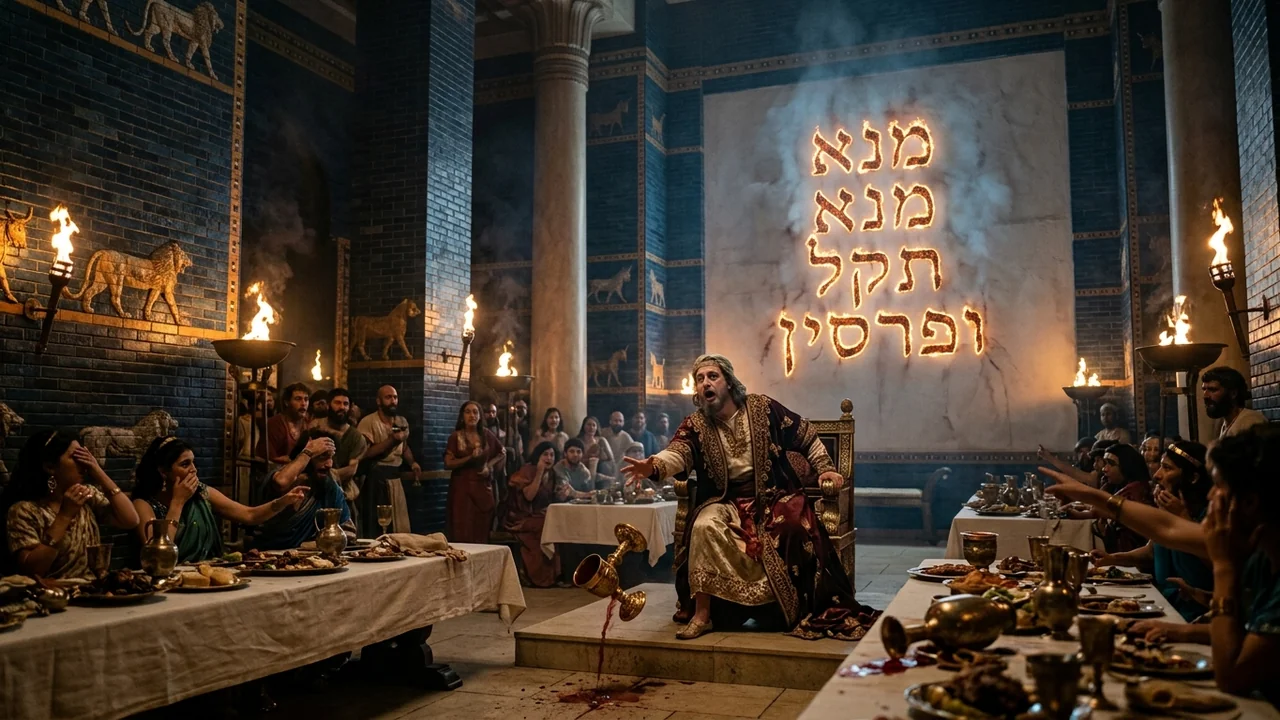
"Belshazzar, whiles he tasted the wine, commanded to bring the golden and silver vessels which his father Nebuchadnezzar had taken out of the temple which was in Jerusalem; that the king, and his princes, his wives, and his concubines, might drink therein. Then they brought the golden vessels that were taken out of the temple of the house of God which was at Jerusalem... They drank wine, and praised the gods of gold, and of silver, of brass, of iron, of wood, and of stone." (Daniel 5:2–4)
Sixty-six years earlier, Nebuchadnezzar had looted the sacred gold vessels dedicated to Yahweh from Solomon's Temple, placing them in the treasure-house of his god in Babylon (Daniel 1:2). Yet, even Nebuchadnezzar had treated the holy vessels with superstitious awe, keeping them secluded in temple vaults.
Belshazzar, however, reduced them to common party goblets. In a deliberate act of theatrical sacrilege, the court toasted the pagan idols of Babylon using the holy chalices consecrated to the Almighty.
The Supernatural Apparition: Mene, Mene, Tekel, Upharsin Decoded
The biblical chronicler records the terrifying climax with cinematic, clinical intensity:
"In the same hour came forth fingers of a man's hand, and wrote over against the candlestick upon the plaster of the wall of the king's palace: and the king saw the part of the hand that wrote. Then the king's countenance was changed, and his thoughts troubled him, so that the joints of his loins were loosed, and his knees smote one against another." (Daniel 5:5–6)
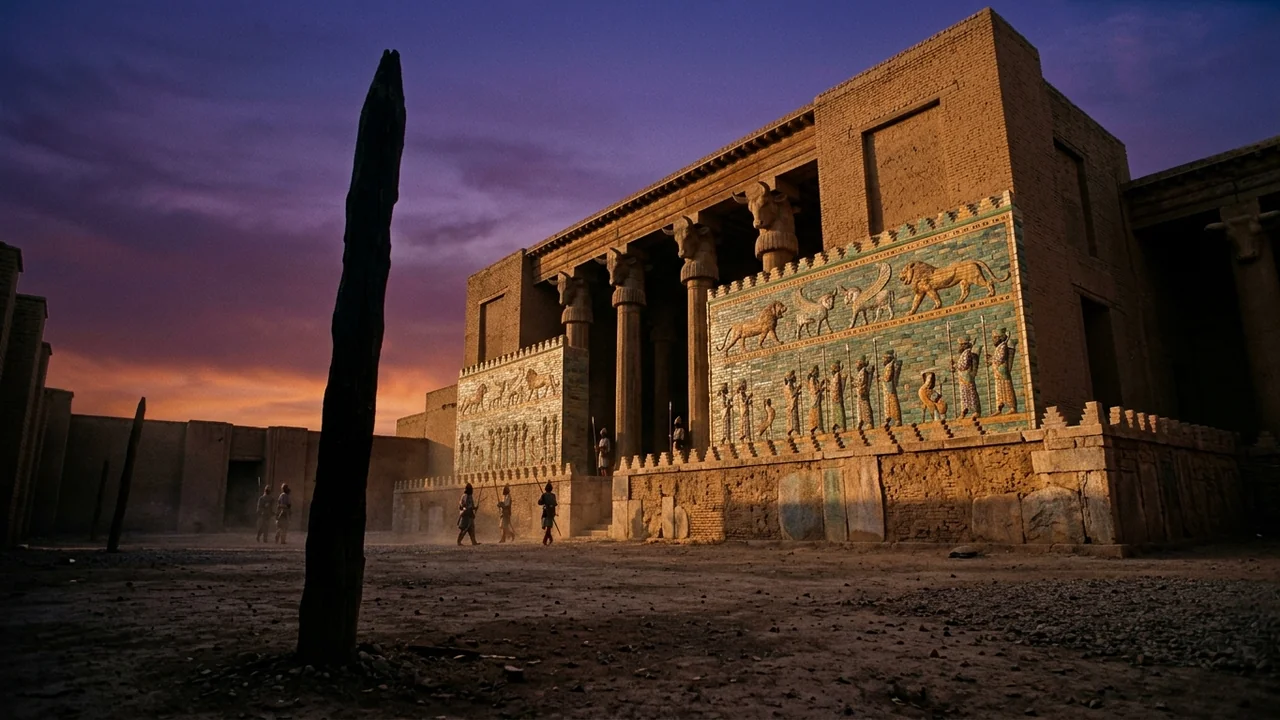
German excavations of the Southern Palace by Robert Koldewey uncovered this exact Great Throne Room—measuring an astonishing 56 meters long by 17 meters wide—featuring white lime-plastered walls where the supernatural hand appeared opposite the royal candelabra!
The physical manifestation of Belshazzar’s terror was visceral: acute neurogenic shock causing sudden loss of bladder control ("the joints of his loins were loosed") and violent shivering of the patellae.
When the astrologers and Chaldean sages could neither read nor interpret the glowing script, the Queen Mother (likely Nitocris, daughter of Nebuchadnezzar) entered the hall and recommended the aged prophet Daniel.
Standing before the terrified monarch, Daniel refused the king's bribes of purple robes and golden chains, delivering a blistering indictment of Belshazzar’s pride. He then deciphered the cryptic Aramaic inscription:
[The Aramaic Cryptogram on the Plaster Wall]
             מנא מנא תקל ופרסין
             M - N - E    M - N - E    T - K - L    P - R - S
The inscription consisted of ancient West Semitic weights and monetary units used as active passive participles:
- MENE (from menah, "to number" or a mina weight): "God hath numbered thy kingdom, and finished it."
- TEKEL (from theqal, "to weigh" or a shekel): "Thou art weighed in the balances, and art found wanting."
- PERES / UPHARSIN (from peras, "to divide" or a half-mina, playing on Paras, "Persia"): "Thy kingdom is divided, and given to the Medes and Persians."
Even as Daniel spoke, the military gears of Cyrus’s army were executing the most audacious commando infiltration in ancient warfare.
Archaeological Vindication: The Nabonidus Cylinder and Belshazzar’s Identity
For centuries, 19th-century higher critics cited Daniel 5 as proof that the Book of Daniel was a late Hellenistic forgery. Critics pointed out that classical Greek historians (Herodotus, Xenophon, Berossus) never mentioned a king named "Belshazzar." Instead, Greek history recorded that the last King of Babylon was Nabonidus, who was away from Babylon when the city fell.
The skeptics' argument collapsed completely in 1854, when British diplomat J.G. Taylor excavated the ruins of the ancient ziggurat of Ur in southern Iraq. Unearthing four foundation cuneiform cylinders inscribed by Nabonidus—now known as the Nabonidus Cylinders of Ur in the British Museum—scholars translated an explicit prayer by King Nabonidus for his eldest son:
"And as for Belshazzar, the eldest son—my offspring—instill within his heart reverence for your great godhead, and let him commit no sin; may he enjoy the fullness of life!"
Subsequent cuneiform discoveries, including the famous Persian Verse Account of Nabonidus, revealed that Nabonidus was an eccentric religious zealot who abandoned Babylon for ten years to live in the desert oasis of Teima in Arabia. Before leaving, the cuneiform text states:
"He entrusted the camp to his oldest son, the firstborn; the troops everywhere in the country he ordered under his command. He let everything go, entrusted the kingship to him, and he himself started on a long journey."
Archaeology established that:
- Belshazzar was indeed the ruling crown prince and coregent in Babylon!
- This explains why Belshazzar promised Daniel that he would be made "the third ruler in the kingdom" (Daniel 5:16)—because Nabonidus was first, and Belshazzar was second! A late fictional forger would never have known this subtle, lost historical truth.
The Military Masterstroke: Diverting the Euphrates River
How did the Persian forces penetrate Babylon's 100-foot walls and bronze river gates?
Both Herodotus (The Histories I.191) and Xenophon (Cyropaedia VII.5.15–33) record Cyrus the Great’s brilliant hydrological engineering strategy:
Cyrus stationed detachments of his army where the Euphrates entered and exited the city. Upstream, Persian engineering corps dug an enormous drainage canal, diverting the flow of the Euphrates into a vast, dry marsh basin.
As the river diverted, the water level inside the city channels plunged from chest-deep to knee-level in a matter of hours:
"By this diversion of the stream the river-bed became passable. Thereupon the Persians who had been posted for this very purpose entered the bed of the Euphrates, which had now sunk so low that it reached only to the middle of a man's thigh, and by this route made their way into Babylon." (Herodotus I.191)
Critically, the Babylonian inner quayside gates lining the riverbanks had been left unlocked and unguarded due to the universal drunkenness of the festival night!
Under cover of darkness, Persian assault units under General Ugbaru waded silently through the mud beneath the water-gates, scaled the river quays, and infiltrated the royal palace courtyards without a major siege battle!
The Forensic Timeline of the Final Night (October 12, 539 BC)
Cross-referencing the Nabonidus Chronicle (British Museum Tablet BM 35382) with Daniel 5 establishes the precise forensic timeline:
| Time | Event & Location | Historical Source |
|---|---|---|
| 8:00 PM | Banquet begins in Great Throne Room; 1,000 nobles carouse | Daniel 5:1 / Xenophon VII.5.15 |
| 10:00 PM | Desecration of Jerusalem Temple golden vessels | Daniel 5:2–4 |
| 11:00 PM | Upstream Euphrates diversion reaches critical depth drop | Herodotus I.191 |
| 11:30 PM | The Supernatural Hand writes on the plaster wall | Daniel 5:5–6 |
| 1:00 AM | Daniel summoned; decodes Mene, Mene, Tekel, Upharsin | Daniel 5:13–28 |
| 2:30 AM | Persian commandos wade into the city via dry riverbed | Nabonidus Chronicle col. iii |
| 3:30 AM | Palace stormed; Belshazzar slain; Babylon falls without a fight | Daniel 5:30 / Xenophon VII.5.30 |
The biblical text records the climax with austere, chilling finality:
"In that night was Belshazzar the king of the Chaldeans slain. And Darius the Median took the kingdom, being about threescore and two years old." (Daniel 5:30–31)
Within a single night, the golden head of world empires was shattered, and the Medo-Persian Empire took custody of the stage of world redemption.
Uncover the Primary Cuneiform Records of Babylon
The fall of Babylon is one of the most thoroughly authenticated military maneuvers of ancient history, confirmed across cuneiform tablets, Greek historiography, and Hebrew prophecy. If you want to explore the unabridged translations of the Cyrus Cylinder, the Nabonidus Chronicle, and the archaeological site plans of Babylon:
👉 Discover Volume II: Kings & Prophets – Tragic Ends & Medical Mysteries ($2.99)
Includes high-resolution photos of the Nabonidus Cylinders, architectural blueprints of the Ishtar Gate and Throne Room, and forensic timelines of biblical empires.
Frequently Asked Questions
Was Belshazzar a real historical king?
Yes. Although 19th-century critics claimed Belshazzar was a myth because Greek historians only named Nabonidus, the discovery of the Nabonidus Cylinders of Ur and the Persian Verse Account in the British Museum proved that Belshazzar was Nabonidus's eldest son, crown prince, and coregent who ruled Babylon while his father resided in Arabia.
Why did Belshazzar offer Daniel the "third" place in the kingdom?
Because Belshazzar was only the second ruler of Babylon! His father, King Nabonidus, was the supreme first ruler, and Belshazzar was coregent. Therefore, the highest political office Belshazzar could legally bestow on Daniel was that of third ruler (Daniel 5:16, 29)—a brilliant historical detail proving the eyewitness authenticity of the text.
How did the Persians capture Babylon without destroying its walls?
According to Greek historians Herodotus and Xenophon, King Cyrus the Great diverted the Euphrates River into an artificial canal and dry marsh basin upstream. This dropped the water level inside the city to knee-height, allowing Persian troops under General Ugbaru to wade silently under the river gates into the city while the Babylonians were drunk at Belshazzar's banquet.
What is the Cyrus Cylinder?
The Cyrus Cylinder is a 9-inch baked clay barrel discovered in the ruins of Babylon in 1879, now in the British Museum. Written in Akkadian cuneiform by Cyrus the Great after capturing Babylon in 539 BC, it confirms his conquest of the city without a major battle and his official decree allowing exiled peoples to return home and rebuild their temples, directly confirming the biblical decree of Ezra 1.
Frequently Asked Questions
Was Belshazzar a real historical king?
Yes. Although 19th-century critics claimed Belshazzar was a myth because Greek historians only named Nabonidus, the discovery of the Nabonidus Cylinders of Ur and the Persian Verse Account in the British Museum proved that Belshazzar was Nabonidus's eldest son, crown prince, and coregent who ruled Babylon while his father resided in Arabia.
Why did Belshazzar offer Daniel the "third" place in the kingdom?
Because Belshazzar was only the second ruler of Babylon! His father, King Nabonidus, was the supreme first ruler, and Belshazzar was coregent. Therefore, the highest political office Belshazzar could legally bestow on Daniel was that of third ruler (Daniel 5:16, 29)—a brilliant historical detail proving the eyewitness authenticity of the text.
How did the Persians capture Babylon without destroying its walls?
According to Greek historians Herodotus and Xenophon, King Cyrus the Great diverted the Euphrates River into an artificial canal and dry marsh basin upstream. This dropped the water level inside the city to knee-height, allowing Persian troops under General Ugbaru to wade silently under the river gates into the city while the Babylonians were drunk at Belshazzar's banquet.
What is the Cyrus Cylinder?
The Cyrus Cylinder is a 9-inch baked clay barrel discovered in the ruins of Babylon in 1879, now in the British Museum. Written in Akkadian cuneiform by Cyrus the Great after capturing Babylon in 539 BC, it confirms his conquest of the city without a major battle and his official decree allowing exiled peoples to return home and rebuild their temples, directly confirming the biblical decree of Ezra 1.
Related Research Dossiers
View all 120 articles →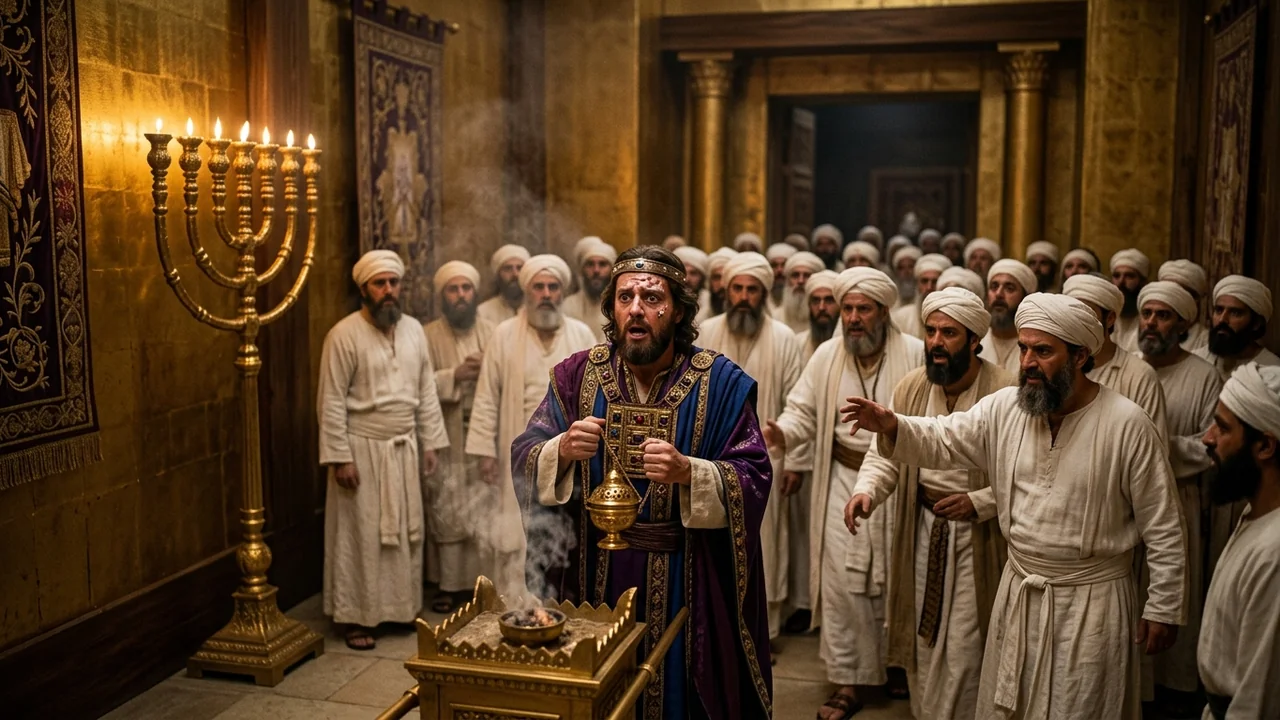
The Defiled Golden Altar: What Really Killed King Uzziah When Leprosy Broke Out on His Forehead
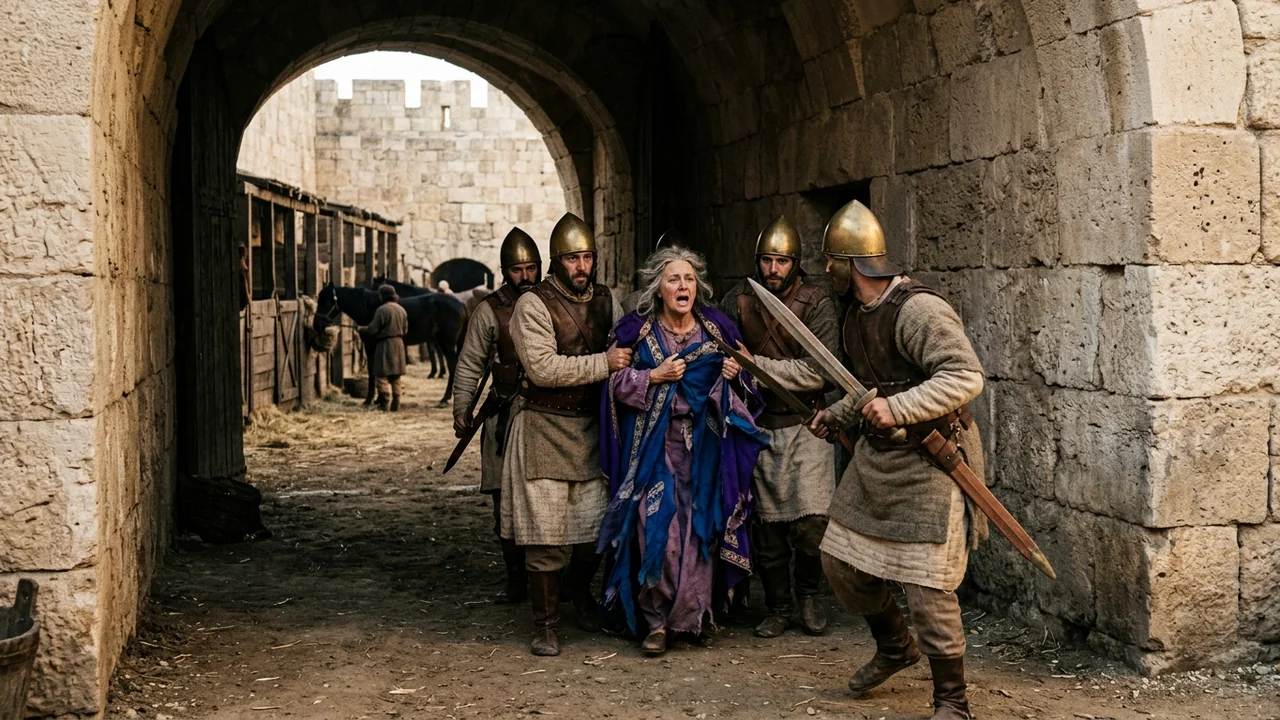
Thrown Down from the Walls of Tyre: The Prophetic Execution of Queen Athaliah