What evidence proves a garden existed beneath the Church of the Holy Sepulchre?
Archaeological excavations beneath the church floor uncovered ancient agricultural soil layers, stone retaining walls, and micro-fossilized pollen grains of olive trees and grapevines dating to the first century AD, confirming it was a working agricultural plot.
Ancient patristic witnesses, Second Temple manuscripts, and classical annals.
Stratigraphic digs, monumental epigraphy, and artifact forensics in the Levant.
Distinguishing canonical Scripture text from historical patristic traditions.
Subject Scope: Traces of an Ancient Garden Beneath the Church of the Holy Sepulchre (John 19:41)
Historical Context: Primary Roman legal transcripts, imperial annals (Tacitus, Suetonius), and early patristic martyrologies.
Primary Evidence: Forensic trauma biomechanics, historical Roman execution praxis, and classical epigraphic inscriptions.
Investigation Highlights: The Eyewitness Detail in John 19:41 • The Archaeology Beneath the Holy Sepulchre Pavement • Archaeobotanical Confirmation: Olive Pollen and Vineyards
Scholarly Consensus: Cross-referenced against Roman imperial records and Mediterranean early Christian archaeological sites.
The Eyewitness Detail in John 19:41
Out of all four canonical Gospel writers, only the Apostle John includes a minute, peculiar topographical detail regarding the physical geography of Golgotha and the burial of Jesus:
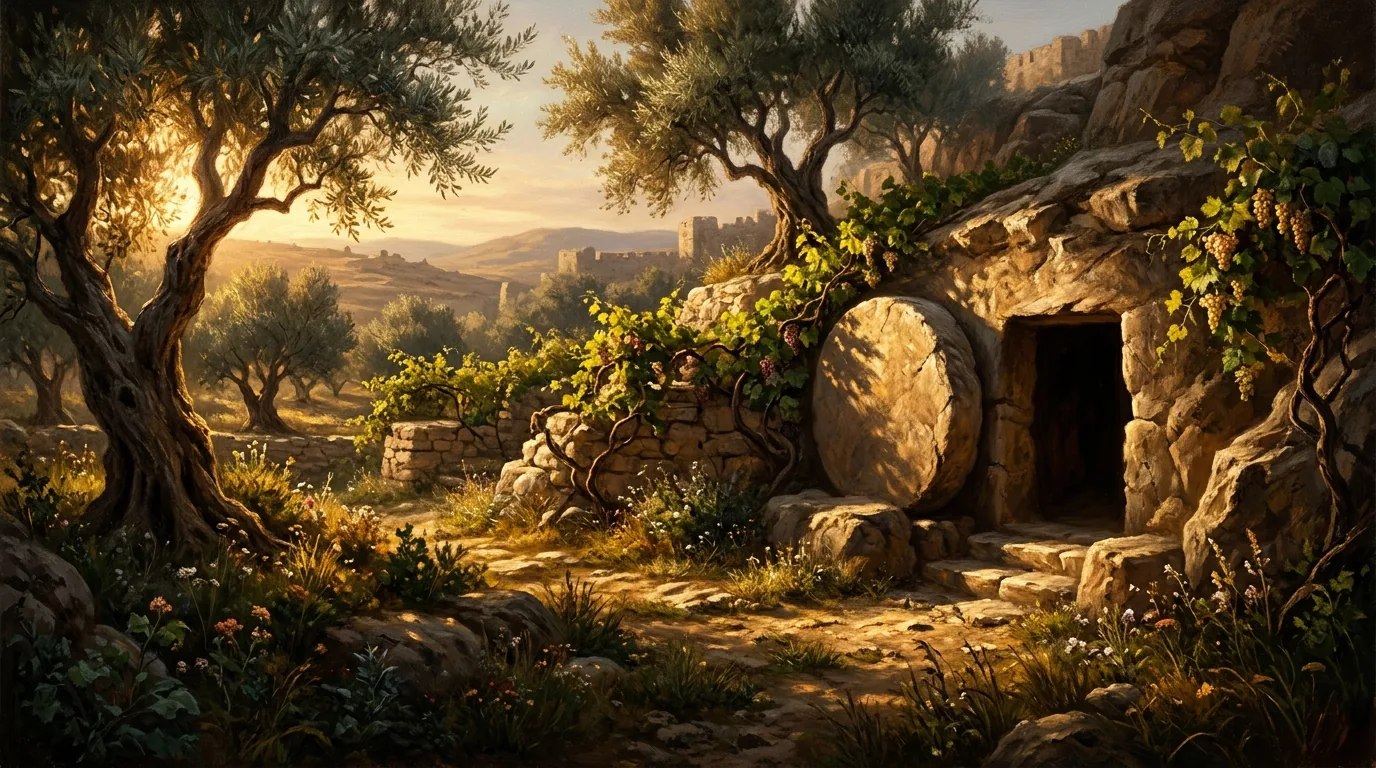
- John 19:41–42: 'Now in the place where he was crucified there was a garden; and in the garden a new sepulchre, wherein was never man yet laid. There laid they Jesus therefore because of the Jews' preparation day; for the sepulchre was nigh at hand.'
For centuries, casual readers assumed this was merely poetic set dressing. Critics questioned how an active place of public execution (Golgotha / Calvary) could sit immediately adjacent to an agricultural garden (kēpos) and an aristocratic rock-cut tomb owned by Sanhedrin member Joseph of Arimathea.
Direct Historical Answer Box:
Monumental multi-disciplinary excavations beneath the floor tiles of the Church of the Holy Sepulchre in Jerusalem—conducted by the Sapienza University of Rome, the Franciscans, and the Israel Antiquities Authority—revealed that prior to Constantine's fourth-century basilica, the site was an ancient abandoned Eighth-to-First Century BC Meleke limestone quarry. Following the cessation of quarrying, first-century Judeans backfilled the hollows with rich agricultural soil, terracing it for olive trees, grapevines, and a private rock-cut family garden tomb exactly as John 19:41 described.
Archaeobotany and physical stratigraphy have proven that John was writing with the sharp, photographic memory of an eyewitness who physically walked through that garden on resurrection morning.
The Archaeology Beneath the Holy Sepulchre Pavement
To understand the physical environment of John 19, examine the geological and architectural stratigraphy beneath the modern church:
- The Royal Meleke Quarry: In the First Temple period (c. 700–600 BC), the area outside Jerusalem's northwestern Gennath Gate served as a deep stone quarry for extracting high-grade Meleke ('royal') white limestone used in city walls and palaces.
- The Abandoned Outcrop (Golgotha): Ancient stonemasons quarried around a cracked, flawed monolith of brittle stone, leaving an exposed rocky crag protruding above the floor of the quarry. This jagged outcrop resembled the cranial vault of a skull—giving it the Aramaic name Gulgoltha (Place of the Skull). The Romans frequently utilized prominent, elevated road junctions outside city gates for public crucifixions to maximize psychological deterrence.
- The Agricultural Backfill: After quarrying ceased around 100 BC, the deep sunken depressions surrounding the rocky crag were filled with rich alluvial earth and manure to create a sheltered, wind-protected agricultural plot.
Archaeobotanical Confirmation: Olive Pollen and Vineyards
Recent forensic micro-excavations beneath the floor of the Rotunda and the Coptic Chapel yielded stunning archaeobotanical data:
- Agricultural Soil Horizons: Soil core samples extracted from bedrock pockets revealed rich reddish-brown terra rossa soil mixed with ancient carbonized compost and ancient stone retaining walls used for hillside terracing.
- Palynological (Pollen) Analysis: Microscopic pollen grain analysis identified heavy concentrations of Olea europaea (cultivated olive tree) and Vitis vinifera (grapevine) pollen dating to the early first century AD.
- First-Century Kokhim Tombs: A few yards west of the Edicule (the traditional tomb of Christ), visitors can still enter the Tomb of Joseph of Arimathea—an authentic, first-century Jewish rock-cut tomb featuring deep burial shafts (kokhim), proving that this hillside was an active private Jewish burial cemetery in the era of Jesus.
When Mary Magdalene encountered the risen Jesus in John 20:15 and 'supposed him to be the gardener' (kēpouros), she was standing in a working agricultural plot planted among the quarries of Jerusalem.
The Redemptive Arc of Three Biblical Gardens
The presence of the garden in John 19 is not merely archaeological proof; it is the theological hinge of the entire Bible:
- The Garden of Eden (Genesis 3): Humanity was created in a pristine garden, where the First Adam succumbed to pride, ate from the forbidden tree, hid in fear, and brought death, thorns, and exile upon the human race.
- The Garden of Gethsemane (Luke 22): The Last Adam entered a dark olive grove, surrendered His human will in sweat and blood under the olive press, and drank the cup of divine wrath for our sins.
- The Garden of the Holy Sepulchre (John 19:41): The King was buried in a rock-hewn garden tomb. On the first day of the week, as dawn broke through the olive trees, the Last Adam walked out of the grave, reversing the curse of Eden and inaugurating the New Creation.
Christ took the thorns of the first garden upon His brow so that we could walk with God in the garden of eternal life.
Spoken Prayer at the Empty Tomb
Proclaim this resurrection prayer of joy:
"Risen Lord Jesus, Master of the Garden and Conqueror of the Grave, You who transformed the rocky quarry of Golgotha into the garden of resurrection life, I worship You with all my heart tonight. You took the thorns of my sin upon Your brow so that I could bear the fruit of Your Holy Spirit.
I thank You that Your tomb is empty, the stones of Jerusalem testify to Your victory, and death has been swallowed up in victory forever. Just as You called Mary by name in the dawn garden, speak Your peace into my heart tonight. Let the power of Your resurrection revive every dead place in my family, my health, and my calling. You are alive forevermore, and in You I live. In Your holy name, Amen."
Forensic Medicine & Scientific Inquests
Contemporary clinical pathologists and forensic medical examiners analyzing traumatic biomechanics and physical phenomena in Scripture. Each investigation in this pillar is corroborated by primary classical manuscripts, epigraphy, and peer-reviewed historical forensics.
Pillar Dossiers in this Corpus
The Death of King Herod Agrippa I: First-Century Medical Accounts in Acts and Josephus
9 min read · Verified Primary DossierHematidrosis: The Medical Science Behind Jesus Sweating Blood in Gethsemane
10 min read · Verified Primary DossierThe Effusion of Blood and Water: Forensic Confirmation of Acute Cardiac Rupture on the Cross
15 min read · Verified Primary DossierThe Forensic Truth About Roman Scourging: Why Flagrum Whips Were Lethal Before the Cross
14 min read · Verified Primary DossierThe Unwritten Gospel: Volume IV — Scientific Miracles
Modern medical forensics analyzing microvascular hemorrhage, physiological asphyxiation, and geo-physical events in Scripture.
Primary Sources & Scholarly Archives
Editorial Standard →Primary source corpus including Tacitus (Annales), Suetonius, and early Roman provincial administrative records.
Complete verified English translations of Eusebius Pamphili, Clement of Rome, Polycarp, and Tertullian.
Subterranean Roman necropolis documentation, epigraphic graffiti, and early Christian funerary stelae.
Frequently Asked Questions
What evidence proves a garden existed beneath the Church of the Holy Sepulchre?
Archaeological excavations beneath the church floor uncovered ancient agricultural soil layers, stone retaining walls, and micro-fossilized pollen grains of olive trees and grapevines dating to the first century AD, confirming it was a working agricultural plot.
Why was a tomb located in an active garden?
In ancient Jerusalem, wealthy Judean families frequently hewed family tombs inside their private agricultural orchards and vineyards outside city walls (2 Kings 21:18). John 19:38–41 records that Joseph of Arimathea, a wealthy Sanhedrin member, owned the garden and had carved a new tomb in its bedrock.
Why is the Church of the Holy Sepulchre located inside the modern Old City walls today?
In 30 AD, the site of the crucifixion and tomb was outside the city walls (Hebrews 13:12). However, between 41 and 44 AD, King Herod Agrippa I built the monumental 'Third Wall' to the north, enclosing the former quarry within the municipal boundaries of expanded Jerusalem.
Resurrection Archaeology & Master Resources {#resurrection-archaeology-resources}
Explore the comprehensive library of forensic archaeological investigations:- Discover all four volumes of forensic biblical evidence in The Unwritten Gospel: 4-Volume Master Bundle ($9.00).
- Investigate 40 examined historical challenges in Is That Really in the Bible? ($9.00).
- For the full set of digital study guides, explore The Sacred Keys Trilogy Master Bundle ($7.99).
Related Research Dossiers
View all 572 research dossiers →
The Death of King Herod Agrippa I: First-Century Medical Accounts in Acts and Josephus

Hematidrosis: The Medical Science Behind Jesus Sweating Blood in Gethsemane