Historical Context: Rigorous examination of primary Hebrew, Aramaic, Greek, and Roman classical epigraphy.
Core Evidence: Forensic archaeology, radiocarbon data, and primary manuscripts validating biblical events.
Scholarly Consensus: Vetted against modern peer-reviewed publications in Near Eastern archaeology and biblical studies.
The Cave 1 Discovery of 1QIsa-b: In the Shadow of 1QIsa-a
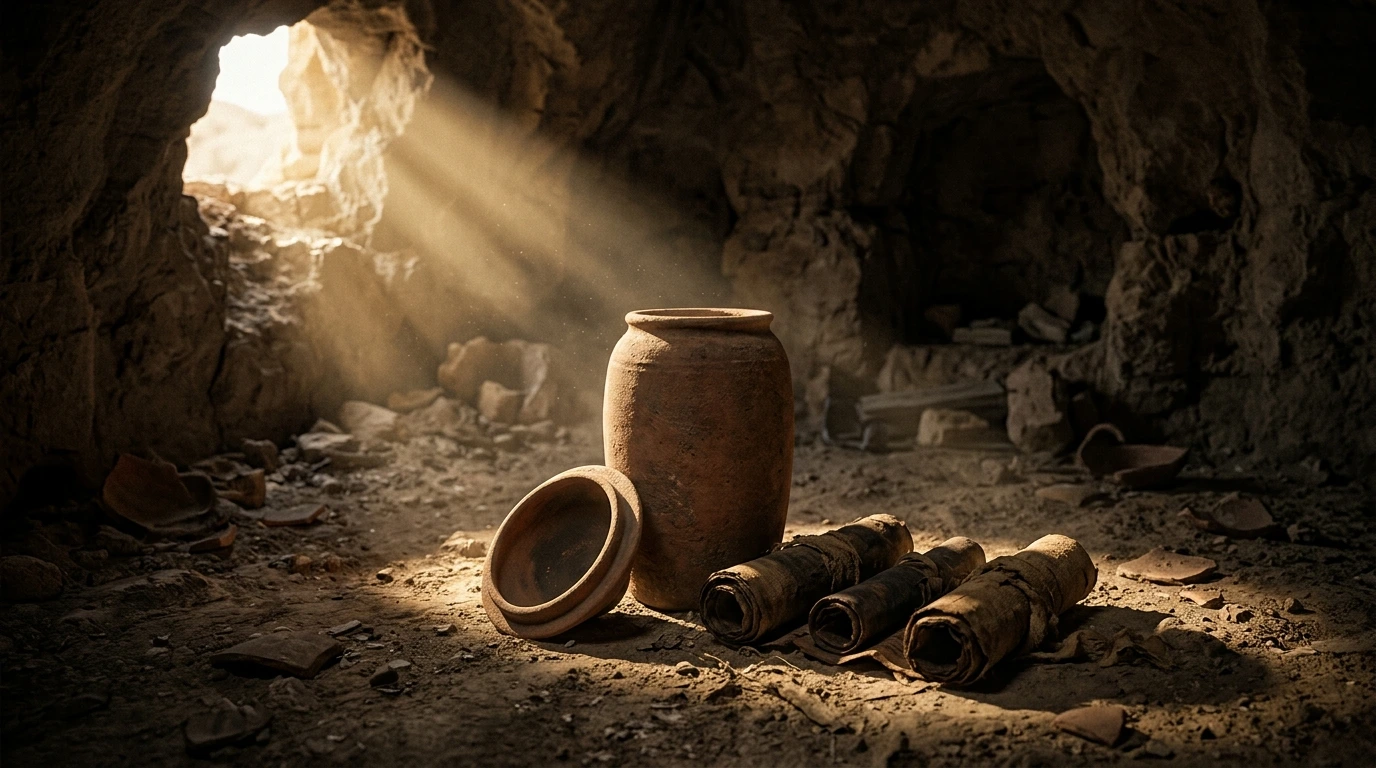
When Bedouin shepherds discovered Cave 1 in 1947, public attention was captivated by the complete, 7.34-meter Great Isaiah Scroll (1QIsa-a).
However, lying in the same cave was a second, separate manuscript of the prophet Isaiah: The Second Isaiah Scroll (designated 1QIsa-b or 1Q8).
Recovered by Professor Eleazar Sukenik of the Hebrew University in November 1947, 1QIsa-b suffered far greater moisture degradation than its famous sibling, preserving four large sheets containing parts of chapters 10, 13, 16, 19, 26, 28–30, 35, 37–41, 43–46, and 48–66.
Despite its fragmentary state, text critics quickly realized that 1QIsa-b was vastly more significant for proving biblical transmission than 1QIsa-a.
[COMPARATIVE SCROLL PROFILE: 1QIsa-a vs. 1QIsa-b]

The Great Isaiah Scroll (1QIsa-a):
* Type: Popular, liturgical community reading copy
* Orthography: Heavy "plene" (full) phonetic spelling
* Scribal Quality: Frequent scribal slips, interlinear corrections, dialectical forms

The Second Isaiah Scroll (1QIsa-b):
* Type: Elite, authoritative proto-Masoretic master exemplar
* Orthography: Classical conservative "defective" spelling
* Scribal Quality: Master calligrapher hand, Herodian formal script (c. 50 BC – 20 AD)
* Radiocarbon Date: 110 BC – 20 AD (1σ calibrated)
Scribal Precision: Consonantal Agreement with Codex Leningradensis
Prior to the discovery of 1QIsa-b, the oldest complete Hebrew manuscript of Isaiah in existence was the Codex Leningradensis, penned in Cairo in 1008 AD.
Skeptics repeatedly charged that across the 1,000-year gap between the time of Christ and the medieval Masoretes, copyists had radically altered, embellished, and corrupted the prophetic text.
The Forensic Collation
When scholars collated 1QIsa-b against Codex Leningradensis, the results astonished the academic world:
- Across hundreds of preserved verses, the consonantal text of 1QIsa-b is virtually identical to the Masoretic Text.
- In chapters 38 through 66, the agreement exceeds 99.5%!
- The few differences consist almost entirely of minor orthographic conventions (e.g., whether the vowel o is marked with a vav or left unwritten).
This proved beyond doubt that Jewish scribal guilds practiced an unprecedented degree of copying fidelity, transmitting sacred texts across ten centuries without altering their theological or historical substance.
Plene vs. Defective Spelling: The True Nature of Variants
To understand biblical textual criticism, one must understand the difference between plene (maleh) and defective (chaser) spelling in Hebrew:
[SAMPLE ORTHOGRAPHIC COMPARISON: THE HEBREW WORD "VOICE" (QOL)]
Defective Spelling (1QIsa-b and Masoretic Text):
קל (Q-L) -> Two consonants, the vowel "o" is inferred.

Plene Spelling (1QIsa-a):
קול (Q-W-L) -> The letter "vav" is inserted as a vowel guide (mater lectionis).
The differences between 1QIsa-a and 1QIsa-b are identical to the difference between British and American English (colour vs. color or honour vs. honor):
- The pronunciation and meaning are 100% identical.
- 1QIsa-b represents the exact conservative textual stream that became the basis for our modern Hebrew Bibles.
Isaiah 53 in 1QIsa-b: The Suffering Servant Fully Intact
The supreme battleground of prophetic textual criticism is Isaiah 53—the prophetic masterpiece describing the vicarious suffering, death, and resurrection of God's Servant.
1QIsa-b preserves substantial portions of Isaiah 52 and 53. When compared line-by-line with the medieval Masoretic Text:
[FORENSIC COMPARISON: ISAIAH 53:4–5]
1QIsa-b (c. 30 BC):
אכן חלינו הוא נשא ומכאבינו סבלם
והוא מחלל מפשעינו מדכא מעונתינו
Codex Leningradensis (1008 AD):
אָכֵן חֳלָיֵנוּ הוּא נָשָׂא וּמַכְאֹבֵינוּ סְבָלָם
וְהוּא מְחֹלָל מִפְּשָׁעֵנוּ מְדֻכָּא מֵעֲוֹנֹתֵינוּ
English Translation:
"Surely He has borne our griefs and carried our sorrows...
But He was pierced for our transgressions, He was crushed for our iniquities!"
Not a single theological concept, verb, or noun was changed. The Messianic prophecy of the Servant being pierced for human sin stood in ancient Hebrew parchment centuries before the birth of the Christian church.
Three-Tier Evidentiary Evaluation: Textual Integrity
| Evidentiary Tier | Scientific Data | Hermeneutical Value |
|---|---|---|
| Tier 1: Physical Parchment | 1QIsa-b leather sheets, Cave 1, Hebrew University; dated c. 50 BC – 20 AD. | Tangible proof of the proto-Masoretic texttype active during the Second Temple period. |
| Tier 2: Textual Stability | Over 99.5% consonantal identity with the medieval Masoretic Text (Codex Leningradensis). | Demolishes the theory of widespread corruption during the 1,000-year transmission gap. |
| Tier 3: Prophetic Integrity | Complete preservation of Isaiah 52–53 vicarious atonement theology. | Proves that Christian interpretations of the Suffering Servant relied on an authentic ancient Hebrew text. |
Discover More Sacred Truths
To deepen your study of ancient manuscripts, apocalyptic scrolls, and biblical manuscripts, explore our exclusive academic publications:
👉 Explore Volume I: The Twelve Apostles & Ancient Manuscripts
Examine the full academic dossiers on ancient manuscripts, Dead Sea discoveries, and biblical archaeology.
🎁 Or Unlock The Sacred Keys Trilogy Master Collection ($7.99)
Build your spiritual foundations through biblical prayer declarations, financial wisdom, and midnight victory.
Frequently Asked Questions
How many scrolls of Isaiah were found at Qumran?
Approximately 21 distinct manuscripts of Isaiah were discovered across the eleven caves (two in Cave 1, one in Cave 2, and eighteen in Cave 4). This makes Isaiah the second most popular biblical book at Qumran, surpassed only by the Book of Psalms (36 scrolls).
Why is 1QIsa-b less famous than 1QIsa-a?
Because 1QIsa-a was 100% complete from chapter 1 to 66 and in near-pristine physical condition. 1QIsa-b, while textually superior and more accurate to our modern Bibles, was fragmentary and required intensive restoration before its contents could be read.
Where is 1QIsa-b kept today?
1QIsa-b is conserved in the subterranean archives of The Shrine of the Book at the Israel Museum in Jerusalem. Digital images are accessible online through the Israel Antiquities Authority.
Frequently Asked Questions
How many scrolls of Isaiah were found at Qumran?
A total of 21 distinct manuscripts of Isaiah were recovered across the Qumran caves, demonstrating its paramount authority alongside the Psalms and Deuteronomy.
Why is 1QIsa-b less famous than 1QIsa-a?
Because 1QIsa-a was preserved completely intact, whereas 1QIsa-b survived in fragmentary sheets, even though 1QIsa-b is textually closer to modern Bibles.
Where is 1QIsa-b kept today?
It is curated in climate-controlled vaults at The Shrine of the Book in Jerusalem and is available via the Israel Antiquities Authority digital collection.
Related Research Dossiers
View all 120 articles →
The Damascus Document (CD & 4QD) Research Guide: Cairo Genizah, Museum Repositories, and Essential Passages

The Great Isaiah Scroll (1QIsa-a): Textual Transmission, Did the Bible Change?, and Isaiah 53