Subject Scope: How Do We Know the Bible Is Reliable? William Tyndale (1494–1536) and the Greek Testament Translation
Historical Context: Rigorous historical and theological examination within the field of Early Church & Patristic History.
Primary Evidence: Forensic archaeology, textual preservation, and primary ancient manuscripts corroborating scriptural events.
Investigation Highlights: The Crime of Translating the Word of God • The Ploughboy Vow: Tyndale’s Sacred Obsession • The 1526 Breakthrough: From Original Greek to English
Scholarly Consensus: Vetted against peer-reviewed academic literature in biblical history, linguistics, and archaeology.
The Crime of Translating the Word of God
In early 16th-century England, reading the Holy Scriptures in your mother tongue was not merely discouraged—it was a capital crime punishable by burning alive at the stake.
Under the draconian Constitutions of Oxford, enacted by Archbishop Thomas Arundel in 1408 to suppress the Lollard followers of John Wycliffe:
"No man hereafter by his own authority shall translate any text of the Scripture into English or any other tongue, by way of a book, booklet, or treatise... upon pain of the greater excommunication and being punished as a heretic!"
For over a century, England’s common people lived in enforced spiritual darkness. Church services were conducted in Latin, a language understood only by educated clergy. Ignorance was so pervasive that when John Hooper, Bishop of Gloucester, tested his clergy in 1551, over 170 priests could not repeat the Ten Commandments, and thirty did not even know who composed the Lord’s Prayer!
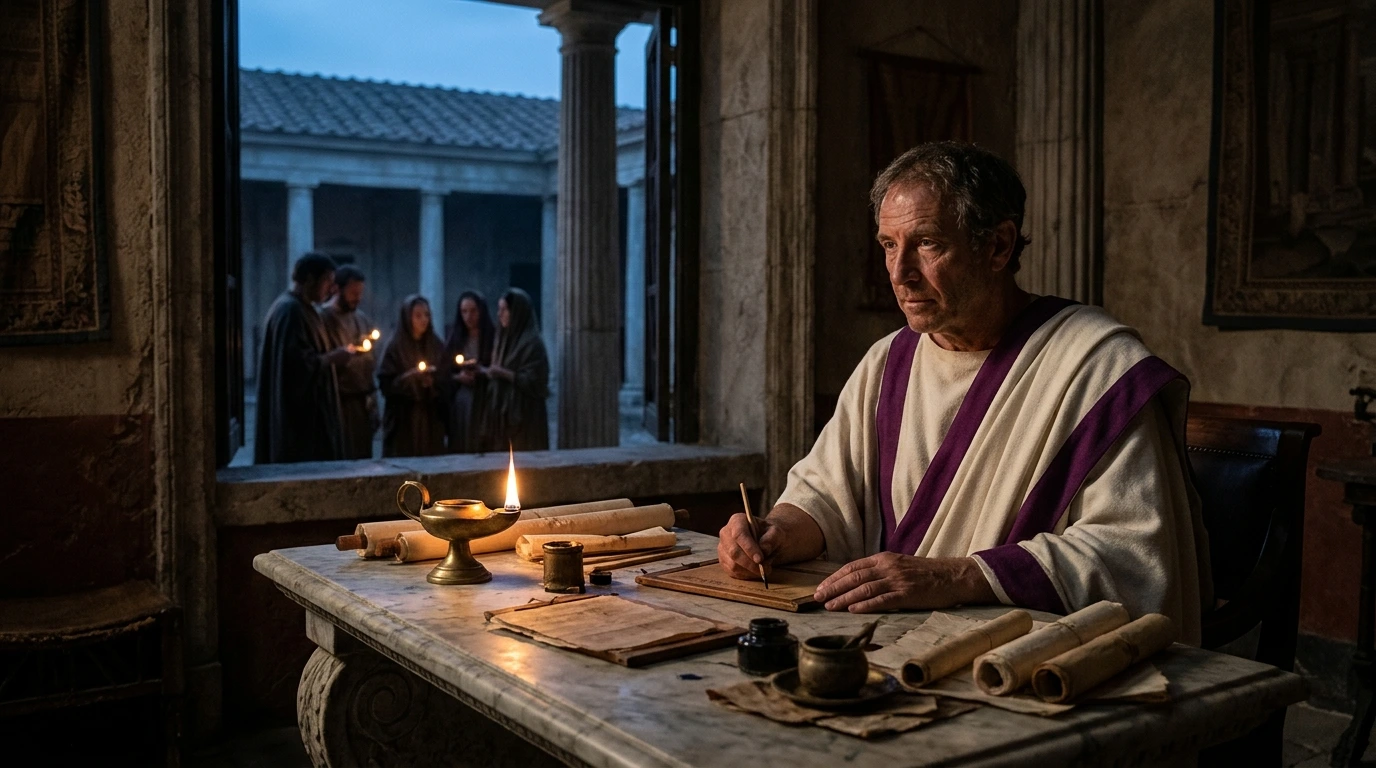
Into this spiritual prison stepped an Oxford scholar named William Tyndale (c. 1494–1536).
The Ploughboy Vow: Tyndale’s Sacred Obsession
Born near Gloucestershire, Tyndale was an intellectual prodigy who earned degrees from Oxford and Cambridge, mastering seven languages: Greek, Hebrew, Latin, Italian, Spanish, French, and English.
While serving as a private tutor at Little Sodbury Manor, Tyndale regularly debated visiting prelates and abbots. When a learned Catholic dignitary exclaimed: "We were better be without God’s law than the Pope’s!" Tyndale’s fiery spirit ignited with righteous indignation:
"I defy the Pope and all his laws; and if God spare my life, ere many years I will cause a boy that driveth the plough shall know more of the Scripture than thou dost!"
Tyndale traveled to London in 1523 to petition Bishop Cuthbert Tunstall for official permission to translate the Greek New Testament into English. Tunstall flatly denied the request. Realizing that there was no room in all of England to translate the Scriptures, Tyndale slipped aboard a merchant ship in 1524, sailing into permanent European exile.
The 1526 Breakthrough: From Original Greek to English
Unlike John Wycliffe’s 1382 manuscript Bible—which was an awkward translation of the Latin Vulgate—Tyndale translated directly from the original Greek and Hebrew:
- For the New Testament, Tyndale utilized Desiderius Erasmus’ printed Greek New Testament (the 1519 and 1522 editions).
- For the Old Testament, Tyndale became the first Englishman in history to translate directly from the Hebrew Masoretic Text (the 1494 Brescia Hebrew Bible).
[THE REVOLUTIONARY POWER OF ORIGINAL LANGUAGE TRANSLATION]
1. GREEK "EKKLESIA" (ἐκκλησία):
   - The Vulgate translated: "Ecclesia" -> English "Church" (connoting the Roman hierarchy).
   - Tyndale accurately translated: "CONGREGATION" (the living assembly of believers!).

2. GREEK "PRESBUTEROS" (πρεσβύτερος):
   - The Vulgate translated: "Priest" (a sacrificial sacerdotal official).
   - Tyndale accurately translated: "ELDER" or "SENIOR" (mature spiritual leaders).

3. GREEK "METANOEO" (μετανοέω):
   - The Vulgate translated: "Poenitentiam agite" -> "Do penance" (sacrament of confession).
   - Tyndale accurately translated: "REPENT" (a transformative change of heart toward God!).

4. GREEK "AGAPE" (ἀγάπη):
   - The Vulgate translated: "Charitas" -> "Charity" (almsgiving).
   - Tyndale accurately translated: "LOVE" (divine self-sacrificing affection).
Smuggled in Bales of Cloth: The Battle for England’s Soul
In February 1526, at the printing shop of Peter Schöffer in Worms, Germany, the presses finished the first complete copies of Tyndale’s English New Testament.
To bypass royal customs officials and inquisitors, English merchants hid the small, portable octavo Bibles inside the center of massive cloth bales, flour sacks, and wine casks.
[THE DRAMA OF BIBLE SMUGGLING (1526–1530)]
- Over 6,000 New Testaments flooded into London, Bristol, and Oxford.
- King Henry VIII and Sir Thomas More issued royal warrants to confiscate and burn them.
- Bishop Tunstall bought up thousands of copies on the Antwerp market to burn them publicly
  at St. Paul's Cross in London.
- IRONIC OUTCOME: The merchant who sold the copies to the bishop was secretly Tyndale's friend!
  The bishop's money paid off Tyndale's debts and financed an improved, corrected second edition
  three times larger!
Architect of the English Language: Tyndale’s Immortal Words
Before Tyndale, English was considered a crude, provincial Germanic dialect unfit for theology or serious literature. Tyndale infused English with the majestic rhythm of Hebrew poetry and the clarity of Greek narrative.
Tyndale literally coined and introduced hundreds of foundational English phrases into the world's vocabulary:
[TYNDALE'S IMMORTAL PHRASES]
- "Let there be light" (Genesis 1:3)
- "Am I my brother's keeper?" (Genesis 4:9)
- "The Lord bless thee and keep thee" (Numbers 6:24)
- "The salt of the earth" (Matthew 5:13)
- "A city set on a hill cannot be hid" (Matthew 5:14)
- "Fight the good fight" (1 Timothy 6:12)
- "Seek and ye shall find" (Matthew 7:7)
- "Ask and it shall be given you" (Matthew 7:7)
- "The spirit is willing, but the flesh is weak" (Matthew 26:41)
- "In whom we live and move and have our being" (Acts 17:28)
- "A law unto themselves" (Romans 2:14)
- "The signs of the times" (Matthew 16:3)
- "A prophet hath no honor in his own country" (John 4:44)
Tyndale also invented brand-new English words when no equivalent existed: "Passover," "peacemaker," "scapegoat," "atonement" (at-one-ment), and "long-suffering".
Betrayal, Vilvoorde Castle, and the Dying Martyr’s Prayer
In May 1535, Tyndale was betrayed in Antwerp by Henry Phillips, a deceitful English aristocrat who befriended Tyndale and then led imperial officers to arrest him in a narrow alleyway.
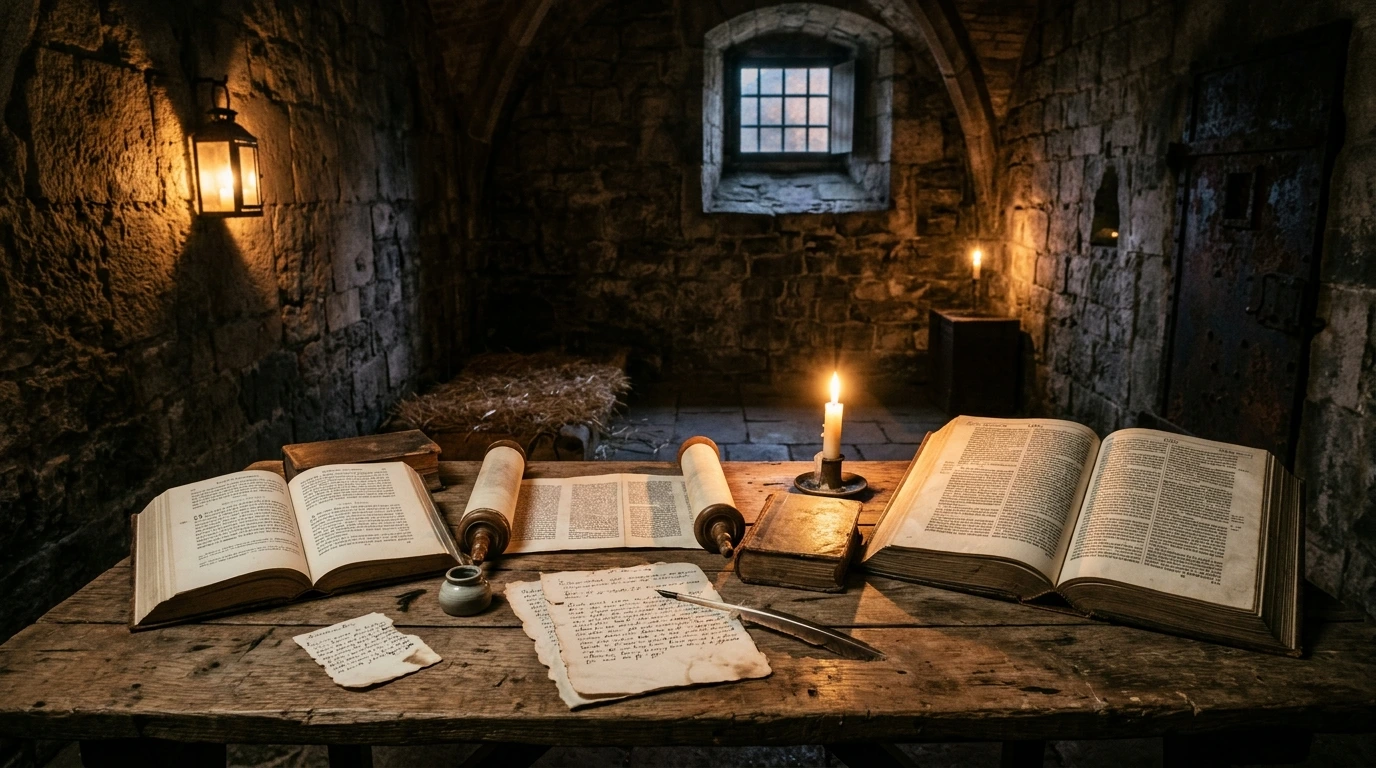
Tyndale was imprisoned in the dark, freezing dungeons of Vilvoorde Castle near Brussels for 500 days. In a surviving letter written in Latin to the prison governor, Tyndale begged for warmer clothing and a candle:
"I entreat your lordship, and that by the Lord Jesus, that if I am to remain here through the winter you will request the procurator to send me a warmer cap... my overcoat is worn out; my shirts are also worn out... But most of all I beg and beseech your clemency to permit me to have my Hebrew Bible, Hebrew Grammar, and Hebrew Dictionary, that I may pass the time in study."
On October 6, 1536, William Tyndale was led to the public execution ground at Vilvoorde. Tied to an upright wooden stake, he cried out his immortal dying prayer with a loud voice:
"LORD! OPEN THE KING OF ENGLAND’S EYES!"
The executioner strangled him with a wire, and his body was immediately consumed by gunpowder and flames.
The 1611 King James Audit: 83% Tyndale’s Exact Text
God answered Tyndale’s dying prayer with breathtaking speed:
- Within two years of Tyndale’s martyrdom (1538), King Henry VIII issued a royal injunction commanding that a copy of the Great Bible (translated by Tyndale's friend Miles Coverdale, utilizing Tyndale's text) be chained to the lectern of every single parish church in England for all subjects to read freely!
- When forty-seven elite scholars assembled in 1604–1611 to create the Authorized King James Version (KJV), they based their work on Tyndale’s foundation.
Computerized linguistic analysis conducted by modern textual scholars (including John Nielson and Royal Skousen) reveals an astonishing historical fact:
- 83.7% of the New Testament in the King James Bible is Tyndale’s exact phrasing verbatim!
- 75.8% of the Old Testament books Tyndale completed is preserved word-for-word in the King James Bible!
When modern readers open the King James Bible, they are not reading the prose of Jacobean scholars; they are reading the prose of William Tyndale, sealed with his martyr's blood.
Three-Tier Evidentiary Evaluation: William Tyndale
+----------------------------------------------------------------------------------------------------+
|                  WILLIAM TYNDALE: THREE-TIER EVIDENTIARY EVALUATION                                |
+====================================================================================================+
| TIER 1: PRIMARY HISTORICAL EDITIONS (1526, 1534)                                                   |
| - First English New Testament translated directly from the original Greek (Erasmus Textus Receptus)|
| - First printed English translation directly from the Hebrew Masoretic Text (Pentateuch & Jonah).  |
+----------------------------------------------------------------------------------------------------+
| TIER 2: LINGUISTIC & PHILOLOGICAL MASTERY                                                          |
| - Coined foundational English theological terms: Atonement, Passover, Scapegoat, Peacemaker.       |
| - Replaced ecclesiastical hierarchy terms with authentic Greek equivalents: Congregation & Elder.  |
+----------------------------------------------------------------------------------------------------+
| TIER 3: CANONICAL TRANSMISSION & MARTYRDOM                                                         |
| - 83.7% of the 1611 King James New Testament derives directly from Tyndale's pen.                 |
| - Martyrdom at Vilvoorde Castle (1536) demonstrates total, self-sacrificing fidelity to Scripture.  |
+----------------------------------------------------------------------------------------------------+
Frequently Asked Questions
Did William Tyndale translate the entire Bible before his death?
No. Tyndale completed the entire New Testament, the Pentateuch (Genesis to Deuteronomy), and the Book of Jonah. While in prison in Vilvoorde, he translated Joshua through 2 Chronicles. His manuscript was smuggled out by his friend John Rogers and published under the pseudonym "Thomas Matthew" in the Matthew Bible (1537).
Why did King Henry VIII want Tyndale killed?
In addition to translating the Bible without royal permission, Tyndale published a book in 1530 titled The Practyse of Prelates, in which he explicitly opposed Henry VIII’s divorce from Catherine of Aragon on strict biblical grounds, incurring the king's furious personal wrath.
How many copies of the original 1526 Worms New Testament survive today?
Of the estimated 6,000 copies printed in Worms in 1526, only three surviving copies exist in the world today: one complete copy at the British Library in London, an incomplete copy at St. Paul’s Cathedral, and a fragment at the library of Stuttgart, Germany. All other copies were seized and burned by ecclesiastical authorities.
Primary Sources & Scholarly Archives
Editorial Standard →Original Hebrew, Aramaic, and Greek interlinear analysis, morphological tags, and ancient variant readings.
Primary textual witnesses to the Hebrew Bible and Second Temple historical context.
Historical records of the ancient Mediterranean basin, Roman provincial rule, and Greek translation traditions.
Frequently Asked Questions
Did William Tyndale translate the entire Bible before his death?
No. Tyndale completed the New Testament, the Pentateuch, Jonah, and Joshua through 2 Chronicles before his martyrdom. His unfinished work was completed by his friend Miles Coverdale and published in the Matthew Bible (1537).
Why did King Henry VIII want Tyndale killed?
Beyond the illegal translation of Scripture, Tyndale published a treatise (The Practyse of Prelates) boldly opposing Henry VIII’s divorce from Catherine of Aragon, provoking royal vengeance.
How many copies of the original 1526 Worms New Testament survive today?
Only three copies survive out of 6,000 printed, with the sole complete copy preserved in the British Library in London. Thousands were confiscated and burned at St. Paul’s Cross.
Related Research Dossiers
View all 515 research dossiers →
Patristic Reading Guide: Key Excerpts and Timeless Lessons from John Chrysostom (c. 347–407 AD)
How Do We Know the Bible Is Reliable? Augustine of Hippo (354–430 AD), Confessions, and The City of God