Table of Contents (Summary)
## The Accidental 2004 Sewer Pipe Discovery {#discovery}
For over a century, tourists visiting Jerusalem were taken to a small Byzantine pool built by Empress Eudocia in the 5th century AD, believing it to be the biblical Pool of Siloam.
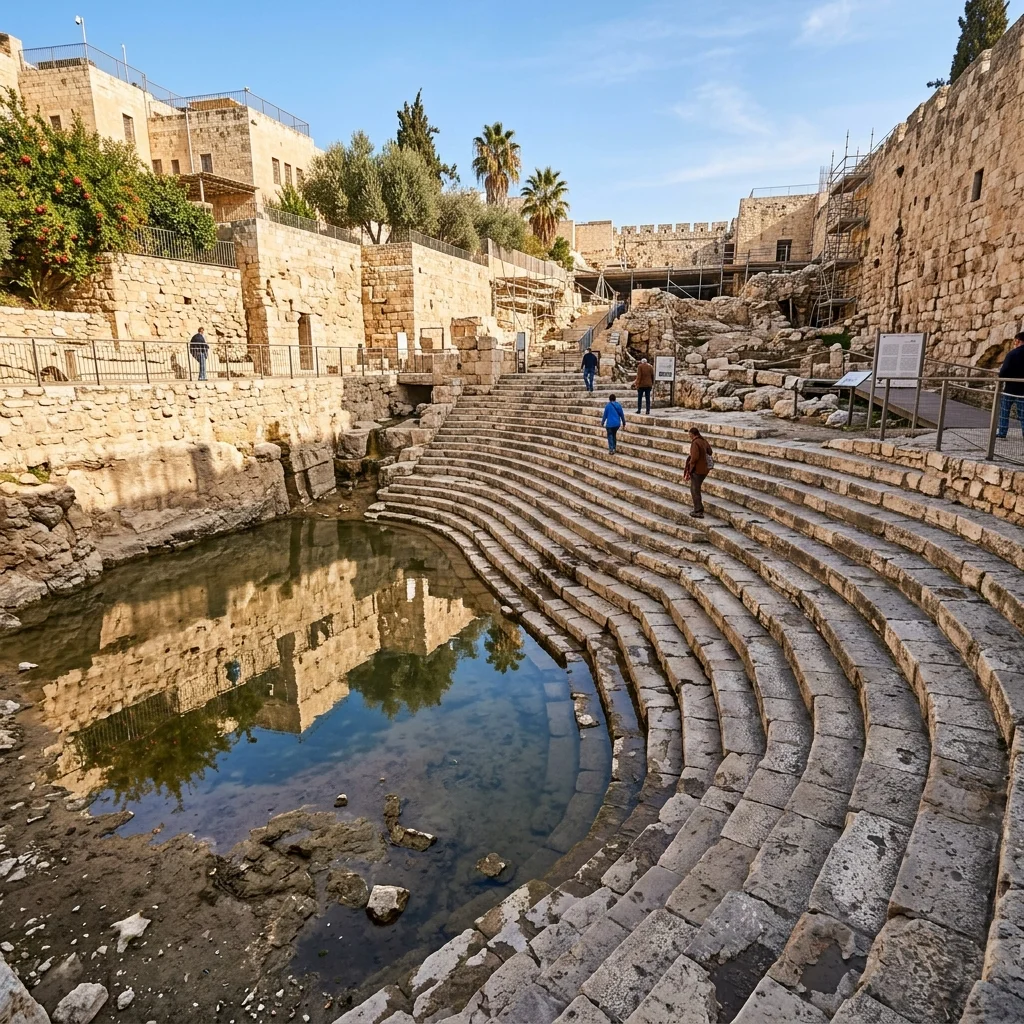
However, in **autumn 2004**, during routine municipal repairs on a damaged sewer pipe in the City of David, heavy machinery excavated by municipal workers uncovered monumental stone steps.
Archaeologists **Eli Shukron** of the Israel Antiquities Authority (IAA) and **Prof. Ronny Reich** of Haifa University immediately halted construction. As dirt was cleared, they realized they had stumbled upon the authentic **1st-century Second Temple Pool of Siloam**.
Architectural Layout of the 1st-Century Pool
Excavations revealed a grand trapezoidal reservoir measuring over 68 meters (225 feet) in length.
- **Tiered Stone Steps**: The pool featured monumental tiers of stone steps separated by wide landings. This design allowed thousands of Jewish pilgrims to step into varying water depths during major pilgrimage festivals (Passover, Pentecost, Sukkot). - **Mikveh Functions**: The Pool served as Jerusalem’s largest public *mikveh* (ritual immersion bath) where pilgrims purified themselves before ascending the Central Valley stepping road to the Second Temple.
Hezekiah’s Tunnel and the Paleo-Hebrew Siloam Inscription
The Pool of Siloam was fed directly by spring water flowing from the **Gihon Spring** through **Hezekiah’s Tunnel**—a 533-meter S-shaped subterranean channel carved through solid bedrock in 701 BC under King Hezekiah to protect Jerusalem’s water supply against Sennacherib’s siege (2 Kings 20:20).
In 1880, a boy swimming near the pool discovered the **Siloam Inscription**—a 6-line Paleo-Hebrew inscription carved into the rock wall describing the exact moment two teams of ancient Judean stonemasons tunneling from opposite directions met in the middle.
Coins of Alexander Jannaeus and Pontius Pilate
Archaeologists used numismatic evidence beneath the plaster steps to establish bulletproof dating:
1. **Plaster Foundation Coins**: Beneath the stone steps, excavators found bronze coins of Hasmonean King Alexander Jannaeus (103–76 BC), establishing when the pool was first constructed. 2. **Upper Plaster Layer**: Coins dated to the First Jewish Revolt (66–70 AD) were found sealed in the top plaster, proving the pool was actively used throughout the ministry of Jesus until the Roman destruction of 70 AD.
John 9: Healing of the Man Born Blind
In John 9:7, Jesus encounters a man blind from birth. Jesus spits on the ground, makes clay with saliva, applies it to the man's eyes, and commands him:
*"Go, wash in the Pool of Siloam" (which means "Sent"). So the man went and washed, and came home seeing.* — John 9:7
The 2004 discovery of the exact stone steps of Siloam transformed John 9 from a spiritual allegory into a grounded, historically verified physical event taking place at a specific excavated site in Jerusalem.
Frequently Asked Questions
When was the real 1st-century Pool of Siloam discovered?
The authentic 1st-century Pool of Siloam was discovered accidentally in autumn 2004 during municipal sewer pipe repairs in Jerusalem.
How did water reach the Pool of Siloam?
Water flowed from the Gihon Spring through Hezekiah’s 533-meter bedrock tunnel, carved in 701 BC.
What was the Pool of Siloam used for in Jesus’ time?
It served as Jerusalem’s primary public ritual immersion bath (mikveh) for thousands of Jewish pilgrims before entering the Temple.