Historical Context: Rigorous examination of primary Hebrew, Aramaic, Greek, and Roman classical epigraphy.
Core Evidence: Forensic archaeology, radiocarbon data, and primary manuscripts validating biblical events.
Scholarly Consensus: Vetted against modern peer-reviewed publications in Near Eastern archaeology and biblical studies.
The Senatorial Historian of the Roman Empire
When evaluating the historical reliability of ancient literature, secular historians establish a golden rule: hostile, unsympathetic eyewitnesses and imperial officials provide the highest quality of historical corroboration.
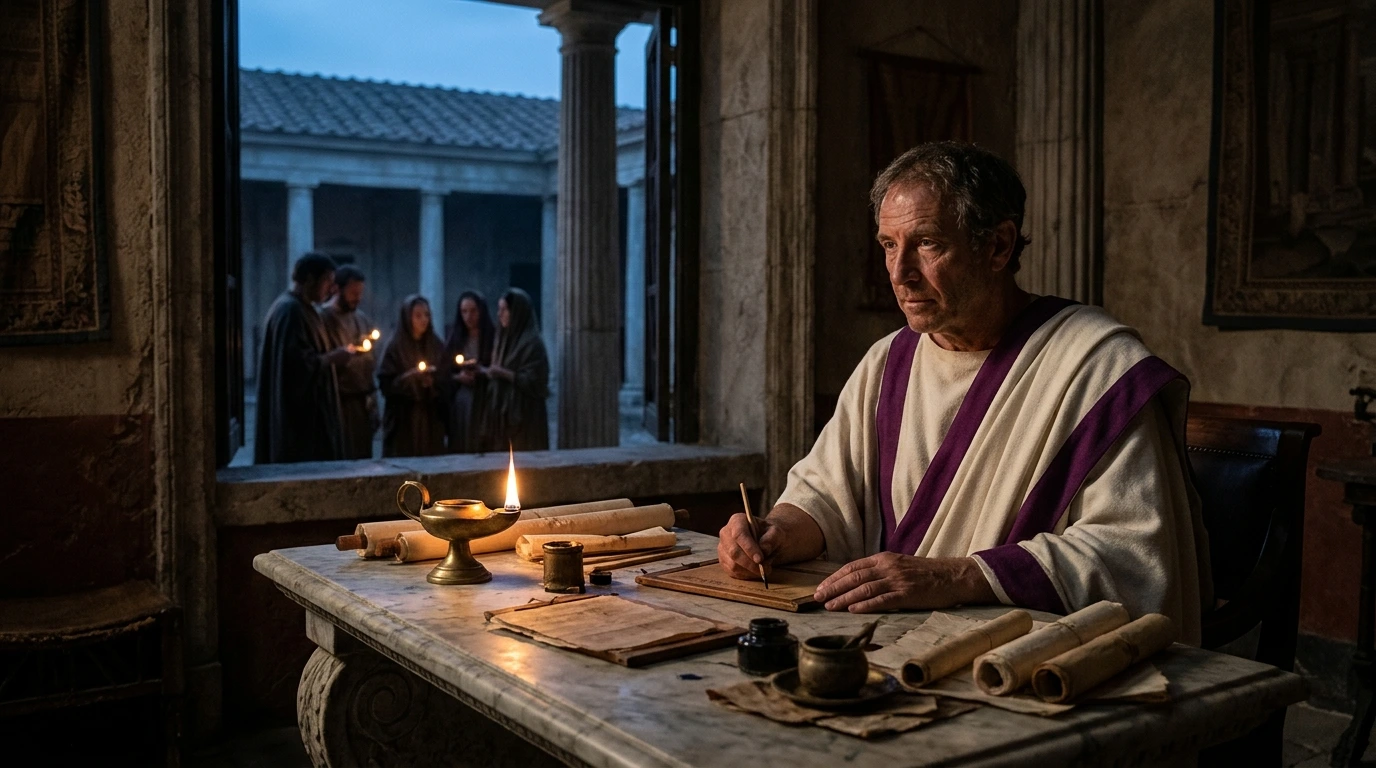
No ancient writer embodies Roman aristocratic disdain for foreign superstitions more completely than Publius Cornelius Tacitus (c. 56–120 AD).
Regarded by modern classicists as the greatest Roman historian, Tacitus was not a provincial storyteller; he was an imperial statesman of the highest rank:
- Member of the Roman Senate under the Flavian emperors.
- Suffect Consul of Rome in 97 AD under Emperor Nerva.
- Proconsul (governor) of the Roman province of Asia (western Turkey) in 112–113 AD.
- Son-in-law of the famous general Gnaeus Julius Agricola, conqueror of Britain.
In his final historical masterpiece, the Annals (Annales), written around 116 AD during the reign of Emperor Trajan, Tacitus chronicled the reigns of the Julio-Claudian emperors from Tiberius to Nero. In Book 15, Chapter 44, he provides the most famous, devastatingly hostile secular account of the crucifixion of Jesus Christ in Roman literature.
Tacitus, Annals 15.44: The Great Fire of Rome and Nero’s Scapegoats
On the night of July 19, 64 AD, a catastrophic fire erupted in the merchant shops near the Circus Maximus in Rome. The fire raged for six days and seven nights, destroying ten of Rome’s fourteen municipal districts and leaving hundreds of thousands homeless.
Rumors quickly swept the city that Emperor Nero had ordered the fire to clear land for his colossal personal palace complex, the Domus Aurea (Golden House), and that he had watched the city burn while singing about the fall of Troy.
To extinguish the rumors, Nero needed a scapegoat. Tacitus records:
[TACITUS, ANNALES 15.44 (ORIGINAL LATIN)]
"Ergo abolendo rumori Nero subdidit reos et quaesitissimis poenis adfecit, quos per flagitia invisos
vulgus Christianos appellabat. Auctor nominis eius Christus Tiberio imperitante per procuratorem
Pontium Pilatum supplicio adfectus erat; repressaque in praesens exitiabilis superstitio rursum erumpebat,
non modo per Iudaeam, originem eius mali, sed per urbem etiam, quo cuncta undique atrocia aut pudenda
confluunt celebranturque."
[ENGLISH TRANSLATION]
"Consequently, to get rid of the report, Nero fastened the guilt and inflicted the most exquisite tortures
on a class hated for their abominations, called Christians by the populace.
Christus, the founder of the name, was put to death by Pontius Pilate, procurator of Judea in the reign
of Tiberius: but the pernicious superstition, checked for a moment, broke out again not only through Judea,
the first source of the evil, but even through Rome, where all things hideous and shameful from every part
of the world find their center and become popular."
Tacitus then describes Nero’s sadistic cruelty: Christians covered in wild animal skins and torn to pieces by hunting dogs, nailed to crosses, and tied to wooden posts soaked in pitch to be burned as human torches to illuminate Nero's imperial gardens at night.
Forensic Historical Analysis of Tacitus’ Latin Text
A careful forensic reading of Tacitus' short paragraph confirms multiple foundational details of the Gospel accounts:
| Historical Fact Confirmed by Tacitus | Biblical Parallel in the New Testament |
|---|---|
| Jesus was known by the historical title Christus | Matthew 1:16; 16:16; Mark 8:29; John 1:41 |
| He was executed during the reign of Emperor Tiberius (14–37 AD) | Luke 3:1 ("In the fifteenth year of the reign of Tiberius Caesar") |
| The execution was carried out by Pontius Pilatus | Matthew 27:2; Mark 15:1; Luke 23:1; John 18:29 |
| He suffered the extreme Roman penalty (supplicio adfectus erat = crucifixion) | Matthew 27:35; Philippians 2:8 ("even death on a cross") |
| The movement originated in the land of Judea | Matthew 2:1; Luke 23:5; Acts 10:37–39 |
| The movement was initially checked (repressaque in praesens), then exploded again | The crucifixion temporary dismay vs. Pentecost explosion (Acts 2) |
| By 64 AD, Christians had multiplied into an immense multitude in Rome | Romans 1:7–8 ("your faith is proclaimed in all the world") |
Notice Tacitus' venomous hostility: he refers to Christianity as a "pernicious superstition" (exitiabilis superstitio) and a "plague/evil" (mali). Tacitus was not a Christian sympathizer repeating Sunday school stories. He detested Christianity, which makes his confirmation of Jesus' death under Pilate completely impervious to charges of Christian bias!
Where Did Tacitus Get His Information? Imperial Archives and Police Reports
Did Tacitus merely repeat what Christians told him? No.
Tacitus had direct, privileged access to the highest confidential state archives of the Roman Empire:
- The Acta Senatus (Minutes of the Senate): As a senator and consul, Tacitus consulted official senatorial debates and imperial decrees.
- The Commentarii Principis (Imperial Diaries and Archives): Official administrative dispatches sent from provincial governors back to the emperor.
- Friendship with Pliny the Younger: Tacitus was an intimate personal friend and correspondent of Pliny the Younger (Letters 6.16, 6.20). Pliny was governor of Bithynia-Pontus in 111–112 AD, where he interrogated Christians under torture, executed them, and sent long official inquiries to Emperor Trajan regarding Christian beliefs (Letters 10.96).
Tacitus knew the legal mechanics of Roman provincial governance intimately. When he states that Christus was executed under Pontius Pilate in the reign of Tiberius, he was citing official Roman administrative reality.
Suetonius Corroboration: Claudius’ Expulsion and Nero’s Persecution
Tacitus’ account is independently corroborated by his younger contemporary Gaius Suetonius Tranquillus (c. 69–122 AD), chief secretary and archivist to Emperor Hadrian:
1. The Expulsion of Jews under Claudius (c. 49 AD)
In his Life of Claudius (25.4), Suetonius writes:
"Since the Jews constantly made disturbances at the instigation of Chrestus (impulsore Chresto), he expelled them from Rome."
- Linguistic Reality: In early imperial Latin, Chrestus (Chrēstos, meaning "good/useful") was the common phonetic spelling used by Romans for Christus (the Greek vowels ēta and iota were pronounced identically, known as iotacism).
- The Riots in Rome: Christian proclamation of Jesus as the Messiah in the Jewish synagogues of Rome triggered civil disputes, prompting Emperor Claudius around 49 AD to issue an imperial decree expelling Jews and Jewish Christians from Rome.
- Direct Biblical Confirmation: Luke records this exact historical event in Acts 18:2: "Paul found a Jew named Aquila, a native of Pontus, recently come from Italy with his wife Priscilla, because Claudius had commanded all the Jews to leave Rome."
2. Nero’s Punishment of Christians
In his Life of Nero (16.2), Suetonius lists Nero’s domestic police actions:
"Punishment was inflicted on the Christians, a class of men given over to a new and mischievous superstition."
What Roman Historians Prove About the Historical Jesus
Secular Roman records from Tacitus, Suetonius, and Pliny the Younger prove that within living memory of the eyewitnesses:
- Jesus of Nazareth was an undisputed historical figure: No Roman writer ever suggested Jesus was a myth or folklore figure.
- The Chronological Window is Precise: Jesus was executed under Emperor Tiberius (14–37 AD) by Governor Pontius Pilate (26–36 AD), perfectly matching the New Testament timeline.
- Crucifixion Confirmed: The method of death (supplicium) was Roman capital crucifixion.
- Resurrection Impact: The sudden revival and explosive growth of the movement ("the superstition, checked for a moment, broke out again") corroborates the disciples' conviction that Jesus had risen from the dead.
Three-Tier Evidentiary Evaluation: Tacitus and Suetonius
+----------------------------------------------------------------------------------------------------+
|               TACITUS & SUETONIUS: THREE-TIER EVIDENTIARY EVALUATION                               |
+====================================================================================================+
| TIER 1: PRIMARY SECULAR ROMAN HISTORIOGRAPHY                                                       |
| - Tacitus, Annals 15.44 (c. 116 AD): Confirms Christus, Pontius Pilate, Tiberius, execution,     |
|   Judean origin, and Nero's catastrophic persecution in 64 AD.                                     |
| - Suetonius, Claudius 25.4 (c. 120 AD): Confirms riots over "Chrestus" and expulsion (Acts 18:2).  |
+----------------------------------------------------------------------------------------------------+
| TIER 2: METHODOLOGY & SOURCING INTEGRITY                                                           |
| - Sourced from Roman senatorial archives, governor reports, and official imperial records.         |
| - Hostile witness testimony: Complete absence of Christian bias eliminates apologetic tampering.   |
+----------------------------------------------------------------------------------------------------+
| TIER 3: HISTORICAL TRIANGULATION                                                                   |
| - Secular Roman history independently authenticates the core Gospel timeline of Jesus' death.     |
| - Conclusively dismantles modern 19th/20th-century mythicist skepticism.                           |
+----------------------------------------------------------------------------------------------------+
Frequently Asked Questions
Did Tacitus call Pilate a "procurator" instead of a "prefect"?
Yes. Tacitus calls Pilate procurator, whereas the famous Pilate Stone discovered at Caesarea Maritima in 1961 proves that Pilate's official epigraphic title under Tiberius was praefectus (Prefect). However, by the time Tacitus wrote in 116 AD under Trajan, Roman governors of Judea had been called procurators for over 70 years (since 44 AD). Tacitus naturally used the title familiar to his 2nd-century Roman readers, an anachronism common in ancient Roman historiography.
Could Tacitus' passage in Annals 15.44 be a later Christian forgery?
No. Virtually all classical scholars and ancient historians reject the forgery theory. The passage is written in Tacitus’ notoriously dense, razor-sharp, aristocratic Latin prose, which is impossible to mimic. Furthermore, no Christian scribe would invent a text that calls Christianity a "hated abomination" (flagitia invisos) and an "evil plague" (mali).
What is the significance of Nero burning Christians as torches?
Tacitus’ horrific account confirms that by 64 AD—just 30 years after Jesus’ death—Christians in Rome were a distinct, recognizable religious group separate from mainstream Judaism. The believers’ willingness to suffer barbaric execution rather than renounce Jesus as Lord demonstrates the indomitable power of their eyewitness conviction.
Frequently Asked Questions
Did Tacitus call Pilate a "procurator" instead of a "prefect"?
Yes. The Pilate Stone proves his formal title was "Prefect." However, by Tacitus’ era (c. 116 AD), all governors of Judea had long been called "procurators," so Tacitus simply used the administrative title familiar to his contemporary Roman audience.
Could Tacitus' passage in Annals 15.44 be a later Christian forgery?
No. The passage displays Tacitus’ unique stylistic Latin syntax and expresses extreme pagan hostility toward Christians, describing them as "hated for their abominations." No Christian copyist would forge such anti-Christian slurs.
What is the significance of Nero burning Christians as torches?
It confirms that within 30 years of the crucifixion, an enormous community of Christians existed in the heart of Rome whose devotion to Christ was so unshakable they endured public martyrdom rather than deny Him.
Related Research Dossiers
View all 120 articles →
Patristic Reading Guide: Key Excerpts and Timeless Lessons from John Chrysostom (c. 347–407 AD)

How Do We Know the Bible Is Reliable? Augustine of Hippo (354–430 AD), Confessions, and The City of God