Table of Contents (Summary)
- Introduction: The World’s Most Studied Artifact
- The STURP 1978 Physical and Chemical Findings
- The 1988 Carbon-14 Dating Controversy
- Palynology: Pollen Grains of Gundelia tournefortii
- Hematological Forensics: Bilirubin and Trauma Bloodstains
- Recent WAXS X-Ray Dating Discoveries (2022-2024)
- Frequently Asked Questions
## Introduction: The World’s Most Studied Artifact {#introduction}
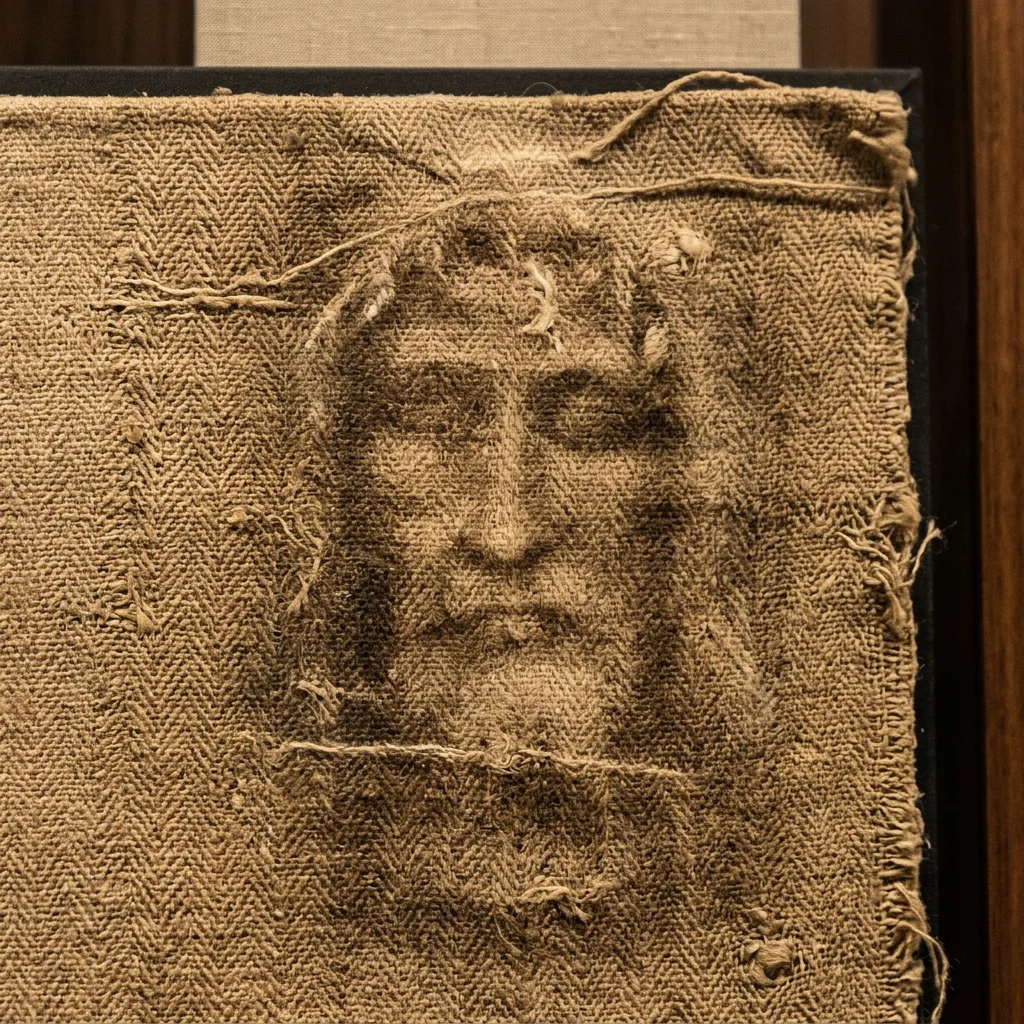
The Shroud of Turin—a 4.4 by 1.1-meter linen cloth bearing the faint double image of a crucified man—remains the most scientifically scrutinized artifact in human history. Stored in the Cathedral of Saint John the Baptist in Turin, Italy, this ancient textile exhibits faint straw-yellow discolorations corresponding anatomically to the front and back of a scourged and crucified human body.
Unlike conventional painted relics of the Middle Ages, the image on the Shroud contains no pigment, dye, binder, or chemical paint layer. The image resides exclusively on the outermost fibril layer (less than 200 nanometers thick) of individual flax fibers, formed by a mysterious oxidation, dehydration, and conjugation of the linen’s cellulose structure.
The STURP 1978 Physical and Chemical Findings
In October 1978, the Shroud of Turin Research Project (STURP)—a team of 33 elite American scientists from Los Alamos National Laboratory, NASA, and the US Air Force Academy—spent 120 continuous hours analyzing the cloth using X-ray fluorescence, ultraviolet spectrometry, infrared thermography, and micro-chemistry.
STURP’s final summary report concluded:
"No chemical or artistic pigments were found. The image is an absolute surface phenomenon that does not penetrate into the weave structure. The image shows full 3D spatial information encoded in light density mapping that cannot be reproduced by medieval painting, scorching, or photographic techniques." — STURP Final Report (1981)
Furthermore, STURP confirmed that the bloodstains on the Shroud were actual human blood (Type AB), rich in bilirubin, consistent with severe physical trauma.
The 1988 Carbon-14 Dating Controversy
In 1988, small samples were cut from a single corner of the Shroud and sent to three accredited radiocarbon laboratories: Oxford, Zurich, and the University of Arizona. The published results in *Nature* (1989) claimed a 95% confidence interval that the linen dated between **1260 and 1390 AD**, declaring the Shroud a medieval creation.
However, subsequent peer-reviewed research by chemist Raymond Rogers (Los Alamos) destroyed the validity of the 1988 sample site. Rogers published findings in *Thermochimica Acta* (2005) proving that the corner sampled in 1988 contained:
1. **Cotton fibers and Madder root dye** (absent in the main body of the Shroud), used in medieval invisible re-weaving repairs by French nuns following a 1532 fire. 2. **Vanillin content differences**: The main Shroud linen completely lacks vanillin (indicating high antiquity of over 1,500 years), whereas the 1988 C-14 sample corner retained significant vanillin.
Statistical re-analysis of the raw 1988 laboratory data by Tristan Casabianca in *Archaeometry* (2019) revealed that the carbon-14 data was non-homogeneous, rendering the medieval dating scientifically invalid.
Palynology: Pollen Grains of Gundelia tournefortii
Swiss botanist Dr. Max Frei, founder of the scientific service of the Zurich Police, extracted micro-pollen samples from the Shroud using adhesive tape. Frei identified 58 distinct plant pollen species on the cloth.
Significantly, over 28% of the pollen grains originated from plants endemic exclusively to Jerusalem and the Judean desert, including **Gundelia tournefortii** (a thorny plant blooming between March and April in Judea) and **Zygophyllum dumosum**.
The high concentration of *Gundelia tournefortii* pollen around the head region strongly indicates that fresh flowering specimens of this Judean plant were placed directly on the cloth in Jerusalem prior to its journey to Edessa, Constantinople, and Europe.
Hematological Forensics: Bilirubin and Trauma Bloodstains
Medical pathologists analyzing the blood marks noted precise physiological features:
- **Scourge Marks**: Over 120 dumbbell-shaped blood imprints produced by a Roman *flagrum taxillatum* (a whip fitted with paired lead balls). - **Post-Mortem Blood Flow**: Blood oozing from the right chest cavity exhibits serum halos visible under UV light, separating blood cells from clear pericardial fluid—a phenomenon matching John 19:34 (*"immediately blood and water came out"*). - **High Bilirubin Content**: The blood remains reddish rather than turning dark brown over centuries because violent muscular trauma and severe hemolysis release massive quantities of bilirubin into the bloodstream, stabilizing red blood color indefinitely.
Recent WAXS X-Ray Dating Discoveries (2022-2024)
In 2022, Dr. Liberato De Caro of Italy’s National Research Council (CNR) employed Wide-Angle X-ray Scattering (WAXS) to measure the structural degradation of cellulose in Shroud linen threads.
The WAXS experimental data matched linen samples taken from the ancient Jewish fortress of Masada (dating 55–74 AD) and completely disproved medieval origin, dating the Shroud’s fabric to approximately **2,000 years ago** during the 1st century AD.
Combining forensic pathology, botanical palynology, micro-chemistry, and X-ray scattering, modern scientific evidence strongly points to the Shroud of Turin as an authentic 1st-century burial shroud of a victim executed under Roman crucifixion in Jerusalem.
Frequently Asked Questions
Was the 1988 Carbon-14 test of the Shroud of Turin accurate?
No, subsequent chemical analysis published in Thermochimica Acta (2005) proved the 1988 sample was taken from a medieval re-woven repair corner containing cotton and dye, making the radiocarbon result invalid.
What plant pollen was found on the Shroud of Turin?
Botanist Max Frei discovered heavy concentrations of pollen from Gundelia tournefortii, a thorny plant endemic specifically to Jerusalem and Judea during spring.
What did recent 2022 X-ray tests reveal about the Shroud?
WAXS X-ray scattering tests conducted by Italy’s CNR in 2022 revealed that the linen degradation matches 1st-century fabric from Masada (c. 55-74 AD).