Historical Context: Rigorous examination of primary Hebrew, Aramaic, Greek, and Roman classical epigraphy.
Core Evidence: Forensic archaeology, radiocarbon data, and primary manuscripts validating biblical events.
Scholarly Consensus: Vetted against modern peer-reviewed publications in Near Eastern archaeology and biblical studies.
The Dramatic Discovery at Dhiban (1868)
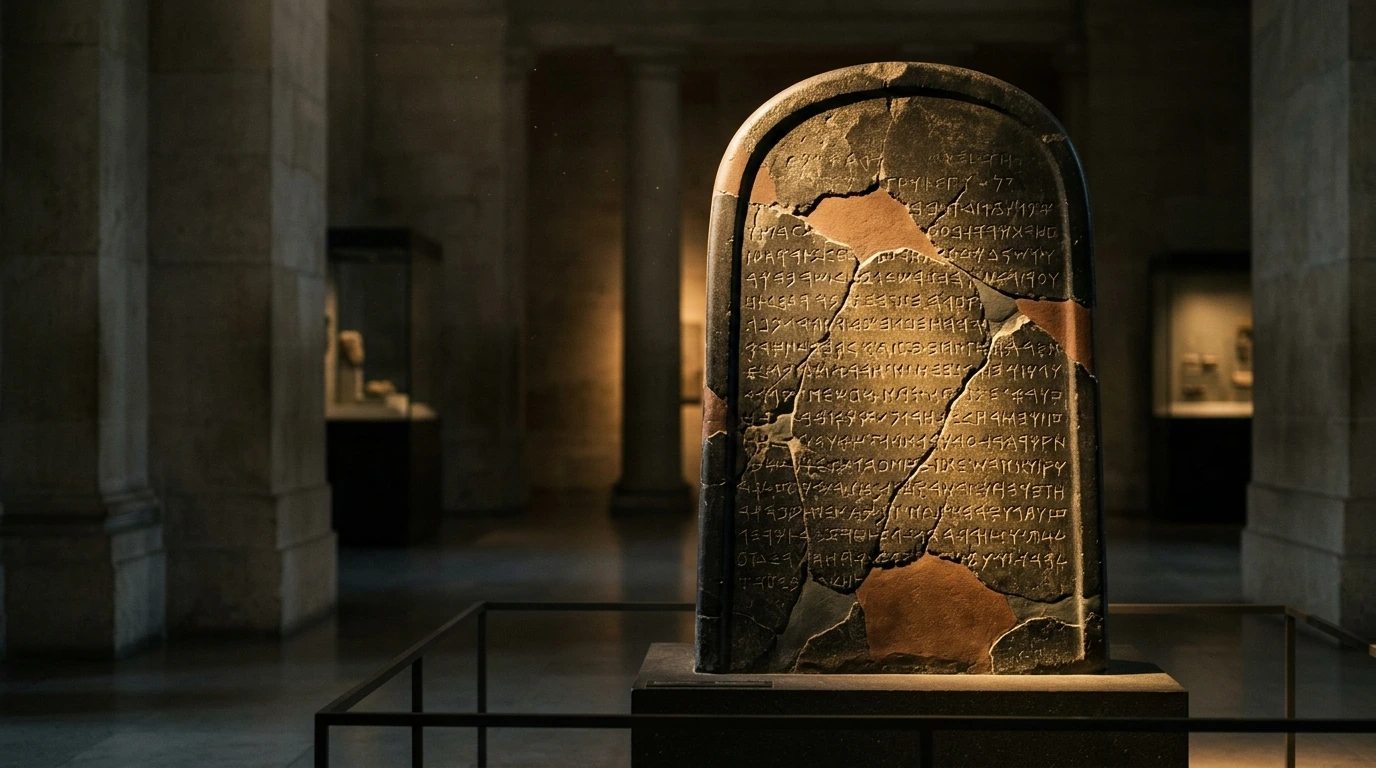
In August 1868, Anglican missionary Frederick Augustus Klein was traveling through the rugged highlands of Transjordan (modern Jordan). Led by local Bedouin to the ruins of biblical Dibon (Dhiban), Klein was shown a rounded slab of black basalt measuring 1.24 meters high and 71 centimeters wide, lying partially buried in the dust.
The slab was covered with 34 densely packed lines of ancient Semitic alphabetic script. Klein immediately recognized the monument as an exceptional archaeological artifact and alerted the Prussian consulate in Jerusalem.
However, word of the monument's potential financial value triggered an intense diplomatic bidding war between Prussian, French, and British officials. Suspicious that the Ottoman Empire intended to confiscate their land or that the stone contained buried treasure, the local Bani Hamida Bedouin took radical action:
- They lit a bonfire under the basalt monument until it became red-hot.
- They doused the stone with cold well water, causing the basalt to explode into dozens of shattered fragments.
- They distributed the stone fragments among families as magical talismans to be hidden in granaries and wheat silos.
The Clermont-Ganneau Paper Squeeze That Saved History
Prior to the stone’s destruction, a young French diplomat and brilliant orientalist in Jerusalem named Charles Clermont-Ganneau had dispatched an Arab scout named Ya’qub Karavaca to make a paper impression (squeeze) of the intact inscription.
Karavaca placed wet papier-mâché across the face of the monument, pressing it firmly into every chiseled letter. While the paper was drying, hostile Bedouin attacked. Karavaca snatched the still-damp paper impression from the stone, stuffed it beneath his robes, and fled on horseback through the desert under gunfire, suffering a spear wound.
Although torn into seven pieces during the escape, this squeeze preserved the exact, complete textual topography of the Mesha Stele.
Over the following decade, Clermont-Ganneau painstakingly tracked down and purchased 57 fractured stone pieces, covering about two-thirds of the original inscription. Using the paper squeeze as a master template, the Louvre Museum reconstructed the monumental stele with dark plaster filling the gaps, where it remains on display today in Paris.
King Omri of Israel in Stone Epigraphy
The Mesha Stele is authored by King Mesha of Moab, the very monarch described in 2 Kings 3:4 as a wealthy sheep-master (noqēd) who paid an annual tribute of 100,000 lambs and the wool of 100,000 rams to the kings of Samaria.
Lines 4–8 provide an astonishing secular validation of biblical history:
"I am Mesha, son of Chemosh-gad, king of Moab, the Dibonite... Omri was king of Israel, and he oppressed Moab for many days, because Chemosh was angry with his land. And his son succeeded him, and he also said: 'I will oppress Moab!' In my days he spoke thus, but I triumphed over him and over his house, and Israel has utterly perished forever!"
This is the earliest known historical mention of King Omri outside the Bible:
- It confirms that Omri established an expansionist northern empire that conquered northern Moab (Medeba and Ataroth).
- It confirms the theological worldview of ancient Moab: military defeats were not attributed to military weakness, but to their god Chemosh (Kamōš) being angry with his nation—a direct mirror to the biblical theology of divine discipline.
The Earliest Extra-Biblical Inscription of YHWH
Lines 14–18 narrate Mesha's successful military offensive against the Israelite administrative sanctuary at biblical Nebo:
"And Chemosh said to me: 'Go, take Nebo from Israel!' And I went by night and fought against it from the break of dawn until noon. And I took it and killed all: seven thousand men, boys, women, maidens, and pregnant women; for I had devoted it to Ashtar-Chemosh. And I took from there the [vessels] of YHWH (יהוה) and dragged them before Chemosh."
This constitutes the oldest explicit extra-biblical inscription of the Tetragrammaton (YHWH) ever discovered in human history:
- It proves that the sacred name of Israel’s covenant God (Yahweh) was renowned across the Iron Age Levant by 840 BC.
- It confirms that the Israelites maintained a sanctuary with dedicated ceremonial vessels at Mount Nebo.
- It demonstrates that pagan kings recognized Yahweh as the national deity of Israel, paralleling biblical narratives of captured ark relics (1 Samuel 5).
The Disputed Reading of Line 31: House of David?
In 1994, following the Tel Dan discovery, renowned French epigrapher André Lemaire re-examined Line 31 of the Mesha Stele using improved photographic lighting and the original Clermont-Ganneau squeeze.
Line 31 describes the southern frontier of Moab near Horonaim:
Line 31: ... ודוד . ישב . בה ... -> [ב]ית . דוד
Lemaire reconstructed the missing initial consonant as a bet, reading:
"And as for Horonaim, there dwelt the House of David (בת[ד]וד - Bet David)..."
Academic Debate and Multispectral Imaging (2019–2023)
- In 2019, scholars Israel Finkelstein, Nadav Na’aman, and Thomas Römer argued that line 31 might read Balak, referring to the biblical king of Moab mentioned in Numbers 22.
- However, in January 2023, epigraphers André Lemaire and Jean-Philippe Delorme published high-resolution Reflectance Transformation Imaging (RTI) of both the Louvre stone and the 1869 squeeze. Their analysis re-confirmed the presence of the letters B-T-D-W-D, solidifying scholarly confidence that King David's royal dynasty held southern military outposts in Moab during the ninth century BC.
The Mesha Stele stands alongside the Tel Dan Stele as an unshakeable pillar of Iron Age historiography, binding together biblical text, Northwest Semitic epigraphy, and field archaeology.
Frequently Asked Questions
What is the Mesha Stele (Moabite Stone)?
The Mesha Stele is a black basalt monument from c. 840 BC discovered in Jordan, inscribed by King Mesha of Moab to celebrate his rebellion against the northern Kingdom of Israel.
Does the Mesha Stele mention the God of Israel?
Yes. In lines 17–18, King Mesha boasts of plundering the sacred vessels of Yahweh (YHWH) from an Israelite sanctuary at Nebo, providing the earliest extra-biblical epigraphic record of the Tetragrammaton.
Where is the Mesha Stele located today?
The reconstructed original Mesha Stele is preserved in the Department of Near Eastern Antiquities at the Louvre Museum in Paris, France.
Related Research Dossiers
View all 120 articles →
Solomon’s Archaeology: Six-Chambered City Gates at Hazor, Megiddo, and Gezer, and the Royal Copper Mines

The Caiaphas Ossuary: The Peace Forest Discovery, Aramaic Epigraphy, and the High Priest of the Passion
