Historical Context: Rigorous examination of primary Hebrew, Aramaic, Greek, and Roman classical epigraphy.
Core Evidence: Forensic archaeology, radiocarbon data, and primary manuscripts validating biblical events.
Scholarly Consensus: Vetted against modern peer-reviewed publications in Near Eastern archaeology and biblical studies.
The 2015 Ophel Revelation: Dr. Eilat Mazar’s Discovery
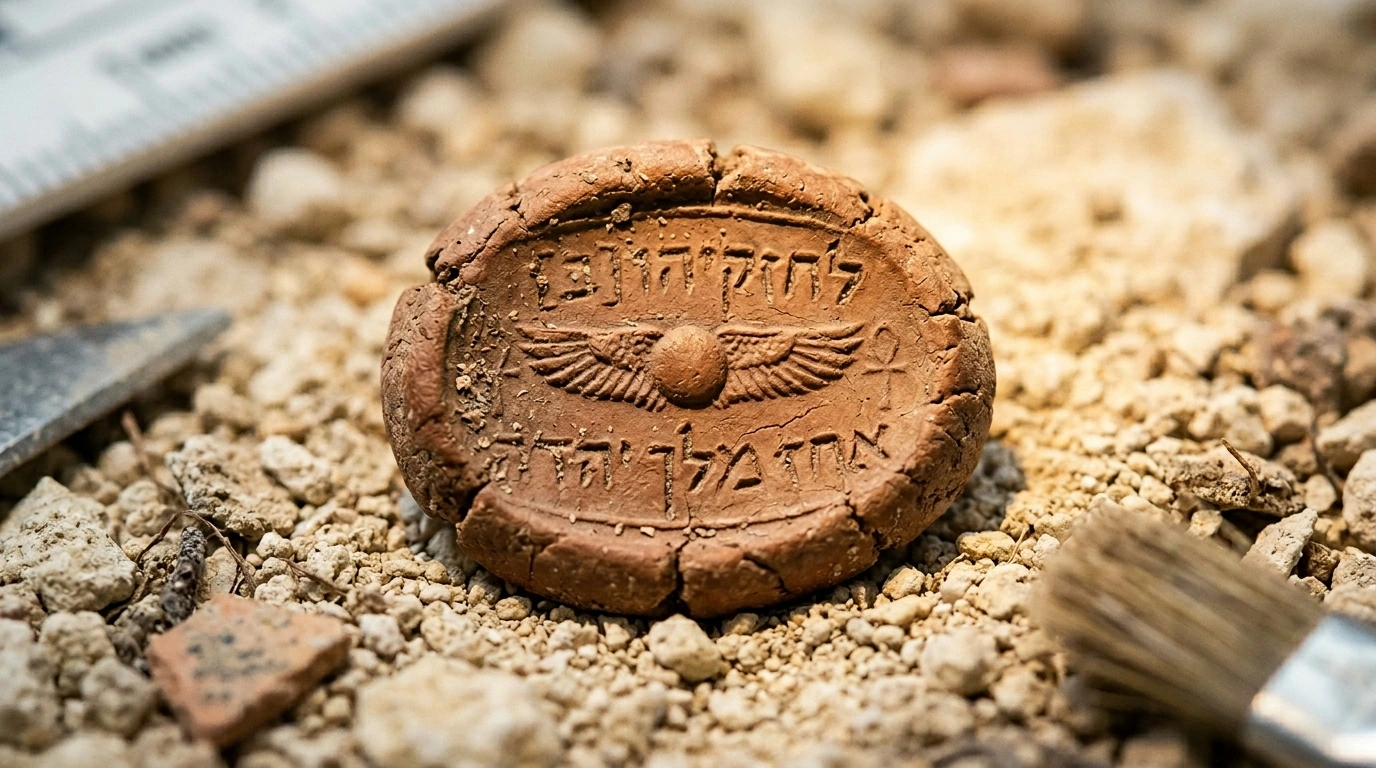
On December 2, 2015, the Hebrew University of Jerusalem announced an archaeological discovery of epochal importance: the recovery of the personal royal seal impression (bulla) of King Hezekiah of Judah (reigned c. 715–686 BC), the righteous king celebrated in 2 Kings, Isaiah, and 2 Chronicles.
The miniature clay bulla, measuring just 9.7 by 8.6 millimeters and less than 3 millimeters thick, was excavated by archaeologist Dr. Eilat Mazar during scientific excavations at the Ophel, the monumental royal quarter connecting the City of David with the Temple Mount.
Although unlooted royal bullae had surfaced on the antiquities black market in previous decades, Mazar’s discovery marked the first time in history that a seal impression bearing the name of an authenticated King of Judah was uncovered in an undisturbed, scientific archaeological excavation (in situ).
Paleo-Hebrew Epigraphy: The Inscription Decoded
The clay bulla was originally pressed against a cord that bound a papyrus document. On the reverse side of the clay, the microscopic impressions of ancient papyrus fibers and the twined tying cords remain perfectly preserved.
The obverse face bears an exquisitely engraved two-line Paleo-Hebrew inscription enclosed within border rings:
Line 1: לחזקיהו [בן] אחז מלך יהד[ה]
Line 2: LYḤZQYHW [BN] 'ḤZ MLK YHD[H]
Translated into English:
"Belonging to Hezekiah [son of] Ahaz, King of Judah"
Epigraphic Details
- The Tetragrammaton Theophoric Suffix (-yahu): The king’s name is spelled Ḥzq-yhw ("Yahweh strengthens"), the exact formal spelling used throughout the Book of Kings and Isaiah.
- Patronymic Confirmation: The inscription names his father as Ahaz ('ḤZ), directly confirming the biblical royal genealogy (2 Kings 16:20; 18:1).
- The Royal Title: Melekh Yehudah ("King of Judah"), leaving zero doubt as to the royal legal authority of the signatory.
Royal Iconography: Winged Sun Disc and Ankh Symbols
Flanking the Paleo-Hebrew lettering is vivid royal imagery: a two-winged sun disc with wings turned downwards, flanked by two ankh symbols (the ancient symbol of life).
Modern readers are frequently startled to find Egyptian motifs on the seal of a pious Judean king who purged pagan idolatry (2 Kings 18:4). However, Levant scholars explain this iconography through the diplomatic and cultural realities of the late eighth century BC:
- The Winged Sun as a Judean Royal Crest: In the ancient Near East, the winged sun disc represented divine protection, sovereignty, and cosmic order. In Judean theology, it symbolized the protection of Yahweh, as articulated in Malachi 4:2: "The Sun of Righteousness shall arise with healing in his wings."
- The Down-Turned Wings: Earlier in Hezekiah's reign, his seals featured six-winged scarabs with raised wings. Following his miraculous recovery from mortal illness and the divine deliverance of Jerusalem from Sennacherib in 701 BC (2 Kings 20:1–11), Hezekiah adopted wings turned downward, symbolizing God’s sheltering wings overshadowing Judah.
- The Ankh Symbol of Life: Adapted into Northwest Semitic royal seals, the ankh was utilized not as an idolatrous talisman, but as a visual emblem representing life bestowed by God—commemorating the miraculous addition of fifteen years to Hezekiah's life (Isaiah 38:5).
Archaeological Context: The Royal Administrative Quarter
The bulla was discovered within an Iron Age II refuse stratum adjacent to a monumental royal building constructed during the eighth century BC.
The stratum yielded:
- Dozens of clay storage jars stamped with royal LMLK (L'Melekh - "Belonging to the King") seal impressions, demonstrating royal logistics for tax collection and siege provisions.
- Administrative weights and bronze arrowheads.
- A second remarkable bulla discovered just 10 feet away in the same layer, bearing the inscription: LYŠ‘YHW NBY[—widely translated by Dr. Mazar and scholars as "Belonging to Isaiah the Prophet" (Yesha'yahu Navi).
This stratigraphical proximity offers thrilling physical confirmation of the intimate political and spiritual partnership between King Hezekiah and the Prophet Isaiah documented in 2 Kings 19–20.
The Geopolitical Crisis: Sennacherib’s Invasion (701 BC)
Hezekiah’s reign was defined by his audacious decision to withhold tribute from the Neo-Assyrian Empire after the death of Sargon II in 705 BC:
"He rebelled against the king of Assyria and would not serve him." (2 Kings 18:7)
Anticipating Sennacherib’s punitive invasion, Hezekiah executed colossal civil defense initiatives across Jerusalem, all of which have been confirmed by modern archaeology:
- Hezekiah’s Tunnel (Siloam Tunnel): A 533-meter subterranean aqueduct carved through solid bedrock to channel the Gihon Spring inside the city walls, confirmed by the Siloam Inscription.
- The Broad Wall: A massive 7-meter-thick stone fortification in the Jewish Quarter built to shelter refugees who fled the fallen northern kingdom of Samaria (Isaiah 22:9–11).
- LMLK Storage System: Establishing centralized depots of wine, grain, and oil across Lachish, Hebron, Ziph, and Socho.
When Sennacherib besieged Jerusalem in 701 BC, his own royal annals carved on the Taylor Prism boast: "As for Hezekiah the Judahite, I shut him up like a caged bird inside Jerusalem, his royal city."
Crucially, Sennacherib never claimed to have conquered Jerusalem or executed Hezekiah—tacitly verifying the biblical record that a miraculous deliverance preserved the city and its righteous king.
Frequently Asked Questions
When and where was King Hezekiah’s bulla discovered?
It was discovered in 2009 and published in 2015 by Israeli archaeologist Dr. Eilat Mazar during scientific excavations at the Ophel, situated just south of the Temple Mount in Jerusalem.
What does the inscription on the bulla say?
Written in Paleo-Hebrew script, it reads: "Belonging to Hezekiah [son of] Ahaz, King of Judah" (לחזקיהו אחז מלך יהודה).
Why does a Jewish king’s seal have a winged sun and ankh symbols?
In the 8th century BC, these were standard Near Eastern royal emblems symbolizing divine protection and longevity, adopted by Judean royalty to celebrate Yahweh’s healing and deliverance from the Assyrian siege.
Related Research Dossiers
View all 120 articles →
Solomon’s Archaeology: Six-Chambered City Gates at Hazor, Megiddo, and Gezer, and the Royal Copper Mines

The Caiaphas Ossuary: The Peace Forest Discovery, Aramaic Epigraphy, and the High Priest of the Passion
