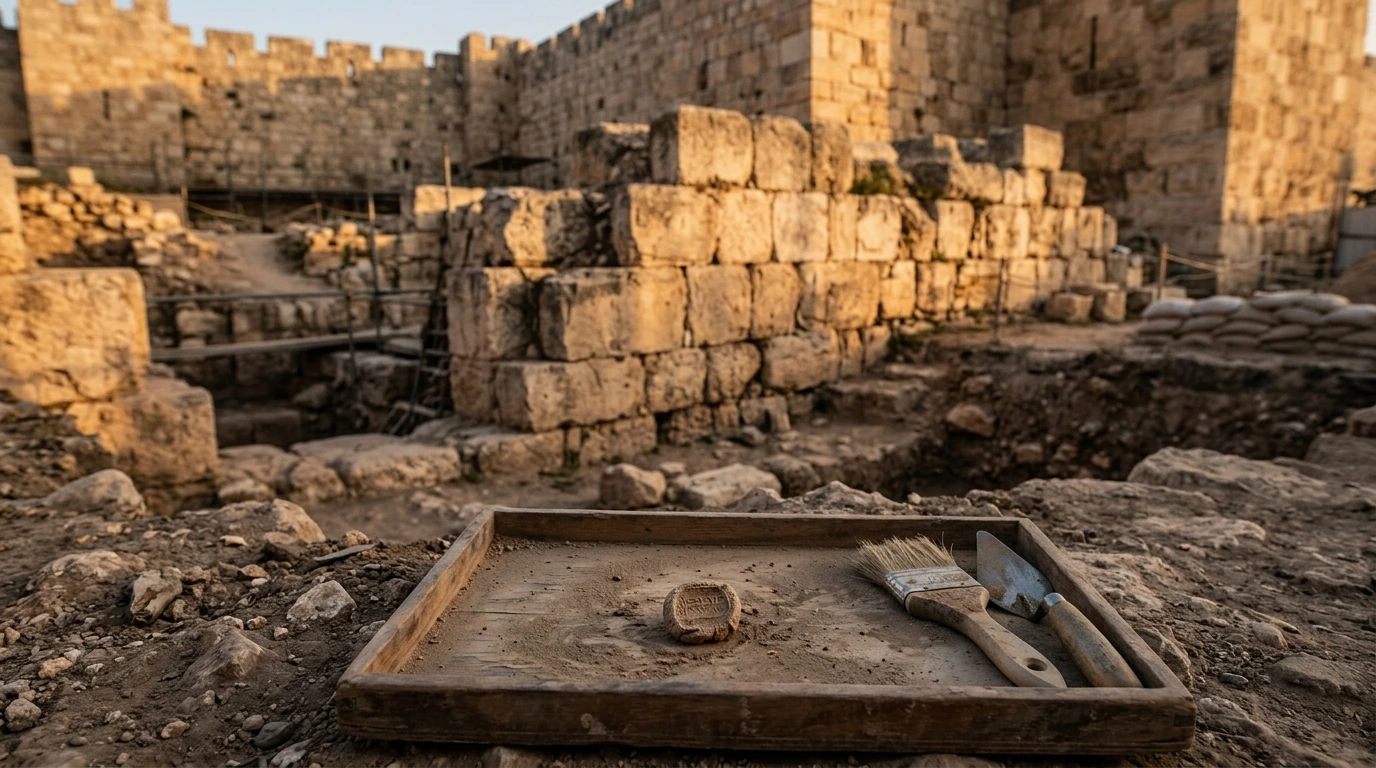
Historical Context: Rigorous examination of primary Hebrew, Aramaic, Greek, and Roman classical epigraphy.
Core Evidence: Forensic archaeology, radiocarbon data, and primary manuscripts validating biblical events.
Scholarly Consensus: Vetted against modern peer-reviewed publications in Near Eastern archaeology and biblical studies.
The Topography of the Ophel Excavations
The term Ophel (עופל, literally "elevated mound" or "acropolis") designates the narrow topographic saddle connecting the ancient City of David to the south with the Temple Mount to the north.
In biblical antiquity, this area formed the executive core of the Davidic monarchy:
- King Solomon constructed his royal palace, the House of the Forest of Lebanon, and the Hall of Judgment here (1 Kings 7:1–8).
- King Jotham built extensively on the wall of the Ophel (2 Chronicles 27:3).
- King Manasseh built an outer wall to the City of David compassing the Ophel (2 Chronicles 33:14).
Between 2009 and 2013, the late Dr. Eilat Mazar directed intensive excavations in the southern Ophel park. Her team uncovered a monumental royal gatehouse complex, a royal administrative building, and an eight-meter-high stone tower dating precisely to the Iron Age IIB period.
Stratigraphy: Dating the Royal Administrative Refuse Layer
The Hezekiah bulla was recovered from Area A, Locus 13-05, within a distinct refuse layer deposited immediately outside the southeastern wall of the Royal Building.
Key stratigraphical markers include:
- Sealed Ceramic Horizon: The pottery sherds associated with Locus 13-05 date exclusively to the late eighth and early seventh centuries BC (Iron Age IIB). There were zero later Persian, Hellenistic, or Roman intrusions.
- Wet-Sifting Methodology: The bulla was recovered through wet-sifting—a meticulous process where excavated soil is gently washed through fine 1-millimeter wire mesh screens. Developed by the Temple Mount Sifting Project, this technique prevents tiny clay bullae from being lost in field excavations.
- Bulla Assemblage: Along with Hezekiah’s bulla, 33 other clay seal impressions bearing Hebrew names were recovered from the exact same locus, indicating an active royal archival repository.
The LMLK Storage Jar Phenomenon
In the same administrative destruction layer at the Ophel, excavators unearthed numerous four-handled ceramic storage jars bearing LMLK stamps (L'Melekh - "Belonging to the King").
Hezekiah standardized Judean royal logistics in preparation for Sennacherib's siege:
- Capacity Standardization: Each jar held approximately 45 liters (one biblical bath) of grain, wine, or olive oil.
- The Four Administrative Hubs: The stamps record the royal designation LMLK accompanied by one of four royal cities: Hebron, Ziph, Socho, or MMST (Mamshet).
- Royal Emblems: The LMLK stamps feature either a four-winged scarab beetle or a two-winged sun disc, directly echoing the iconographic evolution seen on King Hezekiah's personal seal.
This proves a unified, state-directed administrative network orchestrated from the Ophel to sustain Judean strongholds during imperial warfare.
Fingerprint Analysis: The Touch of the Ancient Scribe
On the upper left rim of the Hezekiah bulla, forensic dermatoglyphic examination identified the unmistakable impression of a human fingerprint.
When the ancient official pressed the seal into the clay, his thumb steadied the clay lump while the signet ring struck the surface. While it cannot be proven whether the fingerprint belonged to King Hezekiah himself or his royal scribe, the microscopic dermal ridge details provide an intimate human connection to the royal court of 700 BC.
Museum Exhibition and Curatorial Preservation
Following its public reveal in 2015, the King Hezekiah bulla was transferred to the permanent custody of the Israel Antiquities Authority (IAA).
Today, it is exhibited at the Israel Museum in Jerusalem, displayed beneath high-magnification lenses and specialized LED lighting to allow visitors to view the fine Paleo-Hebrew characters and royal winged sun disc that guided Jerusalem through its greatest biblical crisis.
Frequently Asked Questions
Where was the Hezekiah bulla excavated?
At the Ophel in Jerusalem, directly between the City of David and the southern wall of the Temple Mount, in an Iron Age II royal administrative building.
What is wet-sifting?
A scientific excavation technique where excavated earth is washed through fine wire mesh screens, ensuring tiny artifacts like coins, beads, and clay bullae are not missed.
What are LMLK storage jars?
Four-handled Judean storage jars stamped with "Belonging to the King" (LMLK) in Paleo-Hebrew, used by King Hezekiah to stockpile food and supplies before the Assyrian siege.
Related Research Dossiers
View all 120 articles →
Solomon’s Archaeology: Six-Chambered City Gates at Hazor, Megiddo, and Gezer, and the Royal Copper Mines

The Caiaphas Ossuary: The Peace Forest Discovery, Aramaic Epigraphy, and the High Priest of the Passion
