Historical Context: Rigorous examination of primary Hebrew, Aramaic, Greek, and Roman classical epigraphy.
Core Evidence: Forensic archaeology, radiocarbon data, and primary manuscripts validating biblical events.
Scholarly Consensus: Vetted against modern peer-reviewed publications in Near Eastern archaeology and biblical studies.
The Jewish Historian to the Roman Emperors
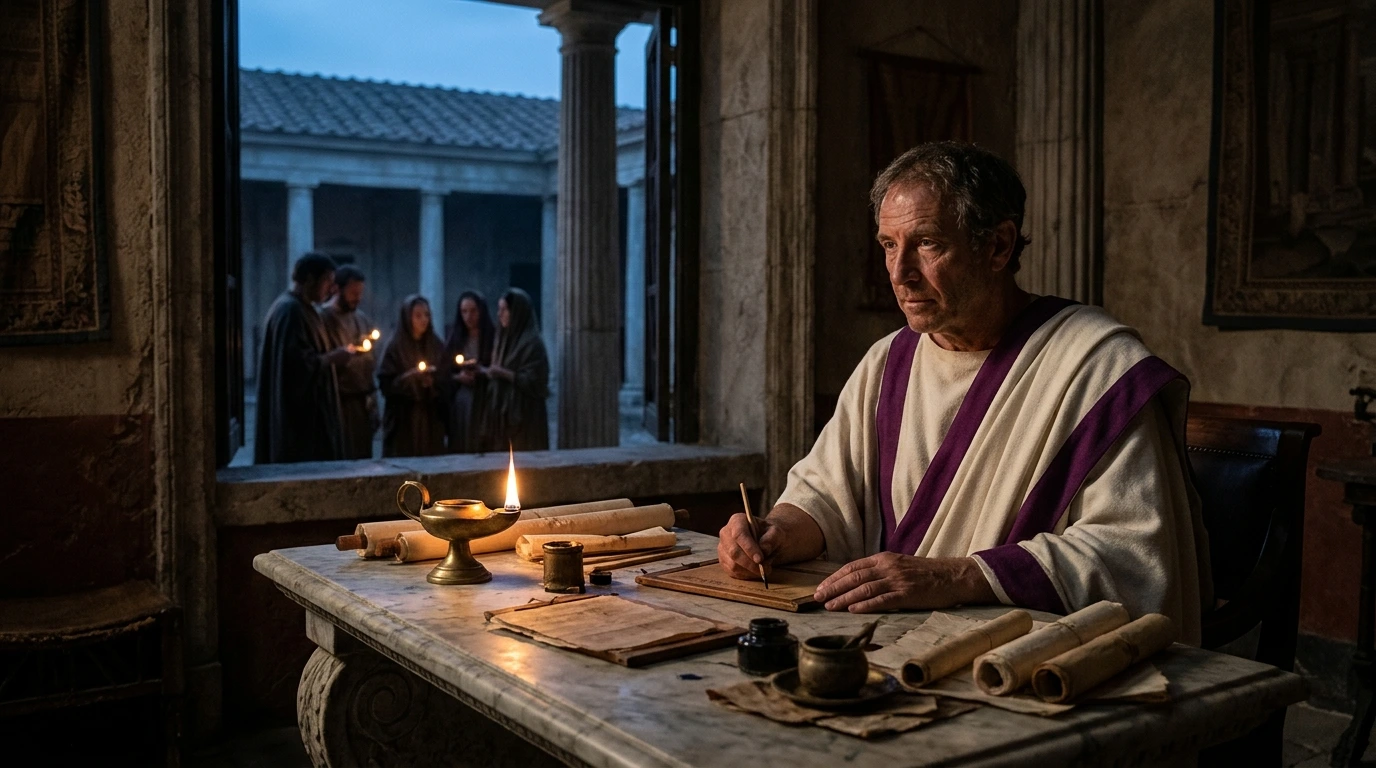
Outside the New Testament, no ancient writer provides more vital historical, political, and cultural evidence for the world of Jesus than Flavius Josephus (Yosef ben Matityahu, c. 37–100 AD).
Josephus was not a Christian; he was an aristocratic Jewish priest, a Pharisee, and a military commander who led Jewish rebel forces in Galilee during the First Jewish-Roman War (66–73 AD). Captured by the Roman general Vespasian, Josephus prophesied that Vespasian would become emperor. When the prophecy came true in 69 AD, Josephus was freed, granted Roman citizenship, adopted the Flavian family imperial name, and spent the remainder of his life in Rome writing monumental historical works financed by the imperial court:
- The Jewish War (Bellum Judaicum, c. 75 AD): A gripping eyewitness chronicle of the siege and destruction of Jerusalem and the Second Temple in 70 AD.
- Jewish Antiquities (Antiquitates Judaicae, c. 93–94 AD): A 20-volume history of the Jewish people from creation to the outbreak of the war with Rome.
Within Jewish Antiquities, Josephus mentions Jesus of Nazareth twice, as well as John the Baptist and Pontius Pilate. How does this non-Christian Jewish witness validate the historical foundation of the Christian Gospels?
The Testimonium Flavianum (Antiquities 18.63–64): The Text
In Book 18, Chapter 3 of Antiquities, Josephus writes the most famous and debated extra-biblical reference to Jesus in world history, known as the Testimonium Flavianum:
[THE STANDARD GREEK TESTIMONIUM FLAVIANUM]
"About this time there lived Jesus, a wise man, [if indeed one ought to call him a man].
For he was one who performed surprising deeds and was a teacher of such people as accept the truth gladly.
He won over many Jews and many of the Greeks. [He was the Christ.]
When Pilate, upon hearing him accused by men of the highest standing among us, had condemned him to be crucified,
those who had in the first place come to love him did not give up their affection for him.
[On the third day he appeared to them restored to life, for the prophets of God had prophesied these and countless
other marvelous things about him.]
And the tribe of the Christians, so called after him, has still to this day not disappeared."
The text explicitly confirms:
- Jesus lived during the governorship of Pontius Pilate.
- He was regarded as a wise teacher (sophos anēr) and worker of surprising deeds (paradoxōn ergōn poiētēs).
- He attracted both Jewish and Gentile followers.
- The Jewish leadership brought accusations against Him before Pilate.
- Pilate condemned Him to crucifixion.
- His followers continued their devotion after His death, forming the enduring community known as Christians.
The Three Scholarly Views: Forgery, Authentic, or Interpolated?
For four centuries, historians have debated the authenticity of the bracketed phrases above:
[THE THREE SCHOLARLY CAMPS]

1. THE COMPLETE FORGERY HYPOTHESIS:
   - Popularized by 19th-century radical skeptics.
   - Claims the entire passage was forged from scratch by Church Father Eusebius around 320 AD.
   - REJECTED BY MODERN SCHOLARSHIP: The Greek syntax and vocabulary (e.g., calling Jesus a
     "wise man" and Christians a "tribe" / phylon) are distinctly Josephan, not 4th-century Christian!

2. THE COMPLETE AUTHENTICITY HYPOTHESIS:
   - Holds that Josephus wrote every single word, including "He was the Christ."
   - UNLIKELY: Josephus remained an observant Jew his entire life. Origen (c. 240 AD, Contra Celsum 1.47)
     explicitly stated that Josephus "did not believe that Jesus was the Christ."

3. THE INTERPOLATION CONSENSUS (MAINSTREAM ACADEMIC VIEW):
   - Held by John P. Meier, Géza Vermes, Louis Feldman, E.P. Sanders, and Craig Evans.
   - An AUTHENTIC JOSEPHAN CORE TEXT existed, into which enthusiastic Christian copyists
     inserted three pious glosses ("if indeed one ought to call him a man," "He was the Christ,"
     and the resurrection confession).
The Arabic Breakthrough: Shlomo Pines and Agapius of Hierapolis
In 1971, Professor Shlomo Pines of the Hebrew University of Jerusalem made a groundbreaking discovery that stunningly confirmed the interpolation consensus.
Pines unearthed a 10th-century universal history written in Arabic by Agapius (Mahbub ibn Qustantin), Christian bishop of Hierapolis in Syria. Agapius quotes Josephus’ Antiquities from an ancient Syriac translation that antedated the Christian scribal tampering:
[THE AGAPIUS ARABIC RECENSION OF THE TESTIMONIUM]
"At this time there was a wise man who was called Jesus. His conduct was good, and he was known to be virtuous.
And many people from among the Jews and the other nations became his disciples.
Pilate condemned him to be crucified and to die.
But those who had become his disciples did not abandon his discipleship.
They reported that he had appeared to them three days after his crucifixion, and that he was alive;
accordingly, he was perhaps the Messiah, concerning whom the prophets have recounted wonders."
Notice the extraordinary historical differences:
- No claim that Jesus was more than a man ("he was a wise man... his conduct was good").
- The resurrection is reported neutrally as a claim of His disciples ("they reported that he had appeared to them").
- The messiahship is stated with Jewish skepticism ("he was perhaps the Messiah").
This discovery proved beyond historical doubt that Josephus wrote an authentic, non-Christian account of Jesus of Nazareth.
The Undisputed Crown Jewel: James, the Brother of Jesus (Ant. 20.200)
While the Testimonium in Book 18 generated debate, Josephus’ second reference to Jesus in Antiquities 20.200 is recognized by virtually 100% of ancient historians and classical scholars as completely authentic and un-interpolated:
"Ananus, who, as we have told you already, was made high priest, was a bold man in his temper, and very insolent; he was also of the sect of the Sadducees... When therefore Ananus was of this disposition, he thought he had now a proper opportunity [to exercise his authority]. Festus was now dead, and Albinus was but upon the road; so he assembled the sanhedrin of judges, and brought before them the brother of Jesus, who was called Christ, whose name was James (ton adelphon Iēsou tou legomenou Christou, Iakōbos onoma autō), and some others; and when he had formed an accusation against them as breakers of the law, he delivered them to be stoned."
Why is this passage incontrovertible proof?
- Incidental Mention: Jesus is mentioned casually to identify James ("the brother of Jesus, who was called Christ"). A Christian forger would have exalted Jesus with grand titles; Josephus uses the exact neutral Greek phrase (tou legomenou Christou) that Matthew uses in Matthew 1:16 and 27:22.
- Attested by Origen (c. 240 AD): Origen quotes this exact passage in Contra Celsum 1.47 and Commentary on Matthew 10.17, centuries before Eusebius.
- Jewish Outrage Against the High Priest: Josephus records that the most law-abiding citizens of Jerusalem were furious at Ananus’ illegal execution of James, appealing to King Agrippa II and the new Roman governor Albinus to depose Ananus from the high priesthood!
Other Historical Intersections: John the Baptist and Pilate
Josephus also corroborates other major figures of the Gospel narrative:
1. John the Baptist (Antiquities 18.116–119)
Josephus provides an extensive, glowing eulogy of John:
"Now some of the Jews thought that the destruction of Herod’s army came from God, and that very justly, as a punishment of what he did against John, that was called the Baptist; for Herod slew him, who was a good man, and commanded the Jews to exercise virtue, both as to righteousness towards one another, and piety towards God, and so to come to baptism..."
Josephus confirms John’s title ("the Baptist"), his preaching of ethical righteousness, his practice of immersion, his massive popularity, and his execution by Herod Antipas at the desert fortress of Machaerus.
2. Pontius Pilate (Antiquities 18.55–62, 85–89; War 2.169–177)
Josephus depicts Pilate’s brutal, insensitive governance: introducing Roman military standards (signa) bearing imperial images into Jerusalem at night, using Temple treasury funds (the Corban) to build an aqueduct, and slaughtering Samaritan pilgrims on Mount Gerizim—a disaster that led to Pilate being deposed and summoned to Rome by Syrian legate Lucius Vitellius in 36 AD.
Three-Tier Evidentiary Evaluation: Flavius Josephus
+----------------------------------------------------------------------------------------------------+
|                  FLAVIUS JOSEPHUS: THREE-TIER EVIDENTIARY EVALUATION                               |
+====================================================================================================+
| TIER 1: PRIMARY HISTORIOGRAPHICAL TEXTS                                                            |
| - Antiquities 20.200 (c. 93 AD): 100% authentic, undisputed reference to "James, the brother of   |
|   Jesus, who was called Christ." Confirms historical personhood, family ties, and execution.       |
| - Antiquities 18.63–64 (Testimonium): Core authentic report confirmed by Agapius Arabic text.     |
+----------------------------------------------------------------------------------------------------+
| TIER 2: CORROBORATING SECULAR WITNESSES                                                            |
| - John the Baptist (Ant. 18.116–119): Confirms baptism, righteousness, Herod Antipas, execution.  |
| - Pontius Pilate: Confirms prefect governorship, chronological window, and harsh rule in Judea.   |
+----------------------------------------------------------------------------------------------------+
| TIER 3: SCHOLARLY CONSENSUS & IMPACT                                                               |
| - Complete refutation of Christ-Myth theory: Hostile Jewish-Roman historian provides independent   |
|   1st-century secular proof of Jesus' existence, execution by Pilate, and emerging movement.       |
+----------------------------------------------------------------------------------------------------+
Frequently Asked Questions
Did Josephus become a Christian?
No. Josephus lived and died an observant Jew proud of his priestly and Hasmonean heritage. Early Christian writers like Origen noted with regret that Josephus did not accept Jesus as the Messiah. This non-Christian identity makes his historical references to Jesus, James, and John the Baptist vastly more valuable as impartial secular evidence.
Could the mention of "James, brother of Jesus" refer to someone else?
No. While "Jesus" and "James" were common Jewish names in the 1st century, Josephus explicitly identifies this Jesus with the specific Greek qualifier tou legomenou Christou ("the one called Christ"). In 1st-century Judea, there was only one historical religious leader named Jesus whose followers claimed he was the Christ and whose brother was named James.
Why doesn't Josephus mention Jesus in "The Jewish War" written earlier in 75 AD?
The Jewish War focused strictly on military campaigns, political revolts, and Roman legions leading up to the fall of Jerusalem. Minor religious movements that did not initiate armed rebellions against Rome (such as early Christianity) fell outside the military scope of that work. In Jewish Antiquities, written 20 years later to present the entire history of Jewish religion and society, Josephus systematically included religious teachers, sects, and judicial controversies.
Frequently Asked Questions
Did Josephus become a Christian?
No. Josephus remained an observant Jew throughout his life. Church Father Origen explicitly notes that Josephus did not believe Jesus was the Messiah, making his historical testimony an invaluable independent witness.
Could the mention of "James, brother of Jesus" refer to someone else?
No. Josephus specifically identifies him as the brother of "Jesus, who was called Christ" (Antiquities 20.200), precisely matching the biblical description in Galatians 1:19 and Matthew 1:16.
Why doesn't Josephus mention Jesus in "The Jewish War" written earlier in 75 AD?
The Jewish War was a military chronicle focused on the legions and armed Jewish revolts. When Josephus wrote Jewish Antiquities in 93 AD covering the broader cultural and religious history of Judea, he included Jesus, John the Baptist, and James.
Related Research Dossiers
View all 120 articles →
Patristic Reading Guide: Key Excerpts and Timeless Lessons from John Chrysostom (c. 347–407 AD)

How Do We Know the Bible Is Reliable? Augustine of Hippo (354–430 AD), Confessions, and The City of God